
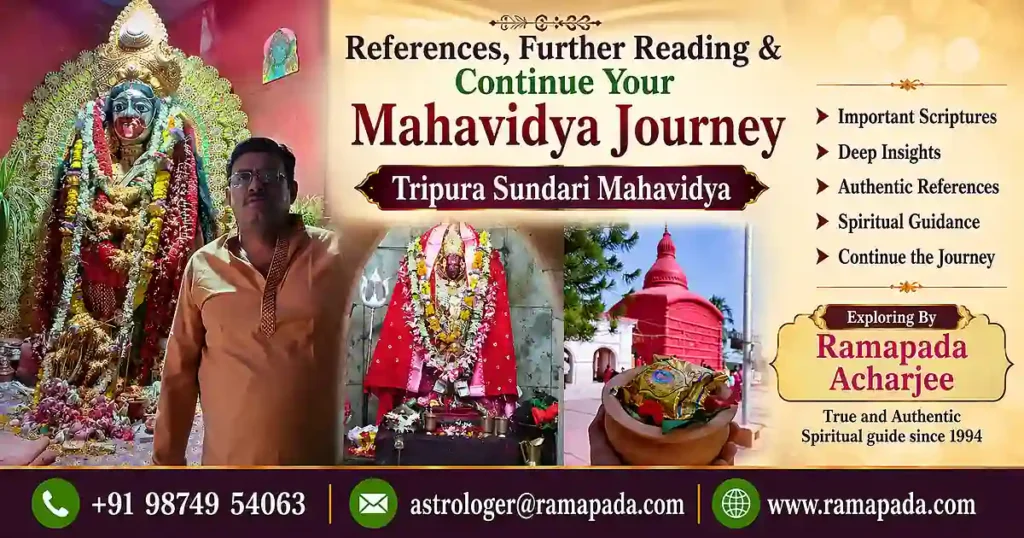
Tripura Sundari Mahavidya
After writing extensively about Tripura Sundari Mahavidya—her meaning, iconography, scriptural traditions, her relationship with Shodashi and Lalita, Sri Vidya, Sri Chakra, common misconceptions, and the spiritual lessons that may be relevant to modern life—I feel it is important to end this part of my Mahavidya journey with something quieter and more practical.
This final article is not meant to introduce another new interpretation. Instead, I want to share some of the texts, traditions, and directions that can help an interested reader continue studying Tripura Sundari with greater depth and responsibility.
আমার দীর্ঘদিনের অভিজ্ঞতায় আমি একটি বিষয় বারবার উপলব্ধি করেছি—আধ্যাত্মিক জ্ঞানকে যত গভীরভাবে জানতে চাইবেন, ততই বিনয়ী হয়ে পড়তে হয়। কারণ একটি বই বা একটি ব্যাখ্যা কখনোই সম্পূর্ণ ঐতিহ্যকে ধারণ করতে পারে না।
Throughout my 35+ years of spiritual study and consultation, I have learned that a grounded foundation matters above all else. Let us look at the classical references and study pathways that guide sincere seekers toward authentic understanding.
Readers who are new to this subject may first explore Tripura Sundari Mahavidya as the Third Mahavidya to understand her fundamental place within the Dasha Mahavidya tradition.
Why References Matter in the Study of Tripura Sundari
Tripura Sundari belongs to a vast spiritual and philosophical landscape. She is understood through different streams of Shakta thought, Sri Vidya traditions, devotional literature, philosophical interpretation, and living spiritual practice.
For this reason, I do not believe that readers should depend on a single modern article—including my own writings—to understand her completely. My purpose throughout this series has been to offer an accessible doorway.
বাংলায় সহজ করে বললে—আমি পথটা দেখানোর চেষ্টা করেছি, কিন্তু পথ এখানেই শেষ নয়।
Traditional texts can sometimes feel challenging. Their terminology, symbolism, and historical contexts may not always be immediately understandable to a general reader. Yet they remain vital because they allow us to see how these ideas developed and were understood within different traditions.
For a detailed academic study of Tripura Sundari within the Mahavidya tradition, readers may consult David Kinsley’s study of the Ten Mahavidyas.
Classical Texts and Traditions Worth Exploring
When beginning your study of Tripura Sundari Mahavidya, certain core texts provide authentic philosophical clarity:
1. Lalita Sahasranama
For anyone interested in Lalita Tripura Sundari, the Lalita Sahasranama (found within the Brahmanda Purana) is one of the most important devotional texts to become familiar with.
Its thousand names present the Goddess through many dimensions:
- Divine beauty and aesthetic harmony
- Pure consciousness (Chit)
- Boundless compassion and sovereign grace
- Esoteric knowledge and cosmic governance
However, simply translating each name literally may not reveal its complete philosophical depth.
আমার মতে, সহস্রনামের আসল সৌন্দর্য শুধু হাজারটি নাম পড়ার মধ্যে নয়। প্রতিটি নামের পিছনে যে ভাব, দর্শন ও উপলব্ধি রয়েছে, সেটাই ধীরে ধীরে বোঝার বিষয়।
A reader can begin with a reliable translation and scholarly commentary rather than trying to master every technical concept immediately.
A valuable primary devotional source is the traditional Tripurasundari Stotra preserved in the Sacred Texts archive.
2. Lalita Trishati
The Lalita Trishati, traditionally associated with three hundred sacred names of Lalita, is another prominent text within the broader Sri Vidya tradition.
It should be approached respectfully and with awareness of its traditional context. For general readers, studying its philosophical and devotional meaning is quite different from attempting specialized ritual practices.
সব শাস্ত্র পড়া যায়, কিন্তু সব শাস্ত্রীয় সাধনা নিজের মতো করে করা উচিত—এমন ধারণা আমি সমর্থন করি না।
Reading for philosophical knowledge and entering a specialized practice are two entirely different steps.
3. Tripura Upanishad
The Tripura Upanishad provides an invaluable philosophical doorway into the concept of Tripura.
Readers interested in the relationship between Shakti, cosmic consciousness, and spiritual realization will find this text particularly illuminating. Its language and concepts may initially seem abstract, but that is entirely natural for Upanishadic literature.
আমাদের দৈনন্দিন ভাষায় যে বিষয় খুব সহজ, শাস্ত্রের ভাষায় সেটিই কখনও অনেক গভীর প্রতীকের মাধ্যমে বলা হয়েছে। তাই ধীরে পড়াই ভালো।
4. Bhavana Upanishad
The Bhavana Upanishad is especially valuable for readers who want to understand how the Sri Chakra can be interpreted inwardly within human consciousness, rather than merely as an external geometric diagram.
This is important because modern platforms often present the Sri Chakra almost entirely as an object for attracting material wealth. That interpretation is far too narrow. The deeper tradition connects its sacred geometry directly with meditation, breath, and the subtle architecture of the human being.
আমি আগের লেখাতেও বলেছি—শ্রীচক্রকে শুধু একটি যন্ত্র হিসেবে দেখলে তার গভীর দর্শনের অনেকটাই বাদ পড়ে যায়।
5. Saundarya Lahari
The Saundarya Lahari, attributed to Adi Shankaracharya, occupies a remarkable place in the devotional and philosophical world of the Divine Mother.
Its verses combine sublime poetry, deep devotion, rich symbolism, and Shakta metaphysics. The word “Saundarya” itself reminds us that beauty in this tradition is never limited to physical appearance alone. Instead, beauty serves as a vehicle for contemplating harmony, consciousness, and the sacred order of existence.
ত্রিপুরা সুন্দরীর ক্ষেত্রে ‘সৌন্দর্য’ শব্দটি আমি কখনোই শুধু বাহ্যিক রূপের অর্থে দেখি না। আমার কাছে এর গভীরে রয়েছে সামঞ্জস্য, চেতনা ও অন্তরের পূর্ণতার ধারণা।
A deeper understanding of the textual background can be gained through the discussion on Tripura Sundari in Shakta and Tantric scriptures
Core Text Summary
| Text Name | Primary Focus | Key Value for Seekers |
| Lalita Sahasranama | 1,000 Names of the Goddess | Devotional breadth, cosmic attributes, and theological depth |
| Lalita Trishati | 300 Sacred Names | Sri Vidya root principles and devotional contemplation |
| Tripura Upanishad | Upanishadic Shakta Metaphysics | Non-dual understanding of Shakti and consciousness |
| Bhavana Upanishad | Internalized Sri Chakra Meditation | Microcosm-macrocosm alignment and inner contemplation |
| Saundarya Lahari | Devotional Poetry & Yantra Metaphysics | Aesthetic contemplation of universal beauty and divine grace |
Reading Modern Books and Commentaries
While traditional texts are indispensable, modern readers often benefit from explanatory books and scholarly studies to understand historical and philosophical contexts clearly.
When choosing modern resources, look for authors who clearly distinguish between:
- Textual evidence from verified classical manuscripts
- Traditional interpretations preserved within authentic lineages
- Historical scholarship examining context and development
- Personal spiritual reflections based on modern experience
This distinction is crucial for intellectual honesty and clarity. A writer’s personal experience can certainly be meaningful, but personal impressions should never be passed off as ancient scriptural mandates.
নিজের উপলব্ধিকে নিজের উপলব্ধি বলাই সৎ পথ। শাস্ত্রের কথা হলে শাস্ত্রের সূত্র থাকা উচিত।
I have maintained this exact standard throughout this series.
For historical material on the iconography of Lalita and Tripura Sundari, readers may explore the IGNCA study of South Indian divine images.
A Word of Caution About Online Information
Today, a search engine can produce thousands of articles, videos, and social media posts about Tripura Sundari, Sri Vidya, and Tantra within seconds.
This accessibility is convenient, but it has also generated widespread confusion. Some online material mixes mythology, personal opinion, unguided ritual steps, and extraordinary claims without distinguishing between them.
Whenever you encounter sensational spiritual claims online, ask yourself:
- Where does this information come from?
- Is it found in an authentic traditional text?
- Is it a later interpretive commentary?
- Does it belong to a specific lineage, or is it merely personal speculation?
ইন্টারনেটে লেখা আছে বলেই কোনো কথা শাস্ত্রসম্মত হয়ে যায় না। আবার পুরনো বইয়ে আছে বলেই তার ব্যাখ্যা সবাই একইভাবে করবেন—এটাও ঠিক নয়। বিচারবোধ এখানে অত্যন্ত জরুরি।
Knowledge and Practice Are Not the Same
This is a fundamental distinction I want to emphasize before concluding this section of the Mahavidya journey.
Learning about a spiritual tradition is one thing; practicing every ritual described within that tradition is another. Readers can safely study the history, philosophy, symbolism, and scriptures without attempting specialized rites.
Certain traditional practices require initiation (Diksha), strict discipline, regular guidance, and personal responsibilities that cannot be taught responsibly through a casual blog post.
আমার দীর্ঘ আধ্যাত্মিক জীবনে আমি শিখেছি—কৌতূহল খুব ভালো, কিন্তু কৌতূহলের সঙ্গে সংযমও থাকা দরকার।
There is no need to rush. Gaining clear, respectful understanding is a complete and fulfilling spiritual journey in itself.
What Tripura Sundari Has Taught Me
After decades of studying spiritual traditions, my understanding of Tripura Sundari has grown simpler, clearer, and more grounded.
To me, she represents a timeless truth:
- True beauty arises from harmony.
- Harmony between desire and wisdom.
- Harmony between material life and spiritual awareness.
- Harmony between caring for relationships and maintaining healthy personal boundaries.
- Harmony between focused daily action and quiet self-reflection.
জীবনের সবকিছু ত্যাগ করলেই আধ্যাত্মিকতা আসে—আমি বিষয়টিকে এত সরলভাবে দেখি না। বরং জীবনের মধ্যে থেকেই ভারসাম্য, সচেতনতা ও সংযম তৈরি করা অনেক বড় সাধনা।
This practical balance is why the philosophy of Tripura Sundari continues to offer meaningful guidance to seekers in our modern world.
The relationship between the different sacred names becomes clearer when we examine Shodashi, Lalita, and Tripura Sundari in their traditional context.
Looking Back at My Tripura Sundari Series
Throughout this series, we have explored Tripura Sundari from multiple angles:
- Her place as the Third Mahavidya
- Her sacred iconography and symbolic attributes
- Her scriptural traditions and philosophy
- The relationship between Shodashi, Lalita, and Tripura Sundari
- The spiritual worldview of Sri Vidya
- The geometry and meaning of the Sri Chakra
- Common modern misconceptions
- Practical spiritual lessons for daily balance
Each article forms one chapter of a larger, interconnected study. If you have just discovered this concluding guide, I recommend beginning with the first post: Tripura Sundari Mahavidya: The Third Mahavidya, and reading through the series in sequence.
একটি লেখা পড়ে ত্রিপুরা সুন্দরীকে বোঝার চেষ্টা না করে পুরো সিরিজটি ধারাবাহিকভাবে পড়লে আমার বক্তব্য অনেক পরিষ্কার হবে।
Those interested in Sri Vidya as a living Tantric tradition may also consult this recent Cambridge University Press study of Sri Vidya.
Continue Your Mahavidya Journey
Tripura Sundari is the Third Mahavidya, but the Ten Mahavidyas encompass a much wider spiritual landscape:
- Kali teaches us to face time, transformation, and the unknown with courage.
- Tara provides guidance, compassion, and protection through life’s turbulence.
- Tripura Sundari leads us toward harmony, balance, beauty, and inner fullness.
And our exploration continues onward.
দশ মহাবিদ্যার প্রত্যেক রূপ যেন মানুষের জীবন ও চেতনার আলাদা একটি দিকের সামনে আমাদের দাঁড় করায়। এই কারণেই আমি এই series-টিকে শুধু দেবদেবীর পরিচয় হিসেবে লিখছি না; মানুষের নিজের ভিতরকে বোঝার একটি পথ হিসেবেও দেখছি।
In the next phase of this journey, we will explore the Fourth Mahavidya while maintaining the same commitment: authentic scripture where appropriate, respect for tradition, clear philosophical language, and personal observations shared with total transparency.
Readers interested in the philosophical tradition surrounding the Goddess may also study Sri Vidya and Tripura Sundari.
My Final Reflection
Writing this series on Tripura Sundari has reminded me once again that spiritual traditions endure not simply because ancient manuscripts are preserved, but because each generation engages with them thoughtfully.
We should neither dismiss a tradition simply because it is ancient nor accept every claim uncritically just because it claims to be traditional. Respect and critical reasoning must go hand in hand. Devotion and thoughtful questioning support one another, allowing ancient wisdom to speak clearly to modern life.
আমার কাছে আধ্যাত্মিকতার সবচেয়ে সুন্দর দিক এখানেই—জ্ঞান যত বাড়ে, প্রশ্নও বাড়ে; আর সেই প্রশ্নের মধ্য দিয়েই উপলব্ধি আরও গভীর হয়।
If this series helps even one reader approach Tripura Sundari with greater respect, clarity, and balanced discernment, I will consider my effort worthwhile.
— Ramapada Acharjee
True and Authentic Spiritual Guide Since 1994
To understand the sacred geometry associated with this tradition, continue with my detailed explanation of Sri Chakra and Tripura Sundari.
Frequently Asked Questions
What should I read first to understand Tripura Sundari?
A general reader should start with accessible introductory studies on the philosophy of Tripura Sundari and Lalita before moving toward classical texts like the Lalita Sahasranama, the Tripura Upanishad, and standard commentaries on Sri Vidya.
বাংলায় বললে—প্রথম দিনেই সবচেয়ে কঠিন শাস্ত্র হাতে নেওয়ার দরকার নেই। সহজ থেকে গভীরে যাওয়াই ভালো।
Is Tripura Sundari the same as Lalita and Shodashi?
These names represent closely related aspects of the same supreme reality. However, their specific emphasis varies depending on textual and lineage contexts. Shodashi highlights completeness and the sixteen Kalas, while Lalita highlights sovereign grace and divine play.
এক কথায় “সব এক” বললেও বিষয়টি অসম্পূর্ণ থেকে যায়; আবার সম্পূর্ণ আলাদা বললেও ঐতিহ্যের সম্পর্কটি বোঝা যায় না।
Do I need to practise Sri Vidya to learn about Tripura Sundari?
No. Anyone can study the history, philosophy, symbolism, and literature of Sri Vidya without undertaking specialized esoteric rituals.
জানা আর সাধনা করা—দুটিকে আলাদা রাখা জরুরি।
Can Sri Chakra be studied simply as a spiritual symbol?
Yes. Its sacred geometry, cosmological structure, and philosophical interpretations can be studied as sacred art and contemplation without making unverified claims about supernatural results.
শ্রীচক্রের দর্শন বোঝাটাই সাধারণ পাঠকের জন্য একটি বিশাল বিষয়।
Why have you included personal reflections throughout this series?
Because spiritual traditions are not merely abstract academic subjects to me; they represent areas I have actively studied and engaged with for over 35 years. Presenting personal insights openly ensures honesty, distinguishing lived observations from direct scriptural citations.
What comes after the Tripura Sundari series?
This article concludes the dedicated exploration of Tripura Sundari. From here, our Mahavidya journey moves directly to the Fourth Mahavidya—Bhuvaneshwari Mahavidya.
ত্রিপুরা সুন্দরীর আলোচনা এখানেই শেষ করছি, কিন্তু দশ মহাবিদ্যার যাত্রা এখনও অনেক বাকি। পরবর্তী অধ্যায়ে আমরা ভুবনেশ্বরী মহাবিদ্যার দিকে এগোব।
Original manuscript resources connected with Lalita and Saundaryalahari can be explored through the University of Pennsylvania’s Indic manuscript collection.
Complete Mahavidya Series Navigation
To explore the entire Mahavidya tradition and read earlier articles in sequence, use the study links below:
- Complete Mahavidya Series—Explore all articles on the Ten Mahavidyas in one organized hub.
- What Are the Ten Mahavidyas? — Understand the origin, cosmic purpose, and spiritual meaning of the Dasha Mahavidyas.
- Kali Mahavidya—The First Mahavidya — Begin the journey with Kali and explore her symbolism of time, impermanence, and liberation.
- Tara Mahavidya—The Second Mahavidya — Learn about Tara’s place in Shakta traditions as the guiding light through adversity.
- Tripura Sundari Mahavidya—The Third Mahavidya — Begin reading the full Tripura Sundari series from Part 1.
- The Iconography and Symbolism of Tripura Sundari — Explore her red radiance, lotus throne, sugarcane bow, and symbolic attributes.
- Tripura Sundari in Shakta and Tantric Scriptures — Examine her foundations across classical Puranas, Agamas, and Tantric texts.
- Shodashi, Lalita, and Tripura Sundari: Are They the Same? — Clarify the similarities, differences, and unique meanings of her sacred names.
- Sri Vidya and Tripura Sundari — Understand the tradition, philosophy, and spiritual worldview of Sri Vidya.
- Sri Chakra and Tripura Sundari — Explore the nine interlocking triangles, Bindu, and contemplative geometry of the Sri Yantra.
- Common Misconceptions About Tripura Sundari Mahavidya — Separate traditional truths from modern sensational claims regarding Tantra and desire.
- Spiritual Lessons from Tripura Sundari for Modern Life — Discover 20 practical reflections on balance, relationships, and inner harmony.
- Tripura Sundari Mahavidya FAQ: Key Takeaways & My Final Reflections — Review key questions and core principles summarized in one place.
আমার অনুরোধ: দশ মহাবিদ্যাকে আলাদা আলাদা কিছু দেবীর পরিচয় হিসেবে না দেখে, পুরো series-টি ধারাবাহিকভাবে পড়ুন। তাহলে প্রতিটি মহাবিদ্যার স্বতন্ত্র রূপের পাশাপাশি তাঁদের মধ্যে থাকা বৃহত্তর আধ্যাত্মিক ও দার্শনিক যোগসূত্রও আরও পরিষ্কারভাবে বোঝা যাবে।
Next in the Mahavidya Journey:
Bhuvaneshwari Mahavidya—The Fourth Mahavidya
Connect with the Best in Kolkata
Stop wandering in uncertainty. Your stars have a story to tell, and Ramapada Acharjee is here to help you read it. With a legacy built on truth, 35 years of experience, and a mission to bring peace to every household, your journey toward clarity starts here.
📍Consultation available in Kolkata, Guwahati, Siliguri, Tarapith & online.
📞 Call/WhatsApp: +91-98749 54063
🌐 Visit Website
You may also read:
Tantric Practices in Tarapith and Kamakhya
Tantrik in Kaal Bhairav Temple, Ujjain
A Devotional Journey to Meenakshi Temple
Kashi Vishwanath Temple, Varanasi
Best Tantrik in Ujjain—Unlock Your Spiritual Path
Related Category: Tantra
