
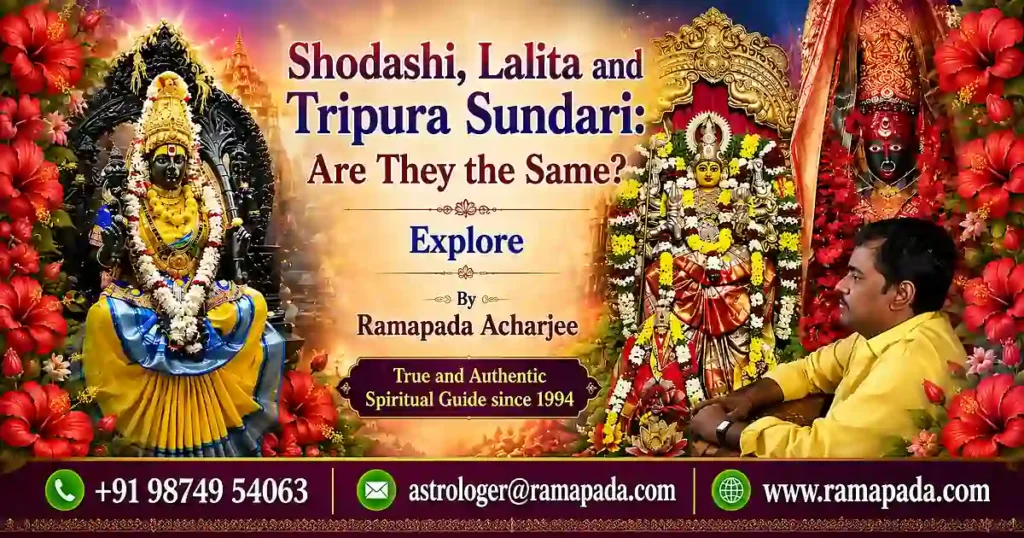
Are They the Same?
When we enter the deeper world of Tripura Sundari Mahavidya, one fundamental question naturally arises: Are Shodashi, Lalita, and Tripura Sundari the same Goddess, or are they different forms?
I have encountered this question countless times throughout my 35+ years of active involvement with Shakta philosophy, Mahavidya traditions, astrology, and spiritual consultations. At first glance, the answer may appear quite simple. Shodashi, Lalita, and Tripura Sundari are deeply connected manifestations of the same supreme reality. However, when we study their names, scriptural roots, core symbolism, and philosophical backgrounds with analytical care, we begin to discover several layers of meaning.
আমার দীর্ঘদিনের অভিজ্ঞতায় আমি দেখেছি, দেবীর একটি নাম জানলেই তাঁকে সম্পূর্ণভাবে বোঝা যায় না। একই মহাশক্তিকে বিভিন্ন নাম, রূপ এবং তত্ত্বের মাধ্যমে বোঝানোর চেষ্টা করা হয়েছে। তাই শুধুমাত্র নামের বাহ্যিক পার্থক্য দেখেই আলাদা দেবী ভেবে নেওয়া ঠিক নয়।
In this article, I want to explain the relationship between Shodashi, Lalita and Tripura Sundari in a clear, balanced, and practical way, without making the subject unnecessarily complicated.
The best starting point for understanding these names is my introduction to Tripura Sundari Mahavidya as the Third Mahavidya.
Who Is Tripura Sundari?
Tripura Sundari is widely recognized as the Third Mahavidya among the sacred Ten Mahavidyas (Dasha Mahavidyas).
Her name is commonly interpreted as “The Beauty of the Three Worlds.” However, this beauty should never be reduced merely to physical appearance or worldly charm. In my understanding, Tripura Sundari represents a much deeper dimension of reality:
- The living harmony of the cosmos
- Pure spiritual awareness
- Perfect emotional and mental balance
- The underlying conscious order that sustains creation
আমরা সাধারণত সৌন্দর্য বলতে কেবল বাহ্যিক রূপ বুঝি। কিন্তু আমার দীর্ঘ উপলব্ধিতে Tripura Sundari-এর সৌন্দর্য শুধু শরীরের সৌন্দর্য নয়। মানুষের চিন্তা, ব্যবহার, সম্পর্ক, সংযম এবং অন্তরের শান্তির মধ্যেও সৌন্দর্য আছে। এই জায়গাটা না বুঝলে Tripura Sundari-এর তত্ত্বের অনেকটাই অধরা থেকে যায়।
This distinction is vital because modern readers can easily misunderstand her divine symbolism if they focus only on her youthful, beautiful imagery.
The relationship between the names Tripura Sundari, Lalita and Shodashi can be studied within the wider Mahavidya context through David Kinsley’s scholarly work on the Ten Mahavidyas.
What Does “Tripura” Mean?
The Sanskrit name Tripura is built on the root Tri, which translates directly to “three.”
Different Shakta and Vedic traditions interpret this “threefold” nature through several complementary dimensions:
| Dimension of Three | Traditional Concept | Spiritual Manifestation |
| Cosmic Realms | Trailokya | Earth (Bhu), Atmosphere (Bhuvah), Heavens (Svah) |
| States of Consciousness | Avasthatraya | Waking (Jagrat), Dreaming (Svapna), Deep Sleep (Sushupti) |
| Primal Energies | Gunas | Dynamic activity (Rajas), Inertia (Tamas), Harmony (Sattva) |
| Divine Powers | Shaktis | Will power (Iccha), Wisdom (Jnana), Action (Kriya) |
Therefore, we do not need to force the word into a single, narrow definition. Traditional Indian spiritual symbols intentionally carry multiple layers of truth simultaneously.
আমার মতে, এখানেই ভারতীয় আধ্যাত্মিক দর্শনের সৌন্দর্য। একটি শব্দের শুধু dictionary meaning ধরে এগোলে অনেক সময় আসল তত্ত্ব বোঝা যায় না। একই প্রতীকের ভিতরে একাধিক স্তরের অর্থ থাকতে পারে।
Tripura Sundari can be contemplated as the supreme Divine Presence that exists within, beyond, and throughout these three states of reality.
Who Is Shodashi?
The name Shodashi comes from the Sanskrit term for sixteen (Shodasha). This naturally prompts another meaningful question: Why sixteen?
Traditional scriptural interpretations provide several profound insights:
- The Full Moon (Purnima): The moon gradually grows through its waxing phases until it reaches sixteen digits (Kalas) of total radiance.
- Completeness: A state that has reached absolute maturity and perfection without entering decay or decline.
- Inner Radiance: The unclouded light of spiritual wisdom within a person.
I personally find this symbolism of fullness particularly meaningful.
এখানে একটা কথা আমি বিশেষভাবে বলতে চাই—’ষোড়শী’ শব্দটাকে শুধু ১৬ বছরের একটি মেয়ের শারীরিক বয়স হিসেবে দেখা ঠিক হবে না। আধ্যাত্মিক তত্ত্বে সংখ্যা অনেক সময় প্রতীক। আমার কাছে এখানে ১৬ মানে পূর্ণতার একটি অবস্থা—যেখানে বিকাশ তার সম্পূর্ণ প্রকাশে পৌঁছেছে।
Viewing the deity this way takes our understanding far beyond physical appearance and enters pure spiritual philosophy.
Her divine attributes can also be understood visually through the iconography and symbolism of Tripura Sundari.
Is Shodashi the Same as Tripura Sundari?
Within the classical Mahavidya tradition, Shodashi is widely identified with Tripura Sundari.
In my practice and teaching, I do not approach Shodashi as an entirely separate goddess from Tripura Sundari. Instead, each name emphasizes a specific dimension of her divine nature:
- Tripura Sundari directs our focus toward her cosmic supremacy, universal harmony, and transcendence across the three realms.
- Shodashi draws our attention toward spiritual fullness, completeness, and the sacred symbolism of sixteen.
আমার বোঝার সুবিধার জন্য আমি বিষয়টাকে এভাবে দেখি—মানুষ একজনই হতে পারেন, কিন্তু তাঁর পরিচয় একাধিক হতে পারে। বাড়িতে একটি পরিচয়, কর্মক্ষেত্রে আরেকটি, সমাজে আরেকটি। মানুষ বদলে গেলেন না, কিন্তু কোন দিকটি সামনে আসছে সেটা বদলে গেল। দেবীর বিভিন্ন নাম বোঝার ক্ষেত্রেও এই উদাহরণটি সাধারণ পাঠকের কাজে লাগতে পারে।
While divine theology is vastly more profound than any human example, this comparison helps seekers understand the core idea clearly.
Who Is Lalita?
The name Lalita carries the essence of divine grace, beauty, spontaneity, charm, and divine play (Lila).
Within the Shakta tradition—especially in the Brahmanda Purana and the celebrated Lalita Sahasranama—Lalita becomes central to a vast philosophical understanding of the Divine Mother. She is commonly venerated as Lalita Tripura Sundari. Her identity unites cosmic beauty, pure consciousness, universal order, and sovereign grace.
আমার কাছে ‘Lalita’ নামটির মধ্যে একটা সহজ, সুন্দর এবং স্বাভাবিক প্রবাহের ভাব আছে। আধ্যাত্মিকতা মানেই যে শুধু ভয়, কঠোরতা, ত্যাগ বা সংসার ছেড়ে দেওয়া—আমি তা মনে করি না। জীবনের মধ্যেও সৌন্দর্য আছে, সম্পর্ক আছে, দায়িত্ব আছে, আনন্দ আছে। এগুলোর মধ্যে থেকেও সচেতন হওয়া যায়।
This harmonious integration is why the philosophy of Tripura Sundari feels deeply relevant to our everyday personal lives.
Sri Vidya scholarship commonly places Lalita Tripurasundari at the centre of the tradition, as discussed in this Cambridge University Press study.
Lalita Tripura Sundari and Sri Vidya
The combined name Lalita Tripura Sundari becomes especially significant when we study the Sri Vidya tradition.
Sri Vidya is an ancient, sophisticated Shakta discipline with its own comprehensive philosophy, revered texts, Sri Yantra geometry, and spiritual guide—disciple lineages (Sampradayas). It should never be trivialized into a few random mantras or rituals found across the internet.
এই জায়গায় আমি পাঠকদের একটু সতর্ক করতে চাই। ইন্টারনেটে Sri Vidya লিখে search করলে অনেক mantra, ritual, secret practice ইত্যাদি পাওয়া যায়। কিন্তু সবকিছু পড়ে নিজে নিজে practice করা আর কোনও tradition-কে বোঝার চেষ্টা করা এক জিনিস নয়।
For general readers and seekers, the essential first step is always understanding the philosophy, history, symbolism, and ethical worldview of Sri Vidya. Advanced ritual practices belong to dedicated personal study under qualified guidance.
Why Does One Goddess Have Different Names?
Having multiple names for the divine is a classical feature of Hindu and Shakta philosophy. One Divine Reality expresses many names because each name reveals a specific quality, relationship, philosophical idea, or spiritual experience:
- One name emphasizes unconditional compassion.
- Another name expresses fierce protection.
- Another name represents supreme wisdom, transformation, or balance.
In the same manner, Shodashi, Lalita and Tripura Sundari guide our awareness toward different facets of a unified divine principle.
আমার এত বছরের অধ্যয়নে একটা বিষয় ক্রমশ পরিষ্কার হয়েছে—আমরা অনেক সময় নাম নিয়ে বেশি তর্ক করি, কিন্তু নামের ভিতরের তত্ত্বটা বোঝার চেষ্টা কম করি। আমার কাছে নামের চেয়ে সেই নামটি কোন ভাব বা তত্ত্ব প্রকাশ করছে, সেটা বেশি গুরুত্বপূর্ণ।
This constructive mindset helps resolve many seemingly contradictory aspects of Shakta literature.
The textual background behind these sacred names is discussed more extensively in Tripura Sundari scriptures and Shakta philosophy.
Shodashi, Lalita and Tripura Sundari: What Is the Difference?
To summarize the relationship simply for readers, we can look at their distinctive focal points:
- Tripura Sundari: Emphasizes divine beauty, supreme consciousness, harmony, and mastery over the threefold nature of existence.
- Shodashi: Highlights the sacred symbolism of sixteen, completeness, lunar radiance, and spiritual perfection.
- Lalita: Highlights spontaneous grace, divine play (Lila), cosmic charm, and her sovereign role within Sri Vidya.
These names are not rigid boundaries; rather, they are complementary windows through which we experience the Divine Feminine.
Are They Three Separate Goddesses?
This question requires a balanced, mature answer:
- I would not say that Shodashi, Lalita, and Tripura Sundari are three completely separate, unconnected goddesses.
- At the same time, different scriptures, historical lineages, and commentaries emphasize specific nuances based on their spiritual focus.
Indian spiritual traditions developed organically over centuries, with various texts highlighting particular dimensions of the same deity.
এই কারণে আমি সবসময় বলি—শাস্ত্রের বিষয় নিয়ে খুব সহজে ‘এটাই একমাত্র সত্য’ বলা উচিত নয়। কোন গ্রন্থে বলা হয়েছে, কোন পরম্পরায় বলা হয়েছে এবং কোন প্রসঙ্গে বলা হয়েছে—এই তিনটি বিষয় দেখা দরকার।
Context always matters. For most readers, viewing Shodashi, Lalita, and Tripura Sundari as interconnected expressions of the same supreme power provides the most accurate and practical understanding.
A classical devotional representation of Tripurasundari can be read in the Tripurasundari Stotra preserved in Hymns to the Goddess.
Tripura Sundari Is Not Only About Physical Beauty
One common misconception surrounding Tripura Sundari is reducing her name solely to physical attractiveness, sensuality, or outer allure.
Her beauty represents an all-encompassing harmony:
- Harmony within human thought and speech
- Harmony in personal and family relationships
- Harmony between material responsibilities and inner growth
- Harmony between human desire and ethical wisdom
বয়স বাড়ার সঙ্গে সঙ্গে আমি একটা জিনিস খুব গভীরভাবে বুঝেছি—শুধু সুন্দর দেখতে হওয়া সৌন্দর্য নয়। যার জীবনে balance নেই, মনে শান্তি নেই, সম্পর্কে সম্মান নেই, তার বাহ্যিক সৌন্দর্য শেষ পর্যন্ত খুব বেশি অর্থ বহন করে না। আমার কাছে Tripura Sundari-এর symbolism এখানেই অত্যন্ত গভীর।
When understood this way, spiritual beauty becomes a transformative quality that enriches every aspect of life.
Tripura Sundari and the Nature of Desire
Discussions around Tripura Sundari frequently touch upon desire (Kama). However, her philosophy does not promote uncontrolled indulgence, nor does it demand cold suppression.
Desire is an inherent part of the human experience. The crucial question is: Does clear awareness guide our desire, or does blind desire control our awareness?
আমার নিজের জীবনের অভিজ্ঞতা থেকে বলছি, মানুষ যতদিন বাঁচে তার চাওয়া-পাওয়া শেষ হয় না। অর্থ, সম্মান, সম্পর্ক, সম্পত্তি, স্বীকৃতি—কিছু না কিছু আমরা চাই। সমস্যা চাওয়ার মধ্যে নয়। সমস্যা তখনই হয়, যখন সেই চাওয়াই আমাদের মনকে নিয়ন্ত্রণ করতে শুরু করে।
Authentic spiritual understanding does not demand that we abandon life. It guides us to live life with clarity, self-control, and emotional maturity.
Their deeper spiritual context becomes clearer through the philosophy of Sri Vidya and Tripura Sundari.
What These Three Names Mean to Me
After more than 35 years of spiritual study and consultation, my personal approach to these sacred concepts has evolved.
In my earlier years, I often sought rigid, dictionary-style definitions for every term. But over time, I realized that living spiritual traditions are far deeper than mechanical formulas.
বয়স এবং অভিজ্ঞতার সঙ্গে আমার একটা পরিবর্তন হয়েছে। এখন কোনও শাস্ত্রীয় বিষয় পড়ে খুব তাড়াতাড়ি সিদ্ধান্তে পৌঁছতে চাই না। যত পড়েছি, ততই বুঝেছি—জানার শেষ নেই। আর আধ্যাত্মিক জগতে অহংকার করে ‘আমি সব জানি’ বলাটাই সম্ভবত সবচেয়ে বড় অজ্ঞানতা।
Today, I view these three names as three practical guides for self-realization:
- Tripura Sundari reminds me to maintain harmony in every situation.
- Shodashi reminds me to seek completeness within rather than depending solely on external validation.
- Lalita reminds me to navigate life’s challenges with grace and cheerfulness.
Together, they present a balanced path where self-awareness and life’s responsibilities enrich each other.
A Practical Lesson for Modern Life
We live in a world driven by continuous social comparison. People constantly compare wealth, career status, physical appearances, and social media attention. Yet this external chase rarely produces genuine mental peace.
The timeless symbolism of Tripura Sundari encourages us to redefine true success and fulfillment:
আজকের দিনে এই শিক্ষা আমার কাছে খুব practical মনে হয়। অন্যের সঙ্গে সারাক্ষণ তুলনা করলে শান্তি পাওয়া কঠিন। আমার কী নেই সেটা দেখার পাশাপাশি আমার কী আছে, আমি কী শিখেছি, কোথায় দাঁড়িয়ে আছি—সেটাও দেখা দরকার।
Inner fullness does not mean we stop working hard or improving ourselves; it simply means our growth begins from self-respect rather than self-rejection.
Her identity as Lalita is also prominent in the traditional Lalita Sahasranama text.
Shodashi and the Concept of Inner Fullness
Modern society frequently promotes the idea that something is always missing—that we must buy more, achieve more, and seek more external praise to feel whole. Yet even after achieving material goals, many individuals feel a deep sense of emptiness.
The symbolism of Shodashi invites an essential question: Can lasting completeness be cultivated from within?
সব পাওয়ার পরেও মানুষ কেন অশান্ত থাকে—এই প্রশ্নের উত্তর শুধু অর্থ বা সাফল্যের মধ্যে নেই। আমার মনে হয়, নিজের ভিতরে একটা স্থির জায়গা তৈরি না হলে বাইরের প্রাপ্তি দিয়ে সেই শূন্যতা পুরোপুরি ভরাট করা কঠিন।
This inner stillness is where an ancient Shakta concept delivers practical value to modern everyday life.
My Personal Understanding After a Long Spiritual Journey
For me, studying the Ten Mahavidyas is never about memorizing mythological trivia. It is a profound exploration of human consciousness:
- Kali teaches us to confront time, impermanence, and fearless transformation.
- Tara provides guidance through uncertainty, struggles, and deep anxiety.
- Tripura Sundari leads us toward harmony, balance, beauty, and inner fullness.
আমি Mahavidya-কে শুধু দশটি আলাদা দেবীর গল্প হিসেবে দেখি না। আমার কাছে প্রতিটি Mahavidya মানুষের জীবন, মন, ভয়, আকাঙ্ক্ষা, পরিবর্তন এবং চেতনার কোনও না কোনও গভীর দিককে সামনে নিয়ে আসে। এই কারণেই এত বছর পরেও বিষয়টি আমার কাছে নতুন মনে হয়।
These traditional insights have endured for centuries precisely because they continue to guide and inspire reflective minds.
Why Context Matters in Shakta Traditions
When reading about Shodashi, Lalita, or Tripura Sundari, we must distinguish between:
- Original scriptural sources
- Philosophical commentaries
- Traditional lineage teachings
- Modern popular interpretations
- Personal reflective realizations
Because modern online platforms often mix different traditions indiscriminately, thoughtful discernment is essential.
একটি website-এ কিছু লেখা আছে বলেই সেটি শাস্ত্রের চূড়ান্ত কথা—এভাবে আমি কখনও দেখি না। আমি পাঠকদেরও বলব, সম্ভব হলে source দেখুন, context বুঝুন এবং বিভিন্ন মত থাকলে সেগুলোকেও সম্মান করুন।
Spiritual inquiry becomes truly fulfilling when intellectual curiosity is paired with humility and patience.
For further clarification about her identity, worship, symbolism, and meaning, see my Tripura Sundari Mahavidya FAQ.
What Comes Next in My Tripura Sundari Series?
In this article, we have explored the relationship between Shodashi, Lalita and Tripura Sundari through scriptural, philosophical, and personal viewpoints.
The upcoming article in this series will explore:
Sri Vidya and Tripura Sundari: A Beginner’s Guide to Philosophy, Symbolism, and Tradition
In that guide, I will introduce the foundations of Sri Vidya in an educational, accessible manner, highlighting its worldview and respect for traditional lineage.
Readers wanting a deeper academic treatment of Lalita Mahatripurasundari may consult Cornell University research on the Goddess and her textual traditions.
Frequently Asked Questions
1. Are Shodashi and Tripura Sundari the same Goddess?
Yes. Within the Dasha Mahavidya tradition, Shodashi is identified directly with Tripura Sundari. The name Shodashi specifically highlights the symbolism of the sixteen lunar digits, maturity, and spiritual completeness.
2. Are Lalita and Tripura Sundari the same deity?
They represent the same divine reality, particularly in the Sri Vidya tradition where she is venerated as Lalita Tripura Sundari. The name Lalita emphasizes sovereign grace and divine play.
3. Why is Tripura Sundari called Shodashi?
The name Shodashi connects with the Sanskrit word for sixteen (Shodasha). This symbolizes the fullness of the sixteen Kalas of the moon, representing a state of spiritual perfection without decline.
4. Is Tripura Sundari the Third Mahavidya?
Yes. Tripura Sundari (also worshiped as Shodashi) is traditionally recognized as the Third Mahavidya, following Kali and Tara.
5. Does Tripura Sundari represent only physical beauty?
No. Her beauty signifies cosmic harmony, mental clarity, balanced emotions, and the conscious intelligence that sustains life.
6. What is the relationship between Tripura Sundari and Sri Vidya?
Lalita Tripura Sundari is the central deity of Sri Vidya metaphysics. Sri Vidya integrates sacred geometry (the Sri Yantra), philosophical texts, and disciplined spiritual lineages.
7. What is the spiritual meaning of Shodashi?
Spiritually, Shodashi represents inner completeness and holistic growth. It refers to a state of radiant awareness rather than a literal physical age.
8. What is the key difference between Shodashi, Lalita, and Tripura Sundari?
Tripura Sundari highlights universal harmony and consciousness. Shodashi emphasizes inner fullness and the sixteen lunar digits. Lalita highlights sovereign grace and divine playfulness.
9. Can general readers study the philosophy of Sri Vidya?
Yes. Anyone can study its foundational philosophy, history, and symbolism. However, specialized mantra practices and esoteric rituals should only be learned under experienced guidance.
10. What practical lesson does Tripura Sundari offer for modern life?
She teaches the vital importance of balance—balancing desires with wisdom, external work with inner peace, and personal ambition with mutual respect in relationships.
My Final Reflection
So, are Shodashi, Lalita, and Tripura Sundari the same?
My answer remains: They are deeply interconnected expressions of the same supreme feminine consciousness, yet each name opens a unique window of understanding.
- Tripura Sundari speaks to us of cosmic harmony.
- Shodashi speaks to us of inner fullness.
- Lalita speaks to us of graceful living.
আমার কাছে শেষ কথা একটাই—নাম মুখস্থ করার থেকে তত্ত্ব বোঝা বেশি জরুরি। Shodashi বলি, Lalita বলি বা Tripura Sundari বলি—যদি তাঁর মধ্যে balance, পূর্ণতা, সৌন্দর্য, সচেতনতা এবং জীবনের গভীর অর্থকে বুঝতে না পারি, তাহলে শুধু নাম জানার মধ্যে আধ্যাত্মিক উপলব্ধি সম্পূর্ণ হয় না।
The more we learn, the more our spiritual study should make us humble, balanced, and thoughtful human beings. That, to me, is the true essence of Tripura Sundari.
— Ramapada Acharjee
35+ years of experience and study in Shakta philosophy, Mahavidya traditions, and spiritual consultancy.
Connect with the Best in Kolkata
Stop wandering in uncertainty. Your stars have a story to tell, and Ramapada Acharjee is here to help you read it. With a legacy built on truth, 35 years of experience, and a mission to bring peace to every household, your journey toward clarity starts here.
📍Consultation available in Kolkata, Guwahati, Siliguri, Tarapith & online.
📞 Call/WhatsApp: +91-98749 54063
🌐 Visit Website
You may also read:
Powerful Tantrik in Kolkata
Genuine Tantrik in Mayang, Assam
Black Magic kriya by Black Magic expert in Kolkata
Related Category: Tantra
