
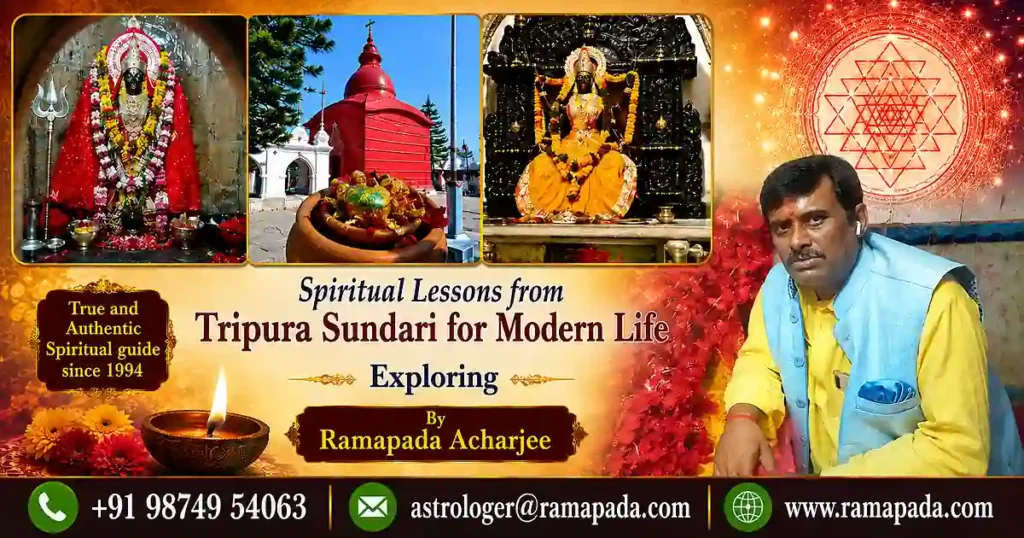
Balance, Beauty, Awareness, Relationships, and Inner Harmony
We live in a time of extraordinary convenience, yet many people feel increasingly restless.
We have faster communication, better technology, more choices, and greater access to information than previous generations. Still, anxiety, comparison, dissatisfaction, relationship problems, and the constant pressure to achieve more have become common parts of modern life.
This is where I find the philosophy and symbolism of Tripura Sundari Mahavidya surprisingly relevant.
After more than 35 years of experience in spiritualism and years of studying Shakta and Tantric traditions, I have gradually come to understand Tripura Sundari not simply as a Goddess associated with beauty. For me, she represents something much deeper: balance, awareness, harmony, the intelligent understanding of desire, and the ability to discover beauty without losing ourselves in appearances.
আমার জীবনের এই পর্যায়ে এসে একটা বিষয় খুব স্পষ্টভাবে বুঝেছি—জীবনে শুধু বেশি পাওয়াই সব নয়। যা পেয়েছি, তার মধ্যে কতটা শান্তি নিয়ে বাঁচতে পারছি, সেটাও সমান গুরুত্বপূর্ণ।
In this article, I want to move away from complex ritual discussions and explore what the philosophy of Tripura Sundari can teach us about ordinary modern life.
Before exploring these practical lessons, readers may find it helpful to understand the spiritual meaning of Tripura Sundari as the Third Mahavidya.
Tripura Sundari and the Meaning of a Beautiful Life
The name Tripura Sundari is commonly understood as “the Beauty of the Three Worlds.”
But what is beauty? Modern society often teaches us to associate beauty primarily with appearance:
- A beautiful face
- A beautiful house
- An expensive car
- Designer clothes
- A luxurious lifestyle
There is nothing inherently wrong with appreciating beautiful things. The problem begins when appearance becomes our only measure of value. Over the years, my understanding of beauty has changed.
আমার কাছে এখন সুন্দর জীবন মানে শুধু দামি বাড়ি, গাড়ি বা বাইরে থেকে impressive জীবন নয়। সুন্দর জীবন হল যেখানে অর্থ আছে কিন্তু অর্থের জন্য সারাক্ষণ অশান্তি নেই; সম্পর্ক আছে কিন্তু প্রতিদিন সংঘর্ষ নেই; নিজের স্বাধীনতা আছে, আবার দায়িত্ববোধও আছে।
Tripura Sundari reminds me that beauty can also mean harmony. And harmony is often more valuable than display.
The larger spiritual symbolism of Tripura Sundari can be better understood through David Kinsley’s scholarly study of the Mahavidyas.
Lesson 1: Balance Is More Important Than Excess
Modern life constantly encourages us to want more:
- More money
- More property
- More recognition
- More followers
- More success
- More possessions
But “more” does not automatically mean “better.” One of the deepest lessons I personally draw from Tripura Sundari is the importance of balance:
- Money is necessary, but money alone cannot create peace.
- Relationships are important, but relationships without personal space can become suffocating.
- Ambition is useful, but ambition without limits can destroy health and happiness.
- Spirituality can enrich life, but spirituality without practical judgement can become escapism.
আমার নিজের অভিজ্ঞতায় দেখেছি—জীবনে কোনও একটা জিনিস যখন অতিরিক্ত হয়ে অন্য সবকিছুকে গ্রাস করে ফেলে, তখনই imbalance শুরু হয়।
A balanced life does not mean having everything in equal amounts; rather, it means understanding what deserves importance at a particular stage of life.
Lesson 2: Desire Is Natural, but It Needs Awareness
Tripura Sundari is sometimes discussed in relation to desire. Unfortunately, this idea is frequently misunderstood.
Desire itself is not unusual. Every human being has desires:
- We desire financial security.
- We desire companionship.
- We want our children to succeed.
- We want respect and dignity.
- We want comfort.
- We want good health.
- We want to enjoy life.
The problem is not always desire itself. The important question is, does desire serve us, or do we become servants of our desires?
মানুষের চাওয়ার কোনও শেষ নেই। আমি নিজেও জীবনে অনেক কিছু চেয়েছি, অনেক কিছুর জন্য পরিশ্রম করেছি। কিন্তু বয়স বাড়ার সঙ্গে সঙ্গে বুঝেছি—কোথায় থামতে হবে সেটা না জানলে অর্জনের আনন্দটাও একসময় হারিয়ে যায়।
Spiritual maturity does not necessarily mean eliminating every desire; sometimes it means learning which desires deserve our energy.
Lesson 3: Do Not Compare Your Life Constantly with Others
Comparison has always existed. Social media has simply made it continuous.
Today we can see other people’s holidays, houses, cars, careers, celebrations, and achievements every hour. But we rarely see their complete lives; we only see selected moments. This creates a dangerous illusion where someone else’s visible success can make our own life appear inadequate.
আমি মনে করি, আজকের সময়ে অন্যের জীবন দেখে নিজের জীবন বিচার করা খুব বড় মানসিক চাপের কারণ। আমরা অন্য মানুষের display দেখি, কিন্তু তার দায়িত্ব, দুশ্চিন্তা, পারিবারিক সমস্যা বা ভিতরের অশান্তি দেখি না।
Tripura Sundari’s philosophy encourages me to look for harmony within my own circumstances rather than copying someone else’s definition of a beautiful life. Your life does not need to look impressive to everyone; it needs to make sense to you.
Her association with consciousness and the Sri Vidya tradition can be explored through this Cambridge academic study of Sri Vidya experience.
Lesson 4: Beauty Changes with Age
When we are young, beauty is often understood physically. With experience, the meaning can change:
- A peaceful home becomes beautiful.
- A trustworthy relationship becomes beautiful.
- Financial independence becomes beautiful.
- Freedom from unnecessary conflict becomes beautiful.
- Good health becomes beautiful.
- A quiet mind becomes beautiful.
বয়সের সঙ্গে মানুষের priority বদলায়। কুড়ি-পঁচিশ বছর বয়সে যেটাকে খুব গুরুত্বপূর্ণ মনে হয়, পঞ্চাশের পরে অনেক সময় সেটাই আর তত গুরুত্বপূর্ণ থাকে না। আবার যে জিনিসকে আগে সাধারণ মনে হত, সেটাই তখন অমূল্য মনে হয়।
This changing understanding of beauty is one reason Tripura Sundari remains meaningful to me. Beauty does not have to disappear with age; its meaning can become deeper.
Lesson 5: Protect Your Inner Peace
Modern life demands attention almost continuously:
- Phones ring constantly.
- Messages arrive without pause.
- News changes every minute.
- Social media demands instant reaction.
- Business creates responsibility.
- Family creates responsibility.
- Money creates responsibility.
- Even possessions create responsibility.
If we are not careful, our mind remains occupied from morning until night. This is why inner peace must sometimes be protected deliberately.
আমার কাছে এখন শান্তি কোনও luxury নয়। শান্তি নিজেই একটা সম্পদ। যে জিনিস, সম্পর্ক বা পরিস্থিতি আমাকে সারাক্ষণ অস্থির করে রাখে, তার মূল্য নতুন করে বিচার করা দরকার।
Tripura Sundari’s symbolism of harmony reminds us that peace should not always be sacrificed for achievement.
The philosophical and theological dimensions of Tripura Sundari have also been examined in academic research on the Tripura tradition preserved by Cornell University.
Lesson 6: Relationships Need Balance, Not Control
Relationships are among the most important parts of human life, yet they are also among the greatest sources of emotional suffering.
Many relationship problems begin when love becomes possession. We want another person to think as we think, live as we want, and respond as we expect. But healthy relationships require:
- Mutual respect
- Honest communication
- Personal space and healthy boundaries
- Acceptance that another human being is not our property
আমার অভিজ্ঞতায় সম্পর্ক তখনই বেশি সুন্দর হয় যখন সেখানে ভালোবাসার সঙ্গে সম্মান থাকে। কাউকে নিজের মতো করে বদলে দেওয়ার চেষ্টা সবসময় সম্পর্ককে শক্তিশালী করে না। অনেক সময় উল্টোটা হয়।
For me, this is another practical lesson connected with harmony. Love without blance can become attachment, and attachment without awareness can turn into control.
Many of these ideas of beauty, harmony, and consciousness are reflected in Tripura Sundari’s sacred iconography and symbolism
Lesson 7: Learn to Let People Live Their Own Lives
As we grow older, this lesson becomes increasingly important.
Parents naturally worry about children, partners worry about each other, and families have expectations. But eventually, every person has their own life to lead. We can advise, we can support, and we can care, but we cannot live another person’s life for them.
একটা সময়ের পরে সন্তানকেও নিজের জীবন নিজের মতো করে গড়তে দিতে হয়। আমরা অভিজ্ঞতা থেকে পরামর্শ দিতে পারি, কিন্তু প্রতিটি সিদ্ধান্ত নিজের হাতে রাখতে চাইলে দু’পক্ষেরই অশান্তি বাড়ে।
Sometimes love also means knowing when to step back. That is not indifference; it is a mature form of respect.
Lesson 8: Money Is Important, but Know Why You Need It
I never believe that money is unimportant. Financial security gives independence, protects dignity, gives us choices, helps us support our families, and allows us to deal with emergencies.
But after a certain point, another question becomes important: What is the money for?
If we spend our entire life accumulating wealth but never allow ourselves to use it meaningfully, wealth can become another burden.
টাকা জমিয়েছি কেন—এই প্রশ্নটাও একটা বয়সের পরে করা দরকার। শুধু bank balance বাড়তেই থাকবে, কিন্তু সেই টাকা আমার জীবনকে কোনও স্বাধীনতা বা স্বস্তি দেবে না—তাহলে accumulation-এর উদ্দেশ্যটাই কী?
Tripura Sundari’s philosophy of balance helps me think about wealth in this way: money should support life; life should not exist only to support money.
Lesson 9: Possessions Also Create Responsibilities
We often think that owning more automatically creates greater security. Sometimes it does, but every possession also requires management:
- A property requires maintenance and care.
- A vehicle requires upkeep.
- Investments require ongoing attention.
- Documents require organization.
More assets can mean more daily responsibility.
ছোটবেলায় আমারও মনে হত—যত বেশি property, তত বেশি security। এখন বুঝি, property শুধু সম্পদ নয়, দায়িত্বও। দেখাশোনা করার লোক না থাকলে বা ব্যবহার না থাকলে অনেক সম্পদই পরে বোঝা হয়ে যেতে পারে।
This does not mean we should avoid ownership; it simply means we should ask whether what we own is actually improving our lives.
Lesson 10: Simplicity Can Be a Form of Luxury
Luxury is usually associated with expensive objects. But at a certain stage of life, simplicity itself can feel luxurious:
- Having enough free time
- Sleeping peacefully
- Being able to say no without guilt
- Not needing to impress anyone
- Having fewer unnecessary responsibilities
- Being able to travel when you want
- Spending quiet time with people you value
আমার কাছে এখন স্বাধীনভাবে নিজের সময় ব্যবহার করতে পারা অনেক বড় luxury। সবসময় লোককে দেখানোর মতো কিছু থাকা luxury নয়; অনেক সময় কারও কাছে জবাবদিহি না করে শান্তিতে নিজের মতো থাকতে পারাটাই বড় luxury।
This is a form of abundance that is difficult to display on social media, yet it may be one of the most valuable forms of wealth.
Readers interested in the traditional idea of divine beauty may explore the IGNCA discussion of Saundaryalahari and Tripura Sundari worship.
Lesson 11: Outer Success and Inner Success Are Different
A person can be successful in the eyes of society and still be deeply unhappy. Conversely, another person may have an ordinary lifestyle but live with remarkable peace. This is why I distinguish between outer success and inner success.
Outer Success:
├── Money & Assets
├── Career & Reputation
└── Social Status & Recognition

Inner Success:
├── Peace of Mind & Stability
├── Self-Respect & Clear Boundaries
├── Healthy & Respectful Relationships
└── Freedom from Constant Anxiety
জীবনে বাইরের success দরকার, আমি সেটা অস্বীকার করি না। কিন্তু শুধু বাইরের success থাকলেই মানুষ সফল—এখন আর আমি সেটা মনে করি না। ভিতরে সারাক্ষণ অশান্তি থাকলে বাইরের সাফল্য উপভোগ করাও কঠিন।
Tripura Sundari’s idea of harmony invites us to consider and balance both.
Lesson 12: Your Identity Is More Than Your Social Position
We spend years building identities around our profession, reputation, family role, and social standing. We become known as someone’s parent, spouse, professional, adviser, businessperson, or public figure.
These identities matter, but they are not the whole person.
মানুষ আমাকে কী নামে চেনে, সমাজে আমার পরিচয় কী—এসব গুরুত্বপূর্ণ। কিন্তু নিজের কাছে আমি কে, আমার ভিতরে কতটা শান্তি আছে, আমি নিজের জীবন নিয়ে কতটা সন্তুষ্ট—এই প্রশ্নগুলোও সমান গুরুত্বপূর্ণ।
If our entire self-worth depends on external recognition, we become vulnerable to other people’s opinions. Inner stability requires a deeper foundation.
The philosophy behind inner balance becomes even clearer when viewed through Sri Vidya and its relationship with Tripura Sundari.
Lesson 13: Learn the Difference Between Need and Display
Modern consumer culture frequently blurs the difference between what we need and what we want others to see:
- A larger house
- A more expensive car
- The latest smartphone
- Luxury lifestyle brands
None of these things are inherently wrong. If someone can comfortably afford them and enjoys them, there is no reason for moral judgement. The real question is motivation: Are we buying something because it improves our life, or because we want other people to notice?
নিজের আনন্দের জন্য কিছু কেনা আর লোককে দেখানোর জন্য কেনা—দুটোর মধ্যে পার্থক্য আছে। প্রথমটা enjoyment হতে পারে, দ্বিতীয়টা অনেক সময় endless competition হয়ে যায়।
Tripura Sundari teaches me to look for genuine beauty rather than competitive performance.
Lesson 14: Accept That Life Will Never Be Perfect
Many people postpone happiness indefinitely:
- “I will be happy when this problem ends.”
- “I will relax when I earn this amount.”
- “I will find peace when my child settles.”
- “I will be content when I buy the house.”
- “I will celebrate when the court case ends.”
- “I will live fully when I retire.”
In reality, one problem often ends and another begins. That is the natural rhythm of life.
একেবারে problem-free জীবন আমি অন্তত দেখিনি। একটা সমস্যা মিটলে অন্য কোনও দায়িত্ব সামনে আসে। তাই সব সমস্যা শেষ হওয়ার পরে শান্তিতে থাকব—এই ভাবনাটা বাস্তবে অনেক সময় কাজ করে না।
Perhaps peace has to be developed within an imperfect life. This is one of the most practical spiritual lessons I have learned.
Lesson 15: Age Should Bring Selection, Not Only Limitation
Growing older is often discussed only in terms of what we lose physically. But age can also bring immense clarity.
We become naturally more selective:
- Which relationships truly matter?
- Which arguments are worth having?
- How much money is enough for our peace?
- What responsibilities are truly ours?
- Where should we spend our precious time?
বয়স আমাকে একটা জিনিস শিখিয়েছে—সব জায়গায় জিততে হবে না, সব কথার উত্তর দিতে হবে না, সবাইকে খুশি রাখতে হবে না এবং প্রতিটি সুযোগ গ্রহণ করতেই হবে না।
Knowing what to ignore can be just as valuable as knowing what to pursue.
Lesson 16: Harmony Does Not Mean Avoiding Every Conflict
Balance should never be confused with weakness or passivity.
Sometimes we must say no. Sometimes we must protect our personal boundaries firmly. Sometimes we must disagree, and sometimes we must leave unhealthy situations. Harmony does not mean accepting everything silently.
শান্তি চাই বলে অন্যায় বা অসম্মান সবসময় মেনে নেওয়া শান্তি নয়। অনেক সময় নিজের সীমা পরিষ্কার করে দেওয়াটাই ভবিষ্যতের শান্তির জন্য দরকার।
True balance always includes healthy self-respect.
Lesson 17: Spirituality Should Make Life Clearer, Not More Fearful
Over the years, I have seen people become unnecessarily frightened by distorted spiritual ideas. They worry constantly about:
- Ritual errors
- Planetary movements
- Omens and superstitions
- Dreams and symbols
- Inauspicious dates
- Invisible forces
For me, authentic spirituality should not create constant fear; it should gradually create greater understanding.
যে spirituality মানুষকে সারাক্ষণ ভয় দেখায়—এটা করলে ক্ষতি হবে, ওটা করলে সর্বনাশ হবে—সেটা নিয়ে আমি সতর্ক থাকি। আমার কাছে সত্যিকারের spiritual understanding মানুষের ভিতরের শক্তি বাড়াবে, ভয় নয়।
A mature spiritual outlook should support life, not make ordinary living impossible.
Lesson 18: Do Not Look for a Shortcut to Every Problem
We live in a modern shortcut culture:
- Quick money schemes
- Quick weight loss
- Quick career success
- Quick relationships
- Quick spiritual results
However, truly meaningful things always require time:
- Trust takes time to build.
- Financial security takes time to establish.
- Real knowledge takes time to absorb.
- Healthy relationships take time to mature.
- Inner stability takes time to cultivate.
আমার 35 বছরের বেশি অভিজ্ঞতার একটা বড় শিক্ষা হল—যে জিনিস খুব দ্রুত সব সমস্যার সমাধান করে দেওয়ার promise করে, সেটাকে একটু সতর্কভাবে দেখা উচিত।
Spiritual development is usually not dramatic; often it is steady and gradual.
It is equally important to separate these spiritual teachings from the common misconceptions surrounding Tripura Sundari Mahavidya.
Lesson 19: Gratitude and Ambition Can Exist Together
Some people think practicing gratitude means we should stop wanting improvement in our circumstances. I do not see it that way.
We can appreciate what we have while still working diligently toward something better. We can be ambitious without feeling permanently dissatisfied with our present life.
যা আছে তার জন্য কৃতজ্ঞ থাকা আর আরও ভালো করার চেষ্টা করা—দুটো একসঙ্গে সম্ভব। সমস্যা তখনই হয় যখন যা নেই সেটাই সারাক্ষণ চোখে পড়ে, আর যা আছে তার কোনও মূল্য থাকে না।
Balance again becomes the essential key.
Lesson 20: Find Your Own Center
In my previous article on Sri Chakra and Tripura Sundari, I discussed the Bindu—the central, unwavering point. That symbolism has great practical meaning for me.
Modern life constantly pulls us outward:
- Toward comparison with others
- Toward material possessions
- Toward public opinions
- Toward social expectations
- Toward external recognition
Because of these pulls, everyone needs a calm inner center that does not change every time another person approves or disapproves of us.
আমার কাছে নিজের center মানে—আমি কী চাই, কী চাই না, কোন জিনিস আমার জন্য যথেষ্ট, কোথায় আমার সীমা এবং কোন জিনিস আমাকে সত্যিই শান্তি দেয়—এই বিষয়গুলো নিজের কাছে পরিষ্কার থাকা।
Without that inner center, even great worldly success can feel confusing and hollow.
What Tripura Sundari Has Gradually Come to Mean to Me
When I first encountered the world of spiritual traditions many years ago, the mysterious and esoteric aspects naturally attracted me. With time and experience, my understanding changed.
Today, when I think about Tripura Sundari:
- I think less about mystery and more about harmony.
- I think less about obtaining everything and more about knowing what is enough.
- I think less about physical beauty and more about a beautiful, dignified way of living.
- I think less about controlling external circumstances and more about understanding myself.
জীবনের এতটা পথ আসার পরে আমার কাছে Tripura Sundari-র সবচেয়ে বড় message হল balance। সংসার থাকবে, অর্থ থাকবে, ইচ্ছা থাকবে, আনন্দ থাকবে, এবং spirituality-ও থাকবে—কিন্তু কোনও একটাকে যেন এত বড় না করি যে বাকিগুলো হারিয়ে যায়।
This is not merely a theoretical scriptural definition; it is my personal understanding shaped by decades of study, observation, and lived experience.
For concise answers to many related questions, readers can continue with my Tripura Sundari Mahavidya FAQ.
Frequently Asked Questions About Tripura Sundari for Modern Life
1. What can Tripura Sundari teach us about modern life?
Her symbolism encourages reflection on balance, beauty, awareness, desire, healthy relationships, inner harmony, and the peaceful coexistence of material and spiritual life.
2. Does Tripura Sundari represent only physical beauty?
No. Her philosophical symbolism can be understood much more broadly through harmony, consciousness, balance, fullness, and spiritual beauty.
3. Is desire always negative in spirituality?
Not necessarily. Desire is natural to human life. The important questions are whether our desires are healthy, whether we understand them consciously, and whether they begin to control our peace.
4. Can spirituality and material success coexist?
Yes. They are not automatic opposites. The challenge is to maintain balance and avoid allowing material accumulation to become the only measure of a successful life.
5. Is wanting money spiritually wrong?
No. Financial security is an important practical need for dignity and family protection. The deeper question is what purpose the wealth serves in your life.
6. What does beauty mean in Tripura Sundari philosophy?
Beauty extends far beyond physical appearance. Harmony, balance, awareness, respectful relationships, sound character, and inner peace all contribute to a truly beautiful life.
7. What is inner harmony?
Inner harmony means having clarity about one’s priorities, desires, responsibilities, boundaries, and values without being constantly tossed around by outside comparison.
8. Can Tripura Sundari’s teachings help relationships?
Her symbolism of harmony and balance encourages reflection on mutual respect, healthy boundaries, open communication, and personal freedom, rather than possessiveness and control.
9. Do we need complicated rituals to learn from Tripura Sundari?
No. General readers can learn valuable lessons from her philosophy, symbolism, history, and spiritual ideas without attempting specialized ritual practices.
10. What is the most important modern lesson from Tripura Sundari?
The most important lesson is simple: building a balanced life in which achievement and inner peace can comfortably coexist.
Continue the Tripura Sundari Mahavidya Series
The next article in this series will be:
Tripura Sundari Mahavidya FAQ: Key Takeaways & My Final Reflections
There I will bring together the major questions from this entire Tripura Sundari series—her meaning, Shodashi and Lalita, Sri Vidya, Sri Chakra, symbolism, common misconceptions, and the practical spiritual understanding I have developed over the years.
A devotional perspective on compassion, beauty and divine refuge can also be found in the traditional Tripurasundari Stotra.
My Final Reflection
The modern world gives us countless ways to improve our lives. That is a wonderful thing.
Yet it also gives us countless reasons to feel that what we have is never enough:
- Someone will always have more money.
- Someone will have a larger house.
- Someone will look younger.
- Someone will have more followers.
- Someone will appear more successful.
If our happiness depends entirely on winning these comparisons, peace will always remain somewhere in the future.
Tripura Sundari offers a different way to think about beauty. A beautiful life does not have to be perfect; it does not have to impress everyone; and it does not require the fulfillment of every fleeting desire. It simply requires a steady harmony between what we have, what we want, what we truly need, and who we are becoming.
আজ আমার কাছে সুন্দর জীবনের সংজ্ঞা অনেক সহজ—নিজের সামর্থ্য অনুযায়ী ভালোভাবে থাকা, প্রয়োজনীয় অর্থনৈতিক নিরাপত্তা রাখা, যাদের ভালোবাসি তাদের পাশে থাকা, অপ্রয়োজনীয় ঝামেলা কমানো এবং নিজের জীবনটা নিজের মতো করে উপভোগ করার স্বাধীনতা থাকা।
Perhaps this is one of the most practical ways in which the ancient symbolism of Tripura Sundari Mahavidya can still speak to modern life.
— Ramapada Acharjee
True and Authentic Spiritual Guide since 1994
Connect with the Best in Kolkata
Stop wandering in uncertainty. Your stars have a story to tell, and Ramapada Acharjee is here to help you read it. With a legacy built on truth, 35 years of experience, and a mission to bring peace to every household, your journey toward clarity starts here.
📍Consultation available in Kolkata, Guwahati, Siliguri, Tarapith & online.
📞 Call/WhatsApp: +91-98749 54063
🌐 Visit Website
You may also read:
There are many Tantrik temples in India; Ramapada Acharjee, the best tantrik in Kolkata, has done his tantra activities at underwritten mandirs:-
Baijnath Temple, Himachal Pradesh
Kamakhya Temple, Guwahati, Assam
Kalighat Temple, Kolkata, West Bengal
Vaital Temple, Bhubaneswar, Orissa
Eklingji Temple, Rajasthan
Balaji Temple, Rajasthan
Khajuraho Temple, Madhya Pradesh
Kaal Bhairav Temple, Madhya Pradesh
Mahabaleshwar Temple, Madhya Pradesh
Jwalamukhi Temple, Himachal Pradesh
Related Category: Tantra
