
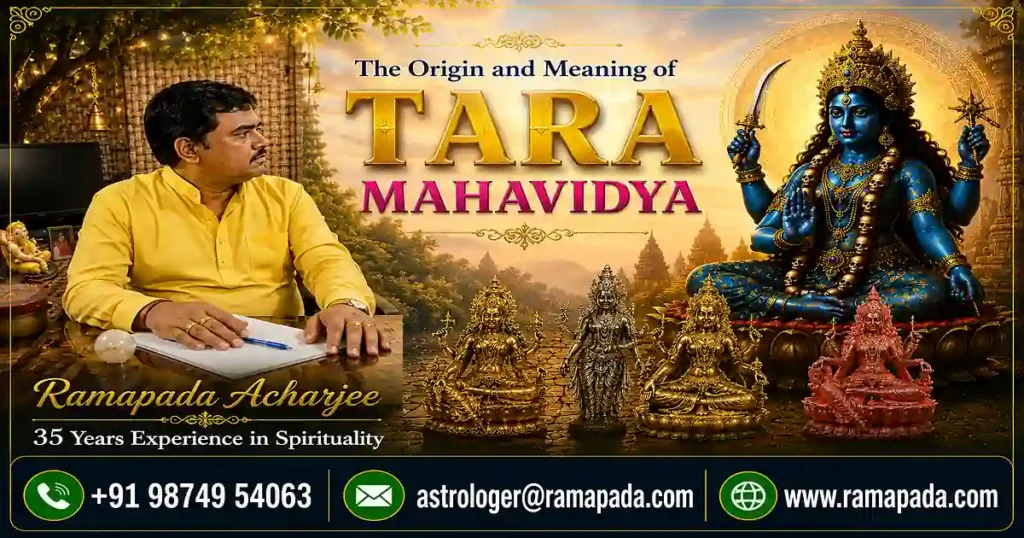
The Compassionate Mother Who Helps Us Cross the Unknown
“তারা মহাবিদ্যার উৎপত্তি ও গভীর অর্থ — সেই করুণাময়ী মাতৃশক্তি, যিনি ভয় ও অজানার সীমা অতিক্রম করতে পথ দেখান।“
(The origin and profound meaning of Tara Mahavidya—that compassionate Mother Divine who guides us to cross the boundaries of fear and the unknown.)
There are some sacred forms of the Divine Mother that we understand first through philosophy. However, there are other forms whom we begin to comprehend only when life places us in difficult situations. For me, Goddess Tara Mahavidya belongs to that second category.
During my thirty-five years of experience in spiritualism, I have met many individuals facing periods of fear, grief, family crises, and emotional confusion. Consequently, those personal interactions gradually changed the way I viewed the word Tara. I began to feel that Goddess Tara is not merely a deity whom we approach when we desire material gain; rather, her deeper symbolism invites a far more profound question: when life becomes uncertain, what enables us to cross safely from fear to courage, from confusion to awareness, and from helplessness to inner strength?
“৩৫ বছরেরও বেশি সময় ধরে আধ্যাত্মিকতা, মানুষের জীবন এবং বিভিন্ন সাধন-পরম্পরার সঙ্গে যুক্ত থাকতে থাকতে মা তারাকে আমি শুধু একটি দেবীমূর্তি হিসেবে দেখিনি। আমার কাছে তাঁর তত্ত্বের একটি গভীর দিক হল—জীবনের কঠিন সময়ে মানুষ কীভাবে নিজের ভয়কে অতিক্রম করে আবার পথ খুঁজে পায়।”
(Over 35 years of engagement with spiritualism and diverse sadhana lineages, I have never viewed Mother Tara as a mere scriptural image; to me, Her core philosophy reveals how humans overcome fear and rediscover their path during trials.)
For the broader context of her position in the Dasha Mahavidya tradition, first read Tara Mahavidya, the Second Mahavidya.
What Does the Name “Tara” Really Mean?
The Sanskrit root of the name Tara connects directly with the idea of crossing over, carrying across, or guiding someone safely beyond difficulty. Therefore, this sacred meaning has always touched my heart deeply, because every human life encounters a turbulent river that must be crossed.
For one person, that obstacle may be persistent fear; for another, it may be deep grief or anxiety. Likewise, someone may struggle with worldly uncertainty, while another feels trapped by toxic attachments, anger, or confusion. Thus, when I reflect upon Goddess Tara, I do not think merely of rescue from external dangers; instead, I perceive an internal spiritual crossing—the movement from ignorance toward understanding, from fear toward courage, and from the feeling “I cannot go further” toward the realization “there is still a way forward.”
“‘তারা’ নামের মধ্যে ‘পার করে দেওয়া’র যে ভাব রয়েছে, সেটিকে আমি খুব গভীরভাবে অনুভব করি। জীবনের নদী শুধু বাইরের নয়; আমাদের মনের মধ্যেও ভয়, দুঃখ, আসক্তি, অহংকার এবং সংশয়ের অনেক স্রোত রয়েছে। সেই স্রোত অতিক্রম করার শিক্ষাও মা তারার তত্ত্বের মধ্যে খুঁজে পাওয়া যায়।”
(The essence of ‘carrying across’ within Tara’s name resonates deeply within me. The river of life is not merely external; our minds carry streams of fear, grief, attachment, ego, and doubt. Learning to cross those internal currents forms the heart of Mother Tara’s philosophy.)
A major scholarly source for Tara’s origin, symbolism and place among the Mahavidyas is David Kinsley’s Tantric Visions of the Divine Feminine.
Tara Is Not Simply a Goddess of Fear and Protection
One common mistake is reducing Goddess Tara’s philosophy strictly to the language of fear and magical protection. While divine protection remains an important spiritual theme, Goddess Tara Mahavidya embodies a truth far richer than being saved from physical danger.
In my understanding, genuine spiritual protection does not always imply that external difficulties will vanish magically; rather, protection often means receiving the inner strength required to confront those challenges bravely. Sometimes, it signifies gaining clarity to make wise decisions, while at other times, it means learning to accept what cannot be altered without losing faith, dignity, or kindness. Indeed, this distinction has become increasingly clear to me through decades of practice.
“আমার কাছে রক্ষা মানেই সব বিপদ অলৌকিকভাবে দূর হয়ে যাওয়া নয়। অনেক সময় মা আমাদের বিপদ সরিয়ে দেন কি না, তার থেকেও বড় কথা—সেই বিপদের সামনে দাঁড়ানোর শক্তি আমাদের ভিতরে জাগে কি না।”
(To me, protection does not mean every danger vanishes magically. Often, what matters most is whether the inner strength to stand firmly before that danger awakens within us.)
Traditional explanations become deeper when studied through Tara in the Shakta and Tantric scriptures.
Why Tara Appears as Both Fierce and Compassionate
At first glance, a fierce appearance and divine compassion may seem contradictory to many seekers. However, anyone who has observed a mother’s love closely can understand this harmony quite easily.
A mother remains exceptionally gentle when her child requires comfort; nevertheless, the same mother becomes immensely strong when her child faces threat from danger. Therefore, fierceness does not oppose compassion; instead, fierceness is compassion adopting a protective form. For this reason, we should never judge Goddess Tara’s iconography solely by Her outward appearance, because Shakta symbols communicate profound philosophical truths through imagery.
“মায়ের কঠোর রূপ মানেই নিষ্ঠুরতা নয়। সন্তানকে রক্ষা করার সময় একজন স্নেহময়ী মা-ও কঠোর হয়ে উঠতে পারেন। মা তারার উগ্রতা ও করুণা—এই দুই দিককে একসঙ্গে বুঝতে পারলে তাঁর রূপের গভীর অর্থ অনেক পরিষ্কার হয়।”
(A mother’s stern form does not denote cruelty; even an affectionate mother becomes firm while protecting her child. Understanding Mother Tara’s intensity and compassion together clarifies Her deeper meaning.)
Readers interested in Tara’s wider historical place in Hindu goddess worship may consult Kinsley’s Hindu Goddesses.
My Understanding Changed With Experience
When I was younger, I naturally searched for intellectual explanations—wanting to know what a specific scripture stated, why a ritual was performed, and how traditions differed. Although those questions remain important, decades of observing seekers gradually brought a deeper realization within me: spiritual knowledge remains incomplete if it never touches daily human behavior.
A person may memorize scriptures yet remain overwhelmed by anger, perform elaborate rituals yet lack empathy, or speak eloquently about devotion while controlled by fear and arrogance. Consequently, my understanding of Goddess Tara moved beyond ritualism alone, and I began asking what internal transformation Her worship brings within our hearts.
“বয়স বাড়ার সঙ্গে সঙ্গে আমার কাছে একটি বিষয় আরও পরিষ্কার হয়েছে—শুধু শাস্ত্র জানা বা আচার পালন করাই আধ্যাত্মিকতার শেষ কথা নয়। সেই জ্ঞান যদি মানুষের ব্যবহার, মন, সহানুভূতি ও আত্মসংযমে প্রকাশ না পায়, তবে কোথাও যেন শিক্ষা অসম্পূর্ণ থেকে যায়।”
(With age, one truth became clear: merely knowing scriptures or performing rituals is not the ultimate end of spirituality. If that knowledge does not manifest in behavior, empathy, and self-restraint, the education remains incomplete.)
Her spiritual meaning is also expressed visually through the symbolism and divine form of Tara Mahavidya.
Tara and the Courage to Enter the Unknown
Human beings naturally seek certainty in life. We desire stable health, secure relationships, predictable plans, and control over our surroundings. However, life rarely grants absolute certainty, and here resides one of Goddess Tara’s most beautiful teachings.
She does not promise that the unknown will disappear; rather, her symbolism teaches us that we need not be defeated by uncertainty. True faith does not require denying reality, nor does courage mean the absence of fear; instead, real courage means continuing to walk forward patiently while fear is still present.
“মানুষ ভবিষ্যৎ জানতে চায় কারণ অজানাকে আমরা স্বাভাবিকভাবেই ভয় পাই। কিন্তু জীবনের সব উত্তর আগে থেকে জানা সম্ভব নয়। আমার কাছে মা তারার শিক্ষা হল—অজানা থাকবে, তবুও বিশ্বাস, বুদ্ধি ও সাহস নিয়ে সামনে এগোনো যায়।”
(Humans seek the future because we naturally fear the unknown. Yet knowing all answers in advance is impossible; Mother Tara teaches that despite uncertainties, we can advance with faith, intelligence, and courage.)
Tara’s relationship with another primordial Mahavidya is explored in Tara and Kali Mahavidya.
What Tara Mahavidya Has Taught Me Personally
After thirty-five years on this path, I would never claim that spirituality offers a shortcut answer for every worldly problem. In fact, experience has taught me to remain cautious regarding claims of instant miracles.
What genuine spiritual practice provides is something far more valuable: it teaches us to stay calm with a question without being terrified by it. Furthermore, it reveals that uncertainty is not an enemy, and that true devotion should make us more humble, compassionate, and aware of our human limitations rather than arrogant.
“৩৫ বছরের পথচলার পরে আমি আজ আর মনে করি না যে আধ্যাত্মিকতা মানে জীবনের প্রতিটি প্রশ্নের তৈরি উত্তর পাওয়া। বরং কখনও কখনও প্রশ্নের মধ্যেও স্থির থাকতে শেখা, নিজের সীমাবদ্ধতা স্বীকার করা এবং অজানার সামনে অহংকার ছেড়ে বিনয়ী হওয়াই বড় শিক্ষা।”
(After 35 years, I no longer believe spirituality means having readymade answers for every question. Rather, remaining calm amidst questions, acknowledging limitations, and staying humble represents true wisdom.)
For background on the philosophical idea of Shakti behind the Mahavidya tradition, see Shakti and Shakta by John Woodroffe.
A Thought Before We Go Deeper
Before we explore the specific symbols and iconography of Goddess Tara Mahavidya, I invite every reader to hold one thought in mind: do not view Goddess TaTara merelys an image, do not approach her solely through fear, and do not reduce Her divine presence is storied of supernatural claims. Instead, seek the profound Shakta philosophy behind Her form, asking what Her symbols teach us regarding courage, wisdom, and the human journey through uncertainty.
“পরের অংশে আমরা মা তারার মূর্তি, রং, অলংকার, পদ্ম, মুদ্রা এবং অন্যান্য প্রতীকের অর্থ নিয়ে আলোচনা করব। সেখানে চেষ্টা করব বাহ্যিক রূপের পিছনে থাকা আধ্যাত্মিক ও দার্শনিক বার্তাকে সহজ ভাষায় বোঝাতে।”
(In the next part, we shall discuss the idol, color, ornaments, lotus, mudra, and symbols of Mother Tara, explaining the deeper spiritual philosophy behind Her visual form.)
Her name and philosophy also come alive through the sacred tradition described in Tara Mahavidya and Tarapith.
Frequently Asked Questions About the Origin and Meaning of Tara Mahavidya
Q1. What does the name Tara mean in Tara Mahavidya?
The name Tara connects with the concept of crossing over or being guided safely across difficulties. Spiritually, this signifies the internal journey from fear to courage, confusion to clarity, and ignorance to deeper spiritual awareness.
“‘তারা’ নামের মধ্যে পার করে দেওয়া বা পথ দেখানোর একটি গভীর ভাব রয়েছে। আমার কাছে এটি শুধু বাইরের বিপদ থেকে রক্ষা নয়; মানুষের মনের ভয়, সংশয় ও অন্ধকার অতিক্রম করার প্রতীকও।”
(The name ‘Tara’ carries a deep meaning of carrying across. To me, this represents crossing beyond internal fear, doubt, and mental darkness.)
Q2. Why is Tara called the Second Mahavidya?
In classical Shakta texts, Goddess Tara appears as the Second Mahavidya following Goddess Kali. However, this order represents distinct dimensions of Divine Feminine wisdom rather than a hierarchical ranking.
“দশ মহাবিদ্যার প্রচলিত ক্রমে কালীর পরে তারার স্থান। কিন্তু এই ক্রমকে আমি শ্রেষ্ঠত্বের তালিকা হিসেবে দেখি না। প্রতিটি মহাবিদ্যার মধ্যেই মাতৃশক্তির আলাদা তত্ত্ব ও শিক্ষা প্রকাশ পেয়েছে।”
(In traditional order, Tara follows Kali, but I do not view this sequence as a hierarchy; each Mahavidya expresses distinct divine philosophy.)
The wider theological diversity of Hindu goddess traditions is explored in Devi: Goddesses of India.
Q3. Is Tara Mahavidya only associated with protection from physical danger?
No. While protection remains a vital aspect, Goddess Tara’s spiritual meaning is much broader, encompassing compassion, wisdom, transformation, and the resilience needed to face life’s uncertainties.
“মা তারাকে শুধু বিপদ থেকে রক্ষাকারী দেবী হিসেবে দেখলে তাঁর তত্ত্বের একটি ছোট অংশই বোঝা হয়। তাঁর মধ্যে করুণা, জ্ঞান, সাহস এবং কঠিন সময় অতিক্রম করার শিক্ষাও রয়েছে।”
(Viewing Mother Tara solely as a protective deity limits her philosophy; she embodies compassion, knowledge, courage, and guidance through trials.)
Q4. Why does Tara Mahavidya possess a fierce form?
Fierce divine iconography does not denote cruelty. Within Shakta traditions, such forms symbolize protective energy, transformation, and the supreme power required to destroy human fear and ignorance.
“মায়ের উগ্র রূপকে ভয়ংকর বলে দূরে সরিয়ে দিলে তার ভিতরের দর্শন বোঝা যায় না। সন্তানকে রক্ষা করার সময় যেমন একজন স্নেহময়ী মা কঠোর হতে পারেন, তেমনই উগ্রতার মধ্যেও করুণার প্রকাশ থাকতে পারে।”
(Fearing Her intense form obscures Her philosophy; just as an affectionate mother turns firm to protect her child, Her intensity reflects protective love.)
Q5. Are Goddess Kali and Goddess Tara the same deity?
Goddess Kali and Goddess Tara are distinct Mahavidyas within the Dasha Mahavidya tradition. Although both express Divine Feminine power, Kali relates with time and dissolution, whereas Tara centres upon compassionate guidance and crossing beyond suffering.
“কালী ও তারা আলাদা মহাবিদ্যা। তাঁদের রূপ ও তত্ত্বের মধ্যে কিছু মিল থাকলেও দুজনের নিজস্ব আধ্যাত্মিক তাৎপর্য রয়েছে। পরবর্তী আলোচনাগুলিতে এই পার্থক্য আরও পরিষ্কার করব।“
(Kali and Tara are distinct Mahavidyas; though sharing symbolic roots, each carries unique spiritual significance, which I shall explain further.)
Q6. What can Tara Mahavidya teach us in modern life?
She teaches us how to face life’s uncertainties without letting fear dictate decisions, inspiring inner stability, patience, compassion, and mental clarity during stressful periods.
“আজকের জীবনে দুশ্চিন্তা, অনিশ্চয়তা এবং মানসিক চাপ খুব সাধারণ। মা তারার তত্ত্ব আমাকে মনে করিয়ে দেয়—সব সমস্যার তাৎক্ষণিক সমাধান না পেলেও স্থির থেকে সঠিক পথ খোঁজার চেষ্টা করা যায়।“
(Anxiety and uncertainty are common today; Mother Tara’s philosophy reminds us that even without instant solutions, we can seek the right path calmly.)
Readers seeking a traditional overview of Tantric doctrine may also consult Principles of Tantra.
Q7. Does worshipping Goddess Tara guarantee that material problems will vanish?
Spiritual practice should never be reduced to magical guarantees. In my thirty-five years of experience, sincere devotion is far more meaningful when it develops internal strength, moral discipline, and mental clarity.
“আমি কখনও ভক্তিকে এমনভাবে দেখতে চাই না যে পূজা করলেই জীবনের প্রতিটি সমস্যা অলৌকিকভাবে চলে যাবে। আমার কাছে প্রকৃত সাধনার একটি বড় ফল হল মানুষের ভিতরের পরিবর্তন—মনকে স্থির করা, সাহস বাড়ানো এবং অহংকার কমানো।“
(I never portray devotion as a magic cure for worldly problems; true sadhana transforms us internally by calming the mind, building courage, and reducing ego.)
Q8. Do I need to practice Tantra to understand Tara Mahavidya?
Not necessarily. Seekers can begin by learning about Goddess Tara through Shakta philosophy, traditional narratives, symbolism, and devotional history before exploring advanced practices.
“মা তারার তত্ত্ব জানতে শুরু করার জন্য কাউকে তান্ত্রিক সাধনা করতেই হবে—এমন নয়। আগে ইতিহাস, দর্শন, প্রতীক এবং শাক্ত ভাবধারা বোঝা অনেক বেশি গুরুত্বপূর্ণ।“
(One need not practice Tantra to begin understanding Mother Tara; learning Her history, philosophy, and symbols is far more important initially.)
Q9. What is the deeper spiritual message of Tara Mahavidya?
Her core message is simple: fear may exist, yet fear does not have to become the master of our lives. Her symbolism invites us to navigate uncertainty with courage, awareness, and faith.
“আমার ৩৫ বছরেরও বেশি সময়ের আধ্যাত্মিক অভিজ্ঞতায় মা তারার তত্ত্ব থেকে যে কথাটি বারবার অনুভব করেছি তা হল—ভয় আসতেই পারে, কিন্তু সেই ভয়কেই জীবনের নিয়ন্ত্রক হতে দিতে হবে এমন নয়।“
(Over 35 years of spiritual practice, Mother Tara taught me that fear may arrive, but we must never allow fear to become the controller of our life.)
Connect with the Best in Kolkata
Stop wandering in uncertainty. Your stars have a story to tell, and Ramapada Acharjee is here to help you read it. With a legacy built on truth, 35 years of experience, and a mission to bring peace to every household, your journey toward clarity starts here.
📍Consultation available in Kolkata, Guwahati, Siliguri, Tarapith & online.
📞 Call/WhatsApp: +91-98749 54063
🌐 Visit Website
You may also read:
Related Category: Tantra
