
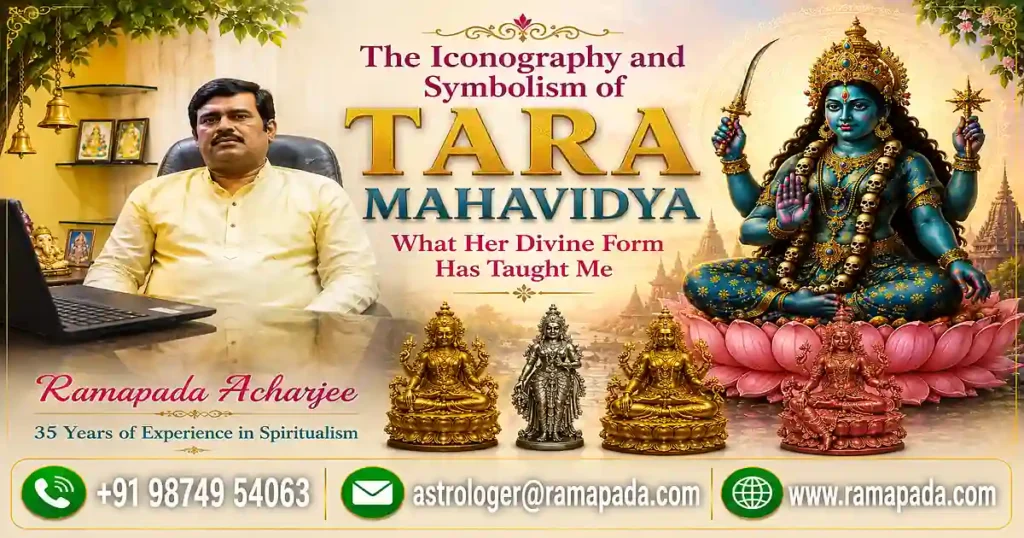
What Her Divine Form Has Taught Me
For more than thirty-five years, I have been closely associated with Vedic astrology, Tantra, and diverse streams of Indian spiritual practice. During this long journey, I have frequently observed how easily people misunderstand the sacred imagery of our Tantric deities.
Goddess Tara Mahavidya offers a prime example of this widespread confusion. When someone encounters Her image for the first time, they naturally notice Her intense appearance, unusual ornaments, and striking symbols. Consequently, several valid questions arise in their minds: why does a compassionate Divine Mother possess such a powerful form? Likewise, why do Her symbols differ so sharply from the serene forms we grew up admiring?
Over the decades, I realized that misunderstandings usually arise when we judge Tantric imagery using physical eyes alone. To me, every element of Goddess Tara’s form carries a profound message, and the deeper I reflect upon that message, the more I realize Her intense form and Her divine compassion exist in perfect harmony.
“মা তারার রূপ শুধু দেখার বিষয় নয়—এই রূপের অন্তর্নিহিত অর্থ বোঝার বিষয়।”
(Mother Tara’s form is not merely something to view; rather, it is a profound philosophy to be understood within.)
Before interpreting Tara’s powerful divine form, readers may first explore Tara Mahavidya as the Second Mahavidya.
I Never See Tara Only as a Fierce Goddess
During my decades of study and observation, I have met many seekers who immediately associate a fierce-looking deity with terror. Naturally, I understand that initial reaction because our human minds respond swiftly to outer appearances.
However, Tantra repeatedly urges us to look far beyond surface appearances. When I stand before Goddess Tara Mahavidya, I do not perceive terror; instead, I perceive the protective strength of a Divine Mother who guides Her children through trials they cannot cross alone.
There exists a fundamental distinction between aggression and protective strength. A mother holding her frightened child appears exceptionally gentle, yet that same mother turns extraordinarily powerful when defending her child against danger. Her love remains identical; only her expression transforms according to necessity.
“মা কখনও স্নেহ দিয়ে সন্তানকে আগলে রাখেন, আবার কখনও সেই সন্তানকে রক্ষা করার জন্য কঠোর রূপ ধারণ করেন।“
(Sometimes a mother shelters her child with gentleness, and at other times, she assumes a firm form to protect that child.)
For me, Goddess Tara’s intense appearance represents that second higher form of maternal compassion.
Tara’s iconography and symbolism receive detailed academic treatment in David Kinsley’s Tantric Visions of the Divine Feminine.
What the Color of Tara Means to Me
Different scriptural traditions portray Goddess Tara in distinct colors. However, she remains most commonly associated with deep blue or dark hues. Whenever I contemplate this specific symbolism, I reflect upon two vast natural realities: the deep ocean and the endless night sky.
Both remain vast, both hold treasures we cannot immediately see, and both remind us how limited ordinary human perception can be. Therefore, Goddess Tara’s deep blue color represents a consciousness expanding far beyond daily human boundaries.
We generally feel comfortable with what is familiar, whereas the unknown creates anxiety within us. Nevertheless, true spiritual evolution begins precisely when we willingly step beyond familiar limits.
“অজানাকে ভয় করাই মানুষের স্বাভাবিক প্রবৃত্তি। কিন্তু সাধনার পথে অনেক সময় সেই অজানার মধ্য দিয়েই এগোতে হয়।”
(Fearing the unknown is human nature. Yet on the spiritual path, one must often advance through that very unknown.)
This is where Goddess Tara Mahavidya symbolism becomes deeply meaningful to me.
Tara Mahavidya and Our Fear of the Unknown
Throughout my thirty-five years of practice, I have witnessed one emotion appear repeatedly in various forms: the fear of uncertainty. People seek my guidance with completely different struggles—some worry regarding relationships, others feel anxious about careers, and several struggle with finances or family stability.
Although their external situations differ, I observe the same underlying question: “What will happen next?” This is not merely an astrological question; rather, it represents a universal human dilemma.
Here resides Goddess Tara’s immense relevance in modern life. She does not promise that every uncertainty will vanish instantly; instead, her symbolism teaches us something far more practical: we can learn to cross life’s uncertainties without surrendering to fear.
For broader discussion of Tara among Hindu goddess traditions, readers may also consult Hindu Goddesses by David Kinsley.
“আমাদের জীবনের বড় ভয় অনৈশ্চিত্য। মা তারার প্রতীক আমাদের শেখায় ভয়ের সামনে মাথা নোয়ানো বন্ধ করতে।“
(Uncertainty is a great fear in human life. Mother Tara’s symbolism teaches us to stop surrendering before fear.)
That vital distinction has become increasingly clear to me with age and experience.
Her appearance becomes more meaningful when we understand the origin and deeper meaning of Tara Mahavidya.
What I See in Tara’s Eyes
Whenever I study sacred iconography, I pay close attention to the eyes, because eyes communicate spiritual states that words cannot express. To me, Goddess Tara’s intense gaze symbolizes unbroken awareness.
In daily existence, we react impulsively—deciding immediately whether an event is good or bad, becoming angry over comments, or feeling fear before understanding a situation fully. However, spiritual maturity gradually teaches us a wiser response: observe calmly first, understand deeply, and then respond thoughtfully.
“আমার দীর্ঘ অভিজ্ঞতায় দেখেছি, অনেক সমস্যাই আসলে ঘটনার জন্য বড় হয় না—আমাদের তাৎক্ষণিক প্রতিক্রিয়ার জন্য বড় হয়ে যায়।“
(In my long experience, many problems grow not because of the event itself, but because of our immediate impulsive reaction.)
Goddess Tara’s powerful gaze serves as a constant reminder to maintain clear awareness in daily life.
Tara’s Weapons—Why I Do Not Interpret Them Literally
Tantric imagery is frequently misunderstood regarding divine weapons. When people see weapons held by a deity, they often interpret them in a literal or physical sense. However, I view them entirely as spiritual metaphors.
In Shakta symbolism, a weapon represents the decisive power to cut through internal obstacles. What needs to be severed? We must cut through ignorance, toxic attachments, fear, ego, confusion, and self-deception that create suffering.
Therefore, Goddess Tara’s weapons are not invitations to violence; rather, they represent tools of inner transformation. While spiritual growth sometimes requires gentleness, at other times it demands the courage to sever unhealthy attachments.
“মায়ের হাতে অস্ত্র মানে হিংসা নয়; তা হলো আমাদের মনের জমাট বাঁধা অন্ধকার ও মোহ কাটার হাতিয়ার।”
(Weapons in the Mother’s hands do not mean violence; they represent tools to cut through internal darkness and delusion.)
A wider scholarly exploration of Divine Feminine imagery is available in Devi: Goddesses of India.
Why Skulls and Images of Mortality Appear in Tantric Symbolism
The presence of skulls in sacred iconography makes many individuals uncomfortable, and I understand that reaction completely. However, after decades of study, I deeply appreciate why Tantra does not hide life’s uncomfortable realities.
Modern culture encourages us to avoid reflecting upon mortality, whereas Tantric symbolism directly confronts impermanence. A skull does not represent evil; instead, it reminds us that our physical body, wealth, social status, and personal relationships are temporary.
Acknowledging impermanence does not make life gloomy; rather, it makes every present moment far more precious and meaningful.
“জীবনে কোনও কিছুই চিরস্থায়ী নয়—এই সত্যটা আমরা জানি, কিন্তু মেনে নিতে চাই না।“
(Nothing in life is permanent—we know this truth intellectually, yet we hesitate to accept it within.)
The Lotus and a Lesson I Have Seen Repeatedly in Life
The lotus remains one of my favorite spiritual symbols because its message is exceptionally clear: it originates in mud, yet its flower rises cleanly above the water.
During my professional journey, I have seen individuals pass through severe personal hardship. While some became bitter or lost confidence, others emerged from suffering with greater maturity, patience, and compassion. Their painful circumstances did not dictate their final character.
“কাদা কোথায় জন্ম হয়েছে সেটা ঠিক করে দিতে পারে না ফুল কতটা সুন্দর হবে।“
(Where the mud resides cannot determine how beautiful the flower will eventually bloom.)
Similarly, our past may influence us, yet it does not have to imprison our future.
Some of Tara’s fierce symbolism becomes clearer when compared with Tara and Kali Mahavidya.
Tara’s Ornaments Are Not Merely Decoration
When viewing sacred artwork, visitors often focus solely on aesthetic beauty. However, traditional iconography communicates profound philosophy through every detail.
Crowns suggest divine sovereignty, jewelry symbolizes spiritual wealth, and garlands carry specific meanings within different lineages. Over the years, I have learned never to dismiss details in sacred images as mere decoration.
“দেবদেবীর প্রাচীন মূর্তি বা চিত্রে অনেক ছোট জিনিসের মধ্যেও গভীর দর্শন লুকিয়ে থাকতে পারে।“
(Even in small details of ancient sacred images, profound spiritual philosophy remains hidden.)
Patience remains essential when studying these sacred forms.
The traditional philosophical understanding of divine Shakti can be explored further in Shakti and Shakta.
Tara and Kali—Similar Appearance, Distinct Experience
Seekers frequently notice striking similarities between Goddess Tara and Goddess Kali. Because both belong to the Dasha Mahavidya tradition and present intense forms, some mistakenly view them as interchangeable.
However, I have never treated them as identical forms. Each Mahavidya opens a distinct doorway into understanding Shakti. Although they share deep philosophical connections, their symbolism and spiritual emphasis differ significantly.
“মা কালী ও মা তারা দেখতে একরকম হলেও, তাঁদের ভাব ও দর্শনের আলাদা গুরুত্ব রয়েছে।“
(Though Mother Kali and Mother Tara appear similar externally, their inner mood and philosophy hold distinct importance.)
I shall elaborate upon their specific differences in an upcoming dedicated article.
What Tara Mahavidya Has Taught Me About Modern Life
When I began my spiritual journey decades ago, life moved at a different pace—without social media or mobile devices. Although technology has advanced enormously, human anxiety has not vanished.
Modern seekers face constant comparisons, career pressure, and financial anxiety, desperately searching for immediate certainty. However, life never promises absolute predictability.
Here resides Goddess Tara’s timeless guidance: we do not always require complete answers before taking our next step forward.
“সব প্রশ্নের উত্তর আগে থেকে পাওয়া যাবে না। কখনও কখনও উত্তর না জেনেও সাহস করে এগিয়ে যেতে হয়।“
(Readymade answers to all questions cannot be obtained in advance. Sometimes, one must advance bravely even without knowing every answer.)
The traditional basis of these symbols can be explored through Tara in the Shakta and Tantric scriptures.
A Personal Reflection From My 35-Year Journey
After thirty-five years in astrology, Tantra, and spiritual guidance, one truth stands clear: spirituality is not merely about removing external problems; rather, it centers upon transforming the individual who faces those problems.
In youth, we desire spirituality to alter our external circumstances. With experience, we realize a higher possibility—spiritual practice alters our internal relationship with circumstances. Fear or loss may arrive, yet we develop the inner resilience to confront them wisely.
“মা তারা আমার কাছে শুধু বিপদ থেকে উদ্ধার করার প্রতীক নন; তিনি সেই অন্তরের শক্তিরও প্রতীক, যা মানুষকে বিপদের মধ্য দিয়েও পার হতে শেখায়।”
(To me, Mother Tara is not merely a symbol of rescue from danger; she embodies that internal strength enabling humans to cross through danger.)
For a living example of Tara’s sacred form and temple tradition, readers may also consult the official West Bengal Tourism description of Tarapith.
Final Thoughts
Goddess Tara Mahavidya symbolism cannot be grasped by a hurried glance. Her intense form reveals maternal compassion, her deep blue color reflects vast awareness, and her weapons symbolize cutting through internal ignorance.
After thirty-five years of guiding seekers, I consider this her greatest lesson: faith does not require knowing everything that lies ahead; sometimes, faith simply means having the courage to walk forward into the unknown.
“আর আমার কাছে, মা তারার করুণা ঠিক এখানেই—তিনি সবসময় পথ থেকে অন্ধকার সরিয়ে দেন না; কখনও সেই অন্ধকারের মধ্য দিয়েই পথ চলার সাহস দেন।“
(To me, Mother Tara’s grace resides right here: She does not always remove darkness from our path; instead, She grants the courage to walk through that darkness.)
— Ramapada Acharjee
35 Years of Experience in Spiritualism
Sacred sound represents another important dimension of her symbolism, discussed in Tara Mahavidya mantra and its spiritual significance.
Frequently Asked Questions About Tara Mahavidya Symbolism
Q1. What does Tara Mahavidya symbolize?
In my understanding, Tara Mahavidya symbolism represents divine compassion, spiritual protection, inner strength, and the ability to cross fear and uncertainty with awareness.
“আমার কাছে মা তারা হলেন সেই শক্তির প্রতীক, যা মানুষকে সমস্ত ভয় ও সংশয় পার হতে সাহায্য করে।“
(To me, Mother Tara symbolizes that divine power helping humans cross beyond all fear and doubt.)
Q2. Why does Tara Mahavidya possess a fierce appearance?
I view her fierce form as protective maternal strength rather than anger. Just as a mother becomes formidable while protecting her child from threat, Goddess Tara’s intensity represents compassionate protection.
“মায়ের উগ্রতা রাগ নয়; তা হলো সন্তানকে রক্ষা করার জন্য মায়ের কঠিন রূপ।“
(The Mother’s intensity is not anger; it is her protective form assumed for her child.)
Q3. Why is Tara Mahavidya portrayed in blue or dark colors?
Blue and dark shades symbolize vastness, mystery, and the unknown—resembling the deep ocean or night sky, reminding us to expand our awareness beyond daily limits.
“নীল ও কালো রং দিয়ে রূপের গভীরতা এবং অসীম চেতনাকে বোঝানো হয়।“
(Blue and dark hues communicate deep spiritual essence and infinite consciousness.)
Q4. What do the weapons of Tara Mahavidya signify?
Her weapons represent spiritual tools to cut through internal obstacles like ignorance, toxic attachments, ego, and fear that impede human growth.
“মায়ের অস্ত্র হলো মানুষের অবিদ্যা ও মোহাচ্ছন্নতা কাটার প্রতীক।”
(The Mother’s weapons symbolize severing human ignorance and delusion.)
Q5. Why are skulls associated with forms of Goddess Tara?
Skulls symbolize impermanence and mortality, reminding us that physical bodies, wealth, and worldly positions are temporary.
“মাথার খুলি জীবনের ক্ষণস্থায়ী রূপকে স্মরণ করিয়ে দেয়, যাতে মানুষ অহংকার ত্যাগ করতে পারে।”
(Skulls remind us of life’s impermanence so that humans may relinquish pride.)
Q6. Are Tara Mahavidya and Kali Mahavidya identical?
While they share symbolic connections within Shakta tradition, I do not treat them as identical. Each Mahavidya expresses a distinct dimension of Shakti and deserves individual study.
“কালী ও তারা এক নন; দুজন মহাবিদ্যার আলাদা আধ্যাত্মিক তাৎপর্য রয়েছে।”
(Kali and Tara are not identical; both Mahavidyas carry distinct spiritual significance.)
Q7. What can Tara Mahavidya symbolism teach us today?
She teaches us to face uncertainty courageously without letting fear dictate our daily decisions, cultivating inner stability during stressful times.
“আজকের দিনে মা তারার বড় শিক্ষা হলো ভয়ের কাছে আত্মসমর্পণ না করে স্থির থাকা।“
(Goddess Tara’s greatest lesson today is remaining steady without surrendering to fear.)
Q8. Can a seeker understand Tara Mahavidya symbolism without practicing Tantra?
Yes. Anyone can study Her philosophy, history, and symbolism through literature and devotion without undertaking complex Tantric rituals.
“আচার-অনুষ্ঠান না করেও শাস্ত্র ও দর্শনের মাধ্যমে মা তারার প্রতীক বোঝা সম্ভব।“
(Even without rituals, understanding Mother Tara’s symbolism is possible through philosophy.)
Connect with the Best in Kolkata
Stop wandering in uncertainty. Your stars have a story to tell, and Ramapada Acharjee is here to help you read it. With a legacy built on truth, 35 years of experience, and a mission to bring peace to every household, your journey toward clarity starts here.
📍Consultation available in Kolkata, Guwahati, Siliguri, Tarapith & online.
📞 Call/WhatsApp: +91-98749 54063
🌐 Visit Website
You may also read:
Top Astrologer in India.
Best Medical Astrologer in India
Best Marriage Astrologer in India.
Astrology Services
Difference Between Tantrik and Astrologer—Truth vs Myth
Related Category: Tantra
