
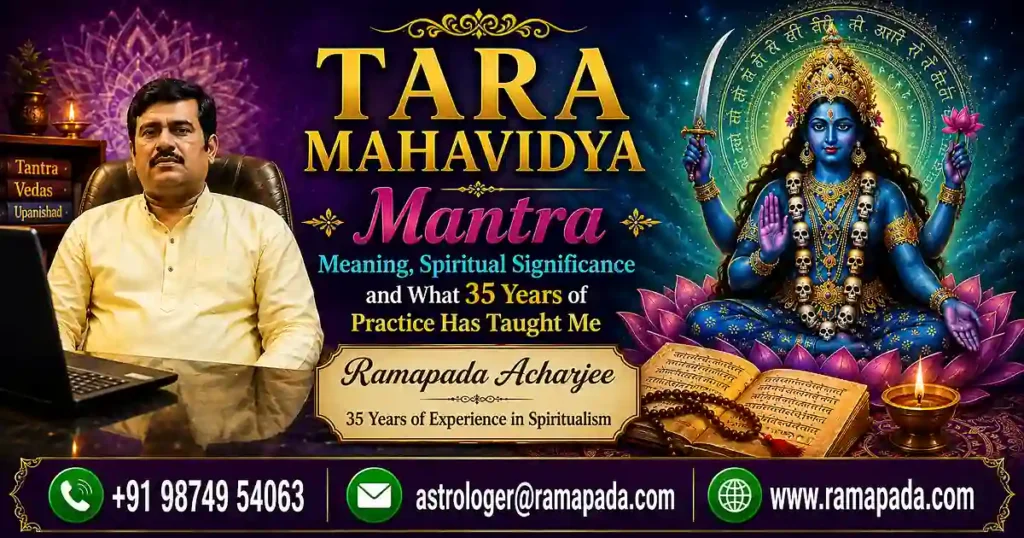
Meaning & Spiritual Significance—What 35 Years of Experience Has Taught Me
For more than thirty-five years, I have been closely connected with Vedic astrology, Tantra, and spiritual traditions, assisting people who seek guidance during difficult life periods. During this long journey, I have observed people’s deep curiosity regarding sacred mantra practice from very close quarters.
Some individuals approach a sacred mantra with genuine devotion, while others turn to it out of deep-seated fear. Likewise, many hope that chanting a specific mantra will swiftly resolve personal, familial, or financial struggles. However, over the decades, my understanding has evolved significantly.
To me, a sacred Tara Mahavidya Mantra is not simply a string of syllables repeated mechanically a fixed number of times. Instead, a mantra becomes truly meaningful when sound, concentration, devotion, personal discipline, and philosophical understanding begin to work together harmoniously.
“আমার ৩৫ বছরের অভিজ্ঞতায় আমি দেখেছি, অনেক মানুষ প্রথমেই জানতে চান—“মন্ত্রটা কী?” বা “কতবার জপ করতে হবে?” কিন্তু খুব কম মানুষ প্রথমে জানতে চান—“এই মন্ত্রের ভাব কী? আমি কেন জপ করছি? আমার মনের মধ্যে কী পরিবর্তন হওয়া উচিত?” আমার কাছে এই প্রশ্নগুলো অনেক বেশি গুরুত্বপূর্ণ।“
(In my 35 years of experience, I have seen many people ask first, “What is the mantra?” or “How many times should I chant?” Yet very few ask initially, “What is the spirit of this mantra? Why am I chanting it? What internal change should occur within my mind?” To me, these questions carry far greater importance.)
To understand the divine identity behind the mantra, begin with Tara Mahavidya, the Second Mahavidya.
What Does Maa Tara Mean to Me?
Before discussing any specific mantra practice, I believe we should first understand the divine essence of Maa Tara. Goddess Tara is traditionally recognized as the Second Mahavidya within the Dasha Mahavidya lineage, following Goddess Kali.
The name Tara connects directly with the concept of crossing over or being guided across turbulent waters. Indeed, this profound meaning has touched my heart deeply, because human life itself represents an ongoing journey of crossing thresholds.
We cross childhood into adulthood, we navigate success and disappointment, and we cross responsibilities, uncertainty, and personal loss. Most importantly, we repeatedly cross our own internal fears. Therefore, when I reflect upon Maa Tara, I do not perceive Her merely as a deity belonging to an ancient Tantric tradition; rather, I perceive a universal spiritual message: moments arrive when we cannot avoid a difficult path, yet we can cultivate the inner strength required to cross it bravely.
“মা তারা বলতে আমার মনে প্রথম যে ভাবটি আসে, সেটি হল “পার করে দেওয়া”। কিন্তু এর অর্থ আমি এইভাবে দেখি না যে মা এলেন আর জীবনের সমস্ত সমস্যা এক মুহূর্তে শেষ হয়ে গেল। বরং কখনও সমস্যা থাকে, অন্ধকারও থাকে—কিন্তু মানুষের ভিতরে সেই অন্ধকারের মধ্য দিয়ে এগিয়ে যাওয়ার সাহস জন্মায়। আমার কাছে সেটিও মায়ের কৃপা।”
(When I reflect upon Maa Tara, the first thought that arises is ‘carrying across.’ Yet I do not view this as Mother arriving to erase all life problems in a single moment. Rather, problems and darkness may remain, yet inner courage awakens to advance through that darkness. To me, that courage is Mother’s true grace.)
For broader historical context on mantra within Tantric traditions, readers may consult Principles of Tantra by Sir John Woodroffe.
What Is a Tara Mahavidya Mantra?
In the simplest sense, a Tara Mahavidya Mantra belongs to sacred traditional lineages associated with Maa Tara. However, various lineages, traditions, and methods of practice exist. Consequently, I do not believe every sacred mantra should be extracted from its traditional context and offered as a generic formula.
This distinction remains particularly vital today, because the internet makes spiritual information instantly accessible to everyone. While digital access offers benefits, it creates a new challenge: individuals watch short videos, copy a complex Tantric mantra, read that it should be chanted a certain number of times, and begin practicing without understanding its proper context. I strongly advise against approaching Tantra in such an undisciplined manner.
“আজকাল YouTube, Facebook বা বিভিন্ন website-এ অসংখ্য মন্ত্র পাওয়া যায়। কিন্তু কোথাও একটা মন্ত্র লেখা আছে মানেই সেটি প্রত্যেকের জন্য একইভাবে প্রযোজ্য—আমি এই ধারণায় বিশ্বাস করি না। তন্ত্রকে shortcut হিসেবে দেখলে তন্ত্রের গভীরতাই হারিয়ে যায়।“
(Nowadays, countless mantras appear on YouTube, Facebook, or websites. Yet I do not believe that because a mantra is published somewhere, it applies equally to everyone. Viewing Tantra as a shortcut destroys the very depth of Tantric wisdom.)
The relationship between sound, consciousness and Shakta philosophy is also explored in Shakti and Shakta.
Why Sound Matters in Mantra Practice
A sacred mantra is experienced primarily through focused sound and repetition. When a seeker repeats sacred words with unbroken attention, the practice becomes a transformative exercise in mental focus and inner discipline. Therefore, simply knowing the literal translation of a mantra is insufficient to grasp true mantra practice.
The fundamental question remains: what occurs within my consciousness while I am chanting? Is my mind becoming calmer? Is my attention growing steadier? Or am I chanting mechanically while simultaneously dwelling on ten different worldly worries? Although the recited words may remain identical, the inner spiritual experience differs completely.
“একজন মানুষ ১০৮ বার মন্ত্র জপ করলেন, কিন্তু পুরো সময় তাঁর মন অন্যদিকে ছিল। আর একজন হয়তো অনেক কম সময় জপ করলেন, কিন্তু গভীর শ্রদ্ধা ও মনোযোগ নিয়ে করলেন। শুধু সংখ্যার বিচারে প্রথমজন এগিয়ে—এমন সিদ্ধান্ত আমি সহজে নিতে পারি না। মন্ত্রের সংখ্যা গুরুত্বপূর্ণ হতে পারে, কিন্তু মন্ত্রের সঙ্গে মন কতটা যুক্ত হচ্ছে সেটিও সমান গুরুত্বপূর্ণ।”
(One person chants 108 times, yet their mind wanders elsewhere continuously. Another chant for a shorter duration, but with deep devotion and focus. I cannot judge the first person superior merely by numerical count. While numbers hold value, how deeply the mind connects with the mantra holds equal importance.)
Why People Become So Concerned About the Number of Chants
Throughout my professional consultation and spiritual guidance, I regularly encounter questions such as “How many times should I chant?”, “Is 108 times mandatory?”, “How many days should I continue?”, and “When will I receive results?” I understand these human concerns completely.
Traditional practices prescribe specific counts, timings, and procedures. However, my experience has taught me never to evaluate practice solely by numbers; instead, I prefer asking a deeper question: what kind of human being is this spiritual discipline helping me become?
If someone performs spiritual rituals regularly yet grows increasingly impatient, arrogant, or obsessed with miraculous outcomes, they should re-examine their approach. Conversely, if someone gradually develops patience, focus, compassion, and self-restraint, genuine spiritual transformation is occurring.
“মন্ত্র কতবার জপ করলেন তার হিসাব রাখুন, তাতে আপত্তি নেই। কিন্তু তার সঙ্গে আর একটা হিসাবও রাখুন—আপনার রাগ কি একটু কমেছে? অস্থিরতা কি একটু কমেছে? মানুষের প্রতি সহানুভূতি কি বেড়েছে? নিজের অহংকারকে কি একটু ভালোভাবে চিনতে পারছেন? আমার কাছে এগুলোও সাধনার ফল বিচার করার গুরুত্বপূর্ণ মাপকাঠি।”
(Keep count of your chants if you wish; I have no objection. But keep another account as well: Has your anger reduced? Has your restlessness lessened? Has your empathy for others grown? Are you recognizing your ego better? To me, these serve as vital measures of spiritual progress.)
The deeper linguistic and philosophical background can also be explored through the origin and meaning of Tara Mahavidya.
Tara Mahavidya Mantra and the Human Experience of Fear
In my thirty-five years of working with seekers, I have seen fear manifest in countless forms—fear of losing a relationship, financial insecurity, worries regarding children, or fear of illness, aging, and loneliness. Although personal narratives change, the core human emotion remains constant: fear of what lies ahead.
Here resides the profound relevance of Maa Tara’s symbolism. Maa Tara does not represent a life where frightening events never occur; rather, she symbolizes the capacity to cross fear without allowing fear to rule our decisions.
“জ্যোতিষী হিসেবে এত বছর মানুষের সঙ্গে কথা বলতে বলতে আমি দেখেছি—মানুষ ভবিষ্যৎ জানতে যতটা চায়, তার পিছনে অনেক সময় আসল কারণ হল অজানার ভয়। “আগামীকাল কী হবে?” এই প্রশ্নটি শুধু জ্যোতিষের প্রশ্ন নয়। এটি মানুষের চিরন্তন প্রশ্ন। আর ঠিক এখানেই মা তারার তত্ত্ব আমার কাছে খুব গভীর হয়ে ওঠে।”
(In my years speaking with people as an astrologer, I observed that behind the desire to know the future lies a fear of the unknown. “What will happen tomorrow?” is not merely an astrological query; it is humanity’s eternal question. Right here, Maa Tara’s philosophy becomes deeply profound.)
Readers interested in classical discussions of mantra formation and worship may examine the Mahanirvana Tantra.
Escaping Fear and Crossing Fear Are Not the Same
I have gradually learned to appreciate an important distinction: escaping fear and crossing fear are two entirely different actions. When we escape, we refuse to confront what frightens us. Conversely, when we cross, we acknowledge that fear exists, yet we continue walking forward steadily.
This difference sounds simple in words, yet it is enormous in daily existence. A genuine spiritual practice should not convince us that trials will never arrive; instead, it cultivates inner stability when difficulties do arrive.
“আমার কাছে মা তারা এই কথাই বলেন বলে মনে হয়—“ভয় পেয়েছ বলে থেমে যেও না।” ভয় মানুষের স্বাভাবিক অনুভূতি। সাধক হলেই মানুষ আর কখনও ভয় পাবে না—এমন কথা আমি বলব না। কিন্তু ভয়ের কাছে নিজের সমস্ত সিদ্ধান্ত সমর্পণ না করাটাই বড় শিক্ষা।”
(To me, Maa Tara teaches: “Do not stop simply because you feel afraid. ” Fear is a natural human emotion; I never claim a seeker will never feel fear. But refusing to surrender all your decisions to fear is the true lesson.)
Why I Am Careful About Random Tantric Mantras Online
I wish to make one point abundantly clear: studying the philosophy of Maa Tara is not identical to undertaking specialized Tantric practices. Anyone can read regarding her history, symbolism, and devotional significance. However, specialized practices belong to specific traditional lineages and require guidance and discipline.
Therefore, I refuse to present this article as another internet page promising guaranteed material results from chanting a mantra. That approach contradicts my thirty-five years of spiritual experience.
“আমি তন্ত্রকে কোনও ‘instant result formula’ হিসেবে দেখি না।” “এই মন্ত্র এতবার বলুন, এত দিনে এই ফল হবেই”—এই ধরনের নিশ্চয়তা দেওয়ার ক্ষেত্রে আমি সবসময় সতর্ক। আধ্যাত্মিকতার মধ্যে বিশ্বাস থাকবে, কিন্তু তার সঙ্গে বিবেচনা, দায়িত্ব এবং সংযমও থাকা দরকার।“
(I never view Tantra as an instant result formula. I remain cautious regarding promises like “Chant this mantra X times for guaranteed results.” Spirituality requires faith, but it also demands discernment, responsibility, and restraint.)
Sacred sound should be understood within its traditional context, which is discussed in Tara in the Shakta and Tantric scriptures.
Mantra, Discipline, and Daily Life
An authentic spiritual practice must never remain disconnected from daily life. Suppose a person meditates or chants every morning. While that is commendable, what happens after meditation? How does that individual speak to family members? How do they behave toward someone holding a differing opinion? Can they manage anger, acknowledge a mistake, or extend kindness to others? These practical questions matter deeply.
“ঠাকুরঘরে আমি কতটা ধার্মিক—সেটাই শুধু আধ্যাত্মিকতার পরীক্ষা নয়। ঠাকুরঘর থেকে বেরিয়ে আমি অন্য মানুষের সঙ্গে কেমন ব্যবহার করছি, সেটাও পরীক্ষা। এই উপলব্ধি আমার বয়স এবং অভিজ্ঞতার সঙ্গে আরও গভীর হয়েছে।”
(How devout I appear in my prayer room is not the sole test of spirituality. How I treat others after leaving the prayer room is equally a test. This realization has deepened with age and experience.)
Maa Tara as a Mother, Not Simply a Mysterious Deity
Seekers unfamiliar with Maa Tara often focus initially on her intense iconography, and I understand that reaction. However, I prefer looking beyond outer appearances to perceive Divine Motherhood.
A mother remains gentle, yet she turns extraordinarily strong when defending her child against danger. These two qualities do not conflict; both spring from love. Thus, I do not interpret Maa Tara’s powerful appearance as terrifying; rather, I perceive protective compassion.
“আমার কাছে মা তারা প্রথমে “মা”, তারপর তাঁর অন্য সমস্ত পরিচয়। মা সব সময় সন্তানের সামনে থেকে বিপদ সরিয়ে দেবেন—এমন নয়। কখনও তিনি সন্তানের হাত ধরে বিপদ পার করান। আবার কখনও হাতটাও ছেড়ে দেন, কিন্তু এমন সাহস দেন যাতে সন্তান নিজের পায়ে হাঁটতে শেখে। এই মাতৃত্বের ভাবটাই মা তারাকে আমার কাছে এত কাছের করে তোলে।“
(To me, Maa Tara is Mother first, before all other identities. A mother does not always remove danger from her child’s path; sometimes she holds their hand through danger. Other times she releases the hand, granting courage so the child learns to walk independently. This maternal bond brings Maa Tara close to my heart.
What Tara Mahavidya Can Teach Us in Modern Life
During my professional decades, technology, communication, and work environments have transformed completely. Information reaches us instantly, yet increased information has not automatically produced peace of mind.
Comparison, expectations, and anxiety remain high among modern individuals. Therefore, Maa Tara’s message remains remarkably relevant today: we cannot control every external circumstance, but we can cultivate the mind that responds to those circumstances.
“আগের তুলনায় আজ মানুষের হাতে তথ্য অনেক বেশি। কিন্তু তথ্য বাড়লেই জ্ঞান বাড়ে না, আর জ্ঞান বাড়লেই শান্তি আসে না। আমার মনে হয়, আজকের মানুষের কাছে মা তারার একটি বড় শিক্ষা হল—বাইরের পৃথিবীকে সব সময় নিয়ন্ত্রণ করা সম্ভব নয়; কিন্তু নিজের মনকে বোঝার চেষ্টা করা সম্ভব।”
(Today people possess far more information than before, yet more information does not equal wisdom, nor does wisdom guarantee peace. A great lesson from Maa Tara for modern times is this: controlling the outer world is not always possible, but striving to understand one’s own mind is possible.)
For a historical discussion of mantra, subtle consciousness and Shakta yoga, John Woodroffe’s The Serpent Power is another important reference.
What I Look for in Genuine Spiritual Practice
After thirty-five years, dramatic claims impress me far less than quietly displayed virtues: humility, patience, discipline, compassion, self-awareness, and the willingness to admit limitations. These quiet qualities reflect true spiritual growth far better than extraordinary tales.
“আমার কাছে প্রকৃত সাধকের পরিচয় শুধু তিনি কত মন্ত্র জানেন বা কত কঠিন সাধনা করেছেন, সেটা নয়। আমি দেখি—মানুষটি কতটা বিনয়ী। কতটা সংযমী। অন্যের প্রতি কতটা সহানুভূতিশীল। নিজের ভুল স্বীকার করার সাহস তাঁর আছে কি না। সাধনা যদি অহংকার বাড়ায়, তাহলে সেই সাধনার উদ্দেশ্য নিয়ে আবার ভাবা দরকার।”(To me, a true seeker’s identity is not measured solely by how many mantras they know or how rigorous their sadhana was. I observe: How humble is the person? How self-restrained? How empathetic toward others? Do they possess the courage to admit a mistake? If sadhana increases ego, its true purpose must be re-evaluated.)
Mantra should never be separated from discipline and responsibility, as explained in Tara Mahavidya Sadhana.
My Personal Understanding of Tara Mahavidya Mantra After 35 Years
If someone asks me today regarding the most crucial aspect of a Tara Mahavidya Mantra, I do not begin with numbers; instead, I begin with intention. Why are you approaching Maa Tara? Is it solely for material gain, out of fear, or because someone promised a miracle? Or do you genuinely seek to understand the spiritual wisdom behind the practice? Intention shapes the journey.
“৩৫ বছর পরে আজ আমার মনে হয়, সাধনার শুরুতেই নিজের মনকে একটা প্রশ্ন করা দরকার—”আমি মায়ের কাছে কেন যাচ্ছি?” শুধু কিছু পাওয়ার জন্য? নাকি নিজের ভিতরটাকেও একটু পরিবর্তন করার জন্য? এই প্রশ্নের উত্তর প্রত্যেকের নিজের কাছে দেওয়া উচিত।”
(After 35 years, I feel every seeker should ask their mind a question before beginning sadhana: “Why am I approaching Mother? Merely to gain something? Or to transform myself internally?” Everyone must answer this question truthfully to themselves.)
Final Reflection—What Maa Tara Has Taught Me
My perspective on spirituality has evolved across the decades. In youth, we seek clear answers and instant resolution of difficulties. However, experience reveals that not every query receives an immediate answer, nor does every hardship vanish automatically. Yet we continue walking forward, and here resides the beauty of Maa Tara’s guidance.
For me, a Tara Mahavidya Mantra connects ultimately with remembrance, mental discipline, heightened awareness, and the courage to cross what we cannot avoid.
“৩৫ বছরের এই দীর্ঘ পথচলায় আমি একটা জিনিস খুব গভীরভাবে বুঝেছি—আধ্যাত্মিকতা মানে জীবনের সমস্ত দুঃখ, সমস্যা বা অনিশ্চয়তা অলৌকিকভাবে মুছে যাবে—এমন নয়। জীবন তার নিজের নিয়মে চলবে। সুখ আসবে। দুঃখও আসবে। কখনও আলো থাকবে। কখনও সামনে অন্ধকার পথও থাকবে। আমার কাছে মা তারার করুণা এখানেই—তিনি সব সময় অন্ধকার সরিয়ে দেন না; কখনও সেই অন্ধকারের মধ্য দিয়েই পথ চলার সাহস দেন। আর সেই সাহস নিয়ে যখন মানুষ এক পা, তারপর আর এক পা এগিয়ে যায়—তখনই হয়তো সত্যিকারের “পার হওয়া” শুরু হয়।”
(Across this 35-year journey, I understood deeply: spirituality does not mean all grief, problems, or uncertainties vanish magically. Life proceeds by its own laws; joy arrives, and sorrow arrives too. Sometimes light shines, and sometimes a dark path lies ahead. To me, Maa Tara’s grace lies right here: She does not always remove the darkness; rather, She grants the courage to walk through that darkness. When a person steps forward bravely with that courage, true crossing begins.)
— Ramapada Acharjee
35 Years of Experience in Spiritualism
Many mantra-related symbols also connect with the divine form and symbolism of Tara Mahavidya.
Frequently Asked Questions About Tara Mahavidya Mantra
Q1. What is the Tara Mahavidya Mantra?
A Tara Mahavidya Mantra belongs to sacred mantra traditions associated with Maa Tara. Because various lineages follow specific forms, understanding context and spiritual intent remains essential.
“মন্ত্রকে শুধু কয়েকটি শব্দ হিসেবে না দেখে তার পিছনের সাধনা ও দর্শন বোঝার চেষ্টা করা উচিত।“
(Rather than viewing a mantra as mere words, one should strive to understand the sadhana and philosophy behind it.)
Q2. What does Tara mean spiritually?
The name Tara signifies “carrying across.” Spiritually, it symbolizes moving through fear, confusion, and uncertainty toward greater inner clarity and awareness.
“আমার কাছে “পার হওয়া” শুধু বাইরের বিপদ থেকে উদ্ধার নয়; নিজের মনের ভয় অতিক্রম করাও তার অংশ।“
(To me, ‘carrying across’ means more than rescue from outer danger; overcoming internal fear is an integral part of it.)
Q3. Can anyone learn about Tara Mahavidya?
Yes. Anyone interested in Indian spiritual philosophy can study Maa Tara’s history, symbolism, and devotional meaning. However, theoretical study and undertaking specialized Tantric practices remain distinct.
“মা তারার ইতিহাস ও দর্শন যে কেউ জানতে পারেন; তবে বিশেষ তান্ত্রিক পদ্ধতি আলাদা বিষয়।“
(Anyone can learn about Maa Tara’s history and philosophy, but specialized Tantric practices remain a separate matter.)
Q4. Should I adopt a Tara mantra randomly from the internet?
I advise caution regarding specialized Tantric mantras found online, because online sources often omit traditional context, proper pronunciation, and necessary discipline.
“সব online information ভুল নয়, কিন্তু সব information নিজের ক্ষেত্রে প্রয়োগ করাও ঠিক নয়।”
(Not all online information is incorrect, but applying every piece of information to oneself is unwise.)
Q5. Does Tara Mahavidya Mantra guarantee specific results?
I never present mantra practice as a magical guarantee for worldly outcomes. In my experience, practice supports concentration, devotion, mental strength, and inner awareness.
“মন্ত্র জপকে কোনো অলৌকিক গ্যারান্টি হিসেবে দেখা ঠিক নয়; এটি অন্তরের ধৈর্য ও একাগ্রতা বাড়ায়।“
(Viewing mantra chanting as a magical guarantee is incorrect; it builds inner patience and concentration.)
Q6. How many times should a Tara mantra be chanted?
Specific traditional practices prescribe distinct counts. Therefore, no single number serves as a universal rule for every practitioner.
“সংখ্যার পাশাপাশি মনোযোগ, নিষ্ঠা এবং উদ্দেশ্যকেও গুরুত্ব দেওয়া দরকার।“
(Along with numerical counts, attention, sincerity, and pure intention must be prioritized.)
Q7. Is Tara Mahavidya associated with Tantra?
Yes, Goddess Tara holds a revered place in Shakta and Tantric lineages. However, authentic Tantra is a disciplined spiritual science that should never be reduced to superstition.
“প্রকৃত তন্ত্র হলো একটি অনুশাসিত শাখা; একে কুসংস্কার বা ভয় দেখানোর মাধ্যম বানানো অনুচিত।“
(Authentic Tantra is a disciplined discipline; reducing it to superstition or fear-mongering is improper.)
Q8. What can Maa Tara teach us in everyday life?
She teaches us to navigate life’s uncertainties without allowing fear to dominate our decisions, building inner resilience during stressful periods.
“ভয় না পাওয়াই সাহস নয়; ভয় থাকা সত্ত্বেও সঠিক পথে এগিয়ে যাওয়াও সাহস।“
(Courage is not the absence of fear; advancing along the right path despite fear is true courage.)
Q9. What is the most important lesson learned from Maa Tara after 35 years?
We cannot always choose what circumstances arrive in life, but we can systematically cultivate the inner awareness and strength needed to meet them.
“মা সব ঝড় থামাবেন—এই আশা করার থেকে, ঝড়ের মধ্যেও স্থির থাকার শক্তি চাওয়া আমার কাছে অনেক গভীর প্রার্থনা।“
(Rather than hoping Mother will stop every storm, praying for the strength to remain steady amidst the storm is a far deeper prayer.)
Tara’s position within the Mahavidya tradition can be studied further through David Kinsley’s scholarly work on the Ten Mahavidyas.
Connect with the Best in Kolkata
Stop wandering in uncertainty. Your stars have a story to tell, and Ramapada Acharjee is here to help you read it. With a legacy built on truth, 35 years of experience, and a mission to bring peace to every household, your journey toward clarity starts here.
📍Consultation available in Kolkata, Guwahati, Siliguri, Tarapith & online.
📞 Call/WhatsApp: +91-98749 54063
🌐 Visit Website
You may also read:
How Real Tantriks Perform Vashikaran
Signs You Are Affected By Negative Energy
Tantra Practice Eligibility – Who Can & Who Can’t
Tantric Remedy for Financial Blockage
Difference Between Tantrik and Astrologer—Truth vs Myth
Related Category: Tantra
