
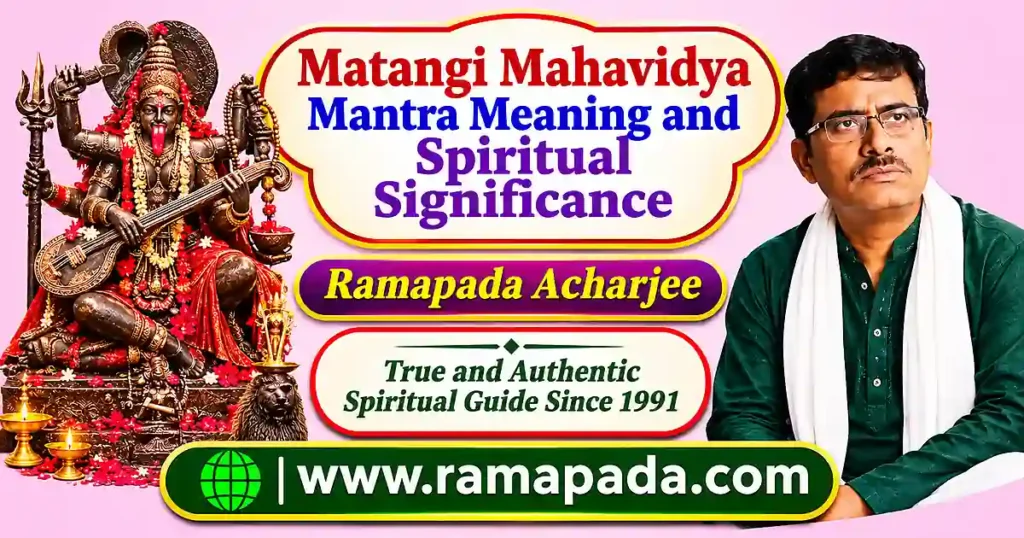
By Ramapada Acharjee
Practicing Astrologer, Palmist, and Spiritual Consultant Since 1991
When people come to consult me with heavy hearts, they often look for a single secret mantra or a quick ritual to wipe away years of accumulated distress. Recently, many seekers ask about Matangi Mahavidya Mantra Meaning after watching a short video clip or reading an isolated line on social media.
However, to every seeker who sits before me, I share the same truth: you cannot comprehend Mother Matangi through one isolated chant, a ten-minute video, or an out-of-context translation.
Indeed, whenever a powerful mantra becomes popular on the internet, public attention moves immediately toward three common questions: What are the words? How many times should they be repeated? What miraculous result will be obtained?
Yet, the far more essential questions are often asked much later, if they are asked at all:
- What does sacred sound truly represent?
- Why has Matangi been connected so strongly with speech?
- What kind of inner discipline should accompany this sacred mantra?
- And what happens when sacred practice is separated from personal responsibility?
Approaching Sacred Sound with Spiritual Maturity
Over decades of spiritual consultation since 1991, a recurring pattern has been observed. People often approach sacred mantras during periods of acute fear, uncertainty, relationship conflict, financial pressure, or emotional exhaustion. In such moments, the desire for an instant solution is completely understandable.
Yet, vulnerability can also make extraordinary promises sound much more convincing than they really are. Therefore, the essential distinction between theoretical reading and practical spiritual application becomes especially vital before any mantra tradition is discussed.
মন্ত্রের প্রতি আকর্ষণ খুব স্বাভাবিক। কিন্তু শুধু মন্ত্রের শব্দ জানলেই মন্ত্রের গভীরতা জানা হয়ে যায় না। কোন ভাব নিয়ে উচ্চারণ করা হচ্ছে, মন কতটা স্থির, উদ্দেশ্য কী এবং দৈনন্দিন ব্যবহারে কোনো পরিবর্তন আসছে কি না—এই প্রশ্নগুলিও সমান গুরুত্বপূর্ণ।
What Does the Word Mantra Really Mean?
Today, the word mantra has acquired many simplified meanings in modern conversation. Sometimes it is used casually to describe a motivational quote. At other times, it simply refers to a repeated prayer.
Within authentic Indian religious traditions, however, mantra possesses a much older and far more specialized history. A scholarly overview of sacred sound explains that a mantra is fundamentally connected with meditative resonance and ritual repetition. Furthermore, different classes of mantras may or may not carry ordinary conversational linguistic meaning.
This distinction matters immensely:
- A mantra is certainly not a simple sentence that can be translated word-by-word with a pocket dictionary.
- Some mantras contain easily recognizable divine names and invocations.
- Meanwhile, others consist of concentrated bija or seed syllables whose spiritual purpose belongs entirely to a specialized sonic framework rather than everyday conversational Sanskrit.
পুরো মন্ত্রকে শুধু বাংলা বা ইংরেজিতে অনুবাদ করে ফেললেই তার সম্পূর্ণ অর্থ বোঝা যায় না। একটি কবিতার শব্দার্থ জানা আর কবিতাটির অনুভূতি বোঝার মধ্যে যেমন পার্থক্য আছে, মন্ত্রের ক্ষেত্রেও সেই পার্থক্য আরও গভীর।
Why Matangi Is So Closely Connected With Sacred Speech
Matangi’s sacred connection with mantra becomes remarkably easy to understand once her identity as Vak, or cosmic speech, is examined. Traditionally, she is worshipped as the supreme deity governing speech, music, wisdom, learning, and fine arts.
For instance, classical representations preserved by institutions like the Metropolitan Museum of Art depict Matangi’s continuous association with musical mastery, articulate speech, and creative wisdom. Consequently, this gives our exploration of her mantra a very practical dimension.
In spiritual reality, human speech is never neutral:
- Every word carries an underlying intention.
- Every phrase preserves memory and emotional charge.
- Through speech, generational wisdom is passed forward.
- Kind words can instantly calm an anxious heart, whereas harsh words intensify fear.
- Peaceful dialogue can reconcile a fractured family, while careless words deepen conflicts.
- Words can instruct, deceive, or transform into sacred prayer.
Therefore, for a Goddess whose core symbolism embodies divine expression, her mantra cannot sensibly be separated from the ethical use of our daily speech.
বাড়িতে ঘণ্টার পর ঘণ্টা জপ করার পরে যদি পরিবারের মানুষের সঙ্গে কঠিন ও অসম্মানজনক ভাষায় কথা বলা হয়, তাহলে সাধনার একটি গুরুত্বপূর্ণ অংশ অসম্পূর্ণ থেকে যায়। মাতঙ্গীর বাকশক্তির শিক্ষা শুধু পবিত্র শব্দ উচ্চারণের মধ্যে নয়; সাধারণ কথাবার্তার মধ্যেও তার পরীক্ষা হয়।
Matangi Mantra in the Classical Tradition
Maa Matangi’s mantra traditions are definitely not modern internet inventions. In fact, comprehensive material associated with Matangi appears across classical medieval Tantric compendiums.
For example, Mahidhara’s renowned work, the Mantra Mahodadhi, includes extensive sections specifically dedicated to Matangi’s mantras, visual forms, and nyasa systems. Thus, this textual evidence confirms that her worship belongs to an authentic, well-structured ritual and philosophical lineage.
Moreover, the same classical manual outlines detailed procedures for mantra purification, meditative yantras, and preliminary practices. That broader structure must never be ignored while hastily copying an isolated formula from a text.
The historical preservation of a mantra clearly proves that a tradition exists. However, it does not automatically prove that every reader should attempt to practice it independently without preparation.
এই পার্থক্যটি মনে রাখা খুব দরকার। কোনো পুরোনো গ্রন্থে মন্ত্র পাওয়া গেল—এটি একটি গুরুত্বপূর্ণ শাস্ত্রীয় তথ্য। কিন্তু সেই মন্ত্র প্রত্যেক মানুষ একইভাবে, একই উদ্দেশ্যে এবং কোনো প্রস্তুতি ছাড়াই জপ করতে পারেন—এটি সম্পূর্ণ আলাদা দাবি।
Why the Exact Mantra Is Not the First Question
There is always an intense human fascination with secret syllables and hidden formulas. Nevertheless, genuine spiritual maturity begins only when curiosity moves beyond the mechanical repetition of syllables.
As I frequently observe during consultations, repeating sacred syllables hundreds of times produces very little fruit if the practitioner’s mind remains completely disconnected from the practice.
For instance, one person may chant thousands of mantras daily while anger and resentment continue to govern their household life. Conversely, another seeker may spend only ten quiet minutes in sincere prayer, yet gradually cultivate remarkable patience, humility, and inner calm.
Traditional lineages certainly respect numerical targets. However, mechanical numbers alone can never measure authentic inner transformation.
দশ হাজার জপ হয়েছে কি এক লক্ষ জপ হয়েছে—এই হিসাব রাখা যেতে পারে। তার পাশাপাশি আর একটি হিসাবও রাখা দরকার। অস্থিরতা কি একটু কমেছে? কথাবার্তায় সংযম এসেছে? অহংকার চিনতে সুবিধা হচ্ছে? অন্যের কথা শোনার ধৈর্য বেড়েছে? এই প্রশ্নগুলিও সাধনার ফল বোঝার অংশ।
Sacred Sound Is Not Ordinary Conversation
Classical Tantric treatises give sacred sound an elevated status that differs fundamentally from casual speech. For example, the Mahanirvana Tantra explains that a mantra should never be regarded as a mere cluster of letters arranged for casual reading.
Whether one approaches these sacred teachings devotionally, historically, or philosophically, one fact remains crystal clear: authentic traditions never treat sacred mantras lightly.
Because of this truth, today’s digital copy-and-paste culture creates severe problems:
- An unverified screenshot appears on social media.
- A curious reader copies the text without understanding its roots.
- Pronunciation is guessed haphazardly.
- Exaggerated claims of overnight wealth or attraction are attached to it.
- Consequently, the essential textual and ethical context disappears entirely.
Within moments, a sacred contemplative discipline is reduced to an irresponsible commercial trick.
মোবাইলের screen থেকে মন্ত্র কপি করা কয়েক সেকেন্ডের কাজ। কিন্তু সেই মন্ত্র কোন পরম্পরায় এসেছে, কোন উদ্দেশ্যে ব্যবহৃত হয়েছে, কোথায় devotional practice আর কোথায় specialised ritual—এই তথ্যগুলি হারিয়ে গেলে শুধু শব্দটি থেকে যায়, প্রেক্ষাপটটি আর থাকে না।
Matangi, Sound, and the Inner State of Mind
Although sound is vocalized through the throat, speech always originates deep within the mind.
Before a hurtful sentence is uttered, an inner tremor of irritation has already occurred. Similarly, before a sincere apology is spoken, an inner softening of the heart has already taken place.
Therefore, Mother Matangi’s connection with speech operates on two distinct levels:
- The external, audible sacred sound.
- The internal mental state from which that sound arises.
If an individual approaches mantra driven by jealousy, malice, or an egoistic urge to dominate another person, merely wrapping that dark impulse in Sanskrit syllables does not make it holy.
While classical texts sometimes document extraordinary claims regarding influence or mastery over the arts, these accounts should be understood as symbolic and historical literature. They must never be converted into manipulative real-world guarantees.
যে ইচ্ছা সাধারণ ভাষায় অনৈতিক, তাকে শুধু তান্ত্রিক শব্দ ব্যবহার করে নৈতিক করে তোলা যায় না। অন্যের স্বাধীন ইচ্ছাকে অগ্রাহ্য করে তাকে নিয়ন্ত্রণ করার আকাঙ্ক্ষা থাকলে প্রথমে নিজের উদ্দেশ্যকেই পরীক্ষা করা দরকার।
Mantra and the Discipline of Intention
Examining one’s true intent is exceptionally difficult because human motives are rarely completely unmixed:
- A person might pray for domestic peace while secretly wishing for their opponent’s public humiliation.
- Another individual might seek spiritual protection while harboring burning thoughts of vengeance.
- Similarly, someone may pray for financial security out of genuine necessity, yet allow unbridled greed and comparison to pollute their devotion.
Spiritual practice does not ask us to pretend that these negative emotions do not exist. Instead, it invites us to observe them honestly. Consequently, the mantra becomes a mirror of deep self-observation rather than an excuse to mask unresolved inner shadows.
এই জায়গায় নিজের সঙ্গে সৎ থাকা খুব গুরুত্বপূর্ণ। রাগ আছে—সেটি স্বীকার করা যায়। ভয় আছে—সেটিও দেখা যায়। কিন্তু সেই রাগ বা ভয়কে দেবীর নামে ঢেকে দিলে নিজের মনকে বোঝা আরও কঠিন হয়ে পড়ে।
Matangi and Bagalamukhi: Two Different Lessons About Speech
A profound symbolic relationship exists between Goddess Bagalamukhi and Goddess Matangi regarding the power of communication:
| Goddess Dimension | Symbolic Principle | Communication Discipline |
|---|---|---|
| Devi Bagalamukhi | Stambhana (Stillness & Restraint) | Teaches us to stop, pause, and withhold harmful, destructive speech. |
| Devi Matangi | Vak-Vilasa (Luminous Expression) | Teaches us that when speech is necessary, it must carry truth, clarity, and grace. |
Bagalamukhi reminds the seeker: “Restrain the tongue when anger threatens to destroy harmony.”
In contrast, Matangi guides the seeker: “When you break your silence, let your words radiate wisdom, compassion, and healing.”
Restraining speech is an essential discipline; using speech constructively is an equally powerful mastery. Therefore, true spiritual growth requires both gates of communication to work in balance.
কখন নীরব থাকা উচিত এবং কখন কথা বলা উচিত—এই বিচারবোধ সহজে আসে না। রাগের সময় চুপ থাকা অনেক সময় শক্তি। আবার অন্যায়ের সময় ভয়ে চুপ থাকা সব সময় শক্তি নয়। বাকসংযমের অর্থ তাই শুধু নীরবতা নয়; সঠিক সময়ে সঠিক ভাষা ব্যবহার করাও তার অংশ।
Does Pronunciation Matter in Mantra Sadhana?
Traditional Sanskrit systems naturally emphasize accurate pronunciation because sound frequencies carry specific meditative weights.
However, fear and paranoia should never be cultivated around this subject. Sincere seekers are frequently terrified by modern ritualists who claim that a tiny slip in pronunciation will invite immediate divine wrath.
Such claims are spiritually hollow and psychologically harmful. Instead, a grounded distinction must be maintained:
- When an initiate undertakes an advanced, technical Tantric rite, rigorous phonetics and exact accents deserve utmost respect.
- But when an ordinary devotee calls upon the Divine Mother with heartfelt love, genuine devotion outweighs minor grammatical imperfections.
Therefore, we must strive for accuracy with respect, while rejecting the commercial manufacture of spiritual panic.
সঠিক উচ্চারণ শেখার চেষ্টা করা ভালো। কিন্তু ভুল হয়ে গেলেই দেবী রুষ্ট হবেন—এই ভয় নিয়ে প্রতিটি শব্দ বলা হলে ভক্তি ধীরে ধীরে উদ্বেগে পরিণত হতে পারে। শ্রদ্ধার সঙ্গে শেখা এবং আতঙ্কের মধ্যে জপ করা এক জিনিস নয়।
Why Bija Mantras Require Context
Seed or bija syllables naturally arouse intense public curiosity because they do not function like ordinary vocabulary words. In authentic mantra theory, these syllables represent highly concentrated forms of sacred energy.
Consequently, trying to translate a bija syllable using everyday grammatical rules is entirely inadequate. Scholars like David Kinsley have rightly emphasized that Tantric deities and their unusual sonic expressions can only be understood within their complete religious framework.
Collecting dozens of unfamiliar seed syllables from various websites gives only an illusion of spiritual knowledge. On the contrary, studying one traditional lineage with thorough ethical context provides genuine, lasting clarity.
অনেক মন্ত্র জানা মানেই তন্ত্র জানা নয়। বরং কম বিষয় নিয়ে গভীরভাবে পড়া, বিভিন্ন উৎস মিলিয়ে দেখা এবং কোথায় জ্ঞান শেষ হচ্ছে আর অনুমান শুরু হচ্ছে সেটি বোঝা অনেক বেশি মূল্যবান।
Devotional Remembrance Versus Specialised Sadhana
Throughout this series on the Mahavidyas, I consistently maintain a clear boundary between two approaches:
- Simple Devotional Remembrance: Any sincere seeker can lovingly remember Maa Matangi, offering heartfelt prayers for wisdom, clarity of mind, artistic growth, and truthful communication.
- Specialized Tantric Sadhana: This advanced path incorporates complex bija arrangements, bodily nyasa, purashcharana rules, fire rituals (homa), and strict lineage disciplines requiring direct initiation.
Reading about an advanced Tantric sadhana in an academic book is enlightening. However, studying the history of an ancient rite never imposes an obligation to perform it without initiation. Respectful contemplation is a complete and fulfilling spiritual path in itself.
শাস্ত্র পড়া মানেই শাস্ত্রের প্রতিটি আচার নিজের জীবনে প্রয়োগ করতে হবে—এমন কোনো বাধ্যবাধকতা নেই। জানা, বোঝা, তুলনা করা এবং শ্রদ্ধার সঙ্গে চিন্তা করাও আধ্যাত্মিক শিক্ষার অংশ।
Mantra Should Not Become a Mere Transaction
One of the most harmful modern habits is converting sacred practice into a commercial business contract:
- “Repeat this mantra exact times to force a specific outcome.”
- “Complete this rite by Friday to bend someone’s mind.”
- “Perform this chant to wipe out financial debts effortlessly.”
Such rigid promises are commercially seductive because everyday life is filled with unpredictable struggles. Yet, spirituality becomes hollow when reduced entirely to a transactional reward system.
A sacred mantra serves to anchor concentration, establish a calming rhythm, and awaken self-awareness. When approached with reverence, it gently elevates human consciousness without needing to become a superstitious trade.
মায়ের কাছে যাওয়ার অর্থ শুধু কিছু পাওয়ার জন্য যাওয়া হলে সম্পর্কটি খুব সংকীর্ণ হয়ে যায়। জীবনে প্রার্থনা থাকবে, প্রয়োজনও থাকবে। কিন্তু তার সঙ্গে কৃতজ্ঞতা, আত্মসমালোচনা এবং অন্তরের পরিবর্তনের জায়গাও থাকা দরকার।
Matangi and the Desire to Control Others
We cannot ignore that certain commercial platforms promote Matangi mantras under the banner of vashikarana, fascination, and psychological domination.
While medieval texts preserve symbolic rituals concerning influence, modern seekers must address a serious moral question: What happens to another human being’s sovereign free will?
Wanting reconciliation with an estranged relative is completely natural. Hoping for respectful dialogue in a difficult marriage is healthy. However, demanding that another person’s independent thoughts and life choices bend entirely to our desires crosses an ethical line. Genuine spirituality never provides a license to override consent or manipulate others.
এই প্রশ্নটি খুব সহজ—যে কাজ নিজের উপর অন্য কেউ করলে অস্বস্তি হতো, সেই কাজ অন্যের উপর করার ইচ্ছাকে শুধু আধ্যাত্মিক নাম দেওয়া কি ঠিক? এই একটি প্রশ্ন অনেক জটিল বিষয় পরিষ্কার করে দিতে পারে।
The Real Test Begins After Chanting
The true measure of any spiritual practice does not take place inside the quiet prayer room. Rather, the real test begins the moment you step outside:
- How do you address your family members when disagreements arise?
- How do you treat your employees, subordinates, and strangers on the street?
- Do you possess the inner humility to admit your mistakes without defensive pride?
- Can you recognize rising temper before it erupts into abusive speech?
- And can you listen patiently to another person’s viewpoint without interrupting?
These quiet, daily transformations may appear ordinary. Yet, over decades of helping people rebuild their lives, I have found that these ethical shifts represent far greater spiritual depth than any dramatic, supernatural claim.
সাধনার ফল সব সময় অদ্ভুত অভিজ্ঞতা দিয়ে মাপতে হবে না। রাগের সময় পাঁচ মিনিট আগে থামতে পারা, ভুল বুঝলে ক্ষমা চাইতে পারা, কাউকে অপমান না করে নিজের কথা বলা—এই ছোট পরিবর্তনগুলিও গভীর সাধনার লক্ষণ হতে পারে।
Can Matangi Mantra Improve Speech?
Traditional faith firmly associates Matangi with eloquence, artistic learning, and articulate communication. Nevertheless, this sacred grace should never be treated as an excuse to neglect practical hard work:
- An aspiring public speaker must read extensively and study speech patterns.
- A classical musician must practice rigorous vocal scales daily.
- A dedicated writer must write, edit, and patiently refine drafts.
- A student must engage in disciplined, persistent academic study.
Devotional prayer and practical perseverance do not oppose one another; rather, they nourish each other. Divine grace shines brightest when united with honest human endeavor.
দেবীর কৃপা চাওয়া যেতে পারে, কিন্তু নিজের দায়িত্ব বাদ দেওয়া যায় না। ভালো বক্তা হতে চাইলে পড়তে হবে, শুনতে হবে, ভুল ধরতে হবে এবং অনুশীলন করতে হবে। শুধু আশীর্বাদ চেয়ে প্রস্তুতি বাদ দিলে উন্নতি অসম্পূর্ণ থেকে যায়।
Matangi, Creativity, and Inner Discipline
Artists and writers often wait passively for sudden inspiration. However, spontaneous inspiration is unpredictable; only structured daily discipline carries creativity across barren seasons.
Because Matangi governs music and the fine arts, her presence is intimately woven into the fabric of disciplined repetition:
- A skilled sitar player tunes strings repeatedly until harmony is achieved.
- A classical vocalist revisits the identical musical note hundreds of times.
- A thoughtful author discards redundant paragraphs to find clarity.
This relentless, quiet discipline is the true altar of Mother Matangi. Genuine artistic talent does not eliminate the need for rules; instead, it demands even greater dedication.
প্রতিভা থাকলেও অনুশীলনের প্রয়োজন শেষ হয় না। বরং সত্যিকারের প্রতিভা অনেক সময় আরও বেশি নিয়ম চায়। মাতঙ্গীর সৃজনশীল শক্তিকে এই শৃঙ্খলার বাইরে দেখলে তার একটি গুরুত্বপূর্ণ দিক বাদ পড়ে যায়।
Fear Should Never Be Used to Sell Mantra Practice
Commercial fear-mongering is one of the most profitable trades in the spiritual marketplace. For this reason, manufactured panic must always be confronted with rational spiritual clarity.
Warnings such as “Chant this immediately or your family will suffer a curse,” or “Stopping this specialized ritual will invite divine punishment,” should raise immediate red flags.
A vulnerable person undergoing hardship deserves calm guidance and emotional support, not manufactured dread. True spiritual wisdom restores your confidence and reasoning power; it never enslaves you to superstitious fear.
এই নীতিটি খুব সাধারণ। মানুষ যখন সংকটে থাকে, তখন তাকে আরও ভয় দেখানো সহজ। কিন্তু সেই সময় তার মনকে শান্ত করা, তথ্য পরিষ্কার করা এবং নিজের বিচারবুদ্ধি ফিরে পেতে সাহায্য করাই বেশি দায়িত্বশীল পথ।
What Should Be Observed During Practice?
Instead of looking for dramatic visions, a seeker should observe subtle, grounded transformations in their everyday character:
- Is your daily concentration becoming sharper and more focused?
- Is impulsive emotional reactivity gradually decreasing?
- Is your daily speech becoming calmer, more truthful, and measured?
- Are you naturally avoiding petty, unnecessary arguments?
- Is your artistic or intellectual work becoming more structured?
- And is personal humility growing alongside your knowledge?
These observable benchmarks require no supernatural explanations. Instead, they provide a reliable, healthy way to confirm that your spiritual practice is truly bearing fruit.
Frequently Asked Questions
What is the true essence of Matangi Mahavidya Mantra?
It represents the sacred sonic lineage dedicated to Goddess Matangi within the Shakta-Tantric tradition. Because multiple lineages and texts exist, no single online formula should ever be declared as universally binding for all seekers.
মাতঙ্গীর মন্ত্র নিয়ে বিভিন্ন পরম্পরা রয়েছে। তাই internet-এ একটি মন্ত্র দেখে সেটিকেই একমাত্র বা সবার জন্য উপযুক্ত মন্ত্র বলে ধরে নেওয়া ঠিক নয়।
Is Matangi genuinely associated with speech and music?
Yes. Classical iconography, Puranic texts, and temple sculptures consistently identify Matangi with articulate speech, instrumental music, poetry, and discerning wisdom.
বাকশক্তি এখানে শুধু সুন্দর কথা বলার ক্ষমতা নয়; সত্য, সংযম ও দায়িত্বের সঙ্গে নিজের ভাব প্রকাশ করার ক্ষমতাও গুরুত্বপূর্ণ।
Can Matangi’s mantras be found in authentic classical texts?
Yes. Authoritative medieval manuals such as Mahidhara’s Mantra Mahodadhi preserve detailed liturgical verses, yantras, and ritual guidelines dedicated to her worship.
শাস্ত্রে মন্ত্রের উপস্থিতি গুরুত্বপূর্ণ, কিন্তু সেই তথ্যকে সরাসরি ব্যক্তিগত সাধনার instruction হিসেবে নেওয়া উচিত নয়।
Should specialized Tantric mantras be practiced directly from web sources?
No. Reading classical texts for educational study is wonderful, but undertaking advanced rites involving seed syllables and ritual nyasa requires proper traditional initiation.
জানার জন্য পড়া যায়। কিন্তু জটিল সাধনা শুরু করা আলাদা সিদ্ধান্ত।
Does chanting a mantra guarantee control over other people?
No. While historical texts contain symbolic poetic accounts of extraordinary influence, spirituality should never be misused to manipulate or violate another person’s free will.
অন্যের ইচ্ছা ও স্বাধীনতাকে অগ্রাহ্য করে কোনো spiritual practice-কে ব্যবহার করা দায়িত্বশীল পথ নয়।
Can an ordinary person pray to Matangi without complex Tantric rites?
Certainly. Sincere devotional remembrance, seeking her blessings for wise speech, artistic insight, and mental clarity is completely safe and spiritually uplifting for every devotee.
মায়ের প্রতি ভক্তির জন্য সব সময় জটিল আচার প্রয়োজন হয় না। আন্তরিকতা ও চরিত্রের শুদ্ধতাও গুরুত্বপূর্ণ।
Is absolute perfection in Sanskrit pronunciation mandatory?
While correct phonetics are respected in advanced ritual settings, minor pronunciation flaws do not invite divine wrath in sincere devotional prayer. Genuine devotion always transcends mere grammar.
শেখার চেষ্টা থাকা ভালো; আতঙ্ক তৈরি করা ভালো নয়।
What is the most important spiritual lesson of Matangi mantra?
The paramount lesson is that the sanctity of the mantra must reflect in our daily speech. A true devotee of Mother Matangi must practice truthfulness, kind words, patient listening, and ethical responsibility in daily life.
মন্ত্রের পবিত্রতা তখনই আরও অর্থপূর্ণ হয়, যখন দৈনন্দিন ভাষাও ধীরে ধীরে আরও সংযত ও মানবিক হয়ে ওঠে।
A Practical and Spiritual Perspective
Ultimately, the true Matangi Mahavidya Mantra Meaning cannot be confined to an isolated sacred formula printed on paper. Instead, it invites us into a lifelong contemplation of sound, thought, and moral responsibility.
Sacred mantras emerge through speech, just as our everyday conversations do. One is spoken before the altar of the Divine, while the other is used among fellow human beings. Dividing the two into contradictory lives creates spiritual hypocrisy.
One cannot seek the grace of the Goddess of Divine Speech while continuing to wound others with cruel, deceptive words. Therefore, let us approach the sacred tradition of Mother Matangi through this foundational golden rule: Before you attempt to harness the cosmic power of sacred words, learn to honor and respect the consequences of your everyday speech.
মাতঙ্গীর মন্ত্রের গভীর শিক্ষা শুধু কতবার জপ করা হল তার মধ্যে সীমাবদ্ধ নয়। মন্ত্রের পরে মানুষ কীভাবে কথা বলছে, অন্যকে কতটা সম্মান করছে, নিজের রাগ ও অহংকার কতটা চিনতে পারছে—এই পরিবর্তনগুলিও সমান গুরুত্বপূর্ণ। পবিত্র শব্দ তখনই জীবন্ত হয়ে ওঠে, যখন তার প্রভাব দৈনন্দিন ব্যবহারে ধীরে ধীরে দেখা যায়।
In the upcoming article of this series, we will examine Matangi Mahavidya Worship and Sadhana: Devotion, Discipline and Responsible Practice, focusing on the clear distinction between simple household devotion and advanced Tantric rituals.
Connect with the Best in Kolkata
Stop wandering in uncertainty. Your stars have a story to tell, and Ramapada Acharjee is here to help you read it. With a legacy built on truth, 35 years of experience, and a mission to bring peace to every household, your journey toward clarity starts here.
📍Consultation available in Kolkata, Guwahati, Siliguri, Tarapith & online.
📞 Call/WhatsApp: +91-98749 54063
🌐 Visit Website
You may also read:
- Vashikaran expert India – Tackle life’s setbacks
- Lost Love Back by Tantra
- Top Tantrik in Kolkata – Bypass life’s barriers
- Black magic removal specialist in Mumbai
- Black magic removal specialist in Delhi
🔗 Related Category: Tantra
