
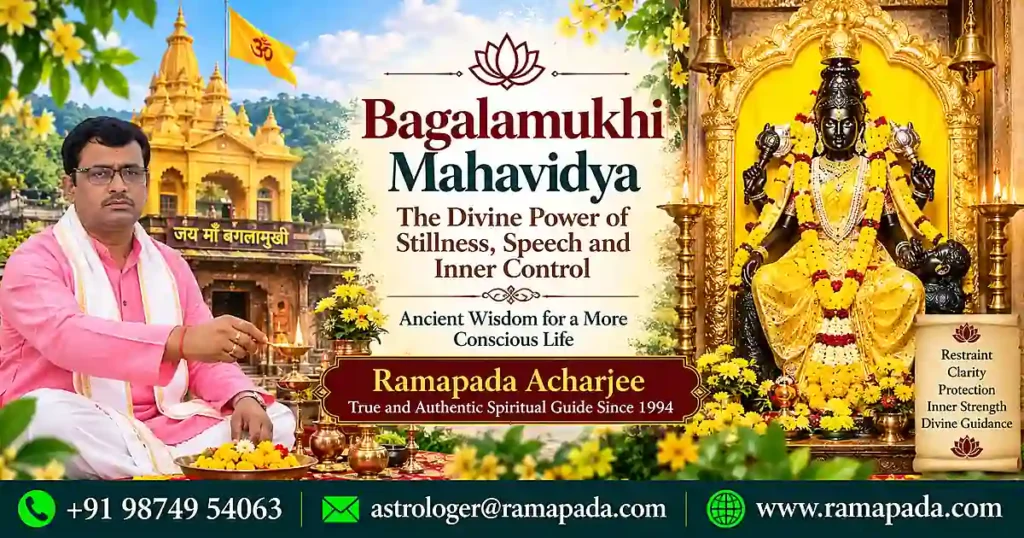
The Divine Power of Stillness, Speech, and Inner Control
After exploring Dhumavati Mahavidya, we now turn to Bagalamukhi Mahavidya, an important Goddess among the Ten Mahavidyas.
Traditional Tantra associates Bagalamukhi with Stambhana Shakti, the power of restraint and stillness.
Many people know her as the Goddess who stops enemies and harmful speech. However, her symbolism also offers a deeper lesson about self-control.
In my understanding, Bagalamukhi teaches us to pause before anger turns into harmful words or actions.
Her spiritual significance extends beyond the idea of defeating external opponents.
বাইরের শত্রুকে থামানোর আগে নিজের রাগ, অহংকার এবং অসংযত কথাকে নিয়ন্ত্রণ করতে শেখাই বগলামুখী মহাবিদ্যার অন্যতম প্রতীকী শিক্ষা।
This inaugural article of the Bagalamukhi Mahavidya series examines the identity of Goddess Bagalamukhi, the meaning behind her striking imagery, and the enduring relevance of her teachings in contemporary life.
Her appearance and the sacred narratives surrounding it are explored in greater detail in the origin of Bagalamukhi Mahavidya.
Who Is Bagalamukhi Mahavidya?
Bagalamukhi occupies a recognized position among the Dasha Mahavidyas, representing the Ten Great Wisdom Goddesses of the Shakta tradition. Her striking iconography features vibrant yellow garments complemented by golden and yellow surroundings. One of her most famous depictions shows the Goddess firmly grasping the tongue of an adversarial figure with one hand while brandishing a club with the other.
Interpreting this imagery purely on a literal level can create an impression of aggression. Tantric symbolism, however, routinely employs dramatic imagery to convey elevated spiritual principles. Restraining the tongue signifies gaining absolute mastery over harmful speech, falsehood, pointless argument, aggression, and unbridled expression.
মুখের কথা একবার বেরিয়ে গেলে তাকে আর ফিরিয়ে নেওয়া যায় না, তাই বাক্সংযম হলো শক্তির এক অনন্য রূপ।
This metaphorical depth expands Bagalamukhi’s symbolism far beyond merely overcoming an external rival.
For a closer interpretation of her yellow colour, tongue, club, posture, and sacred imagery, explore Bagalamukhi spiritual symbolism.
For a comprehensive scholarly introduction to Bagalamukhi as one of the Ten Mahavidyas, readers may consult David Kinsley’s Tantric Visions of the Divine Feminine.
What Does the Name Bagalamukhi Mean?
Imagine an angry thought entering your mind.
First, the thought creates an emotional reaction. Next, that emotion may influence your words. Eventually, impulsive speech can lead to unnecessary conflict.
Bagalamukhi’s symbolism encourages us to interrupt this process.
We can recognise anger without acting immediately. Similarly, we can hear an insult without responding with another insult.
This conscious pause represents an important lesson in self-control.
Why Is Bagalamukhi Associated With Yellow?
Yellow is closely associated with Bagalamukhi Mahavidya. Traditional representations often show the Goddess wearing yellow garments and surrounded by golden colours.
In devotional practice, yellow holds special religious significance. It may also symbolise clarity, concentration, and awareness.
However, wearing yellow clothes does not automatically create spiritual progress.
True discipline requires patience, thoughtful speech, and control over harmful impulses.
Therefore, external symbols should support inner spiritual understanding.
Understanding Stambhana Shakti
Stambhana is an important concept in traditional Bagalamukhi worship. The Sanskrit word refers to stopping, restraining, or making something still. The Sanskrit word refers to stopping, restraining, or making something still.
In Tantric traditions, Stambhana has specific ritual meanings.
However, its symbolism can also encourage personal discipline.
For example, a person may learn to stop harmful speech, avoid unnecessary arguments, and control impulsive reactions.
Contemplative practice teaches us to halt:
- Unnecessary arguments.
- Impulsive decisions.
- Harmful speech.
- Obsessive rumination.
- Spiteful actions born of anger.
- Panic overriding sound judgment.
- Untested rumors before circulation.
- Retaliation driving behavior.
যে ব্যক্তি নিজেকে থামাতে অক্ষম, সে অন্য কাউকে নিয়ন্ত্রণ করার শক্তির আসল অর্থ কখনোই বুঝতে পারে না।
Through this lens, Bagalamukhi transforms into a profound emblem of conscious, deliberate restraint.
A museum interpretation of Bagala as the Mahavidya associated with stilling speech and mind can be found in The Metropolitan Museum of Art’s Goddess Bagala entry.
Why Does Bagalamukhi Hold the Tongue?
This gesture defines the most celebrated aspect of Bagalamukhi’s iconography, leveraging the tongue as a potent symbol. Speech empowers us to comfort souls, impart wisdom, offer prayers, articulate affection, and voice truths. Conversely, that same tongue generates falsehoods, insults, manipulations, humiliations, gossip, and fractured relationships. Spoken words unleash long-lasting consequences spanning years.
Depicting the Goddess grasping the tongue serves as an eternal reminder that verbal expression must remain governed by conscious awareness.
জিহ্বাকে সংযত করার অর্থ শুধু কম কথা বলা নয়, বরং কোথায় মুখ খোলা উচিত আর কোথায় নীরবতা প্রয়োজন—তা অনুধাবন করাই সাধনা।
This vital interpretation ensures Bagalamukhi resonates powerfully within modern, communication-heavy societies.
For a second historical visual reference to the tongue-holding form and yellow iconography, readers may examine The Met’s Bhuvanesvari and Bagala print.
Bagalamukhi in the Age of Social Media
Modern technology amplifies this ancient symbolism dramatically. Contemporary digital platforms enable instant public reactions within seconds. Encountering disagreeable content across Facebook, Instagram, WhatsApp, or YouTube frequently triggers an overwhelming urge to fire back immediately.
Such knee-jerk responses often escalate minor disagreements into massive conflicts. Bagalamukhi’s core principle advocates an alternative path: pause. Observe. Evaluate whether a response serves any constructive purpose.
This approach signifies supreme self-command rather than weakness.
আজকের দিনে অনেক জটিলতার সূত্রপাত হয় তাড়াহুড়ো করে টাইপ করা একটি বাক্য থেকে, তাই পোস্ট করার আগে মুহূর্তের বিরতি নেওয়া মানেই হলো আত্মসংযম।
Ancient iconography thus delivers thoroughly modern behavioral wisdom.
Bagalamukhi Is Not Simply the Goddess of Enemies
Online discourse frequently confines Bagalamukhi strictly to the domain of “enemy destruction,” breeding unwarranted fear and conceptual misunderstanding. Traditional Bagalamukhi practices undoubtedly encompass protection, restraint, conflict resolution, and triumph over opposing forces. Spiritual interpretation, however, extends far beyond literal adversaries.
Adversaries manifest internally as well:
- Uncontrolled anger acts as a formidable enemy.
- Destructive addictions operate as enemies.
- Unchecked speech functions as an enemy.
- Crippling fear serves as an enemy.
- Inflated ego operates as a persistent enemy.
- Repetitive negative rumination acts as an enemy.
মানুষের সবচেয়ে কঠিন শত্রু বাইরে থাকে না, বরং তা আমাদের নিজেদের মনের গহিনেই লুকিয়ে থাকে।
This perspective elevates Bagalamukhi from an object of fear into a guardian of inner discipline.
For a broader academic context that places dramatic Mahavidya imagery within Tantric religious traditions rather than reducing it to sensational claims, see The Oxford Handbook of Tantric Studies.
Bagalamukhi and the Power of Silence
Silence and weakness share no common ground. Fear occasionally compels silence, yet wisdom frequently dictates silence upon realizing that further speech yields zero results. The latter form of silence demands extraordinary internal strength. Bagalamukhi’s symbolism trains seekers to differentiate between the two.
Certain situations demand transparent, vocal communication, whereas others reward stepping away from futile disputes entirely.
নীরবতা তখনই সত্যিকারের শক্তিতে রূপান্তরিত হয় যখন তা ভয়ের বদলে সচেতন সিদ্ধান্ত থেকে জন্ম নেয়।
Discerning this boundary forms an indispensable pillar of spiritual maturity.
Bagalamukhi and Anger
Anger is a natural human emotion. However, uncontrolled anger can lead to harmful words and poor decisions.
Bagalamukhi’s symbolism reminds us to pause before reacting.
Even a brief moment of reflection may prevent an argument from becoming a serious conflict.
Therefore, self-control remains one of the most practical lessons associated with the Goddess.
Bagalamukhi and Protection
Many devotees seek Bagalamukhi’s blessings during personal conflicts, legal disputes, or difficult circumstances.
Traditional worship may offer spiritual comfort and emotional strength.
However, prayer should not replace practical responsibility.
Legal problems require qualified advice. Similarly, financial disputes need careful records, and personal safety concerns require appropriate action.
Faith and responsible decisions can remain important parts of a person’s life.
Bagalamukhi Is Not About Controlling Other People
Correcting a fundamental misconception from the outset of this series is vital. Spiritual practice must never serve as a tool to dominate others’ choices, emotions, associations, or personal freedoms. Compulsive urges to control external environments usually stem from underlying personal insecurities. Bagalamukhi’s symbolism achieves maximum depth when redirection occurs internally:
Rather than asking how to manipulate another person, seekers must ask how to govern their personal reactions.
অন্যের মনকে নিজের ইচ্ছামতো নিয়ন্ত্রণ করার চেষ্টা বাদ দিয়ে, নিজের মনকে নিজের শৃঙ্খলায় আনাই হলো প্রকৃত সাধনা।
This conceptual shift redefines the very nature of spiritual potency.
What Bagalamukhi Can Teach an Ordinary Person
Unlocking Bagalamukhi’s philosophical depth requires zero mastery over complex Tantric rituals. Her symbols offer everyday lessons for lay practitioners: pause prior to reacting, deliberate prior to speaking, master temper before acting, sidestep pointless arguments, retain composure during provocations, and recognize when silence outvalues confrontation.
These milestones represent supreme human achievements rather than supernatural exploits, explaining their immense intrinsic worth.
যে মুহূর্তে পরিস্থিতি কঠিন কথা শোনার দাবি তোলে, কিন্তু সচেতনভাবে নিজেকে সংযত রাখি—সেটাই হলো সংযমের প্রকৃত পরীক্ষা।
My Understanding of Bagalamukhi Mahavidya
During my years of spiritual consultation, I have seen how quickly anger can damage relationships.
A careless remark may create lasting misunderstanding. Similarly, an impulsive message can turn a small disagreement into a serious conflict.
Bagalamukhi Mahavidya offers a powerful symbolic lesson about restraint.
In my understanding, true strength sometimes means choosing not to react immediately.
Frequently Asked Questions About Bagalamukhi Mahavidya
1. Who is Bagalamukhi Mahavidya?
Bagalamukhi is one of the Ten Mahavidyas in the Shakta tradition.
Traditional images often show the Goddess wearing yellow garments and surrounded by golden colours.
In one well-known depiction, she holds the tongue of an opposing figure with one hand and carries a club in the other.
These striking symbols have important meanings in traditional Tantra.
2. Why is Bagalamukhi associated with yellow?
The tongue is an important symbol in Bagalamukhi’s traditional iconography.
Speech allows people to express love, wisdom, prayers, and truth. However, words can also cause pain, misunderstanding, and conflict.
By holding the tongue of an opposing figure, Bagalamukhi symbolically represents restraint over harmful speech.
This interpretation encourages thoughtful communication and greater self-control.
3. What does Stambhana Shakti mean?
Stambhana traditionally means stopping or restraining movement. It has specific meanings in Tantric ritual practice. Symbolically, it may also represent control over harmful words and impulsive actions.
স্তম্ভনশক্তির আচারগত অর্থ রয়েছে। পাশাপাশি এর প্রতীকী ব্যাখ্যায় অসংযত আচরণ ও ক্ষতিকর বাক্যকে নিয়ন্ত্রণ করার শিক্ষাও পাওয়া যায়।
4. Why does Bagalamukhi hold the tongue?
Her well-known iconography shows her holding the tongue of an opposing figure. One symbolic interpretation connects this image with the restraint of harmful speech and falsehood.
দেবীর জিহ্বা ধারণের চিত্রটি তান্ত্রিক প্রতীকবিদ্যার গুরুত্বপূর্ণ অংশ। এর একটি ব্যাখ্যা হলো মিথ্যা, অপমানজনক এবং ক্ষতিকর বাক্যকে সংযত করা।
5. Is Bagalamukhi only associated with defeating enemies?
No. Although certain traditions associate her with overcoming opposition, her symbolism also invites reflection on inner discipline and self-control.
বগলামুখী উপাসনাকে শুধু শত্রুদমনের মধ্যে সীমাবদ্ধ রাখা উচিত নয়। তাঁর প্রতীকী শিক্ষার মাধ্যমে নিজের রাগ ও অহংকার নিয়ন্ত্রণের গুরুত্বও বোঝা যায়।
6. Can anyone worship Bagalamukhi?
People may offer respectful prayers according to their religious beliefs. However, specialised Tantric rituals and mantra practices may require guidance from an appropriately qualified traditional practitioner.
সাধারণ ভক্তি ও প্রার্থনার সঙ্গে বিশেষ তান্ত্রিক সাধনার পার্থক্য রয়েছে। জটিল আচার বা মন্ত্রসাধনার ক্ষেত্রে যথাযথ ঐতিহ্যগত নির্দেশনা প্রয়োজন।
7. Can Bagalamukhi worship control another person’s mind?
There is no scientific evidence that spiritual rituals can control another person’s thoughts or choices. Ethical spiritual practice should respect personal freedom and consent.
অন্যের মন বা স্বাধীন সিদ্ধান্ত নিয়ন্ত্রণের প্রতিশ্রুতি দেওয়া দায়িত্বশীল আধ্যাত্মিক আচরণ নয়। নিজের মন, বাক্য ও আচরণকে সংযত করাই এখানে অধিক অর্থবহ শিক্ষা।
Final Thoughts
Bagalamukhi Mahavidya represents an important spiritual tradition associated with Stambhana Shakti.
Her symbolism encourages us to pause before reacting with anger or speaking harmful words.
A moment of silence can prevent unnecessary conflict. Similarly, thoughtful decisions may help us avoid impulsive actions.
In my understanding, the deeper lesson of Bagalamukhi is self-control rather than domination over others.
True strength sometimes begins with the ability to remain calm.
— Ramapada Acharjee
True and Authentic Spiritual Guide Since 1991
Connect with the Best in Kolkata
Stop wandering in uncertainty. Your stars have a story to tell, and Ramapada Acharjee is here to help you read it. With a legacy built on truth, 35 years of experience, and a mission to bring peace to every household, your journey toward clarity starts here.
📍Consultation available in Kolkata, Guwahati, Siliguri, Tarapith & online by prior appointment (in-person & online)
Consultant: Ramapada Acharjee
Professional Experience: True & Authentic Spiritual Guide Practicing Since 1991
Phone / WhatsApp: +91 98749 54063
Official Email: astrologer@ramapada.com
🌐 Website
You may also read:
How to find a genuine Tantrik in India
Love Problem Solution Specialist
Tantra defined by Best Tantrik in Kolkata
Related Category: Tantra
