
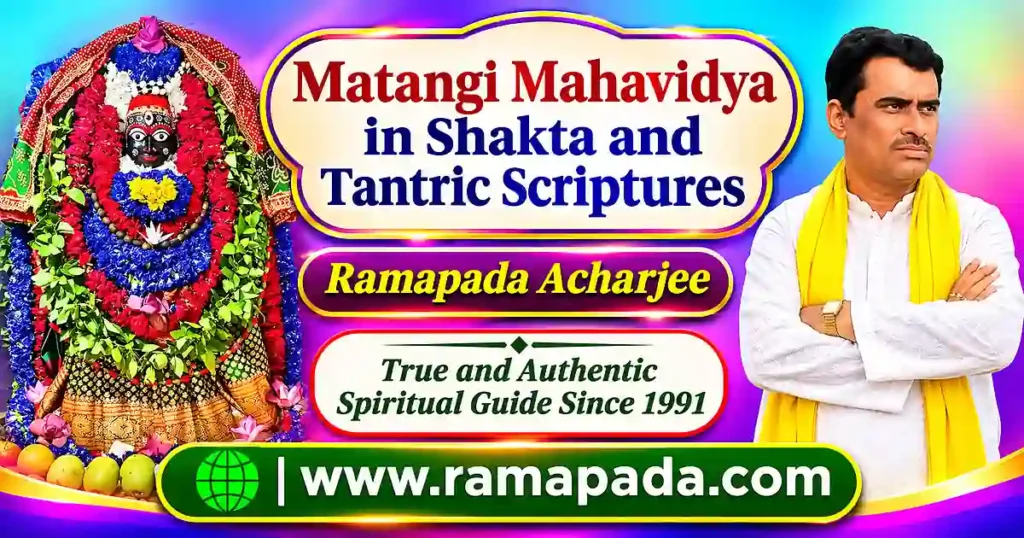
By Ramapada Acharjee
Practicing Astrologer, Palmist, and Spiritual Consultant Since 1991
When people come to consult me with heavy hearts, they often look for a single secret mantra or a quick ritual to wipe away years of accumulated distress. Recently, many seekers ask about Matangi Mahavidya in Shakta and Tantric scriptures after watching a short video clip or reading an isolated line on social media.
However, to every seeker who sits before me, I share the same truth: you cannot comprehend Mother Matangi through one isolated chant, a ten-minute video, or an out-of-context translation.
Her divine presence developed through multiple layers across our sacred traditions. In classical texts, she stands among the sacred Ten Mahavidyas. Furthermore, in specialized Tantric lineages, scriptures describe her unconventional, fierce forms that transcend social conventions. In devotional practice and the royal Sri Vidya tradition, she emerges as Shyamala, who embodies refined speech, melodious music, intellectual counsel, and higher learning.
Because these sacred traditions developed naturally across different regions and centuries, each text emphasizes a distinct dimension of her being. This variation is completely natural. Consequently, in Shakta philosophy, the infinite power of the Divine Mother cannot be confined to a single rigid framework.
দশমহাবিদ্যার আলোচনা যত গভীরে যায়, ততই বোঝা যায় যে প্রতিটি দেবীর পরিচয় একটিমাত্র বই বা একটিমাত্র কাহিনির মধ্যে সীমাবদ্ধ নয়। বিভিন্ন শাস্ত্র, তান্ত্রিক পরম্পরা এবং আঞ্চলিক বিশ্বাস একই তত্ত্বকে ভিন্ন ভাষায় প্রকাশ করেছে। সেই পার্থক্যকে ভুল বলে বাদ দেওয়ার পরিবর্তে প্রেক্ষাপট বুঝে পড়া অধিক গুরুত্বপূর্ণ।
Over my years of consultation and textual research since 1991, I have watched how modern seekers seek quick, rigid formulas where our ancestors preserved profound depth. For instance, someone discovers a verse in an obscure manuscript and broadcasts it online as the universal rule for all Tantra. That approach causes immense confusion. Therefore, we must study our ancient texts with reverence, patience, and clear discrimination.
Matangi Within the Dasha Mahavidya Tradition
Traditional Shakta lists place Devi Matangi as the ninth manifestation among the Ten Mahavidyas. Specifically, the familiar sequence places her immediately after Goddess Bagalamukhi and before Goddess Kamala.
However, this order does not indicate a spiritual hierarchy. The Mahavidyas do not form a ladder where one goddess sits higher than another. Instead, every single Mahavidya represents a complete and sovereign revelation of the Supreme Divine Mother.
Consider the historical evidence: the Brihaddharma Purana preserves a revered list of the ten Mahavidyas that clearly includes Matangi, describing how these supreme forms manifested from Sati during Daksha’s sacrifice. Thus, this ancient source proves that Matangi does not belong merely to modern popular folklore; she remains firmly anchored in classical Shakta literature.
মাতঙ্গীকে শুধু আধুনিক তান্ত্রিক উপাসনার একটি দেবী হিসেবে দেখলে তাঁর অবস্থান ছোট হয়ে যায়। দশমহাবিদ্যার বৃহত্তর শাক্ত দর্শনের মধ্যেই তাঁর স্থান বোঝা দরকার। সেখানে তিনি বাকশক্তি, জ্ঞান এবং সামাজিক সীমারেখার বাইরে থাকা সত্যের এক বিশেষ প্রকাশ।
Moreover, different lineages and regional commentaries sometimes alter the order or the specific names of the ten goddesses. Rather than ignoring these differences, a sincere student should recognize them as proof of a rich, living spiritual heritage.
Why Tantric Texts Must Be Read Carefully
Approaching a traditional Tantric text requires spiritual maturity, self-restraint, and responsible guidance. Although a verse may seem simple enough in modern translation, its ritual core remains deeply technical.
Indeed, core elements like mantra, nyasa, dhyana, yantra, and mudra belong to a specialized inner discipline. You cannot unlock them with an everyday dictionary or an internet search.
- Textual preservation does not equal casual practice: Just because an ancient palm-leaf manuscript documents a specific ritual does not mean you should test it in your living room.
- Mantra study is not do-it-yourself experimentation: Chanting complex bija mantras without proper initiation (diksha) and systematic mental discipline often leads to psychological imbalance.
- Academic analysis is not a commercial promise: Scholarly study provides vital historical and philosophical context; hence, it is never a mechanical guarantee of supernatural wealth or influence.
শাস্ত্রে কোনো বিশেষ মন্ত্র বা আচার লেখা আছে মানেই সেটি ইন্টারনেট থেকে দেখে সরাসরি প্রয়োগ করা উচিত—এই ধারণা বিপজ্জনক। ধর্মীয় গ্রন্থ পড়া এবং বিশেষ সাধনপদ্ধতি অনুসরণ করা দুটি আলাদা বিষয়। জ্ঞান অর্জনের জন্য পড়া যেতে পারে, কিন্তু জটিল তান্ত্রিক প্রয়োগে পরম্পরা ও সঠিক নির্দেশনার গুরুত্ব অস্বীকার করা যায় না।
Certainly, a genuine desire to understand our ancient heritage is noble. However, running after specialized esoteric practices without steady foundations is never advisable.
Matangi in the Todala Tantra
The Todala Tantra serves as an authoritative classical guide for meditating upon the meditative forms (dhyana) of the Mahavidyas.
In this text, Matangi’s form is described with clear precision:
- Complexion: Dusky, dark, radiating a subtle celestial aura.
- Facial Features: Beautiful, arched brows and compassionate, lotus-shaped eyes.
- Throne: Seated gracefully upon a jeweled lion-throne (simhasana).
- Implements: She holds four distinct implements across her four hands: a noose (pasha), a sword (khadga), a shield (kheta), and an elephant goad (ankusha).
Notice how markedly this meditative form differs from modern calendar paintings, where artists usually show her with a veena and a parrot. This distinction is meaningful because it shows that sacred iconography was never meant to be confined to one uniform picture.
একই দেবীর বিভিন্ন শাস্ত্রীয় রূপ পাওয়া গেলে অনেকেই ভাবেন কোন ছবিটি “সঠিক”। বাস্তবে একটি দেবীর একাধিক ধ্যানরূপ থাকা ভারতীয় উপাসনাপদ্ধতিতে অস্বাভাবিক নয়। তাই মাতঙ্গীর হাতে কোথাও বীণা, আবার কোথাও অন্য অস্ত্র বা প্রতীক দেখা গেলে তা সরাসরি বিরোধ হিসেবে দেখার প্রয়োজন নেই।
Unfortunately, when we rely only on popular modern prints, we lose sight of the deeper, classical visions recorded in our root tantras.
What Her Traditional Implements Suggest
Every implement held by the Divine Mother carries profound symbolic significance when examined with care:
- The Noose (Pasha): Represents attachment, worldly bonds, and the divine restraint that reins in erratic mental impulses.
- The Goad (Ankusha): Symbolizes sharp focus, decisive direction, and persistent spiritual discipline.
- The Sword (Khadga): Signifies the sharp edge of wisdom that cuts cleanly through ignorance and ego-driven delusions.
- The Shield (Kheta): Denotes spiritual fortitude and inner calm, shielding our consciousness during worldly crises.
Therefore, it is unwise to reduce these sacred implements to single psychological labels. Traditional symbols work across multiple planes at once: cosmic, devotional, and practical.
ভৈরবী, ছিন্নমস্তা, বগলামুখী বা মাতঙ্গী—প্রত্যেক মহাবিদ্যার অস্ত্র ও প্রতীককে শুধু বাহ্যিক অর্থে দেখলে বিষয়টি অসম্পূর্ণ থেকে যায়। আবার প্রতিটি অস্ত্রকে আধুনিক psychology-র একটি নির্দিষ্ট শব্দ দিয়ে ব্যাখ্যা করাও সব সময় শাস্ত্রসম্মত নয়। মাঝের পথটিই বেশি নিরাপদ।
Matangi and the Mantra Mahodadhi Tradition
Matangi’s worship appears consistently in classical liturgical manuals. For example, Mahidhara’s Mantra Mahodadhi dedicates precise chapters to the mantras, yantras, and ritual nyasa systems of Matangi and related Syama deities.
This documentation demonstrates that her worship rests upon established scriptural roots. At the same time, finding a mantra preserved in a Sanskrit manual should never become an excuse for reckless chanting.
Authentic mantra practice rests on five essential pillars:
- Accurate Pronunciation (Uchcharana): Sanskrit phonetics carry distinct vibrational nuances.
- Mental Discipline (Samyama): The mind must remain centered, stable, and free from destructive impulses.
- Purity of Intent (Sankalpa): Selfish, harmful, or vengeful intent turns the chant into a spiritual burden.
- Contextual Readiness (Adhikara): A seeker must recognize whether they possess the necessary preparation for the practice.
- Moral Responsibility (Dharma): Ethical living must anchor daily life.
মন্ত্রের অক্ষর কপি করা খুব সহজ। কিন্তু একটি মন্ত্র যে দার্শনিক পরিবেশ, নিয়ম এবং মানসিক প্রস্তুতির মধ্যে ব্যবহৃত হয়েছে, সেটি বোঝা অনেক কঠিন। তাই শুধু Sanskrit শব্দ দেখেই কোনো সাধনার গভীরতা বিচার করা উচিত নয়।
Matangi as Vak: The Power of Speech
Among all the spiritual attributes of Matangi, her identity as Vak—the cosmic power of sound, speech, and expression—is paramount.
In Indian philosophy, speech is not merely everyday talking. Sacred sound forms the creative pulse of the universe:
- Sound carries reality: Mantra originates as sound vibration.
- Knowledge requires voice: Wisdom travels from teacher to student through speech.
- Culture blooms in expression: Poetry, music, and philosophy depend directly on the spoken word.
- Healing flows through communication: Honest advice, heartfelt prayer, and reconciliation rely on balanced speech.
Her presence reminds us that speech mirrors the condition of our inner world. A restless mind produces reckless words. Similarly, a hurt ego uses language to wound and humiliate. Conversely, a disciplined, purified heart speaks with compassion, clarity, and steady resolve.
বাকশক্তি মানে শুধু সুন্দরভাবে কথা বলা নয়। অনেক সময় একজন মানুষ খুব সুন্দর ভাষায় এমন কথা বলেন যা অন্যকে আহত করে। আবার সাধারণ ভাষায় বলা একটি সত্য কথা বহুদিন মনে থাকে। তাই কথার মূল্য তার অলংকারে নয়, তার সত্যতা, সময় এবং উদ্দেশ্যের মধ্যে।
Over my decades of helping families through difficult disputes, I have seen a clear pattern: relationships are rarely broken by the initial problem itself; rather, they are shattered by the bitter, careless words spoken during the conflict. Hence, aligning with Matangi’s grace starts with mastering the words that leave your lips.
Matangi and Saraswati: Parallel Streams of Wisdom
Seekers often refer to Matangi as the “Tantric Saraswati.” This comparison is understandable because both deities govern wisdom, arts, music, and eloquence.
However, Matangi cannot simply be treated as an alternate name for Saraswati. Instead, they represent two distinct spiritual currents:
| Spiritual Dimension | Devi Saraswati | Matangi Mahavidya |
|---|---|---|
| Social Domain | Classical learning, formal Vedic education, social purity | Marginalized knowledge, unconventional wisdom, raw truth |
| Aesthetic Nature | Pure white, serene, formal, academic | Deep emerald or dark, intense, untamed, deeply transformative |
| Ritual Sphere | Orthodox ritual purity (Shaucha) | Transcends orthodox boundaries of pure and impure |
| Expression | High literature, formal discourse, classical grammar | The primal impulse of speech, raw creative power, fierce insight |
In this manner, Matangi challenges narrow assumptions: must wisdom arrive only from formal, elite, or conventionally approved institutions? Her presence proves that pure divine consciousness shines just as brightly in the overlooked and marginalized corners of creation.
সরস্বতীর সঙ্গে মাতঙ্গীর মিল আছে, কিন্তু সেই মিলের আড়ালে পার্থক্য হারিয়ে ফেলা উচিত নয়। সরস্বতীর জ্ঞান যেখানে অনেক সময় শুদ্ধ, পরিশীলিত শিক্ষা ও বিদ্যার সঙ্গে যুক্ত, মাতঙ্গীর তত্ত্ব সেখানে এমন প্রশ্ন তোলে—জ্ঞান কি শুধু সমাজের স্বীকৃত স্থান থেকেই আসতে হবে?
Matangi, Shyamala, and Refined Expression
In the royal Sri Vidya tradition, Matangi reveals herself as Raja Shyamala, also known as Mantrini:
- She serves as the supreme counselor and minister to Empress Sri Lalita Tripura Sundari.
- She holds the veena, inspiring divine music, poetry, subtle intellect, and noble governance.
- She embodies the luminous mind that implements cosmic order with grace and dignity.
This connection teaches an extraordinary lesson: the same Goddess who stands outside conventional society in one form becomes the sovereign master of wisdom, royal courts, and high culture in another. Therefore, wisdom does not depend on social status; rather, true wisdom brings value wherever it arrives.
জ্ঞান কখনও সমাজের প্রান্ত থেকে আসে, আবার সেই জ্ঞানই একসময় সভা, শিক্ষা ও নেতৃত্বের ভাষা হয়ে উঠতে পারে। মাতঙ্গীর বিভিন্ন রূপের মধ্যে এই বিস্তৃত পরিসরটি বিশেষ তাৎপর্যপূর্ণ।
Matangi and the Shakta Understanding of Shakti
In Shakta philosophy, Shakti is not a blind mechanical force. Rather, she is dynamic, conscious awareness manifesting as the living universe.
Every Mahavidya cuts through a specific human illusion:
- Chhinnamasta shatters the illusion of physical preservation and teaches that life and sacrifice coexist.
- Bhairavi confronts fear, destruction, and spiritual heat.
- Matangi confronts the illusions of social pride, pretension, and reckless speech.
একজন মানুষ নিজের ভয়কে এড়িয়ে যেতে পারেন, আবার নিজের কথার দায়িত্বও এড়িয়ে যেতে পারেন। মহাবিদ্যার বিভিন্ন রূপ জীবনের এই এড়িয়ে যাওয়া জায়গাগুলোকেই সামনে নিয়ে আসে। সেই কারণেই তাঁদের রূপ অনেক সময় আরামদায়ক নয়, কিন্তু চিন্তার জন্য অত্যন্ত শক্তিশালী।
Why Matangi Challenges the Idea of Purity
One of the most discussed dimensions of Matangi’s worship is her association with Uchchhishta—food that is leftover or socially classified as impure.
This sacred dimension must be approached with philosophical maturity, not sensationalism:
- Dismantling spiritual ego: She challenges those who mistake external washing for genuine inner purity.
- Divine omnipresence: If the Divine Mother resides everywhere, she exists in the discarded leftovers of existence just as fully as in golden temples.
- Inner test, not an excuse for carelessness: Her tradition does not encourage unhygienic behavior or cheap rebellion. Instead, it serves as a rigorous inner trial to see whether the spiritual seeker can perceive divine consciousness beyond social labels.
বাহ্যিক শুদ্ধতার নিয়মকে সম্মান করেও একটি কঠিন প্রশ্ন করা যায়—মনের ভিতরে যদি অহংকার, প্রতারণা বা নিষ্ঠুরতা থাকে, তবে শুধু বাহ্যিক শুদ্ধতাই কি যথেষ্ট? মাতঙ্গীর প্রতীক এই প্রশ্নটিকে খুব সহজে এড়িয়ে যেতে দেয় না।
Outer Purity Versus Inner Purity
True spiritual growth reveals itself in personal conduct and daily interactions:
- One person may take three ritual baths a day, yet tear others down with cruel remarks behind closed doors.
- Another individual may chant devotional hymns for hours, yet treat family members with anger and contempt.
- Similarly, someone may perform expensive rituals, yet show zero compassion to the vulnerable.
External rituals certainly have their place in personal discipline, but without clean character, they remain empty performances. Over decades of spiritual guidance, I have found that authentic progress shows up in gentleness, patience, and honesty.
Matangi and the Discipline of Listening
While people focus almost entirely on the power of speech, Matangi equally embodies the forgotten art of receptive listening.
Speech without listening degenerates into hollow, self-absorbed noise:
- Giving rushed advice before truly hearing someone’s pain creates emotional distance.
- Passing moral judgments before understanding someone’s full situation causes deep wounds.
- Preparing your rebuttal while another person is speaking destroys genuine connection.
Thus, true mastery over speech means knowing when to stay silent and listen with an open, compassionate heart.
মাতঙ্গীর বাকশক্তির একটি বাস্তব শিক্ষা এখানে পাওয়া যায়। কথা বলা যেমন শক্তি, তেমনই অন্যের কথা মন দিয়ে শোনাও একটি শক্তি। সব সমস্যার সঙ্গে সঙ্গে উত্তর দেওয়া দরকার হয় না। অনেক সময় সঠিকভাবে শোনা নিজেই একটি বড় সহায়তা।
Matangi and Bagalamukhi: The Two Gates of Communication
The traditional sequence that places Goddess Bagalamukhi right before Goddess Matangi offers a profound communication lesson:
[ Devi Bagalamukhi ]  ──►  Restrains, immobilizes harmful impulses, teaches SILENCE.
         │
         ▼
[ Devi Matangi ]      ──►  Releases, illuminates, creates purposeful and truthful SPEECH.
Bagalamukhi reminds the seeker: Do not speak destructive, reckless words; practice self-restraint and cultivate silence.
In contrast, Matangi reminds the seeker: When it is time to speak, ensure your words are truthful, constructive, and full of light.
Together, they govern the sacred balance between stillness and expression.
চুপ থাকা এবং কথা বলা—দুটোরই সময় আছে। কখন কথা থামাতে হবে আর কখন সত্য ও দায়িত্ব নিয়ে কথা বলতে হবে, এই বিচারবোধ তৈরি হওয়াই পরিণত যোগাযোগের লক্ষণ।
Matangi and Dhumavati: Wisdom from Life’s Shadows
Comparing Matangi with Devi Dhumavati reveals another deep layer of Tantric philosophy:
- Devi Dhumavati represents life’s inevitable losses: bereavement, old age, abandonment, poverty, and quiet loneliness.
- Devi Matangi represents life’s excluded corners: the marginalized, the unrefined, and voices that polite society ignores.
Consequently, both goddesses dismantle the shallow assumption that spirituality is only about sweet fragrances, comfortable rooms, and pleasing experiences. They compel us to recognize the Divine in life’s difficult, uncomfortable moments.
জীবনের সব শিক্ষা আনন্দ থেকে আসে না। কিছু শিক্ষা আসে ক্ষতি থেকে, কিছু অপমান থেকে, কিছু নীরবতা থেকে, আবার কিছু এমন মানুষের কাছ থেকে যাঁদের সাধারণত গুরুত্ব দেওয়া হয় না। মহাবিদ্যা দর্শনের একটি বড় শক্তি হল এই অস্বস্তিকর বাস্তবতাগুলিকেও আধ্যাত্মিক চিন্তার বাইরে না রাখা।
Scripture Does Not Speak with One Uniform Voice
Whenever someone declares “it is written in the scriptures,” my question is always: which scripture, which century, which commentator, and which living tradition?
Scholars like David Kinsley have shown that the Mahavidya tradition represents a rich tapestry of historical voices, not a single monolithic manual. Furthermore, acknowledging this diversity preserves the integrity of our faith. Matangi reveals herself uniquely to the mystic, the scholar, the artist, and the devotee.
“শাস্ত্রে আছে” কথাটি বলার আগে কোন শাস্ত্রের কথা বলা হচ্ছে সেটি জানা জরুরি। বিভিন্ন গ্রন্থে বিভিন্ন দিককে গুরুত্ব দেওয়া হয়েছে। একটি গ্রন্থের একটি বর্ণনাকে সব tradition-এর একমাত্র মত বলে উপস্থাপন করলে পাঠক বিভ্রান্ত হতে পারেন।
Should Ancient Tantric Claims Be Taken Literally?
Tantric manuscripts frequently mention extraordinary results (siddhis), such as total attraction (vashikarana), victory over rivals, or the discovery of hidden treasures.
In this regard, we must separate these layers with clear discrimination:
- Metaphor and Mystical Allegory: Classical authors often used heightened poetic imagery to depict profound inner psychological breakthroughs.
- Devotional Conviction: The faith and sincere surrender of the practicing seeker.
- Historical Documentation: What manuscripts physically record from specific eras.
- Everyday Reality: Ethical actions, real-world efforts, and empirical facts.
Promising immediate supernatural wonders through ancient verses is neither honest nor spiritual. Above all, genuine sadhana purifies the soul; it is not a transaction for material gain.
এই পার্থক্যটি খুব গুরুত্বপূর্ণ। কোনো প্রাচীন গ্রন্থে একটি ফলের উল্লেখ আছে—এটি একটি ঐতিহাসিক বা ধর্মীয় তথ্য হতে পারে। কিন্তু সেই ফল আধুনিক পরীক্ষায় নিশ্চিতভাবে প্রমাণিত—এমন দাবি আলাদা বিষয়। দুটি কথা এক করে বলা উচিত নয়।
Matangi Is More Than Quick Eloquence
Reducing Devi Matangi to a goddess of public speaking misses her true spiritual depth:
- An articulate speaker can easily use eloquence to deceive.
- A gifted writer can deliberately spread hatred and division.
- A skilled musician can become arrogant and self-obsessed.
Clearly, speech without inner virtue is dangerous. When intellectual brilliance pairs with humility, communication becomes a blessing for all. Indeed, a single gentle sentence, spoken with truth and love, carries far more spiritual weight than hours of boastful oratory.
Matangi in Contemporary Life
In our digital era, humans generate more public speech than ever before. With a smartphone tap, anyone can broadcast hostility, share unverified claims, and ignite conflicts across the world.
In this noisy environment, Matangi’s presence is more urgent than ever. As a result, the critical question today is not: Can I say something?
Rather, the vital question is: Is it truthful, is it necessary, and does it bring peace?
আজকের দিনে কথা বলার সুযোগ অসীম বেড়েছে। কিন্তু সেই সঙ্গে ভুল তথ্য, অপমান, তাড়াহুড়ো করে মন্তব্য এবং অপ্রয়োজনীয় বিতর্কও বেড়েছে। প্রযুক্তি বাকশক্তিকে অনেক বাড়িয়ে দিয়েছে; তাই বাকসংযম এবং দায়িত্বের প্রয়োজনও আরও বেড়েছে।
A Responsible Way to Study Matangi Scriptures
To explore Shakta and Tantric scriptures safely and meaningfully, keep these core principles in mind:
- Verify your sources: Cross-reference translations with reliable Sanskrit critical editions.
- Understand the context: Distinguish between root verses (mula) and later individual commentaries (tika).
- Avoid amateur rituals: Never attempt specialized tantric rites learned casually from the internet.
- Balance devotion with intellect: Authentic spiritual surrender never asks you to abandon sound judgment.
- Reject fear-mongering: Never allow anyone to manipulate you using spiritual curses or planetary fears.
এই কয়েকটি নিয়ম মনে রাখা গেলে শাস্ত্রপাঠ অনেক বেশি নিরাপদ ও অর্থপূর্ণ হয়। ভক্তি এবং বিচারবুদ্ধি একে অপরের শত্রু নয়। বরং দুটিকে একসঙ্গে রাখলে ধর্মীয় বিষয়কে বেশি গভীরভাবে বোঝা যায়।
Frequently Asked Questions
Is Matangi mentioned in authentic Shakta scriptures?
Yes. She is systematically documented across core Shakta and Tantric texts, including the Brihaddharma Purana, Todala Tantra, and Mantra Mahodadhi. Hence, her worship is centuries old.
মাতঙ্গীর পরিচয় শুধু আধুনিক প্রচলনের উপর দাঁড়িয়ে নেই; বিভিন্ন শাক্ত ও তান্ত্রিক ধারায় তাঁর উপস্থিতি পাওয়া যায়।
How does the Todala Tantra describe Devi Matangi?
The Todala Tantra describes her with a dark, glowing complexion, compassionate eyes, and seated upon a lion throne. Her four hands hold a noose, a sword, a shield, and a goad, offering a powerful contrast to modern veena-holding depictions.
এই ধ্যানরূপ জনপ্রিয় বীণাধারিণী মাতঙ্গীর ছবির থেকে কিছুটা আলাদা, যা তাঁর একাধিক iconographic tradition থাকার প্রমাণ দেয়।
Is Matangi mentioned in mantra manuals?
Yes. Classical compendiums such as Mahidhara’s Mantra Mahodadhi contain detailed liturgies and bija systems dedicated to her worship, which historically required systematic guidance.
মন্ত্রের ঐতিহাসিক উপস্থিতি জানা আর সেই মন্ত্র নিজে থেকে সাধনায় প্রয়োগ করা এক বিষয় নয়।
Why is Matangi called the Goddess of Speech?
She governs Para, Pashyanti, Madhyama, and Vaikhari—the four cosmic stages of sound. Thus, she connects the unmanifest thought of the mind to the articulated spoken word.
বাকশক্তিকে শুধু ভালো বক্তৃতা নয়, সত্য, সংযম ও দায়িত্বপূর্ণ যোগাযোগ হিসেবে বোঝা অধিক অর্থপূর্ণ।
Is Matangi identical to Goddess Saraswati?
While both govern speech, arts, and intellect, their philosophical scope differs. Specifically, Saraswati represents conventional, pristine knowledge, whereas Matangi encompasses both pristine arts and the raw, unconventional wisdom found beyond societal boundaries.
মিল আছে, কিন্তু মাতঙ্গীর সামাজিক সীমারেখা ও তান্ত্রিক প্রতীকের দিক তাঁকে স্বতন্ত্র করে।
What is the relationship between Matangi and Raja Shyamala?
In Sri Vidya and South Indian traditions, Matangi is revered as Raja Shyamala or Mantrini—the prime counselor of the cosmic Empress Sri Lalita, embodying divine intellect and melodious arts.
সব পরম্পরাকে এক করে না দেখে কোন tradition কোন রূপকে কীভাবে ব্যাখ্যা করেছে সেটি দেখা ভালো।
Do Matangi rituals guarantee supernatural abilities?
While medieval manuscripts detail extraordinary results (siddhis), these should be read as devotional and symbolic literature rather than mechanical guarantees. Ultimately, authentic spirituality transforms character, not circus tricks.
ধর্মীয় বিশ্বাসকে সম্মান করেও নিশ্চিত অলৌকিক ফলের প্রতিশ্রুতি দেওয়া থেকে বিরত থাকা উচিত।
Can ordinary devotees worship Mother Matangi?
Simple devotional remembrance, chanting her universal names, and seeking her grace for wisdom, truthful speech, and artistic inspiration are open to all seekers. Specialized esoteric rituals, however, require strict initiation.
ভক্তিভরে দেবীকে স্মরণ করা এবং বিশেষ তান্ত্রিক সাধনা করা একই বিষয় নয়।
A Practical and Spiritual Perspective
Contemplating Matangi Mahavidya brings us back to life’s practical realities:
- Your spoken words reveal the true quality of your consciousness.
- Furthermore, the way you speak demonstrates whether your heart carries unresolved anger or calm compassion.
- Ultimately, how you treat other people reveals the genuine fruit of your spiritual practices.
Therefore, a living tradition centered on the divine power of speech cannot be separated from personal, ethical responsibility.
মাতঙ্গীর শাস্ত্রীয় পরিচয় যতই গভীরভাবে পড়া হয়, ততই বোঝা যায় যে তাঁর শিক্ষা শুধু মন্ত্র, সংগীত বা বাকপটুতা নিয়ে নয়। জ্ঞান কীভাবে প্রকাশ করা হচ্ছে, অন্য মানুষের কথা কতটা শোনা হচ্ছে এবং বাকশক্তি কাকে আঘাত বা সাহায্য করছে—এই প্রশ্নগুলিও সমান গুরুত্বপূর্ণ।
In the upcoming article of this series, we will examine Matangi Mahavidya Mantra: Meaning, Spiritual Significance and Responsible Practice, focusing on the philosophy of sacred sound, the discipline of mantra, and how genuine spiritual guidance protects the sincere seeker.
Connect with the Best in Kolkata
Stop wandering in uncertainty. Your stars have a story to tell, and Ramapada Acharjee is here to help you read it. With a legacy built on truth, 35 years of experience, and a mission to bring peace to every household, your journey toward clarity starts here.
📍Consultation available in Kolkata, Guwahati, Siliguri, Tarapith & online.
📞 Call/WhatsApp: +91-98749 54063
🌐 Visit Website
You may also read:
No. 1 Tantrik in India
Signs You Are Affected By Negative Energy
Difference Between Tantrik and Astrologer—Truth vs Myth
How to find a genuine Tantrik in India
🔗 Related Category: Tantra
