
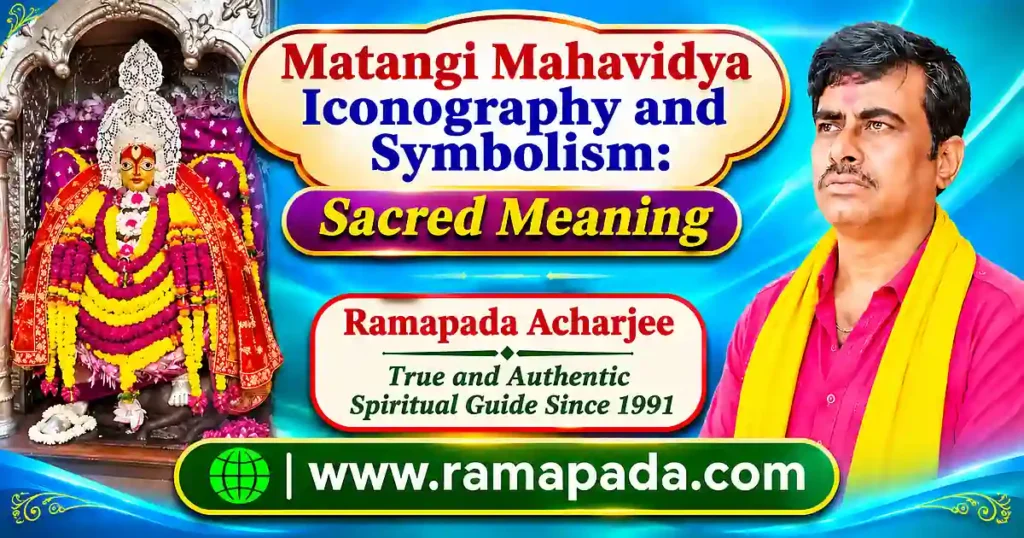
By Ramapada Acharjee
Practicing Astrologer, Palmist, and Spiritual Consultant Since 1991
The Matangi Mahavidya Iconography and Symbolism cannot be understood properly by looking at a single painting, calendar print, or temple murti.
Across more than three decades of spiritual consultation, manuscript reading, and guiding seekers from diverse walks of life, I have observed that people frequently look at sacred imagery as if it were a literal, historical photograph of the Divine. In reality, classical iconography functions as a sophisticated visual language. Different traditional texts, regional traditions, and meditative lineages depict Devi Matangi through varied visual forms:
- In one manifestation, she is a graceful goddess holding or playing the veena.
- In another, she holds a noose, a sword, an elephant goad, or a club.
- Her complexion shifts from vibrant emerald green to deep blue-green, sapphire, or radiant dark tones.
- A green parrot rests near her hand in royal forms, while other depictions emphasize her dwelling in untamed forests, marginal spaces, and unconventional spheres of divine knowledge.
Before examining each sacred attribute, understanding the wider background of the Ten Mahavidyas and their spiritual meaning proves vital. Every Mahavidya represents a distinct, transformative dimension of the supreme Divine Feminine.
মহাবিদ্যার মূর্তি বা ছবিকে শুধু বাহ্যিক সাজসজ্জা হিসেবে দেখলে অনেক গভীর অর্থ অদেখা থেকে যায়। রং, বসার ভঙ্গি, হাতে ধরা বস্তু, অলংকার, বাদ্যযন্ত্র কিংবা পাশে থাকা প্রাণী—প্রতিটি উপাদান একটি বিশেষ ধারণা প্রকাশ করতে পারে। তবে সব ছবির প্রতিটি প্রতীক একই অর্থ বহন করে—এমন ধারণাও ঠিক নয়।
Since 1991, my interactions with seekers have shown how easily sacred symbols can be misunderstood when taken out of context. Devi Matangi requires particular discernment, because her iconography weaves together refined culture and unconventional reality with unmatched depth.
Why Matangi Has More Than One Iconographic Form
A frequent mistake occurs when someone discovers an image online and assumes it represents the only authentic depiction of the goddess. Sacred Indian art developed across diverse regions, centuries, dhyana mantras, and lineages. Naturally, visual details reflect these distinct approaches.
For example, historical archives at the Metropolitan Museum of Art preserve a nineteenth-century Bengali Kalighat painting where Matangi appears as a dark-complexioned, youthful goddess seated upon a golden throne, adorned in vibrant red garments and gold ornaments. Another classical visual record preserved by the Met describes Matangi as an esoteric manifestation of Parvati, bearing a sword, a shield, a noose, and an elephant goad.
Therefore, the absence of a veena in an image does not mean the depiction is flawed. Likewise, the presence of a veena in another form does not imply that every depiction must hold one.
একই দেবীর বিভিন্ন রূপ দেখে বিভ্রান্ত হওয়ার প্রয়োজন নেই। ভারতীয় আধ্যাত্মিক পরম্পরায় একই দেবীকে বিভিন্ন অঞ্চল ও সাধনাধারায় ভিন্ন প্রতীকের মাধ্যমে প্রকাশ করা হয়েছে। তাই একটি ছবিকে একমাত্র শাস্ত্রসম্মত রূপ বলে ধরে নেওয়ার পরিবর্তে তার উৎস ও প্রেক্ষাপট দেখা বেশি গুরুত্বপূর্ণ।
This distinction is especially essential today, when sacred imagery circulates across digital platforms without context or lineage references.
The Green and Blue-Green Complexion of Matangi
One of the most notable visual characteristics of Matangi is her vibrant green, emerald (marakata), or deep blue-green complexion.
In sacred Tantric iconography, color rarely indicates physical pigmentation. Instead, it serves as a profound symbolic shorthand:
- Green reflects life and growth: It connects with dense forests, lush vegetation, natural vitality, and renewal. Matangi’s intimate ties with raw nature, forest spaces, and original creative insight make green deeply appropriate.
- Dynamic creative flow: Scholarly surveys of the Mahavidya tradition document blue, deep blue-green, and dark forms alongside green, illustrating that her color embodies living spiritual presence rather than static pigment.
সবুজ রংকে শুধু বাহ্যিক বর্ণ হিসেবে দেখলে প্রতীকের গভীরতা কমে যায়। প্রকৃতিতে সবুজের সঙ্গে বৃদ্ধি, পুনর্জন্ম, প্রাণশক্তি ও সৃজনশীলতার সম্পর্ক রয়েছে। সেই কারণে মাতঙ্গীর সবুজ বা নীলাভ-সবুজ রূপকে জ্ঞান ও সৃষ্টিশীল শক্তির জীবন্ত প্রবাহের সঙ্গে যুক্ত করে দেখা যেতে পারে।
Human thought thrives when freed from rigid assumptions. A closed mind merely repeats past patterns; an active mind observes, learns, and grows. Matangi’s radiant emerald hue reminds us that authentic wisdom stays perpetually fresh and dynamic.
Matangi and the Veena
Among the diverse symbols of Matangi, the veena is immediately recognizable, creating a natural affinity with Devi Saraswati. Yet its spiritual teaching extends beyond musical artistry.
A veena produces melodious, resonant sound only when balanced conditions are maintained:
- Precision of tension: The strings must have the exact degree of tension—too tight and they break; too loose and they produce dull silence.
- Harmonic tuning: Every string must align with the primary pitch.
- Mastery of pauses: The artist must discern both when to strike a chord and when to honor silence.
This precise discipline mirrors our daily speech (vak). If emotional agitation dominates, speech turns harsh, wounding others. If unaddressed fear silences a person, vital truths remain unspoken. Balanced communication requires both quiet strength and conscious restraint.
এই কারণেই বীণাকে শুধু সংগীতের প্রতীক হিসেবে না দেখে বাকশক্তির শৃঙ্খলার প্রতীক হিসেবেও বোঝা যায়। সুর তৈরি করতে যেমন টান, ছন্দ, বিরতি ও নিয়ন্ত্রণ প্রয়োজন, তেমনই সঠিক কথার জন্যও আবেগ, সত্য, সময় এবং ভাষার মধ্যে সামঞ্জস্য দরকার।
Academic research published by the University of California Press highlights Matangi within this Tantric framework of sacred knowledge and unconventional wisdom. Over thirty-four years of personal consultations, I have observed that most human disputes arise not from the core topic itself, but from the sharp tone and unrefined manner in which it was spoken.
Why the Parrot Appears With Matangi
The green parrot (shuka) is a prominent feature in Raja Matangi and Shyamala iconography, frequently shown perched upon or near her hand.
Because a parrot can replicate human speech, it holds a natural link with sound, voice, and linguistic learning. However, repetition is not the same as true understanding:
- A phrase can be recited effortlessly without comprehending its real import.
- Sacred verses and philosophical doctrines can be committed to memory while ethical integrity remains absent in daily life.
- The parrot highlights the difference between mechanical mimicry and lived realization.
মুখস্থ করা এবং উপলব্ধি করা এক বিষয় নয়। কোনো শ্লোক, মন্ত্র বা দর্শন নিখুঁতভাবে বলা সম্ভব, অথচ তার শিক্ষা জীবনের আচরণে না-ও থাকতে পারে। তাই তোতাপাখির প্রতীককে শুধু বাকশক্তি নয়, অনুকরণ আর প্রকৃত বোঝাপড়ার পার্থক্য হিসেবেও ভাবা যায়।
Spiritual knowledge begins when spoken words gradually shape character and action. Without this alignment, language remains mere noise.
The Sword in Matangi Iconography
A sharp sword appears in several traditional forms of Devi Matangi. Whenever a weapon appears in sacred iconography, people often associate it with physical violence or wrath. That interpretation misses the deeper philosophical message.
Within classical philosophy, the sword represents viveka—the keen edge of spiritual discernment that severs illusion from reality. Matangi’s association with pure wisdom makes this symbol apt.
A clear, discerning mind must learn to separate:
- Verifiable facts from unfounded rumors.
- Authentic understanding from hasty assumptions.
- Inner confidence from destructive arrogance.
- Living tradition from harmful superstition.
- Genuine spiritual practice from commercial sensationalism.
জ্ঞান অর্জনের চেয়ে অনেক সময় সত্য-মিথ্যা আলাদা করার ক্ষমতা বেশি গুরুত্বপূর্ণ হয়ে ওঠে। তথ্যের পরিমাণ বাড়লেও বিচারবোধ না বাড়লে বিভ্রান্তিও বাড়তে পারে। সেই কারণে তলোয়ারকে মানসিক স্বচ্ছতা ও বিবেকের প্রতীক হিসেবে দেখা যথেষ্ট অর্থপূর্ণ।
This discernment is indispensable today, as digital feeds and automated platforms deliver an unceasing barrage of information. The discipline to evaluate what we consume has become an essential spiritual and mental practice.
The Noose and the Power of Attachment
In classical depictions, Matangi holds a sacred noose (pasha). The noose is a potent visual emblem of bondage.
Human beings often live in invisible chains forged by our own psychology:
- Deeply rooted emotional attachments create unseen limits.
- Lingering fears stifle growth and constructive change.
- The relentless craving for external approval controls our peace of mind.
- Resentment and old emotional wounds keep the mind trapped in the past.
- Compulsive behavioral habits dictate daily actions.
The external object serves as an unmistakable reminder of these invisible inner knots. We observe a complementary perspective in Bagalamukhi Mahavidya and the discipline of restraint, where erratic impulses and runaway speech are brought to an intentional halt.
মানুষকে সব সময় বাইরের কোনো শক্তি বেঁধে রাখে না। অনেক সময় পুরোনো অভিমান, ভয়, আসক্তি, অহং বা অন্যের স্বীকৃতি পাওয়ার তীব্র প্রয়োজনই সবচেয়ে শক্ত বন্ধনে পরিণত হয়। সেই বন্ধন দেখা গেলে তবেই ধীরে ধীরে তা থেকে বেরিয়ে আসার পথ তৈরি হয়।
Sacred symbols serve their true purpose when they illuminate our inner habits and guide real behavior.
The Elephant Goad or Ankusha
The elephant goad (ankusha) holds direct significance, as the name Matangi connects etymologically with matanga, meaning an elephant, as well as referring to forest lineages and Sage Matanga.
An elephant possesses immense power. Yet an untamed, rampaging elephant causes devastation, whereas a guided elephant channels that strength constructively. The ankusha represents conscious direction and disciplined guidance:
- Raw intellectual talent without ethical direction leads to confusion.
- Eloquent speech without clear purpose creates vanity.
- Creative ambition without structured discipline remains unfulfilled.
- Influence without accountability turns into arrogance.
একটি শক্তিশালী হাতি যদি নিয়ন্ত্রণহীন হয়ে যায়, তার শক্তিই বিপদের কারণ হতে পারে। একইভাবে প্রতিভা, জ্ঞান বা প্রভাব যথাযথ দিশা না পেলে তা কল্যাণের বদলে বিভ্রান্তি সৃষ্টি করতে পারে। শক্তির চেয়ে শক্তির সঠিক ব্যবহার তাই বেশি গুরুত্বপূর্ণ।
Historical visual archives, such as those cataloged by the Met, highlight the elephant goad among Matangi’s core attributes, emphasizing conscious direction as a central theme of her iconography.
The Club and the Meaning of Inner Strength
A club or mace (gada) appears in specific traditional descriptions of Matangi. Literal interpretations view this simply as an instrument of conflict, yet spiritual imagery invites a deeper perspective.
True strength rarely reveals itself through outward aggression. More often, it manifests as grounded stability:
- Staying composed and patient in the face of deliberate provocation reveals profound personal strength.
- Breaking away from a harmful habit requires far greater bravery than giving a charismatic speech.
- Acknowledging an error with humility demands more inner resilience than stubbornly defending one’s pride.
Through decades of spiritual practice and consultation, I have noticed that this quiet, centered strength builds enduring character.
মানসিক শক্তি সব সময় উচ্চস্বরে প্রকাশ পায় না। নিজের ভুল স্বীকার করা, পুরোনো ক্ষতিকর অভ্যাস ছাড়া, অযথা তর্ক থেকে সরে আসা কিংবা কঠিন সময়ে স্থির থাকা—এসব ক্ষেত্রেও শক্তির প্রকাশ দেখা যায়।
The sacred club represents disciplined moral force and steadiness, rather than destructive conflict.
The Golden or Jewelled Throne
Classical texts often describe Devi Matangi seated upon an exquisite golden or jeweled throne (simhasana).
While a throne visually signifies sovereignty, spiritual sovereignty has nothing to do with dominating others. It points directly toward complete mastery over one’s own internal kingdom:
- When reactive anger dictates our responses, anger rules the throne.
- When anxiety decides our choices, fear wears the crown.
- When we constantly seek external validation, other people’s opinions reign over our peace.
True spiritual maturity restores balanced leadership within. We observe our thoughts with detachment, acknowledge our emotions honestly, and choose our actions with conscious intent.
সিংহাসন বাইরের রাজত্বের প্রতীক হতে পারে, কিন্তু আধ্যাত্মিকভাবে এটি নিজের মন ও আচরণের উপর কর্তৃত্বের কথাও মনে করিয়ে দেয়। যে ব্যক্তি নিজের রাগ, ভয় ও আবেগকে বুঝে সিদ্ধান্ত নিতে পারে, তার ভিতরে এক ধরনের স্বাধীনতা তৈরি হয়।
Here, traditional iconography speaks directly to the daily challenges of human life.
Red Garments and the Presence of Shakti
While Matangi’s complexion is usually green or dark, traditional descriptions almost universally dress her in rich red garments (rakta-vastra).
Within Shakta philosophy, the color red signifies dynamic life force, kinetic creative energy, and active Shakti. This pairing of colors holds immense spiritual significance:
- The emerald complexion embodies inward growth, serene balance, and receptive knowledge.
- The red clothing introduces the active, transformative impulse to manifest that wisdom in the world.
Wisdom that remains locked in abstract theory produces little benefit for society. Conversely, unconsidered action without wisdom leads to costly errors. Together, these colors represent the harmonious union of deep insight and purposeful action.
জ্ঞান যদি শুধু চিন্তার মধ্যে সীমাবদ্ধ থাকে, তবে তার সামাজিক মূল্য কমে যায়। আবার কাজ যদি জ্ঞান ও বিচার ছাড়া করা হয়, তবে ভুলের সম্ভাবনা বাড়ে। মাতঙ্গীর রূপে জ্ঞান ও সক্রিয় শক্তির এই সমন্বয় একটি গভীর শিক্ষা হয়ে উঠতে পারে।
This balance distinguishes genuine spiritual maturity from passive information gathering.
Matangi, Saraswati and Sacred Knowledge
Devi Matangi shares an undeniable kinship with Devi Saraswati—both rule over sacred music, intellectual illumination, speech, and the creative arts.
However, Matangi brings an additional, radical element to this knowledge: she carries sacred insight directly into domains that rigid conventions consider unsuitable or impure. This places her among the most transformative and socially challenging Mahavidyas.
Scholarly analyses from institutions like the British Museum emphasize her relationship with marginality, outcaste spaces, and unconventional Tantric environments. This requires mature handling. Classical allegories of ritual impurity must never be distorted to justify real-world prejudice. Instead, the imagery poses a challenging question: can we recognize truth and honor when it arrives from an unexpected voice or an unconventional space?
সমাজে পরিচয়, অর্থ, শিক্ষা বা অবস্থান দেখে মানুষের মূল্য বিচার করার প্রবণতা রয়েছে। কিন্তু অভিজ্ঞতা বারবার দেখায়—গভীর উপলব্ধি সব সময় সামাজিক মর্যাদার সঙ্গে আসে না। অনেক সাধারণ মানুষের জীবনের অভিজ্ঞতার মধ্যেও এমন শিক্ষা থাকে, যা বইয়ের পাতায় পাওয়া কঠিন।
This remains one of Matangi’s most liberating and timeless teachings.
The Forest and the Edge of Society
Historical scriptures describe Matangi’s presence within the quiet forest, connecting her with communities dwelling away from urban centers.
Across world literature, the forest holds layered symbolic significance:
- It represents the wild, untamed dimensions of existence.
- It symbolizes expansive freedom from rigid social expectations.
- It marks the threshold where comfortable assumptions end and profound truths begin.
Wisdom does not flourish solely within comfortable, predictable environments. Many of life’s most profound realizations emerge during times of disruption and uncertainty. This resonates with the lessons of Dhumavati and the wisdom found in difficult phases of life.
জীবনের সব শিক্ষা সুখের সময়ে আসে না। ক্ষতি, অপেক্ষা, অনিশ্চয়তা কিংবা একাকিত্বের সময়েও চিন্তার গভীর পরিবর্তন ঘটতে পারে। অনেক সময় পরিচিত নিরাপদ পরিবেশের বাইরে গিয়েই নিজের সম্পর্কে নতুন সত্য দেখা যায়।
Matangi’s presence at the periphery encourages complete intellectual and spiritual freedom from automatic, herd-like thinking.
Matangi’s Three Eyes
Classical dhyana mantras describe Matangi with three expressive eyes (trinetra).
The third eye is a revered emblem in Hindu imagery, representing spiritual sight rather than physical novelty:
- The two physical eyes observe visible surfaces, forms, and outer behavior.
- The third eye perceives the underlying currents, motives, and unspoken realities behind appearances.
A polished speech may conceal subtle manipulation, while a direct, difficult critique may offer constructive guidance. A person appearing prosperous on the outside may be experiencing deep emotional distress, while a humble exterior may house peace and understanding.
তৃতীয় নয়নের প্রতীককে বাহ্যিক অলৌকিকতার মধ্যে সীমাবদ্ধ না রেখে গভীর উপলব্ধির প্রতীক হিসেবে দেখা যায়। চোখে যা দেখা যাচ্ছে, তার পেছনে কী কারণ রয়েছে—সেই প্রশ্ন করার ক্ষমতাই বিচারবোধকে পরিণত করে।
This clear seeing develops gradually through mindful self-awareness, life experience, and patient reflection.
The Crescent Moon
Traditional texts depict a delicate crescent moon adorning Devi Matangi’s crown. The moon serves as the universal emblem of natural rhythms, cyclic change, and time.
Human emotional life moves in natural waves:
- Vitality and creative inspiration naturally rise and fall.
- Mental focus and emotional energy vary from day to day.
- Expecting unvarying emotional output every single day creates needless guilt and inner tension.
A balanced spiritual outlook honors these natural phases. We learn to observe inner shifts patiently, without allowing transient moods to drive life-altering decisions.
এই প্রতীকটি মনে করিয়ে দিতে পারে যে মানসিক অবস্থা সব সময় একই থাকবে না। কখনও মন খুব সক্রিয় থাকবে, কখনও স্থির হবে, আবার কখনও ক্লান্তিও আসবে। সাময়িক অবস্থাকে স্থায়ী সত্য ভেবে সিদ্ধান্ত না নেওয়াই অধিক বিচক্ষণতা।
The crescent moon integrates gracefully with Matangi’s sovereignty over creative and artistic flow.
Why Some Matangi Forms Appear Fierce
Not all representations of Devi Matangi are gentle or serene. Specific Tantric lineages depict her with intense, formidable features.
This intensity should never be mistaken for negativity. The Mahavidya tradition deliberately uses intense imagery to dissolve complacency:
- As explored in Chhinnamasta Mahavidya and her challenging spiritual symbolism, striking iconography demands total presence.
- It ensures that spiritual practice does not devolve into superficial comfort.
- It pierces through mental laziness and confronts us with raw truth.
তীব্র দেবীমূর্তি দেখলে প্রথমে ভয় বা অস্বস্তি হওয়া স্বাভাবিক। কিন্তু সেই অস্বস্তিই অনেক সময় প্রশ্ন তৈরি করে। কেন এই রূপ? কোন মানসিক বা দার্শনিক সত্য বোঝানো হচ্ছে? প্রশ্নটি করা গেলে বাহ্যিক ভয়ের আড়ালে থাকা অর্থ ধীরে ধীরে স্পষ্ট হয়।
Devi Matangi’s intense forms must be understood through the lens of Tantric visual philosophy, rather than sensationalized claims.
Matangi and the Symbolism of Discipline
While Devi Matangi governs creative expression, unchecked creativity without discipline rarely achieves enduring depth. This reveals a natural harmony with Bhairavi Mahavidya and the power of Tapasya:
- Devi Bhairavi represents the internal fire of focused discipline and rigorous tapasya.
- Devi Matangi represents the disciplined, harmonious expression of that inner realization.
An author must refine their words through patient editing. A musician must practice scales for hours to achieve effortless melody. A speaker must reflect before addressing an audience. A spiritual counselor must speak with responsibility and measured truth.
সৃষ্টিশীলতার সঙ্গে স্বাধীনতা যেমন জড়িত, তেমনই শৃঙ্খলাও জড়িত। যে প্রতিভা নিয়মিত অনুশীলনের মাধ্যমে পরিণত হয় না, তা অনেক সময় সম্ভাবনা হিসেবেই থেকে যায়।
Talent provides the initial possibility; consistent, dedicated discipline transforms that potential into mastery.
Matangi and the Beauty of Refined Expression
A meaningful connection exists between Matangi and Tripura Sundari Mahavidya and the philosophy of harmony. Devi Tripura Sundari shows that authentic beauty stems from internal harmony and balance, while Matangi translates that inner harmony into conscious communication:
- An elevated, truthful idea can be undermined by arrogant delivery.
- A challenging truth can be shared with dignity and grace.
- Disagreements can be voiced firmly without resorting to disrespect.
This refinement of expression is one of the most practical applications of Matangi’s wisdom for daily life.
ভদ্র ভাষা মানেই দুর্বল মত নয়। দৃঢ় বক্তব্যও সম্মানজনকভাবে প্রকাশ করা যায়। সত্য বলা এবং কাউকে অপমান করা এক বিষয় নয়। এই সূক্ষ্ম পার্থক্য বোঝা গেলে বাকশক্তি অনেক বেশি কার্যকর ও পরিণত হয়।
Real eloquence relies on clarity of thought, timing, and personal responsibility, rather than ornate vocabulary.
Historical Bengali Images of Matangi
Bengal preserves an extraordinary visual and scriptural heritage regarding the Mahavidyas.
The Metropolitan Museum of Art archives a rare nineteenth-century woodblock print from Kolkata featuring both Dhumavati and Matangi together. In this historical print, Matangi is depicted with a deep blue complexion, seated upon a throne, surrounded by traditional ritual attributes.
Such historical records confirm that variations in color and attributes are not recent modern inventions. Distinct visual lineages flourished long before digital media emerged.
বাংলার পুরোনো ছাপচিত্রে মহাবিদ্যাদের নানা রূপ পাওয়া যায়। এর ফলে বোঝা যায় যে আজ ছবিতে যে পার্থক্য দেখা যায়, তার অনেকটাই আধুনিক পরিবর্তন নয়; ঐতিহাসিকভাবেও বিভিন্ন শিল্পী ও পরম্পরায় আলাদা বৈশিষ্ট্য ব্যবহার করা হয়েছে।
This rich history demonstrates why claims that insist upon a single “only correct” depiction fail to honor the breadth of our traditions.
What Matangi’s Image Does Not Mean
To appreciate sacred iconography, several common misinterpretations should be laid aside:
- The sword does not indicate physical hostility; it represents the sharp edge of discrimination.
- The noose does not promote subjugating others; it reveals our hidden inner attachments.
- The elephant goad does not suggest coercion; it reminds us to direct our own talents wisely.
- The throne does not imply worldly arrogance; it celebrates true self-mastery.
- An intense expression does not represent malice; it cuts through superficial delusions.
- The green complexion is not a physical label; it symbolizes living vitality and wisdom.
প্রতীককে আক্ষরিক নির্দেশ হিসেবে পড়লে অনেক ভুল ব্যাখ্যা তৈরি হয়। মূর্তির হাতে তলোয়ার থাকলেই হিংসা শেখানো হচ্ছে না, আবার পাশ বা অঙ্কুশ থাকলেই অন্য মানুষকে নিয়ন্ত্রণ করার অনুমতি দেওয়া হচ্ছে না। এগুলিকে মানসিক ও আধ্যাত্মিক প্রতীকের ভাষায় পড়া বেশি উপযুক্ত।
Responsible understanding becomes vital whenever sacred traditions are shared in public forums.
What Decades of Spiritual Interaction Reveal About Symbols
Since 1991, my consultations have shown a consistent human pattern: people remember a striking visual symbol long after they have forgotten abstract philosophical lectures.
- A person may forget a lengthy explanation about restraint, but they vividly remember Bagalamukhi holding the tongue of speech.
- A theoretical talk on ego may fade, yet the image of Chhinnamasta remains etched in consciousness.
- A discussion on mindful speech may blur, while Matangi holding her veena beside the green parrot stays clear in memory.
Sacred iconography endures because it distills complex philosophical principles into immediate visual form.
দীর্ঘ ব্যাখ্যার অনেক অংশ ভুলে যাওয়া সম্ভব, কিন্তু একটি শক্তিশালী প্রতীক মনে থেকে যায়। তাই প্রাচীন আধ্যাত্মিক পরম্পরায় প্রতীকের ব্যবহার এত গুরুত্বপূর্ণ হয়েছে। তবে প্রতীক মনে রাখা যথেষ্ট নয়; তার অর্থ বোঝার চেষ্টা করাই আসল বিষয়।
The visual image is the entry gate to contemplation, not the final destination.
Matangi Iconography in Daily Life
We can integrate Devi Matangi’s iconography into practical daily awareness:
| Sacred Attribute | Symbolic Representation | Daily Practice |
|---|---|---|
| Veena | Harmonious, balanced speech | Speaking with measured calm and clarity |
| Parrot | Articulation vs. mechanical mimicry | Reflecting deeply before repeating information |
| Sword | Sharp spiritual discrimination (viveka) | Separating fact from assumption |
| Noose | Confronting unseen attachments | Identifying habits and fears that limit personal freedom |
| Elephant Goad | Focused direction of personal power | Guiding talents toward purposeful, ethical actions |
| Throne | Inner self-mastery and sovereignty | Responding with awareness rather than emotional reactivity |
| Emerald Hue | Fresh, dynamic intelligence | Keeping the mind open, curious, and receptive to learning |
| Red Garments | Dynamic, active Shakti | Translating good intentions into constructive action |
প্রতিদিনের জীবনে এই প্রতীকগুলিকে সহজভাবে মনে রাখা যায়। কথা বলার আগে ভাবা, শোনা তথ্য যাচাই করা, নিজের আসক্তি চিনে নেওয়া, প্রতিভাকে শৃঙ্খলার মধ্যে আনা এবং আবেগের বদলে বিবেচনা থেকে সিদ্ধান্ত নেওয়া—এসবের মধ্যেও মাতঙ্গীর প্রতীকের বাস্তব প্রয়োগ খুঁজে পাওয়া যায়।
A sacred image reveals its greatest value when reflection gradually refines our daily conduct.
Frequently Asked Questions
What colour is Matangi Mahavidya?
Devi Matangi is traditionally described with a green, radiant emerald (marakata), blue-green, sapphire, or deep dark complexion across classical dhyana verses and artworks. No single color holds exclusive claim across all lineages.
মাতঙ্গীর বর্ণ নিয়ে বিভিন্ন শাস্ত্রীয় ও শিল্পধারায় কিছু পার্থক্য দেখা যায়। তাই একটি রংকেই একমাত্র সঠিক বর্ণ হিসেবে ঘোষণা করা ঠিক নয়।
Why does Matangi hold a veena?
The veena represents her rule over music, language, learning, and balanced communication. It reminds us that speech, like music, requires proper tension, harmonic tuning, and conscious pauses to convey genuine meaning.
বীণার সুর যেমন নিয়ম ও সামঞ্জস্যের উপর নির্ভর করে, তেমনই অর্থপূর্ণ বাক্যও সংযম ও সচেতনতার উপর নির্ভর করে।
Why is a parrot associated with Matangi?
The parrot reflects speech, resonance, and memory. Symbolically, it draws attention to the difference between mechanically repeating words and truly understanding their ethical, transformative meaning.
মুখস্থ করা সহজ হতে পারে, কিন্তু উপলব্ধি আচরণের পরিবর্তনের মধ্যে প্রকাশ পায়।
Why does Matangi carry a sword?
The sword symbolizes sharp discrimination (viveka) and mental clarity. It represents the ability to sever truth from falsehood, rather than physical conflict.
জ্ঞান তখনই কার্যকর হয় যখন সত্য-মিথ্যা, প্রমাণ-অনুমান এবং বিবেচনা-আবেগের মধ্যে পার্থক্য করা যায়।
Is Matangi always shown with a veena?
No. Classical and regional depictions vary widely. Some lineages show her playing the veena, while others depict her carrying a sword, a shield, a noose, an elephant goad, or a club.
একটি নির্দিষ্ট ছবিকে মাতঙ্গীর একমাত্র রূপ মনে করা ঠিক নয়।
Is Matangi the same as Saraswati?
Matangi shares deep attributes with Devi Saraswati regarding arts, speech, and intellect. However, Matangi introduces unique Tantric dimensions, embracing marginal spaces and questioning conventional social and ritual boundaries.
দুই দেবীর মধ্যে গভীর মিল থাকলেও তাঁদের সম্পূর্ণ একই বলে সরলীকরণ করলে মাতঙ্গীর স্বতন্ত্র তান্ত্রিক চরিত্রটি হারিয়ে যায়।
A Practical and Spiritual Perspective
Devi Matangi’s iconography becomes deeply transformative when viewed as a living guide rather than a collection of esoteric curiosities. Every attribute invites an honest question:
- Is my speech balanced, or driven by impulsive emotion?
- Am I living my values, or merely repeating memorized phrases?
- Am I guiding my talents with structured discipline?
- Do I recognize the hidden attachments that limit my freedom?
- Am I directing my personal energy toward constructive goals?
- Can I look past superficial exteriors to perceive underlying truth?
These questions are far more valuable than approaching sacred imagery with fear or superstition.
মাতঙ্গীর মূর্তিতত্ত্বের গভীর শিক্ষা বাহ্যিক অলৌকিকতার চেয়ে অন্তরের শৃঙ্খলার সঙ্গে বেশি যুক্ত। কথা, জ্ঞান, বিচারবোধ, সৃজনশীলতা এবং দায়িত্ব—এই পাঁচটি বিষয়ের মধ্যে সামঞ্জস্য তৈরি হলে তাঁর প্রতীকের ব্যবহারিক অর্থ আরও স্পষ্ট হয়ে ওঠে।
Sacred iconography has endured across generations because it communicates profound wisdom that words alone cannot capture. By approaching these symbols with study, historical awareness, and open contemplation, we transform ancient art into living clarity.
In the next article in this series, we will examine Matangi in Shakta and Tantric Scriptures, exploring the textual lineages, her identity with sacred speech (paravak), and how classical commentaries illuminate her spiritual power.
About the Author and Spiritual Guidance
Ramapada Acharjee is a Kolkata-based astrology and spiritual guidance practitioner, practising since 1991. Learn more about his background on the About Ramapada Acharjee page.
If you would like to discuss the devotional meaning of these traditions, you can explore his approach to spiritual guidance. For appointment inquiries, visit Contact Ramapada Acharjee.
আমার কাছে আধ্যাত্মিক আলোচনা মানে ভয় বাড়ানো নয়, বিষয়টি বুঝতে সাহায্য করা। পরামর্শ নেওয়ার আগে নিজের প্রশ্ন, প্রত্যাশা ও বাস্তব পরিস্থিতি স্পষ্ট করে জানাবেন।
📍Consultation available in Kolkata, Guwahati, Siliguri, Tarapith & online by prior appointment (in-person & online)
📞 Consultant: Ramapada Acharjee
Professional Experience: True & Authentic Spiritual Guide Practicing Since 1991
📞 Phone / WhatsApp: +91 98749 54063
✉️ Official Email: astrologer@ramapada.com
🌐 Website
— Ramapada Acharjee
True and Authentic Spiritual Guide Since 1991
You may also read:
- No. 1 Tantrik in India
- হাজার বছরের পুরনো বাঙালি তান্ত্রিক কাহিনি
- Vashikaran Specialist in Varanasi – Overcome Life’s Barriers
Best Tantrik in India Explaining TANTRA SHASTRA - বাংলার লোকতন্ত্রে তন্ত্রসাধনা র প্রভাব
- Infinite Powers of the Left-Hand Path
🔗 Related Category: Tantra
