
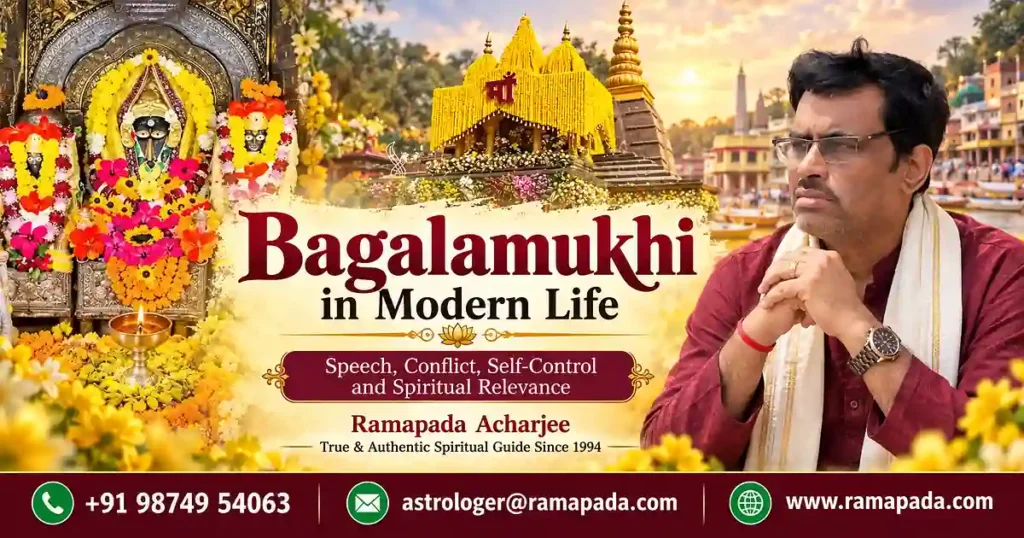
Speech, Conflict, Self-Control, and Spiritual Relevance
By Ramapada Acharjee
True and Authentic Spiritual Guide Since 1994
The spiritual teachings of Bagalamukhi in modern life can be understood far beyond ritual, temple worship, or traditional sadhana. In today’s world of constant communication, arguments, social media reactions, professional pressure, family conflicts, anxiety, and impulsive speech, the deeper symbolism of Goddess Bagalamukhi has become especially relevant.
Bagalamukhi is traditionally associated with Stambhana—the power of stopping, restraining, stilling, or interrupting harmful movement.
Spiritually, however, this teaching need not be directed toward controlling another person. Therefore, it can first be applied to ourselves. Can we stop before speaking harshly? Can we pause before reacting in anger? Can we restrain a damaging habit? Can we remain silent when an argument is becoming destructive? Can we prevent fear from controlling our decisions? Ultimately, these questions reveal a practical and ethical way of understanding Bagalamukhi Mahavidya in everyday life.
माँ बगलामुखी की शिक्षा केवल किसी बाहरी विरोधी को रोकने की नहीं है। कई बार सबसे बड़ी साधना अपने भीतर के क्रोध, भय, उतावलेपन और असंयम को रोकना होती है।
1. Bagalamukhi Beyond Ritual Practice
One of the most common misunderstandings surrounding Bagalamukhi is that her spiritual significance is limited to rituals connected with enemies, disputes, competition, or victory. Consequently, that represents a very narrow interpretation.
Within the larger Mahavidya tradition, Bagalamukhi represents a profound spiritual principle: the ability to stop destructive momentum. Indeed, life constantly creates momentum. For instance, a single angry sentence often leads to another. One fearful thought can easily produce ten more. Similarly, an impulsive decision creates long-term consequences. Sometimes, a minor argument becomes a family conflict, and a hasty online comment turns into public hostility.
Therefore, the symbolic power of Bagalamukhi reminds us that not every movement must continue.
कभी-कभी जीवन में आगे बढ़ना ही समाधान नहीं होता। सही समय पर रुकना, सोचना और फिर निर्णय लेना भी आध्यात्मिक बुद्धिमत्ता है।
This is exactly where Bagalamukhi becomes highly relevant to modern life.
For the traditional and scholarly background of Bagalamukhi beyond modern popular claims, readers may consult David Kinsley’s academic study of the Ten Mahavidyas.
2. The Power of Speech and Silence
Bagalamukhi iconography is strongly associated with the restraint of speech. However, this symbolism should not simply be interpreted as silencing another person. Instead, it teaches something far more useful: control your own tongue before trying to control someone else’s words.
Words can certainly heal, but they can also create wounds that remain for years. For example, many conflicts begin because people speak while angry, frightened, jealous, humiliated, or impatient. Furthermore, modern communication has made this problem even greater. We send messages instantly, comment instantly, reply instantly, and forward instantly. Yet, wisdom rarely works instantly.
वाणी पर नियंत्रण का अर्थ हमेशा चुप रहना नहीं है। इसका अर्थ है—कब बोलना है, कितना बोलना है, और किस भावना से बोलना है, यह समझना।
Before speaking during a tense situation, ask whether it is true, necessary, and timed correctly, and whether it will improve the situation. Thus, this simple discipline reflects the inner teaching of Bagalamukhi.
The Goddess’s tongue, yellow color, posture, and other sacred elements are discussed in greater depth through Bagalamukhi spiritual symbolism.
A historical representation of Bagala and the traditional symbolism of restraining speech can be viewed in The Metropolitan Museum of Art’s Goddess Bagala collection entry.
3. Bagalamukhi and Conflict Management
Conflict is genuinely unavoidable. For instance, families, business partners, neighbors, colleagues, and couples frequently disagree. The spiritual question is never whether conflict will occur, but rather how we respond when it happens.
Bagalamukhi symbolism teaches interruption. Whenever an argument becomes emotionally heated, continuing it may not lead to resolution. Consequently, the wiser action is sometimes to stop, wait, allow emotions to settle, and then return to the issue with greater clarity.
हर विवाद का उत्तर उसी समय देना आवश्यक नहीं है। कभी-कभी कुछ समय का मौन एक बड़े झगड़े को रोक सकता है।
This is not weakness; rather, it is emotional discipline. A person who can control an immediate reaction often possesses more real strength than someone who feels compelled to answer every provocation.
The practical value of slowing down before responding during anger is also reflected in the American Psychological Association’s guidance on controlling anger.
4. Self-Control as Inner Stambhana
In earlier parts of this series, I discussed Stambhana as one of the concepts associated with Bagalamukhi. At its deeper ethical level, Stambhana can be understood as stopping what is destructive within oneself.
Consider how many things we may need to stop: uncontrolled anger, unnecessary criticism, gossip, obsessive thinking, revenge fantasies, impulsive spending, unhealthy arguments, jealousy, harmful habits, and constant comparison with others. Therefore, this constitutes inner Stambhana.
अपने मन की गलत दिशा को रोकना किसी दूसरे व्यक्ति को रोकने से कहीं अधिक कठिन है। यही कारण है कि आत्मसंयम वास्तविक साधना बन जाता है।
Ultimately, the ability to interrupt an unhealthy pattern remains one of the greatest forms of personal power.
This inward interpretation becomes clearer when we examine the spiritual meaning of Stambhana in the Bagalamukhi tradition.
5. Social Media and Digital Discipline
Modern life has created a new field where Bagalamukhi’s teaching is particularly relevant: social media. Platforms like Facebook, Instagram, X, and WhatsApp constantly encourage immediate reactions. A provocative post appears, someone criticizes us, or a comment feels insulting, and the natural impulse may be to answer instantly.
Every reaction, however, creates a permanent digital record. As a result, an angry reply written in thirty seconds may remain online for years. Before posting, always ask whether a response is truly necessary, whether it improves anything, and whether it stems from clarity or a wounded ego.
सोशल मीडिया पर हर बात का जवाब देना आवश्यक नहीं है। कई बार सबसे समझदार उत्तर कोई उत्तर न देना होता है।
Indeed, digital silence can sometimes serve as a modern expression of Bagalamukhi’s principle of restraint.
For a modern evidence-based perspective on pausing before sharing emotionally charged online information, see the American Psychological Association’s report on misinformation and disinformation.
6. Fear, Anxiety, and Mental Stillness
Bagalamukhi is often discussed in relation to external obstacles. Nevertheless, many of our strongest obstacles arise internally. Fear can easily stop us from acting, anxiety can make small situations appear catastrophic, and repeated negative thoughts can create mental exhaustion.
The Bagalamukhi principle of stillness suggests a highly useful approach: do not automatically believe every thought that appears in the mind. Instead, pause, observe it, ask whether it is based on reality or imagination, and then respond.
मन में उठने वाला हर विचार सत्य नहीं होता। साधक को विचार और वास्तविकता के बीच अंतर करना सीखना चाहिए।
This certainly does not mean suppressing emotions; rather, it means refusing to let every emotion immediately control our behavior.
Readers who want to distinguish ordinary stress from persistent anxiety may consult the National Institute of Mental Health’s stress and anxiety fact sheet.
7. Decision-Making and the Wisdom of Pause
Many bad decisions are not caused by a lack of intelligence but by haste. For instance, a person may be intelligent yet angry, frightened, emotionally excited, or under pressure. In such moments, intelligence alone may not protect us, making a pause absolutely necessary.
Consequently, the spiritual symbolism of Bagalamukhi reminds us that stopping before deciding can itself constitute true wisdom.
बड़े निर्णय क्रोध, भय या अत्यधिक उत्साह की स्थिति में नहीं लेने चाहिए। कुछ समय रुककर परिस्थिति को देखना निर्णय को अधिक स्पष्ट बना सकता है।
Furthermore, this principle applies directly to financial decisions, business agreements, relationships, property matters, career changes, legal disputes, and important family choices.
8. Bagalamukhi in Professional Life
Professional life frequently tests speech, patience, and emotional control. For example, a difficult client may speak harshly. A colleague might behave unfairly. A business negotiation can become tense, or someone may completely misunderstand our intentions. In such situations, an immediate emotional reaction can severely damage professional credibility.
Therefore, Bagalamukhi’s deeper teaching can be applied as professional discipline. Before reacting, you should pause, collect the facts, separate emotion from evidence, and answer calmly.
कार्यस्थल पर आत्मसंयम कमजोरी नहीं है। शांत व्यक्ति कई बार परिस्थिति को अधिक स्पष्टता से देख पाता है।
This does not mean accepting injustice silently; instead, it means responding deliberately rather than impulsively.
9. Relationships and Responsible Communication
Many relationships are damaged not because people stop caring, but because communication becomes uncontrolled. For instance, a single harsh sentence can reopen an old wound. A sudden accusation can create defensiveness, and one sarcastic remark can destroy trust entirely.
Because Bagalamukhi symbolism reminds us that speech carries immense power, relationship discipline must include knowing when to speak and when to remain silent.
संबंधों में केवल सही बात कहना पर्याप्त नहीं है। सही बात को सही समय और सही तरीके से कहना भी आवश्यक है।
Instead of saying, “You always do this,” try saying, “This situation is hurting me. Can we discuss it calmly?” Consequently, this small change shifts communication away from attack and toward understanding.
10. Spiritual Boundaries and Ethical Strength
Self-control definitely does not mean allowing everyone to mistreat us. Moreover, spirituality does not require the passive acceptance of harmful behavior. Sometimes, stopping is also about creating firm boundaries.
For example, you may need to stop an abusive conversation, constant manipulation, unnecessary interference, repeated disrespect, or a situation consistently damaging your peace. Bagalamukhi’s symbolism can thus be understood as the power to say enough.
मर्यादा रखना भी आध्यात्मिक अनुशासन का हिस्सा है। हर संबंध को बचाना आवश्यक नहीं, लेकिन हर निर्णय क्रोध या बदले की भावना से भी नहीं लेना चाहिए।
Healthy boundaries and revenge are entirely different; one protects dignity, whereas the other prolongs conflict.
Anyone wishing to move from philosophy to devotional practice should first understand the principles of safe Bagalamukhi practice and ethical guidance.
11. Bagalamukhi and the Control of Anger
Anger is undoubtedly one of the strongest forces capable of destroying judgment. When anger rises, the body reacts quickly through an increased heart rate, sharper speech, and a tendency to view small issues as major crises. During such moments, distinguishing justice from ego becomes extremely difficult.
Therefore, Bagalamukhi’s inner teaching is especially relevant here: do not try to win while angry. First, you must regain control of yourself.
क्रोध के समय मौन कुछ क्षणों के लिए ढाल की तरह काम कर सकता है। जब मन शांत हो जाए, तब बात अधिक स्पष्टता से रखी जा सकती है।
A practical method involves pausing for a few minutes, avoiding immediate messaging or major decisions, and returning to the matter only after emotions have subsided.
12. The Difference Between Silence and Suppression
Silence is incredibly valuable, but it should never become unhealthy suppression. Conscious silence means choosing not to react impulsively, whereas suppression involves repeatedly hiding genuine feelings until resentment builds.
Ultimately, Bagalamukhi’s principle is not about making ourselves voiceless but about becoming masters of our voice.
मौन का अर्थ यह नहीं कि अपनी बात कभी न कहें। इसका अर्थ है कि भावनाओं के गुलाम बनकर न बोलें।
When necessary, speak clearly, but do so only after the mind becomes steadier.
13. A Simple Daily Bagalamukhi-Inspired Practice
Applying these principles in daily life requires no complicated rituals; rather, only a simple awareness practice is needed. Every morning, take a few quiet minutes and ask yourself what needs to be stopped today. This could be unnecessary anger. Perhaps you struggle with gossip or fear. Sometimes, impatience takes over. Other times, it is overthinking or reacting too quickly to criticism.
Then ask what quality you want to strengthen, such as patience, clarity, discipline, courage, responsible speech, or inner stillness.
प्रतिदिन कुछ मिनट अपने व्यवहार को देखने की आदत साधना का एक सरल रूप बन सकती है। बाहर की दुनिया बदलने से पहले भीतर की दिशा को देखना आवश्यक है।
Consequently, this provides a highly practical way to bring Mahavidya philosophy into everyday life.
14. What Bagalamukhi Does Not Teach
It remains equally important to understand what this deeper spiritual tradition should not become. Bagalamukhi should never be reduced to fear-based advertisements, claims of guaranteed victory, obsession with enemies, attempts to dominate relationships, superstitious panic, or uncontrolled experimentation with advanced rituals.
Indeed, any spiritual path increasing constant fear, aggression, or obsession deserves careful reconsideration.
सच्ची साधना व्यक्ति को अधिक संतुलित, जिम्मेदार और संयमी बनाती है। यदि साधना के नाम पर केवल भय, बदला और दूसरों को नियंत्रित करने की इच्छा बढ़ रही है, तो दिशा पर फिर से विचार करना चाहिए।
15. My Perspective After Decades of Spiritual Practice
Over many years of spiritual service since 1994, I have observed that people frequently approach guidance during periods of conflict. They often face family disagreements, relationship tension, business disputes, fear, uncertainty, or emotional pressure.
In such situations, the initial desire is typically to change the other person. However, asking how to change one’s own response can transform the entire situation. The spiritual relevance of Bagalamukhi becomes clear when we understand her as the power of conscious restraint.
We must realize that not every attack requires retaliation. Furthermore, every disagreement does not require victory. It is also true that not every criticism requires a response. Ultimately, certain thoughts do not deserve attention, and passing emotions rarely demand immediate action.
यही आत्मसंयम धीरे-धीरे मनुष्य को भीतर से मजबूत बनाता है। माँ बगलामुखी की शिक्षा मेरे लिए इसी जागरूक शक्ति की ओर संकेत करती है।
Conclusion
Bagalamukhi in modern life can be understood as a profound teaching of conscious restraint. Her symbolism continually reminds us to pause before destructive speech, interrupt unhealthy mental patterns, avoid impulsive reactions, set ethical boundaries, and develop greater mastery over anger, fear, and ego.
In a world where communication is instant and emotional reactions are constantly encouraged, this teaching is definitely more relevant than ever.
The deepest form of Stambhana may not be stopping another person. Instead, it may be stopping the destructive force within ourselves before it becomes action.
माँ बगलामुखी का वास्तविक संदेश केवल बाहरी विजय नहीं, बल्कि भीतर की जागरूकता, वाणी का संयम, मन की स्थिरता और सही समय पर रुकने की बुद्धि भी है।
Thus, that inner victory can become the foundation for wiser relationships, better decisions, stronger character, and deeper spiritual maturity.
Frequently Asked Questions
1. How is Bagalamukhi relevant in modern life?
Bagalamukhi can symbolically teach discipline in speech, emotional restraint, thoughtful decision-making, and the ability to stop harmful reactions.
आज के जीवन में जहाँ हर बात का तुरंत उत्तर देने का दबाव रहता है, माँ बगलामुखी की शिक्षा हमें प्रतिक्रिया से पहले विचार करना सिखाती है।
2. Does Bagalamukhi only represent control over enemies?
No, that represents a limited popular interpretation; spiritually, her symbolism signifies self-control, restraint of harmful speech, and mastery over destructive impulses.
सबसे पहले अपने भीतर के क्रोध और असंयम को रोकना अधिक महत्वपूर्ण है।
3. What is inner Stambhana?
Inner Stambhana means stopping destructive patterns within oneself, such as anger, fear, gossip, revenge, impulsive behavior, or unhealthy thoughts.
अपने गलत व्यवहार को पहचानकर समय पर रोकना भी एक प्रकार की आध्यात्मिक साधना है।
4. Can Bagalamukhi’s teaching help during arguments?
Yes, in a symbolic and practical sense, because pausing during an emotionally heated argument prevents unnecessary escalation.
हर विवाद उसी क्षण समाप्त करना आवश्यक नहीं है। कभी-कभी शांत होकर बाद में बात करना अधिक बुद्धिमानी होती है।
5. Does silence mean accepting injustice?
No, conscious silence means avoiding impulsive reactions rather than accepting abuse or injustice.
जहाँ आवश्यक हो, वहाँ स्पष्ट सीमा बनाना भी आत्मसम्मान और अनुशासन का हिस्सा है।
6. How can I apply Bagalamukhi principles to social media?
Avoid instant angry replies, verify information before sharing, and evaluate whether responding will improve the situation.
सोशल मीडिया पर कुछ मिनट रुककर उत्तर देना कई अनावश्यक विवादों से बचा सकता है।
7. Can Bagalamukhi worship remove anger completely?
Spiritual practice is not an automatic emotional cure; hence, discipline, awareness, reflection, and responsible behavior remain essential.
क्रोध का उद्देश्य केवल उसे दबाना नहीं, बल्कि उसके कारण को समझना और उसे सही दिशा देना है।
8. What is the simplest daily practice connected with this teaching?
Take a few minutes each day to identify one harmful reaction to stop and one positive quality to strengthen.
आज मुझे क्या रोकना है और क्या बढ़ाना है—यह दो प्रश्न रोज़ पूछना बहुत उपयोगी हो सकता है।
9. Is Bagalamukhi spirituality about dominating other people?
Responsible spiritual interpretation focuses on discipline and self-mastery rather than domination.
दूसरों को नियंत्रित करने की इच्छा से अधिक महत्वपूर्ण है अपने व्यवहार को नियंत्रित करना।
10. What is the main spiritual lesson of Bagalamukhi?
It is the ability to pause consciously before harmful thought, speech, or action.
सही समय पर रुकना भी एक शक्ति है।
About the Author and Spiritual Guidance
Ramapada Acharjee is a Kolkata-based astrology and spiritual guidance practitioner, practicing since 1994. Learn more about his background on the About Ramapada Acharjee page.
If you would like to discuss the devotional meaning of these traditions, you can explore his approach to spiritual guidance. For appointment inquiries, visit Contact Ramapada Acharjee.
मेरे पास आध्यात्मिक चर्चा का अर्थ भय बढ़ाना नहीं, बल्कि विषय को सही ढंग से समझने में सहायता करना है। परामर्श लेने से पहले अपने प्रश्न, अपेक्षा और वास्तविक स्थिति को स्पष्ट रूप से साझा करें।
📍Consultation available in Kolkata, Guwahati, Siliguri, Tarapith & online by prior appointment (in-person & online)
📞 Consultant: Ramapada Acharjee
Professional Experience: True & Authentic Spiritual Guide Practicing Since 1994
📞 Phone / WhatsApp: +91 98749 54063
✉️ Official Email: astrologer@ramapada.com
🌐 Website
— Ramapada Acharjee
True and Authentic Spiritual Guide Since 1994
You may also read:
- Tantrik Astrologer in Gurugram – Eliminate life’s obstacles
- Skills of Black Magic Specialist
- Difference Between Tantrik and Astrologer—Truth vs Myth
- How Real Tantriks Perform Vashikaran
- Tantrik Astrologer in Panipat – Overcome life’s hurdles
🔗 Related Category: Tantra
