
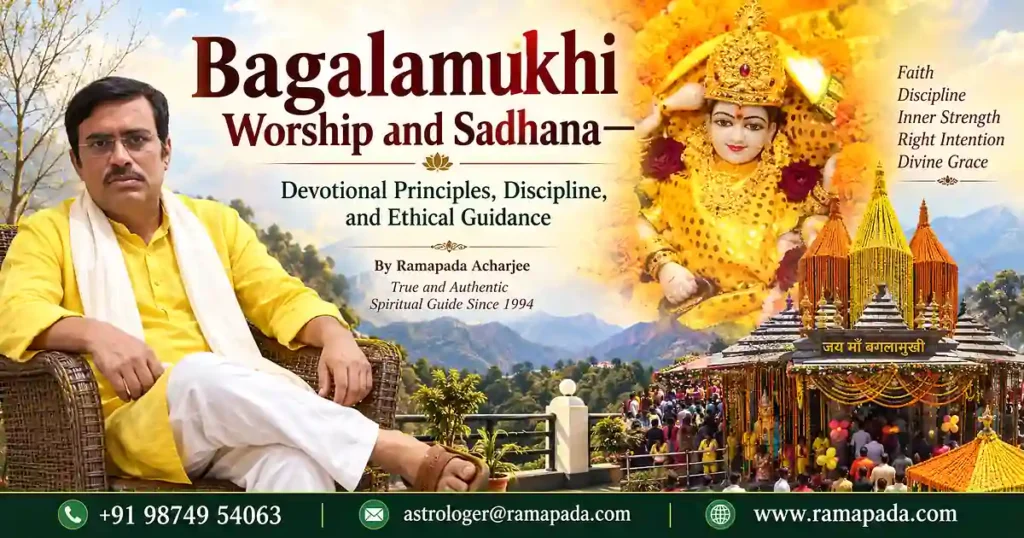
Devotional Principles, Discipline, and Ethical Guidance
By Ramapada Acharjee
True and Authentic Spiritual Guide Since 1994
Internet descriptions regarding Bagalamukhi worship and sadhana frequently feature dramatic claims of instant victory, enemy control, or extraordinary supernatural results. Such exaggerated portrayals only generate fear, misunderstanding, and unrealistic expectations around a deeply revered form of the Divine Mother.
Authentic devotion to Goddess Bagalamukhi avoids foundations built on revenge or desires to dominate others. Instead, its spiritual roots lie in disciplined speech, inner stillness, ethical conduct, prayer, and mastery over destructive impulses.
Drawing from decades of professional spiritual practice, this article explores general devotional principles associated with Bagalamukhi without revealing restricted rituals or encouraging unprepared experimentation.
माँ बगलामुखी की उपासना का वास्तविक उद्देश्य किसी को भयभीत या नियंत्रित करना नहीं, बल्कि अपने मन, वाणी और आचरण में अनुशासन स्थापित करना है।
What Is Bagalamukhi Worship?
Tradition associates Bagalamukhi Mahavidya with stillness, restraint, protection, disciplined speech, and Stambhana Shakti. Forms of worship vary across family traditions, regional customs, lineages, and individual preparation levels.
Simple devotional worship suits most devotees, incorporating respectful prayer, contemplation, offering flowers, or lighting lamps according to family customs. Conversely, advanced Tantric sadhana requires specific rules, initiations, mantra discipline, ritual preparations, and expert supervision, meaning seekers should never casually copy procedures from videos, social media, or incomplete instructions.
साधारण भक्ति और गूढ़ साधना के बीच का अन्तर समझना आवश्यक है। श्रद्धा सभी के लिए है, लेकिन प्रत्येक विशेष साधना बिना तैयारी के नहीं की जानी चाहिए।
Sacred narratives and origins of Bagalamukhi help practitioners understand why she restores order when destructive movements become overwhelming.
For an academic introduction to Bagalamukhi and Mahavidya worship traditions, readers may consult David Kinsley’s Tantric Visions of the Divine Feminine.
Worship and Advanced Sadhana Are Not the Same
Discussions frequently conflate puja, upasana, and sadhana as identical terms despite their distinct depths and requirements.
Devotional Worship
General devotional practices involve:
- Respectful remembrance of the Goddess
- Simple daily prayer
- Ethical self-reflection
- Safely lighting lamps
- Offering suitable flowers or fruit
- Reading spiritual teachings
- Practicing restraint in speech
- Helping others without expectation
Advanced Sadhana
Specialized practices include mantras, nyasa, yantras, prescribed offerings, strict timings, and lineage procedures unsuitable for casual experiments. True spiritual advancement stems from humility, truthfulness, and disciplined behavior rather than outward ritual complexity.
कठिन अनुष्ठान कर लेना ही आध्यात्मिक उन्नति का प्रमाण नहीं है। साधना का प्रभाव व्यवहार, वाणी और चरित्र में दिखाई देना चाहिए।
The diversity of Tantric ritual, initiation, mantra, meditation, and lineage practice is examined in The Oxford Handbook of Tantric Studies.
The Inner Foundation of Bagalamukhi Worship
Bagalamukhi’s spiritual symbolism continually directs attention toward restraint, where her tongue-holding gesture reminds seekers to control false, cruel, or impulsive speech. Consequently, the primary altar of worship resides within our own minds and speech.
Before starting devotional practices, sincere seekers reflect upon specific questions:
- Do I speak truthfully?
- Do I spread rumors?
- Do I insult others during anger?
- Do I use spiritual knowledge to frighten people?
- Do I respect another person’s freedom?
- Can I remain calm during disagreement?
- Do I acknowledge my own mistakes?
Uncomfortable answers often arise, yet genuine self-examination outweighs public religious displays.
यदि पूजा के बाद भी वाणी में कटुता, व्यवहार में अहंकार और मन में प्रतिशोध बना रहे, तो केवल बाहरी अनुष्ठान पर्याप्त नहीं है।
Bagalamukhi’s traditional iconography of controlling speech can be studied through The Metropolitan Museum of Art’s historical Goddess Bagala print.
Why Discipline Matters in Bagalamukhi Sadhana
Discipline establishes stability, preventing spiritual practices from becoming irregular, emotional, or driven by short-term desires. Helpful disciplines include maintaining personal cleanliness, setting regular prayer schedules, keeping worship areas tidy, avoiding intoxication, speaking truthfully, respecting privacy, controlling arguments, avoiding exaggerated claims, and remaining patient about results. Discipline never acts as harsh self-punishment; it simply steadies the mind.
Professional experience shows individuals often seek spiritual help exclusively during crises, abandoning disciplines once immediate pressure subsides. Lasting inner development demands consistency over temporary desperation.
नियम का अर्थ स्वयं को कष्ट देना नहीं है। उसका उद्देश्य मन को स्थिर बनाना और भक्ति को केवल संकट के समय तक सीमित न रखना है।
The Role of Speech and Silence
Speech remains central to Bagalamukhi’s philosophy, possessing power to bless or permanently damage relationships. Devotees gradually learn to reduce false statements, humiliating language, unnecessary criticism, angry messages, gossip, deliberate provocations, unfulfillable promises, and unverified spiritual claims.
Responsible speech replaces permanent silence, allowing firm expressions of truth when necessary. Silence must never conceal injustice or tolerate abuse; Bagalamukhi teaches mindful awareness over emotional recklessness, aligning directly with Stambhana principles: stopping, observing, and choosing appropriate responses.
मौन तभी आध्यात्मिक शक्ति बनता है जब वह विवेक से उत्पन्न हो। भय के कारण चुप रहना और समझदारी से मौन चुनना एक बात नहीं है।
The Devotional Importance of Yellow
Yellow and golden hues traditionally represent Bagalamukhi, appearing frequently in temples, garments, and imagery to symbolize mental clarity, concentration, awareness, radiance, sacred attention, and stability of purpose.
External colors cannot transform character; wearing yellow while harming others contradicts spiritual teachings. External symbols merely reinforce internal virtues, allowing devotees to use clean yellow cloths or flowers based on availability and personal tradition without expecting material guarantees.
पीला रंग देवी की परम्परा का महत्वपूर्ण भाग है, लेकिन साधना का वास्तविक प्रकाश मन की स्पष्टता और आचरण की शुद्धता से प्रकट होता है।
Devotees interested in the living pilgrimage tradition may also explore important Bagalamukhi temples and sacred places in India.
The long-standing association of Bagalamukhi with yellow attire is also documented on the Government of Himachal Pradesh’s Bagalamukhi Temple page.
Mantra and Responsible Practice
As discussed previously in the Bagalamukhi Mahavidya Mantra guide, mantras require correct pronunciation, proper intention, discipline, proper mental states, and traditional contexts rather than mechanical repetition. Collecting unverified mantras from websites creates confusion, and greater complexity never guarantees faster spiritual progress.
General devotees offer respectful prayers without restricted practices, while those seeking specialized mantra sadhana secure personal guidance instead of anonymous online instructions. Most importantly, mantras must never violate another person’s freedom.
मन्त्र का उद्देश्य मन को पवित्र और एकाग्र बनाना है। यदि उसका प्रयोग भय, लालच या प्रतिशोध से किया जाए, तो साधना की दिशा ही बदल जाती है।
For a fuller explanation of sacred sound, intention, pronunciation, and discipline, see the detailed guide to the Bagalamukhi Mahavidya mantra.
For historical manuscript evidence of Bagalamukhi mantra, japa, dhyana, and ritual texts, readers may consult IGNCA’s Agama, Tantra, Mantra and Yantra manuscript catalogue.
Can Bagalamukhi Be Worshipped at Home?
Simple, respectful, and safe devotional worship at home avoids advanced experimentation. Home devotional spaces feature clean images of the Goddess. Bagalamukhi, stable lamps, fresh flowers or simple fruit offerings, quiet prayers, short periods of contemplation, and commitments to responsible speech.
Devotees keep spaces clean and peaceful while maintaining strict fire safety, avoiding complex online ritual arrangements, unfamiliar substances, or misunderstood fire rites.
घर की पूजा सरल, स्वच्छ और श्रद्धापूर्ण हो सकती है। भक्ति की गहराई सामग्री की अधिकता से नहीं, मन की sincerity और नियमितता से तय होती है।
What Should Be Avoided?
Reckless promises and unethical intentions have no place in Bagalamukhi worship. Practitioners strictly avoid controlling specific individuals, seeking revenge, breaking relationships, performing unknown fire rituals, consuming unidentified substances, chanting restricted mantras unguided, paying large sums out of fear, believing guaranteed victory promises, sharing private documents carelessly, stopping medical or legal treatments, or threatening others.
Frightening language used to create dependence signals a need to step back. Authentic spiritual guidance increases clarity and responsibility rather than panic or helplessness, paralleling safe practice principles outlined in Dhumavati Mahavidya Worship.
जहाँ भय दिखाकर धन, आज्ञाकारिता या गोपनीय जानकारी माँगी जाती है, वहाँ साधक को विशेष सावधानी रखनी चाहिए।
These cautions are discussed more fully in the guide to safe Bagalamukhi practice and ethical guidance.
Ethical Guidance for Practitioners
Practitioners offering Bagalamukhi guidance carry serious ethical responsibilities. Honest advisors explain limitations, avoid guarantees, respect confidentiality, prevent harm, avoid fear-mongering, respect consent, recommend professional help when needed, distinguish faith from facts, avoid labeling every conflict as supernatural attacks, and prevent client dependence.
Compassionate communication influences vulnerable people safely, ensuring spiritual counseling fosters practical judgment, clarity, and personal responsibility.
सच्चा मार्गदर्शन व्यक्ति को निर्भर और भयभीत नहीं बनाता। वह उसे अधिक जागरूक, जिम्मेदार और आत्मविश्वासी बनने में सहायता करता है।
Bagalamukhi Worship in Modern Life
Modern applications of Bagalamukhi teachings thrive without complex rituals:
- Digital Communication: Pause before sending angry messages or publishing unverified accusations.
- Family Relationships: Avoid using private vulnerabilities as weapons during arguments; allow emotions to settle first.
- Professional Life: Respond to unfair criticism using facts and documentation rather than aggression.
- Legal Conflict: Preserve evidence and obtain qualified advice while letting spiritual prayer provide emotional strength.
- Anxiety: Separate present reality from imagined future worries, focusing on realistic actions.
- Spiritual Practice: Prioritize regularity, patience, and self-observation over dramatic experiences.
आधुनिक जीवन में माँ बगलामुखी की शिक्षा हमें प्रतिक्रिया से पहले रुकना, तथ्य समझना और फिर उचित कदम उठाना सिखाती है।
Frequently Asked Questions
1. Can anyone worship Goddess Bagalamukhi?
General devotional prayer may be offered respectfully by anyone, whereas advanced Tantric procedures require strict preparation.
भक्ति सभी के लिए हो सकती है, लेकिन प्रत्येक गूढ़ साधना बिना तैयारी के सबके लिए उपयुक्त नहीं होती।
2. Is initiation compulsory for simple prayer?
Formal initiation is unnecessary for simple respectful remembrance, though specialized mantra systems maintain distinct traditional rules.
साधारण प्रार्थना और विशेष मन्त्र-साधना को एक ही स्तर पर नहीं रखना चाहिए।
3. Can Bagalamukhi worship be performed at home?
Simple home worship works wonderfully in clean spaces, avoiding complicated fire rites or unfamiliar procedures without competent guidance.
घर की पूजा सरल और सुरक्षित रखें। अनजान विधियों की नकल करना आवश्यक नहीं है।
4. Does Bagalamukhi worship destroy enemies?
Reducing the Goddess to enemy destruction creates narrow interpretations, as primary inner enemies include uncontrolled anger, false speech, fear, and ego.
सबसे कठिन शत्रु कई बार बाहर नहीं, हमारे अपने मन और व्यवहार के भीतर छिपे होते हैं।
5. Are yellow clothes compulsory?
Yellow holds strong traditional associations, but devotion relies fundamentally on cleanliness, sincerity, and ethical conduct rather than clothing color alone.
केवल वस्त्र का रंग साधना को सफल नहीं बनाता; मन की निष्ठा और आचरण भी उतने ही आवश्यक हैं।
6. Can worship replace medical or legal treatment?
No. Prayer offers emotional courage, but physical health requires medical care, and legal matters require professional legal advice.
आस्था सहारा दे सकती है, लेकिन चिकित्सा और कानूनी आवश्यकता की उपेक्षा करना उचित नहीं है।
7. How can I identify misleading spiritual claims?
Exercise caution whenever individuals guarantee supernatural results, induce fear, demand secrecy, or request large payments without clear explanations.
भय और असम्भव गारंटी पर आधारित दावे हमेशा सावधानी से जाँचने चाहिए।
Final Thoughts
Approaching Bagalamukhi worship and sadhana with reverence, discipline, and ethical awareness reveals that her supreme power expresses itself through conscious restraint rather than uncontrolled domination. Gradual mastery over harmful speech, anger, falsehood, and impulse transforms everyday behavior, anchoring spiritual life in truthfulness, humility, and respect for others.
माँ बगलामुखी की सच्ची उपासना हमें दूसरों पर अधिकार जमाने की नहीं, बल्कि अपने मन, वाणी और कर्म पर संयम रखने की शिक्षा देती है।
— Ramapada Acharjee
True and Authentic Spiritual Guide Since 1994
About the Author and Spiritual Guidance
Ramapada Acharjee is a Kolkata-based astrology and spiritual guidance practitioner, practicing since 1994. Learn more about his background on the About Ramapada Acharjee page.
If you would like to discuss the devotional meaning of these traditions, you can explore his approach to spiritual guidance. For appointment inquiries, visit Contact Ramapada Acharjee.
मेरे पास आध्यात्मिक चर्चा का अर्थ भय बढ़ाना नहीं, बल्कि विषय को सही ढंग से समझने में सहायता करना है। परामर्श लेने से पहले अपने प्रश्न, अपेक्षा और वास्तविक स्थिति को स्पष्ट रूप से साझा करें।
📍Consultation available in Kolkata, Guwahati, Siliguri, Tarapith & online by prior appointment (in-person & online)
📞 Consultant: Ramapada Acharjee
Professional Experience: True & Authentic Spiritual Guide Practicing Since 1994
📞 Phone / WhatsApp: +91 98749 54063
✉️ Official Email: astrologer@ramapada.com
🌐 Website
— Ramapada Acharjee
True and Authentic Spiritual Guide Since 1994
You may also read:
- Genuine Tantrik in Mayang, Assam
- Kamakhya Tantrik—Exploring the Mystical Tradition
- Powerful Tantrik in Kolkata
- Tarapith Tantrik – Exploring the Mystical Tradition
🔗 Related Category: Tantra
