
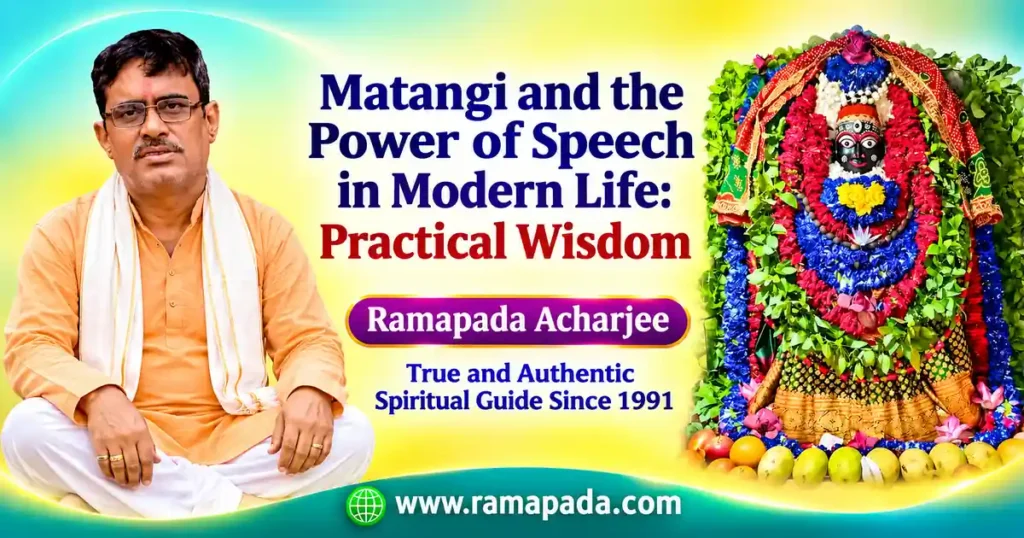
By Ramapada Acharjee
Practising Astrologer, Palmist, and Spiritual Consultant Since 1991
We live in a fast-paced era where a few sentences typed within seconds can travel across cities, countries, and continents almost instantaneously.
Consider how rapidly communication has transformed. A private opinion easily turns into a viral post. A casual remark can reach thousands of strangers overnight. Furthermore, a forwarded message can quietly influence someone we will never meet face-to-face. Even a thirty-second video can reshape how entire communities view religion, personal relationships, public health, politics, or spirituality.
Living amidst this constant digital noise, I frequently reflect on how Matangi and the Power of Speech in Modern Life offers a timely, practical anchor for us all.
As I explained in my introductory piece on Matangi Mahavidya: The Ninth Mahavidya, Maa Matangi holds a distinctive place within the sacred Shakta tradition. She embodies speech (vak), higher knowledge, music, creative intellect, and the conscious expression of wisdom.
Major cultural and historical institutions, including the Metropolitan Museum of Art, preserve sacred art documenting Goddess Matangi as an esoteric form connected with speech, music, knowledge, learning, and the traditional arts.
However, the real-world significance of her sacred symbolism extends far beyond reciting poetry or speaking eloquently. Instead, it confronts us with a vital question:
What are we truly doing with the power of our daily words?
আমার দীর্ঘ অভিজ্ঞতায় আমি দেখেছি, একজন মানুষের জীবনে অনেক বড় পরিবর্তন কখনও কখনও একটি বাক্য থেকেই শুরু হয়। একটি ভালো কথা সাহস দিতে পারে, আবার অসাবধান বা কঠোর একটি বাক্য বহু বছর মনে কষ্ট রেখে দিতে পারে। তাই আমার কাছে বাক্শক্তি শুধু কথা বলার ক্ষমতা নয়—এটি একটি দায়িত্ব।
Speech Has Become More Powerful in the Digital Age
During the early years of my consultation work in the 1990s, human conversation was largely confined to families, direct neighbours, local offices, or immediate communities.
Today, a single social media update travels across the globe in seconds. The American Psychological Association (APA) observes that while digital platforms create unmatched opportunities for mutual connection, they also carry severe risks like misinformation, hate speech, and online bullying.
Consequently, modern communication extends far beyond our physical vocal cords.
To understand our digital footprint clearly, consider these modern forms of expression:
Writing a brief public comment is speech.
Composing a photo caption is speech.
Forwarding a forwarded chain note is speech.
Leaving a star review for a business is speech.
Sending a direct instant message is speech.
Publishing a personal status update is speech.
Even clicking the “Share” button functions as active communication.
আমার কাছে আজকের digital যুগে কথা বলার দায়িত্ব আগের চেয়ে অনেক বেশি। আগে একটি ভুল কথা হয়তো কয়েকজনের মধ্যে সীমাবদ্ধ থাকত, কিন্তু এখন একটি ভুল তথ্য কয়েক মিনিটে অসংখ্য মানুষের কাছে পৌঁছে যেতে পারে। তাই কথা বলার আগে যেমন ভাবা দরকার, share করার আগেও তেমনই ভাবা দরকার।
For this reason, the traditional discipline of conscious speech has never been more relevant than it is right now.
Matangi and Vak: Speech Is More Than Sound
In classical Sanskrit philosophy, the sacred concept of Vak represents speech, yet its true spiritual meaning runs much deeper than acoustic vibrations.
Speech never begins when sound leaves your lips. Instead, it follows a steady internal evolution:
Thought → Intention → Language → Action → Consequences
This natural progression demonstrates why classical spiritual traditions treat our words as potent forces.
As I highlighted in my article on Matangi Mahavidya Mantra Meaning and Spiritual Significance, sacred sound cannot be separated from daily language. A person cannot expect spiritual transformation through sacred mantras while actively using everyday language to demean, deceive, or exploit others.
আমি মনে করি, মুখ থেকে শব্দ বেরোনোর আগেই বাক্যের নৈতিকতা শুরু হয়ে যায়। যে কথা বলছি, তার উদ্দেশ্য কী—সাহায্য করা, সত্য বলা, নিজেকে বড় দেখানো, না অন্যকে আঘাত করা—এই প্রশ্নটি খুব গুরুত্বপূর্ণ।
Spiritual practice becomes meaningful only when genuine awareness guides every sentence we speak.
The Pause Before Speaking Is a Form of Wisdom
Throughout my decades of practice, I have noticed that communication breakdowns rarely stem from a lack of intelligence. Rather, they happen because people respond with excessive speed.
Observe our standard human reactions:
When an acquaintance criticises our work, we instinctively defend ourselves.
If a relative speaks sharply, we react before understanding the broader context.
When an online stranger posts an irritating remark, we immediately type a harsher comeback than we would ever utter in person.
Regret usually follows this haste. Fortunately, an effective remedy is remarkably straightforward: we must learn to pause.
Pausing for just three to five seconds creates a protective gap between emotional irritation and decisive action.
আমার নিজের অভিজ্ঞতায় দেখেছি, রাগের মুহূর্তে সঙ্গে সঙ্গে উত্তর না দেওয়া অনেক সমস্যাকে বড় হতে বাধা দেয়। সেই কয়েক মুহূর্তের বিরতিতে আমরা বুঝতে পারি—আমি কি সমস্যার সমাধান করতে চাই, না শুধু রাগ প্রকাশ করতে চাই?
Taking a conscious pause does not show weakness. On the contrary, that quiet space is precisely where maturity and wisdom enter.
Listening Is Also Part of Sacred Speech
People routinely equate communication with speaking fluently. Yet healthy dialogue depends just as heavily on patient listening.
If our attention is occupied with formulating a counter-argument while someone is talking, we are not truly listening. Similarly, interrupting repeatedly prevents us from grasping the real problem. Assuming we already know what the speaker will say almost always leads to avoidable misunderstandings.
Listening requires inner patience and genuine humility.
আমার consultation জীবনে বহুবার দেখেছি, মানুষ সব সময় উত্তর চান না; অনেক সময় তাঁরা চান কেউ মন দিয়ে তাঁদের কথা শুনুক। কাউকে সত্যিকারের শোনা নিজেই এক ধরনের সম্মান, এবং অনেক ক্ষেত্রে সেটাই সমস্যার প্রথম সমাধান।
Devi Matangi’s connection to refined expression naturally encompasses refined listening. Ultimately, wise speech can only grow out of attentive hearing.
Social Media Has Made Impulsive Speech Visible
Modern digital algorithms tend to reward reactive urgency over depth. They urge users to comment first, react immediately, publish before others, and share before an event fades from trends.
However, rapid reactions must never be confused with wisdom. Impulsive posting routinely prompts people to declare opinions before verifying facts or exploring context.
UNESCO’s guidelines on media and information literacy repeatedly stress the importance of critically evaluating data and sharing information with ethical accountability. This educational objective aligns seamlessly with traditional spiritual self-restraint.
আজকের social media-তে দ্রুত প্রতিক্রিয়া দেওয়াকে অনেক সময় গুরুত্ব দেওয়া হয়। কিন্তু আমার মতে, সব বিষয়ে সঙ্গে সঙ্গে মতামত দেওয়া জরুরি নয়। কোনো বিষয় না জানলে কিছুক্ষণ পড়া, যাচাই করা বা চুপ থাকা অনেক বেশি দায়িত্বশীল আচরণ।
Sometimes, the most mature message is the one you decide not to publish.
Forwarding Information Is Also a Moral Responsibility
Whenever problematic content spreads, many people excuse themselves by saying:
“I only forwarded the message; I did not write it.”
Yet passing along unverified claims actively contributes to their distribution. If a claim happens to be misleading or harmful, every person who shares it shares responsibility for its consequences.
The World Health Organization (WHO) coined the term “infodemic” to describe an overabundance of information—both accurate and false—that generates public confusion and panic during crises. Although originally applied to public health, this principle holds true for every aspect of our lives: information spreads solely because individuals choose to pass it forward.
আমি বহুবার বলেছি—কোনো message আমাদের কাছে এসেছে মানেই সেটি সত্য নয়। বিশেষ করে health, ধর্ম, অর্থ, আইন বা কারও reputation নিয়ে কিছু forward করার আগে source দেখা উচিত। “আমার কাছে এসেছিল, তাই পাঠিয়ে দিলাম”—এটা যথেষ্ট দায়িত্বশীল অবস্থান নয়।
Before sharing any post or message, review these six practical checkpoints:
Authorship: Who originally created this claim?
Verification: Does this update reference a dependable, documented source?
Tone: Does the headline use exaggerated language to provoke emotional outrage?
Impact: Will sharing this create unnecessary anxiety or panic for vulnerable readers?
Dignity: Could this message unfairly damage another individual’s personal reputation?
Motivation: Am I sending this because it is verified, or simply because it sounds dramatic?
Addressing these simple enquiries prevents widespread harm.
Matangi and the Difference Between Information and Wisdom
Our generation enjoys access to more data than any civilisation before us. Still, an abundance of information does not guarantee knowledge, nor does knowledge automatically translate into wisdom.
A person can spend hours scrolling through thousands of posts daily while gaining very little substantive insight.
To appreciate the difference:
Information supplies raw data and isolated facts.
Knowledge organises data into meaningful understanding.
Wisdom shows us when, why, and how to apply that understanding ethically.
As I observed in Matangi Mahavidya in Shakta and Tantric Scriptures, sacred texts urge seekers to look beyond superficial interpretations.
আমার কাছে আজকের যুগের বড় সমস্যা তথ্যের অভাব নয়; বরং অতিরিক্ত তথ্যের মধ্যে কোনটা দরকার, কোনটা সত্য এবং কোনটা শুধু attention পাওয়ার জন্য তৈরি—সেটা বোঝা। এই বাছাই করার ক্ষমতাই ধীরে ধীরে wisdom তৈরি করে।
Memorising facts makes an individual informed. Discerning how to communicate those facts with compassion is what makes a person wise.
Words Can Build or Damage Relationships
Most human bonds are formed, preserved, or broken through daily conversation. A single dramatic argument rarely causes a divorce or ends a lifelong friendship on its own.
Instead, human relationships evolve through thousands of small, daily remarks:
Tone of voice matters.
Choosing the right moment to speak matters.
Thoughtful word choices matter.
Giving someone your full attention matters.
Even respectful silence matters.
In domestic life, persistent sarcasm gradually erodes mutual trust. Within marriages, habitual criticism builds emotional walls. In workplaces, humiliating an employee publicly shatters confidence long after the meeting concludes.
Conversely, a few sincere words of appreciation can uplift a struggling soul for years.
আমার কাছে সম্পর্কের ক্ষেত্রে একটি বিষয় খুব গুরুত্বপূর্ণ—সত্য কথা বলতেই হবে, কিন্তু সত্য বলার ভঙ্গিও গুরুত্বপূর্ণ। কাউকে সংশোধন করা আর কাউকে অপমান করা এক বিষয় নয়।
The practical power of speech is always most visible in our conduct toward those closest to us.
Online Arguments Rarely Require Immediate Victory
Online discussions frequently turn into verbal battles. Participants often stop examining the actual issue and focus entirely on defeating their opponent.
Notice how quickly the goal shifts during an online disagreement:
Initial Healthy Goal: “Let us exchange viewpoints and understand the issue.”
Destructive Shift: “I must crush your argument and prove you wrong publicly.”
Once that shift happens, genuine communication collapses. Sarcastic comments increase, personal character attacks take over, and facts become secondary to emotional performance.
আমি মনে করি, প্রতিটি online argument জেতা জীবনে কোনো বড় সাফল্য নয়। কখন আলোচনা বন্ধ করতে হবে, কখন আর উত্তর না দেওয়াই ভালো এবং কখন disagreement-কে disagreement হিসেবেই থাকতে দিতে হবে—এই বোধটাও maturity-এর অংশ।
Stepping away from an unproductive debate is never a defeat. In truth, it is an act of mature discipline.
Matangi, Speech, and Personal Reputation
Our daily communication steadily constructs the perception others hold of our character.
People quietly observe whether we speak with measured care. They notice whether our stories include wild exaggerations. They remember if we leak private information entrusted to us in confidence. Furthermore, they quickly recognize when someone shifts their opinions depending on which crowd they are addressing.
In our current digital landscape, this awareness is vital because old updates, screenshots, voice notes, and private messages can remain preserved for decades. A single impulsive outburst can become a permanent public record.
আমি সব সময় মনে করি, online-এ এমন কিছু লেখা উচিত নয় যা পরে নিজের নামের পাশে দেখতে অস্বস্তি হবে। একটি মুহূর্তের রাগ কেটে যায়, কিন্তু screenshot অনেক সময় থেকে যায়।
Digital speech demands the exact same sobriety as a spoken promise—perhaps even more.
The Spiritual Danger of Gossip
Casual gossip is often dismissed as harmless banter. People frequently justify these conversations with convenient excuses:
“Everyone in our social circle already knows about this.”
“I am only sharing this with you in strict confidence.”
“A very reliable mutual friend told me earlier today.”
Yet gossip routinely destroys personal dignity without giving the accused individual any opportunity to explain their perspective. Moreover, every retelling distorts the original story further.
An ethical approach to speech begins with a simple question: Does this conversation truly need to happen?
আমার অভিজ্ঞতায়, অন্যের ব্যক্তিগত বিষয় নিয়ে অপ্রয়োজনীয় আলোচনা খুব দ্রুত ছড়িয়ে পড়ে। কিন্তু সেই কথার সত্যতা বা তার ফলে ওই মানুষের কতটা ক্ষতি হতে পারে, সেটা আমরা অনেক সময় ভাবি না। তাই সব সত্য কথাও সব জায়গায় বলা প্রয়োজন হয় না।
Selective silence often protects personal honor far better than unnecessary speech.
Freedom of Speech Does Not Remove Responsibility
Freedom of expression remains a cornerstone of a healthy society. However, having the legal right to express an opinion does not liberate anyone from the moral consequences of their words.
We may possess the right to make a statement, yet we must still evaluate whether making it is fair, accurate, necessary, and helpful. Traditional spiritual discipline never demands that we suppress differences of opinion. Rather, it asks us to state our disagreements without losing our human empathy.
আমার কাছে মতের অমিল কোনো সমস্যা নয়। সমস্যা শুরু হয় যখন মতের বিরোধ থেকে ব্যক্তিগত অপমান, বিদ্বেষ বা ইচ্ছাকৃত ভুল তথ্য ছড়ানোর দিকে চলে যাই। ভিন্নমত থাকলেও ভদ্রতা বজায় রাখা সম্ভব।
Principled disagreement and civil language can always coexist gracefully.
The Difference Between Correction and Humiliation
Whenever another person is clearly mistaken, offering a correction may be appropriate. Nevertheless, constructive correction and deliberate humiliation remain worlds apart.
| Approach | Typical Expression | Underlying Purpose |
|---|---|---|
| Constructive Correction | “This detail appears inaccurate based on current evidence; let us look at the documentation.” | Focuses on clarifying the facts to help the individual grow. |
| Deliberate Humiliation | “Only a foolish person could possibly believe such nonsense.” | Attacks the individual’s character to assert personal dominance. |
Recognizing this distinction is essential in schools, family households, corporate workplaces, and social media interactions.
আমি দেখেছি, মানুষ ভুল স্বীকার করতে বেশি প্রস্তুত হন যখন তাঁদের সম্মান বজায় থাকে। কাউকে অপমান করে সত্য শেখানোর চেষ্টা করলে অনেক সময় সত্যের চেয়ে অপমানটাই বেশি মনে থাকে।
If your authentic intention is to help, your delivery must reflect that goodwill.
Silence Can Also Communicate
Words are not required in every circumstance. Strategic silence offers profound value:
Practicing silence allows for deep personal reflection.
Quiet composure prevents unnecessary escalation during heated disputes.
Staying quiet gives the other speaker room to be fully heard.
Discretion safeguards sensitive personal confidences.
Even so, silence is not unconditionally virtuous. Remaining silent when someone is being actively abused or harmed allows injustice to continue unchecked.
Therefore, our primary consideration should never be choosing between absolute silence or constant talking. Rather, we should ask: What is the most constructive, responsible response to this specific moment?
আমার কাছে নীরবতা তখনই মূল্যবান, যখন তা সচেতন সিদ্ধান্ত। ভয়ে চুপ থাকা আর বিবেচনা করে চুপ থাকা এক বিষয় নয়। কোথাও নীরবতা শান্তি আনে, আবার কোথাও সত্য কথা বলার সাহসও দরকার হয়।
Maturity lies in knowing which situation demands quiet reflection and which requires courageous honesty.
Matangi and the Discipline of Creative Expression
Maa Matangi is revered as the patron deity of the fine arts, music, scholarship, and creative enterprise. Her symbolic world encompasses everyday speech as well as elevated artistic expression:
Creative writers mold the viewpoints of their readers.
Skilled musicians influence profound human emotions.
Inspiring teachers guide the future path of their students.
Public orators influence community choices.
Modern content creators influence the daily habits of their audience.
The sacred iconography examined in Matangi Mahavidya Iconography and Symbolism illustrates why the musical vina, written manuscripts, and articulate speech define her traditional visual form. The Met also documents traditional representations depicting her as an esoteric form of Parvati, reflecting the depth of her artistic legacy.
আমি মনে করি, সৃজনশীল প্রতিভা যত বড় হয়, দায়িত্বও তত বাড়ে। একজন লেখক, বক্তা বা content creator-এর একটি কথা হাজার মানুষের চিন্তায় প্রভাব ফেলতে পারে। তাই creativity-এর সঙ্গে সততা ও আত্মসংযম থাকা খুব দরকার।
Creative talent realizes its highest purpose only when technical skill is paired with ethical responsibility.
The Problem of Misinformation and Confident Speech
One of the most concerning habits in modern communication is speaking with absolute authority about subjects we have not studied.
Charismatic confidence sounds convincing to listeners, but confidence is never an acceptable substitute for verified truth. An individual can speak loudly while being factually wrong. Conversely, a cautious speaker may express nuanced facts accurately.
UNESCO’s educational resources on misinformation emphasize how rapidly unsubstantiated narratives travel across digital networks.
আজকের দিনে একটি বড় শিক্ষা হলো—“আমি নিশ্চিত” বললেই কোনো কথা সত্য হয়ে যায় না। নিজের অজানা জায়গা স্বীকার করা দুর্বলতা নয়; বরং ভুল তথ্য ছড়ানোর চেয়ে “আমি জানি না, দেখে বলছি” অনেক বেশি দায়িত্বশীল।
A mature thinker readily separates proven evidence from personal assumptions.
Artificial Intelligence Makes Responsible Speech Even More Important
Modern dialogue is no longer shaped exclusively by human voices. With generative artificial intelligence, computer models produce essays in seconds, synthetic audio mimics living voices, and digital images can be altered seamlessly.
Consequently, written material can appear polished and persuasive while containing completely fabricated claims. UNESCO highlights critical information evaluation as an indispensable pillar of contemporary literacy.
AI আমাদের কাজ সহজ করতে পারে, কিন্তু judgment-এর দায়িত্ব আমাদের কাছেই থাকে। কোনো লেখা সুন্দর দেখাচ্ছে বলেই তা সত্য ধরে নেওয়া উচিত নয়। বিশেষ করে গুরুত্বপূর্ণ বিষয়ে source যাচাই করা আগের চেয়েও বেশি দরকার।
While technological tools change, our personal duty of ethical discernment remains unchanged.
A Practical Five-Question Test Before Speaking or Posting
Before making an important statement aloud—or posting a comment online—run your thoughts through these five questions:
1. Is It True? → Have I personally verified the facts?
2. Is It Necessary? → Does this really need to be shared?
3. Is It Fair? → Am I describing the circumstances honestly?
4. Is It Respectful? → Can I communicate this without causing humiliation?
5. Is It Accountable? → Would I stand by these exact words tomorrow?
এই পাঁচটি প্রশ্ন খুব সাধারণ মনে হতে পারে, কিন্তু নিয়মিত ব্যবহার করলে communication অনেক বদলে যেতে পারে। বিশেষ করে রাগের সময় বা social media-তে কিছু post করার আগে একবার এগুলো মনে করলে অনেক অপ্রয়োজনীয় সমস্যা এড়ানো সম্ভব।
This practice does not make you hesitant or fearful. Rather, it ensures that your expression remains deliberate and conscious.
A Seven-Day Conscious Speech Practice
This exercise requires no secret initiation or esoteric ritual. It is simply a practical discipline inspired by the spiritual heritage of Devi Matangi:
Day 1: Mindful Observation → Notice how often you make statements on impulse without reflecting first.
Day 2: Attentive Listening → Allow colleagues and family members to finish speaking before formulating your reply.
Day 3: Fact Verification → Check the background of at least one news item before sharing it with peers.
Day 4: Gossip Reduction → Consciously decline to participate in one conversation concerning someone who is not present.
Day 5: Sincere Appreciation → Offer genuine, encouraging words to an acquaintance who is working hard.
Day 6: The Deliberate Pause → When feeling irritated, wait two minutes before sending an email or answering a text.
Day 7: Weekly Review → Spend five minutes reflecting on which of your words brought peace and which caused strain.
আমি মনে করি, সাত দিনে মানুষ সম্পূর্ণ বদলে যায় না। কিন্তু সাত দিন সচেতনভাবে নিজের কথার দিকে তাকালে এমন অনেক অভ্যাস চোখে পড়ে যা আগে আমরা লক্ষ্যই করতাম না। সচেতনতা থেকেই পরিবর্তনের শুরু।
This self-discipline requires no counting of beads—only honest attention.
Matangi Worship and Modern Communication
As I noted in Matangi Worship and Sadhana: Ethical Guidance, authentic spiritual devotion must gradually transform our outer conduct.
If someone reveres a deity who embodies pure speech while continuing to circulate slander, humiliate subordinates, manipulate friends, or breach confidences, an unfortunate contradiction remains. The ritual at the altar and the conduct in public move in opposite directions.
আমার কাছে পূজার আসল প্রভাব তখনই বোঝা যায় যখন মানুষের দৈনন্দিন আচরণে তার ছাপ দেখা যায়। বাক্দেবীর উপাসনা করছি, অথচ কথায় ক্রমাগত অসত্য, অপমান বা প্রতারণা থাকছে—এটা আমাদের নিজেকেই ভাবতে বাধ্য করা উচিত।
Spiritual life becomes genuine only when its foundational principles guide our ordinary communication.
Frequently Asked Questions
What does Matangi represent in relation to speech?
Devi Matangi traditionally embodies articulate speech, sacred knowledge, music, arts, and creative learning. In our modern context, her symbolism offers a practical guide for disciplined, truthful, and ethical communication.
Does devotion to Matangi require speaking softly at all times?
Not necessarily. Ethical speech does not mean hiding from difficult discussions. Firm, clear communication is often essential when addressing wrongdoing. What matters is that your words remain honest, measured, and free from deliberate cruelty.
Is staying silent always better than speaking out?
No. While silence helps prevent petty disputes, keeping quiet during genuine injustice allows harm to continue. Wisdom consists in recognizing when to reflect quietly and when to speak with principled courage.
How is social media connected with Matangi’s symbolism?
Digital networks expand the velocity and reach of our statements exponentially. Because Maa Matangi represents speech and wisdom, her teachings provide a practical framework for maintaining accountability in digital writing, messaging, and sharing.
Should we verify every message before forwarding it?
Whenever a message discusses public health, personal reputations, legal matters, finances, or religious beliefs, checking its authenticity is mandatory. We should avoid circulating messages merely because they provoke emotional excitement.
Can casual gossip undermine spiritual growth?
Yes. If spiritual disciplines are intended to cultivate mental purity and speech control, participating in gossip directly undermines that purpose by spreading distorted, unverified claims about others.
Is disagreeing with someone considered spiritually inappropriate?
Disagreements are natural and necessary in human life. The ethical issue is not the disagreement itself, but whether the conversation descends into character assassination, insult, or deceit.
Can professional creative work be considered a form of sadhana?
Devi Matangi’s deep ties to literature, art, and music mean that dedicated, disciplined creative effort serves as a profound avenue for self-refinement and mindful expression.
What is the most reliable way to control angry speech?
Begin by establishing a deliberate pause. Delaying your response gives intense emotions time to cool, allowing you to address the core problem with reasoned clarity.
What is the core lesson of Matangi and the power of speech in modern life?
The central lesson is simple: think before speaking, listen with empathy before offering opinions, verify information before sharing it, and wield your words with ethical responsibility.
A Practical and Spiritual Perspective
Ultimately, exploring Matangi and the Power of Speech in Modern Life is not about learning how to speak more frequently. Instead, it is about learning how to speak with greater wisdom.
Speaking with excessive volume does not create genuine truth.
Amassing digital followers does not guarantee personal wisdom.
Displaying confident charisma does not replace factual knowledge.
Consuming endless information does not lead to deep understanding.
The authentic spiritual discipline lies in refining the way we communicate every single day.
আমার দীর্ঘ জীবনের অভিজ্ঞতায় আমি একটি বিষয় বারবার দেখেছি—মানুষ অনেক কথা ভুলে যায়, কিন্তু কোনো কথা তাকে সম্মান দিয়েছিল না অপমান করেছিল, সাহস দিয়েছিল না ভয় দেখিয়েছিল—সেই অনুভূতি অনেক দিন মনে থাকে। তাই আমাদের প্রতিটি বাক্য ছোট হলেও তার প্রভাব ছোট নাও হতে পারে।
Initially, let us pause before offering an immediate reaction.
Furthermore, let us verify facts thoroughly before hitting the share button.
In addition, let us seek to understand others before passing judgment.
Similarly, let us examine our personal motives before trying to influence our peers.
Above all, let us learn to listen patiently before demanding that our voices be heard.
This is how the timeless symbolism of Devi Matangi becomes a living, practical philosophy in our modern digital society. Her wisdom reaches far beyond the boundaries of an esoteric shrine—it enters our family dinners, professional meetings, social media feeds, and the messages we send each day.
When speech becomes conscious, our knowledge becomes responsible. When knowledge becomes responsible, human communication elevates our shared world.
Jai Maa Matangi.
— Ramapada Acharjee
Connect with the Best in Kolkata
Stop wandering in uncertainty. Your stars have a story to tell, and Ramapada Acharjee is here to help you read it. With a legacy built on truth, 35 years of experience, and a mission to bring peace to every household, your journey toward clarity starts here.
📍Consultation available in Kolkata, Guwahati, Siliguri, Tarapith & online.
📞 Call/WhatsApp: +91-98749 54063
🌐 Visit Website
You may also read:
Panchamundi Asana – Five-Skull yoga Posture
Shava Sadhana: A Controversial Tantrik Practice
Tantra Practice Eligibility – Who Can & Who Can’t
Skills of Black Magic Specialist
Navamundi Asana—Advanced and esoteric yoga posture
Related Category: Tantra
