
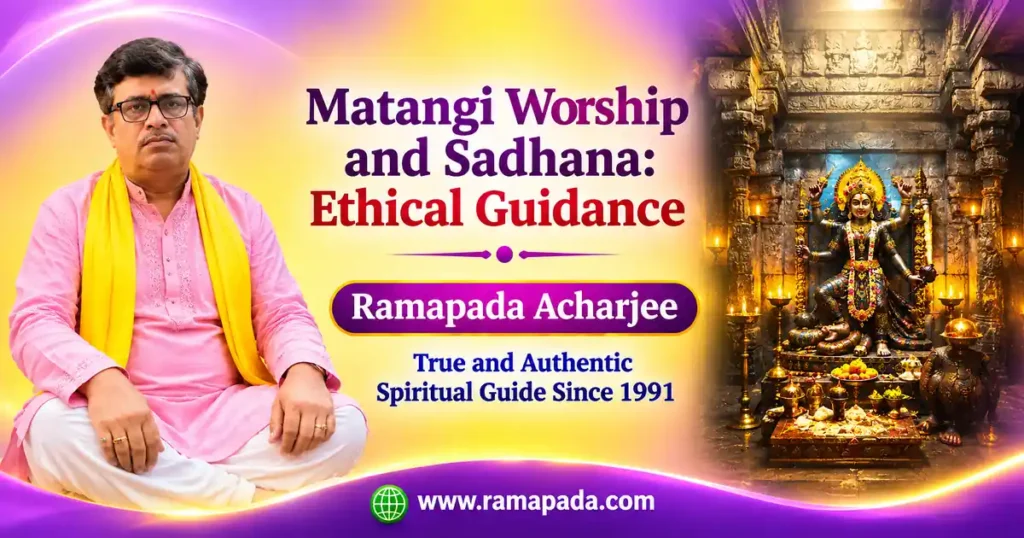
By Ramapada Acharjee
Practising Astrologer, Palmist, and Spiritual Consultant Since 1991
Matangi Worship and Sadhana requires far more maturity than simply memorising a mantra, buying ritual ingredients, or copying a set of instructions from the internet.
In my spiritual consultation practice, which began in 1991, I have met countless seekers with one pressing question:
“How can I get fast results from this ritual?”
Whenever someone asks me this, I gently steer them toward a much more fundamental question:
“Why do you want to do this practice, and what is truly happening to your mind while you do it?”
This distinction is essential when we study Devi Matangi.
As I explained in my foundational article on Matangi Mahavidya: The Ninth Mahavidya, Maa Matangi occupies a distinct place within the sacred Dasha Mahavidya tradition. She embodies speech, sacred knowledge, music, unconventional wisdom, creative intelligence, and the courage to look beyond social boundaries.
Major cultural and historical institutions, including the Metropolitan Museum of Art, preserve traditional art documenting Goddess Matangi as an esoteric form connected with speech (vak), music, learning, and Shakta traditions.
Therefore, authentic Matangi Worship and Sadhana must never be reduced to commercial promises, fear-driven rituals, or mechanical shortcuts. True spiritual practice always begins with clear intention, personal discipline, ethical responsibility, and honest self-examination.
আমার দীর্ঘ অভিজ্ঞতায় দেখেছি, মানুষ অনেক সময় সাধনার আগে ফলের কথা ভাবেন, কিন্তু নিজের মানসিক অবস্থার কথা ভাবেন না। কেন এই সাধনা করতে চাইছি, আমার ভিতরে ভয় আছে কি না, রাগ আছে কি না, অন্যকে নিয়ন্ত্রণ করার ইচ্ছা আছে কি না—এই প্রশ্নগুলিই আগে দেখা দরকার।
Understanding Worship Before Approaching Sadhana
Today, people frequently use the words “worship” (puja) and “sadhana” as if they mean the exact same thing. In reality, they represent entirely different levels of spiritual commitment and discipline.
Simple, devotional worship is gentle and accessible to everyone. It generally includes:
- Respectful daily remembrance of the Divine.
- Simple prayer and heartfelt reflection.
- Peaceful meditation and breathing exercises.
- Reading authentic sacred literature.
- Offering flowers, incense, or a lamp (diya) according to your family traditions.
- Cultivating inner gratitude and living by basic ethical conduct.
- Contemplating the virtues and divine qualities of the deity.
In contrast, classical Tantric sadhana demands a strict, highly specialised structure. It involves lineage-specific mantra systems (diksha), technical ritual sequences, detailed meditative visualisations (dhyana), strict dietary vows, and physical austerities.
These specialised practices were never intended to be pieced together from scattered forum posts or social media reels. For this reason, I always remind people to keep devotional prayer and advanced Tantric practice clearly distinct. I do not say this to frighten anyone; I say this to preserve context, safety, and respect for the tradition.
Simple Devotion and Specialised Practice Are Not the Same
A householder who feels a deep, loving connection to Mother Matangi does not need to plunge into complex esoteric rituals. You can approach her through sincere prayer and contemplation.
As a householder, you might pray for:
- Clarity and sweetness of speech.
- Wisdom before speaking in difficult situations.
- Better listening skills and empathy.
- Dedication to creative arts, writing, or music.
- Steady progress in academic studies.
- Humility when learning new subjects.
- Greater control over impulsive, hurtful words.
These are wholesome, noble aspirations.
Specialised tantric practice, however, belongs to a completely different domain. The Dasha Mahavidya tradition evolved across centuries through diverse philosophical, regional, and scriptural lineages. Practices vary significantly depending on the textual source, sampradaya, geographic region, and the living guidance of a qualified spiritual preceptor.
Because of these variations, reading five random articles online and stitching their methods together will never produce an authentic sadhana.
বরং অনেক সময় পাঁচটি আলাদা উৎস থেকে পাঁচ রকম নিয়ম নিয়ে একটি নতুন পদ্ধতি তৈরি হয়ে যায়, যার কোনো নির্দিষ্ট পরম্পরা নেই। তখন মানুষ ভাবেন তিনি প্রাচীন সাধনা করছেন, কিন্তু বাস্তবে হয়তো বিচ্ছিন্ন তথ্যকে নিজের মতো করে জুড়ে নিচ্ছেন।
Why Ethical Intention Matters in Matangi Worship
Because Maa Matangi governs speech and personal magnetism, popular online articles often focus on questionable topics: controlling others (vashikaran), defeating rivals, acquiring worldly influence, or gaining mysterious powers.
It is true that historical manuscripts and mediaeval texts record these desires. For example, records at The Met and academic historical archives note how historical devotees frequently invoked forms of Matangi to master the arts, gain higher learning, or establish influence.
However, we must understand an essential truth: a historical record is not an ethical instruction for your daily life.
Historical manuscripts simply record what people believed, feared, or attempted within a specific era. However, this historical context does not mean every recorded objective should be practiced today.
Therefore, consider this critical question: if someone’s core intention is, “I want to break another person’s free will so they obey me,” does wrapping that desire in spiritual vocabulary make it right?
In truth, it does not. Unethical actions never turn holy simply because a Sanskrit phrase is chanted over them.
এই বিষয়টি আমি খুব পরিষ্কারভাবে বলি—অন্যের স্বাধীন ইচ্ছাকে অগ্রাহ্য করে তাকে নিজের অধীনে আনার আকাঙ্ক্ষা যদি সাধারণ জীবনে ভুল হয়, তবে শুধু তাকে “সাধনা” নাম দিলেই তা নৈতিক হয়ে যায় না।
Worship Should Begin with Self-Examination
Before taking up any spiritual discipline, I encourage seekers to sit quietly and examine four specific areas:
| Area of Inquiry | Honest Self-Question |
|---|---|
| 1. Intention | Why am I doing this? Is it devotion and learning, or fear, jealousy, revenge, and ego? |
| 2. Expectation | Am I expecting an overnight miracle? Am I treating God like a business transaction? |
| 3. Responsibility | Am I prepared to do the practical, real-world work required to resolve my problems? |
| 4. Ethics | Will the outcome I seek harm, manipulate, deceive, or exploit any other human being? |
These questions are not barriers. Instead, they act as an inner shield, preventing spiritual practice from becoming a mask for unresolved emotional pain.
Matangi Worship and the Purification of Speech
Because Devi Matangi rules over vak (the spoken word), any authentic practice dedicated to her must refine the way we speak every single day.
If our daily conversation remains harsh, ritualistic worship loses its meaning.
A person might sit in front of an altar for an hour, repeating a sacred mantra with devotion. But what happens the moment they stand up?
Do they immediately speak harshly to their family members?
Perhaps they spread gossip and unverified rumours.
In business, they may deceive their clients.
Even small irritation may turn into abusive language.
Spiritual knowledge may also become a tool for belittling and humiliating others.
When this happens, the ritual in the puja room and the conduct in daily life move in opposite directions.
As I noted in my discussion on Matangi Mahavidya Mantra Meaning and Spiritual Significance, sacred sound cannot be separated from ethical speech. The Goddess of divine expression cannot be honoured while our ordinary speech remains deliberately unkind.
The First Sadhana May Be Restraint
People often assume sadhana must be dramatic or mysterious. In my experience since 1991, the most profound spiritual disciplines are quiet, practical, and ordinary:
- Pausing before you reply in anger.
- Choosing not to pass along an unverified rumour.
- Having the courage to say, “I do not know.”
- Apologising sincerely when you speak unfairly.
- Listening attentively without interrupting others.
- Avoiding exaggeration when narrating a story.
- Speaking the truth without intending to hurt or humiliate.
- Keeping private matters confidential.
These actions may not look magical, but for a deity who governs speech, they represent the highest form of discipline. For most householders, mastering this simple restraint transforms life far more effectively than collecting dozens of mantras.
Matangi and Bagalamukhi: Restraint Before Expression
Within the classical order of the Dasha Mahavidyas, Devi Bagalamukhi appears just before Devi Matangi. This sacred sequence offers a brilliant psychological and practical lesson.
Devi Bagalamukhi represents stillness, stopping, and halting impulsive, destructive movement (stambhana). Devi Matangi represents refined, expressive, creative speech.
Applied to our daily communication:
Bagalamukhi teaches us to stop.
Matangi teaches us to speak wisely after we have stopped.
If you cannot pause and quiet your mind, you can never express yourself with genuine wisdom. This is why stillness and conscious expression always go hand in hand. The goal is never permanent silence; the goal is conscious, meaningful communication.
Why a Teacher or Lineage Matters in Advanced Practice
In traditional Tantra, genuine advancement depends upon direct human transmission (mentor-shishya parampara). The role of an authentic teacher is not to sell secrets or hand out magical formulas.
A responsible spiritual guide helps the seeker with:
- Real contextual understanding.
- Personal emotional and physical discipline.
- Firm ethical boundaries.
- Unpacking deep philosophical symbolism.
- Choosing practices suited to the student’s unique psychology.
- Assessing mental and emotional readiness.
- Clarifying the line between simple prayer and esoteric sadhana.
Maa Matangi’s background is rich and complex. In my article on Matangi Mahavidya Origin and Traditional Stories, I explained how her narratives cross conventional boundaries of ritual purity, forest living, social margins, and conventional food rules.
When people read these stories without a teacher, they often interpret them literally or sensationally. A mature guide helps you see the profound philosophical message underneath: that the Divine is present beyond human social divisions and artificial concepts of purity.
Reading About Tantra Is Not the Same as Practicing Tantra
Academic scholarship is immensely valuable. Museums, universities, and religious historians have done exceptional work documenting how Shakta traditions developed over time.
For example, the British Museum’s major exhibition and catalogue, Tantra: Enlightenment to Revolution, provides historical insight into the Mahavidyas and Matangi’s role within Indian art and philosophy.
These historical works help us understand cultural heritage. However, studying a historical ritual manuscript does not mean you should attempt it at home.
Consider this comparison: reading a surgical textbook does not make you a surgeon, nor does it qualify you to perform an operation. In the exact same way, reading academic religious history is completely different from undergoing personal ritual initiation.
Matangi’s Unconventional Symbolism Requires Maturity
Devi Matangi’s traditional iconography carries deep spiritual meaning that cannot be understood through surface-level thinking. Traditional texts portray her with distinct elements:
- Emerald green complexion, representing life, growth, and nature.
- The musical vina, signifying mastery over sound, resonance, and arts.
- Association with wilderness, forest groves, and birds like the parrot.
- Presence in marginal spaces that transcend rigid social hierarchies.
- Deep connection to higher wisdom (para vidya) and direct creative insight.
Historic prints, such as those preserved in The Met’s collection showing Dhumavati and Matangi, demonstrate how Mahavidya imagery deliberately disrupts standard social expectations.
As I emphasized in Matangi Mahavidya Iconography and Symbolism, sacred imagery is not a literal photograph. It is a visual language that communicates profound philosophy through colour, posture, tools, and symbolic tension.
Worship Is Not a Competition
Another unfortunate habit I have observed over the years is spiritual pride and competition.
Seekers sometimes argue:
“I complete more rounds of japa than you.”
“My ritual is much more powerful than yours.”
“My lineage is older and superior.”
“I have accumulated more initiations and visited more shrines.”
This competitive mindset reduces sacred life to social status.
Maa Matangi, who represents the marginalized and breaks through false social arrogance, provides the perfect cure for this pride. Spiritual depth is never measured by ritual showmanship.
Often, a humble person who works honestly, speaks kindly, cares for their family, and treats neighbors with dignity shows far greater spiritual maturity than someone who brags about complex rituals.
সাধনা যত গভীর হয়, নিজের সাধনা নিয়ে প্রচার করার প্রয়োজন ততই কমে আসা উচিত। আধ্যাত্মিক জীবন যদি অহংকার বাড়ায়, তবে কোথাও না কোথাও আত্মসমীক্ষার দরকার আছে।
Household Devotion Should Remain Grounded
For most of us living family lives, spiritual devotion must support our daily duties, not replace them.
Every householder has practical responsibilities:
- Earning an honest living.
- Paying household bills.
- Caring for the health of aging parents and children.
- Fulfilling workplace and professional commitments.
- Nurturing honest relationships.
- Making practical life choices and taking responsibility for the outcomes.
Devotion must strengthen your ability to handle these duties.
If you face financial hardship, prayer brings mental resilience, but you still need disciplined budgeting. If a relationship is strained, meditation creates calm, but open communication is still necessary. If you want career growth, prayer sharpens your focus, but upgrading your skills and working diligently are indispensable.
Spiritual devotion and practical effort must always walk together.
A Safe Devotional Framework for Ordinary Seekers
You do not need secret rituals to connect with Mother Matangi. Any sincere seeker can follow this safe, grounded daily approach:
Begin with Silence: Sit quietly for five minutes before your day begins so that your thoughts can settle.
Remember the Divine with Respect: Contemplate Maa Matangi’s core qualities—wisdom, sweet speech, knowledge, creative focus, and clarity.
Read Deeply Rather Than Widely: Instead of collecting dozens of obscure mantras online, study one authentic scriptural or philosophical text with patience.
Examine Your Daily Words: Reflect honestly on whether your speech today was truthful, gentle, and necessary.
Select One Small Habit to Improve: For instance, you can resolve: “Today, I will not interrupt when someone is speaking.”
Close with Sincere Gratitude: Prayers do not always need requests for favours. Often, thanking the Divine for life, breath, and awareness is more than enough.
Sincere practitioners do not need secret initiations to begin this path; these practical steps directly reflect the true spiritual essence of Devi Matangi.
Why Fear-Based Worship Should Be Avoided
Fear is the enemy of genuine spiritual growth. When people are frightened or anxious, they become targets for manipulation.
Over the decades, I have comforted many clients who were told alarming things:
“If you stop this practice midway, terrible disasters will strike your family.”
“Someone has cast a destructive spell on you.”
“Only an extremely costly ritual performed by me can save your career.”
“You must pay immediately, or misfortune will follow.”
These tactics build unhealthy dependency. Responsible spiritual guidance removes fear; it never creates it.
No ethical astrologer, priest, or consultant should ever frighten a vulnerable person to extract money, obedience, or influence. A true spiritual relationship leaves you feeling grounded, steady, and clear-minded.
Matangi Worship Should Not Be Used to Control Relationships
This is an area where clear ethical boundaries are vital. People often seek spiritual solutions when going through painful relationship struggles.
They may wish for:
- An ex-partner to return against their wishes.
- A spouse may be expected to become completely submissive.
- Someone may wish for a specific individual to accept a marriage proposal.
- In other cases, a rival or relative may be expected to yield without question.
Heartbreak is painful, and these desires are human. However, another human being is a living soul with their own free will, not an object to be possessed or controlled.
A healthy spiritual outlook honours human dignity and mutual consent:
- Pray for personal clarity and emotional healing.
- Where reconciliation is healthy, seek mutual understanding and peace.
- Ask for the inner courage to speak honestly.
- Finally, cultivate the maturity to accept what cannot be changed.
Spiritual practice must never be turned into an excuse for coercion or manipulation.
The Difference Between Influence and Manipulation
Human beings naturally influence one another. Teachers inspire students, parents guide children, writers move readers, and spiritual consultants advise clients.
The question is not whether influence exists, but how we use it:
Ethical Influence: Respects the other person’s intelligence, shares information transparently, and preserves their freedom to choose.
Selfish Manipulation: Conceals truth, plays on guilt or fear, and seeks to take away personal freedom for selfish gain.
Keep this distinction in mind whenever you read older texts connecting Matangi with mastery, charm, or influence. Those passages reflect a specific historical setting; they should never be turned into methods for modern manipulation.
Knowledge Must Produce Responsibility
Maa Matangi’s sacred connection to wisdom places a serious moral responsibility upon anyone who studies or teaches.
Knowledge naturally creates an imbalance of power. When you know something another person does not, you face an ethical choice:
You can use your knowledge to educate and uplift.
Or you can use your knowledge to exploit and dominate.
Experienced spiritual consultants know that distressed clients will believe almost anything out of vulnerability. Similarly, teachers realize how hesitant students can be when questioning authority. In public life, seasoned speakers also know that mere charisma is easily mistaken for absolute truth.
This is why knowledge must always be anchored in strong ethics. In classical iconography, Maa Matangi shares deep symbolic ties with Devi Saraswati, both holding the sacred vina and manuscripts. Wisdom without ethical integrity quickly degenerates into arrogance.
Creativity Can Also Become Sadhana
Devi Matangi is the patron deity of the fine arts. For artists, musicians, writers, sculptors, and educators, disciplined creative practice is a true sadhana.
Consider how the creative process refines the soul:
A musician practicing scales for hours learns true patience and humility.
Through repeated revision, a writer discovers that the first impulsive idea is rarely the clearest.
By listening to recorded performances, public speakers discover where clarity was lost.
Students, meanwhile, develop resilience and discipline by correcting their mistakes.
Classical depictions of Saraswati and Matangi celebrate the vina, palm-leaf manuscripts, and prayer beads. These sacred emblems remind us that divine inspiration and steady human effort belong together.
True creativity is not just a sudden flash of inspiration. It is daily practice, honest editing, patient listening, and dedicated craftsmanship.
The Problem with Spiritual Shortcuts
Modern digital culture heavily promotes mechanical shortcuts to spiritual success:
Problem → Secret Mantra → Fixed Count → Guaranteed Miracle
Life does not work this way.
A strained marriage usually stems from years of unspoken pain and communication gaps.
Financial difficulties often involve market shifts, family health expenses, career changes, or budget issues.
Career stagnation can result from skill deficits, changing industries, or emotional burnout.
Prayer and spiritual contemplation can give you the mental clarity and strength to handle these realities. However, worship will never erase the need for practical effort. Be cautious whenever anyone promises absolute guarantees where life itself offers none.
The Real Measure of Matangi Sadhana
The authentic test of Matangi worship is never whether you see visions or have unusual experiences while meditating. The true proof appears in your character and daily interactions:
Has your everyday speech become gentler and more thoughtful?
Have you become a better, more patient listener?
Have your unnecessary arguments at home and work decreased?
Is your study and learning more disciplined?
Are you more consistent in your creative endeavours?
Has your arrogance diminished?
Have you stopped trying to manipulate people to get your way?
Do you treat others with greater fairness and respect?
Can you admit your mistakes openly and make amends?
These results may look ordinary to the outside world, but they represent the deepest, most authentic spiritual transformation possible.
A Seven-Day Ethical Reflection
If you wish to honour Devi Matangi in daily life without undertaking complex rituals, try this week-long reflection:
Day 1: Speech → Observe your tone; eliminate unnecessary harshness.
Day 2: Listening → Listen completely; do not interrupt anyone while they speak.
Day 3: Truth → Speak accurately; avoid exaggeration or half-truths.
Day 4: Knowledge → Check facts carefully before repeating any information.
Day 5: Creativity → Dedicate focused, uninterrupted time to practice one skill.
Day 6: Humility → When you do not know an answer, simply say, “I do not know.”
Day 7: Reflection → Review your week; see how your words affected those around you.
This discipline requires no secret initiation, yet it mirrors the spiritual essence of Devi Matangi.
Matangi and the Responsibility of Spiritual Advisers
Those of us who advise others—astrologers, palmists, counsellors, spiritual mentors, and teachers—carry a sacred duty.
A person in distress often remembers a single sentence from an adviser for years. Because our words carry weight, we must avoid reckless, absolute pronouncements.
There is an enormous ethical difference between saying:
“This catastrophe will definitely strike you unless you do this ritual.”
and saying:
“According to astrological indicators, this is a sensitive period requiring caution, but your practical decisions and personal efforts remain decisive.”
Responsible guidance leaves room for human dignity and common sense. Fear-based speech only breeds weakness and dependency.
Since 1991, my work has taught me one enduring lesson: people remember how your words made them feel long after they forget technical explanations. That reality demands utmost honesty from anyone who guides others.
Traditional Texts Should Be Approached with Context
As I discussed in Matangi Mahavidya in Shakta and Tantric Scriptures, traditional scriptures must always be read within their historical and philosophical context.
Ancient manuscripts frequently employ:
- Multi-layered symbolic imagery.
- Specialized esoteric terminology.
- Poetic exaggeration to emphasize a point.
- Culture-specific idioms of a past era.
- Philosophical metaphors intended only for initiated students.
When modern readers take these descriptions literally, confusion follows. Careful scholarship, historical awareness, and sound ethical guidance keep us grounded in truth.
When to Step Away from Spiritual Practice and Seek Practical Help
Spiritual practice has clear, healthy boundaries. It should nurture your life, never replace essential professional care:
Medical Concerns: Consult a qualified doctor or hospital immediately.
Domestic Abuse or Danger: Reach out for legal protection and safety resources.
Legal Disputes: Seek guidance from an experienced legal professional.
Severe Mental Distress or Depression: Consult a licensed mental health therapist or psychiatrist.
Heavy Debt or Financial Crisis: Work with a qualified financial advisor to restructure your finances.
Prayer can accompany practical action. It must never become an excuse to delay it. A mature spiritual tradition always honours practical expertise.
Frequently Asked Questions
Is anyone allowed to worship Matangi Mahavidya?
Yes. Sincere devotion, prayer, studying authentic texts, and ethical reflection are open to all seekers. However, advanced Tantric sadhana involves strict lineage-specific rules and should never be undertaken casually without qualified personal guidance.
Is initiation (diksha) mandatory for Matangi worship?
Formal initiation is not required for everyday devotional prayers, reading stotras, or ethical reflection. You can pray peacefully using your established family traditions. Advanced, specialized Tantric practices, however, traditionally require direct guidance from an authentic preceptor.
Is it safe to chant a Matangi mantra found on the internet?
Public websites make many sacred syllables accessible, but reading a mantra online cannot provide its authentic lineage context, correct pronunciation, or philosophical foundation. It is far wiser to focus on simple devotional prayers or classical hymns rather than experimenting with esoteric mantras without guidance.
Is Matangi worship dangerous in daily life?
No, genuine devotion is never dangerous. Sensational, fear-driven claims are completely unfounded. The only real harm comes from reckless, manipulative rituals or following exploitative advice that promotes superstition and dependency.
Can devotion to Devi Matangi refine speech and communication?
Maa Matangi embodies divine speech, music, and learning. While sincere worship inspires internal discipline, real-world improvement still requires deliberate effort: listening patiently, reading widely, practicing articulate communication, and speaking with consistent kindness.
Can this sadhana be used to control or influence another person?
Although historical texts document rituals related to influence and attraction, authentic modern spirituality strictly honors individual free will and mutual consent. Spiritual practice must never be degraded into an instrument to manipulate, control, or dominate another human being.
What practices should a householder focus on?
Householders should prioritize truthful speech, attentive listening, lifelong learning, dedication to family duties, honest work, and quiet, loving devotion.
Is an expensive ritual necessary to receive divine grace?
Not at all. Spiritual value cannot be measured in monetary terms. Always exercise caution if someone uses fear, guilt, or urgent threats to pressure you into sponsoring expensive rituals.
How do I recognize an authentic and responsible spiritual teacher?
Genuine teachers encourage clear thinking, emotional maturity, moral responsibility, and practical judgment. Rather than demanding blind obedience or charging exorbitant sums for “secret remedies,” they help you build inner strength and clarity.
What is the core lesson of Matangi worship?
The essential truth is that sacred worship and everyday communication must align. Spiritual practice fulfills its purpose only when the wisdom we celebrate before an altar transforms how we speak, listen, and behave in daily life.
A Responsible Way Forward
Ultimately, Matangi Worship and Sadhana invites us to rethink our entire spiritual journey.
Is worship merely a tool to extract things from the universe? Or is it a path to refine the human being who is praying?
Initially, seekers might seek sacred knowledge, yet true wisdom must always lead to humility.
Furthermore, dedicating effort to sweeter speech should gradually mature into ethical responsibility.
In addition, any desire for social influence must be carefully tempered by respect for free will.
Finally, external rituals accomplish their highest purpose only when they transform our everyday character.
This remains the truest measure of spiritual progress.
আমার কাছে সাধনার সত্যিকারের মূল্য তখনই বোঝা যায়, যখন পূজার ঘরের বাইরে তার প্রভাব দেখা যায়। মানুষ আগের তুলনায় একটু কম রাগ করছে, একটু বেশি শুনছে, ভুল হলে ক্ষমা চাইছে, অন্যকে ছোট না করে নিজের কথা বলছে, জ্ঞান নিয়ে অহংকার না করে শেখার চেষ্টা করছে—এই পরিবর্তনগুলিই অনেক সময় সবচেয়ে গভীর ফল।
Mother Matangi’s worship must never be degraded into fear, control, or empty promises. Her divine wisdom calls us toward conscious speech, disciplined learning, creative dedication, and personal integrity.
Therefore, let us learn to respect the power and consequence of our everyday words before attempting to master sacred mantras.
Similarly, we must learn to govern our own impulsive reactions before attempting to control or influence other people.
Above all, let us strive to live our ordinary daily routines with greater kindness and awareness before chasing extraordinary mystical states.
That is the true, responsible path to Devi Matangi’s wisdom.
Jai Maa Matangi.
— Ramapada Acharjee
About the Author and Spiritual Guidance
Ramapada Acharjee is a Kolkata-based astrology and spiritual guidance practitioner, practicing since 1991. Learn more about his background on the About Ramapada Acharjee page.
If you would like to discuss the devotional meaning of these traditions, you can explore his approach to spiritual guidance. For appointment inquiries, visit Contact Ramapada Acharjee.
मेरे पास आध्यात्मिक चर्चा का अर्थ भय बढ़ाना नहीं, बल्कि विषय को सही ढंग से समझने में सहायता करना है। परामर्श लेने से पहले अपने प्रश्न, अपेक्षा और वास्तविक स्थिति को स्पष्ट रूप से साझा करें।
📍Consultation available in Kolkata, Guwahati, Siliguri, Tarapith & online by prior appointment (in-person & online)
📞 Consultant: Ramapada Acharjee
Professional Experience: True & Authentic Spiritual Guide Practicing Since 1991
📞 Phone / WhatsApp: +91 98749 54063
✉️ Official Email: astrologer@ramapada.com
🌐 Website
— Ramapada Acharjee
True and Authentic Spiritual Guide Since 1991
You may also read:
Genuine Tantrik in Mayang, Assam
Kamakhya Tantrik—Exploring the Mystical Tradition
Powerful Tantrik in Kolkata
Online Astrology Reading: Modern Approach to Ancient Wisdom
Astrology by Date of Birth – Unleash the Secrets of Astrology
Tarapith Tantrik – Exploring the Mystical Tradition
🔗 Related Category: Tantra
