
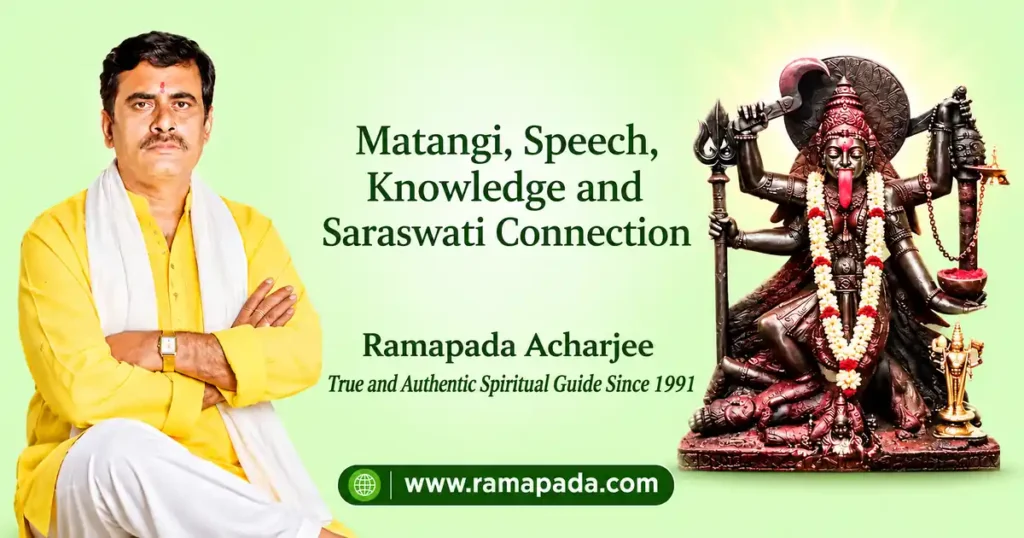
Authentic Wisdom and Practical Reflections
By Ramapada Acharjee
Practising Astrologer, Palmist, and Spiritual Consultant Since 1991
The spiritual link connecting Devi Matangi, sacred speech (Vak), intuitive knowledge, and Maa Saraswati represents one of the most rewarding areas of contemplation within the Dasha Mahavidya tradition.
Frequently, seekers who first explore Devi Matangi encounter a simple description:
“Matangi is simply the Tantric Saraswati.”
While a meaningful foundation supports this comparison, stopping at that single sentence creates confusion. Devi Matangi never acts as a mere alternate name for Saraswati, nor does she exist as a simple duplicate.
The Intersection of Speech, Knowledge, and Living Experience
Understanding her place in spiritual life requires deep reflection on where these symbolic currents align and where their traditions differ. Most importantly, one must examine why the Mahavidya tradition presents divine knowledge through Matangi in such an unconventional form.
Decades of spiritual consultations conducted since 1991 reveal one steady reality: possessing raw information and knowing how to communicate it with empathy remain two entirely different abilities.
For instance, an individual often knows the absolute truth yet delivers it so harshly that the listener feels crushed.
Similarly, remarkable scholarship can exist alongside an inability to explain foundational principles with clarity.
In contrast, another speaker might present words with polished charm while lacking genuine substance or honesty.
Consequently, this exact intersection makes Devi Matangi’s teaching indispensable for daily life.
দীর্ঘ কয়েক দশকের বাস্তব অভিজ্ঞতায় বারবার একটি সত্য সুস্পষ্টভাবে প্রত্যক্ষ করা যায়—তথ্য জানা আর সেই জ্ঞানকে সংবেদনশীলভাবে প্রকাশ করতে পারা সম্পূর্ণ ভিন্ন বিষয়। বহু মানুষের শাস্ত্রজ্ঞান থাকে, কিন্তু কখন কীভাবে কথা বলতে হবে, কোন কথা বলা উচিত এবং কোন কথা নীরব রাখা উচিত—এই বিচারবোধটির অভাব সর্বত্রই পরিলক্ষিত হয়।
Ultimately, Devi Matangi unifies conscious knowledge, spoken expression, active listening, creative nuance, and moral responsibility into a single spiritual path.
Matangi and the Sacred Power of Speech (Vak Shakti)
Human speech easily stands as the most potent instrument in the world. Indeed, words possess the power to heal or harm within a fraction of a second:
For example, a compassionate phrase frequently rekindles hope in someone facing deep despair.
Conversely, a single bitter sentence spoken in anger shatters trust built across thirty years.
Moreover, a dedicated teacher’s patient guidance illuminates a student’s entire life path.
Meanwhile, a parent’s persistent, sharp criticism lingers as painful self-doubt in a child’s mind for decades.
Furthermore, a spiritual consultant’s demeanour either brings steady composure to an anxious visitor or amplifies fear needlessly.
Because of these observable realities, the connection between Matangi and Vak—sacred speech—must never be reduced to superficial rhetoric or clever debate.
Undoubtedly, speech carries spiritual weight because it produces undeniable consequences in this world.
As noted in the detailed study Matangi Mahavidya, the Ninth Mahavidya, Matangi never represents idle chatter; rather, she personifies the inner purification of communication through deliberate awareness.
Thus, the vital inquiry for self-realisation never asks:
“Can a person speak?”
Instead, the deeper question always asks:
“Can speech be delivered truthfully, clearly, constructively, and at the right time?”
এই স্থানেই মাতঙ্গীর দর্শন মানুষের প্রাত্যহিক আচরণে অত্যন্ত প্রাসঙ্গিক হয়ে ওঠে। শুধু সুন্দর ভাষায় কথা বলাই, কিন্তু বাকশক্তি নয়। সত্য বাক্য কখন বলতে হবে, কীভাবে উপস্থাপন করতে হবে এবং সেই উচ্চারণে অন্য কেউ অনর্থক আঘাত পাচ্ছেন কি না—এই সূক্ষ্ম বিবেকবোধ বজায় রাখাই হলো বাকশুদ্ধির যথার্থ সাধনা।
Why Is Matangi Connected with Saraswati?
This deep-rooted connection exists because both deities govern overlapping areas of human intellect, culture, and creative expression.
Shared Cultural and Symbolic Realms
| Attribute / Domain | Maa Saraswati | Devi Matangi |
|---|---|---|
| Primary Realm | Classical learning, Vedic studies, formal arts | Esoteric insight, spontaneous speech, living wisdom |
| Sacred Implements | The Vina, sacred scriptures, white lotus, crystal rosary | The Vina, symbolic implements, emerald radiance, flora |
| Expression Form | Polished, structured, institutional, orderly | Intuitive, raw, border-crossing, transformative |
| Vocal Level | Vaikhari (audible speech) & Madhyama (thought) | Pashyanti (visionary speech) & Para (transcendent source) |
Throughout the Indian subcontinent, Maa Saraswati commands reverence as the guardian of:
- Systematic knowledge and academic education
- Refined speech and classical poetry
- Instrumental music and melodic composition
- Formal scholarship and sacred texts
- Pure intellectual contemplation and artistic discipline
Curated exhibits at cultural institutions such as the Metropolitan Museum of Art frequently document Maa Saraswati through iconic motifs: the melodic vina, sacred manuscripts, prayer beads, and the pristine lotus throne.
Similarly, Devi Matangi presides over these identical creative realms: spoken articulation, musical mastery, creative fertility, and profound intellect. Historical collections at the Met preserve representations of Devi Matangi that specifically identify her as an esoteric manifestation linked with Saraswati’s sphere of music, learning, and expressive power.
Hence, this substantial overlap clarifies why practitioners refer to her as the Tantric counterpart to Saraswati. Nevertheless, the Tantric dimension introduces an entirely new perspective on what constitutes genuine knowledge.
Saraswati and Matangi: Deeply Aligned Yet Distinct
Maa Saraswati reveals learning through balance, crystalline clarity, structured order, social propriety, and disciplined scholarship. Visually, her white garments, radiant swan (Hamsa), and classical manuscripts represent illumination, ethical harmony, and ritual purity.
In contrast, Devi Matangi enters human consciousness from an entirely different direction:
[Maa Saraswati] → Formal Culture, Systematic Study & Structured Discipline
↓ The Unified Current of Divine Wisdom ↓
[Devi Matangi] → Lived Insight, Unconventional Truth & Direct Experience
She directly challenges habitual assumptions by asking:
Does wisdom belong only to formal universities, prestigious titles, socially favoured teachers, and sanctioned ritual environments?
Her core scriptural narratives consistently challenge conventional boundaries:
As discussed in Matangi Mahavidya Origin and Traditional Stories, her sacred narratives place her deliberately beyond standard notions of ritual orthodoxy and social privilege.
Furthermore, she maintains an intimate connection with wild forests, peripheral communities, and unconventional offerings, illustrating that divine truth remains completely untainted by artificial social hierarchies.
Therefore, Saraswati demonstrates the sacredness of disciplined study, whereas Matangi asks if seekers possess the humility to welcome truth when it arrives from an unassuming, uncredentialed guide.
মা সরস্বতীর আরাধনায় বিশুদ্ধ জ্ঞান, শাস্ত্রচর্চা, বিধিবদ্ধ শিক্ষা ও মার্জিত সংস্কৃতির রূপটি ফুটে ওঠে। পক্ষান্তরে, মাতঙ্গীর তত্ত্ব সেখানে আরও একটি বৃহত্তর প্রশ্নের অবতারণা করে—সমাজ যাঁকে খুব একটা গুরুত্ব বা পদমর্যাদা দেয় না, তাঁর কাছ থেকেও যদি কোনো গভীর সত্য বা শিক্ষা আসে, তবে তা অবনত মস্তকে গ্রহণ করার মতো মানসিক ঔদার্য আছে কি না।
Without a doubt, that question remains remarkably urgent today.
Knowledge Does Not Belong Only to the Powerful
Human institutions instinctively build social hierarchies. Frequently, society defers to:
- Academic degrees and institutional badges
- Material wealth, pedigree, and professional titles
- Polished accents and social privileges
These external structures certainly have practical value, and rigorous scholarship deserves respect. However, they do not hold an exclusive monopoly on true insight.
For instance, an oldage villager without formal schooling often understands human character with unmatched precision through decades of observant living.
Likewise, a traditional artisan understands raw wood or stone in ways that no textbook can fully convey.
Similarly, a smallholder farmer reads seasonal changes and soil conditions through generational experience.
Meanwhile, a folk musician conveys heartbreak, devotion, and longing through simple notes long before encountering classical terminology.
In the same manner, a loving mother senses emotional anxiety in her child’s silence without consulting psychology manuals.
Matangi’s sacred symbolism prompts society to honour insight outside familiar comfort zones. Of course, this does not mean abandoning critical thinking or accepting every casual claim without evidence. Discernment remains essential. Rather, it prevents practical wisdom from being dismissed simply because the speaker lacks social prestige.
The Vina: When Knowledge Becomes Living Harmony
Both Maa Saraswati and several classical forms of Devi Matangi carry the vina. This musical instrument serves as far more than an ornamental addition.
To play the vina with true skill, an artist must master:
- Exact pitch and subtle microtones
- Steady tempo, rhythm (tala), and dynamic pace
- The discipline of the musical pause
- The balance between active performance and receptive listening
- Honest emotional nuance and expression
Everyday human communication requires this exact same sensitivity:
[Careless Talking] → Continuous Sound Without Pauses = Unbearable Noise
[Conscious Speech] → Words Balanced by Thoughtful Pauses = Meaningful Harmony
If an instrumentalist struck every wire at maximum volume without a single pause, the performance would become deafening noise. In the same way, if a person voices every fleeting impulse, conversation collapses into friction.
Consequently, a thoughtful silence never acts as an empty void; rather, it provides the interval that gives clarity, dignity, and resonance to the words that follow.
Museum records at the British Museum highlight the vina in depictions of Saraswati as an emblem of creative discipline and harmony. Similarly, when seen in Matangi’s hands, this instrument teaches three foundational truths:
True speech requires natural pacing.
True wisdom requires receptive listening.
True maturity means knowing when quiet restraint is far more constructive than another argument.
সংগীতের ক্ষেত্রে যেমন কেবল নিরবচ্ছিন্ন ধ্বনি থাকলেই হয় না, প্রতিটি সুরের মাঝে যথাযথ বিরতি থাকা প্রয়োজন; তেমনই প্রাত্যহিক আলাপচারিতাতেও শুধুই কথা বলা যথেষ্ট নয়, মন দিয়ে শোনার ক্ষমতাও অপরিহার্য। বহু সামাজিক ও পারিবারিক সম্পর্ক ভুল মন্তব্যের কারণে যতটা ভাঙে, অপর পক্ষের অনুচ্চারিত বক্তব্যটি শান্ত হয়ে না শোনার কারণে ক্ষতি তার চেয়ে কম হয় না।
Conscious Speech Begins with Mindful Listening
Many people equate good communication simply with the ability to speak fluently. Over decades of consulting work, however, observation proves that attentive listening forms the far more essential half of wisdom.
When consultations begin, a visitor often opens with an initial, surface-level complaint:
If the consultant interrupts immediately to provide an astrological or remedial opinion, they risk missing the actual emotional wound hidden beneath the words.
In many cases, the issue voiced in the first five minutes does not represent the central problem at all.
Consider how these everyday conversations typically unfold:
A visitor explains that career progress feels entirely blocked, yet patient listening often uncovers an underlying fear of vulnerability or past disappointment.
Another individual mentions that family life feels deeply unhappy, and then, as the room falls quiet, years of unvoiced concerns and neglected emotional needs slowly come to light.
Someone inquires which specific ritual they should perform, but later, through gentle dialogue, it becomes clear that practical guidance, calm reassurance, and organized steps are what they truly need.
Thus, listening clarifies perception. Without deep listening, even well-meaning advice targets the wrong situation.
Devi Matangi’s affinity with speech never endorses nonstop talking; rather, cultivating a calm, receptive ear serves as her foundational discipline.
The Four Conscious Stages of Communication
In daily life, mindful communication follows four steady steps:
1. RECEIVE → 2. REFLECT → 3. REFINE → 4. RESPOND
Listen well → Check facts → Pick words → Speak clear
Receive: Listen fully without mentally preparing a counter-argument while the other person is still speaking.
Reflect: Step back momentarily to separate objective realities from raw personal bias or wounded pride.
Refine: Choose words that address the root problem directly without humiliating the other party.
Respond: Speak only after evaluating the likely impact created by the words.
While simple in concept, this process requires daily discipline. Modern communication channels work against this poise by constantly rewarding instantaneous friction:
For instance, people read an inflammatory headline and leave an impulsive reaction.
Similarly, someone reads a message while irritated and sends a biting reply before breathing settles.
Therefore, Matangi’s guidance asks for an intentional rhythm:
Receive → Reflect → Refine → Respond
instead of the exhausting cycle of:
React → Regret → Defend → Apologize.
Matangi, Bagalamukhi and the Discipline of Expression
The traditional sequence of the Dasha Mahavidyas reveals an astute understanding of human psychology:
[Eighth Mahavidya: Bagalamukhi] → Complete Restraint, Stillness, Stopping Reaction
↓
[Ninth Mahavidya: Matangi] → Refined Expression, Articulate Truth, Clear Action
Devi Bagalamukhi embodies stillness, immobilization of conflict, and deliberate restraint. Devi Matangi follows immediately, presiding over refined speech, artistic creativity, and truthful communication.
This sacred progression contains practical wisdom:
Before authoritative speech can develop, careless chatter must first be silenced.
Before responding effectively, a person must learn to pause.
Before sharing deeper insights, emotional reactions must be calmed.
Countless life situations prove that twenty seconds of calm restraint can prevent years of unnecessary conflict:
First, an angry digital note is drafted in haste.
Next, an irritated relative fires back an even sharper response.
Consequently, relatives take sides, screenshots circulate, and old grievances revive.
Within minutes, an avoidable clash erupts that requires months of mediation to heal.
Symbolically, Maa Bagalamukhi commands: “Stop. Halt raw reaction.”
Then, Maa Matangi follows with the vital second question: “Now that your mind is calm, what is the most constructive way to express the truth?”
দশমহাবিদ্যার ক্রমানুসারে এই দুই দৈবী তত্ত্বকে পাশাপাশি বিচার করলে সত্যটি স্পষ্ট অনুধাবন করা যায়। বগলামুখী মানুষের তীব্র উত্তেজনার মুহূর্তে তাৎক্ষণিক প্রতিক্রিয়া স্তব্ধ করে সংযমী হতে নির্দেশ দেন, আর মাতঙ্গী শিক্ষা দেন সেই স্থিরতার পর কীভাবে পরিশীলিত ও মর্যাদাশীল ভাষার মাধ্যমে যথার্থ বক্তব্য উপস্থাপন করা উচিত।
Navigating Information Overload in the Modern Era
Human civilization currently exists in an extraordinary historical moment. Never before has society enjoyed such instant access to global information:
- Sacred scriptures, commentaries, and classical translations
- Peer-reviewed scientific, medical, and environmental research
- Extensive historical records and university archives
- Real-time global reporting alongside cultural analysis
- Millions of dynamic personal opinions and digital discussions
Yet, unlimited access to information does not automatically produce clear judgment. In reality, constant digital connectivity creates fresh complications. Seekers constantly need to separate:
- Verified facts from speculative assumptions
- Substantial expertise from confident performance
- Serious scholarship from viral content designed for clicks
- Compassionate spiritual traditions from commercialized shortcuts
- Original contextual teachings from isolated, cherry-picked quotes
This balance is particularly necessary when exploring Shakta and Tantric philosophy. As detailed in Matangi Mahavidya in Shakta and Tantric Scriptures, extracting single verses from traditional contexts and presenting them as universal guarantees damages genuine spiritual progress. The internet makes duplicating text effortless; however, it does not make lived understanding automatic.
Clarifying the Difference: Information, Knowledge, and Wisdom
Society often treats these three terms as interchangeable. In actual spiritual practice, they represent three very different stages of personal development:
WISDOM (Matangi’s Realm)
Discerning WHEN, HOW, and IF knowledge should be used.
KNOWLEDGE (Saraswati’s Study)
Understanding how different facts connect and work.
INFORMATION (Data & Facts)
Raw statements, measurements, and cataloged text.
Information: Collects the raw details and cataloged facts.
Knowledge: Grasps how these different elements connect systematically.
Wisdom: Determines whether, when, and how that insight should be applied for the common good.
Consider everyday examples:
For instance, a practitioner might memorize dozens of rituals. Wisdom decides which approach genuinely benefits the seeker—or whether quiet personal effort serves better than any ritual.
In addition, an individual might discover an associate’s personal vulnerability. Wisdom decides that exposing it serves no constructive purpose.
Similarly, a family member might easily win a household dispute through sharper arguments. Wisdom recognizes that winning an argument at the expense of someone’s dignity damages the bond.
Accordingly, this inner movement—from collecting information to embodying wisdom—forms the heart of Devi Matangi’s teaching.
The Saraswati Principle: Learning Requires Steady Discipline
While exploring these shared insights, one must also honor Maa Saraswati’s unique scriptural role.
Historical artwork at the Met preserves classic nineteenth-century representations of Devi Saraswati holding her musical instrument alongside traditional palm-leaf manuscripts. These iconic emblems remind everyone that steady competence requires patient, regular practice:
For example, an accomplished musician practices scales for years to achieve effortless expression.
In the same manner, a capable scholar reads, verifies sources, and reflects over decades.
Furthermore, a good writer crafts, edits, and reworks draft after draft.
Similarly, a serious seeker deepens character through sustained daily discipline, not by collecting borrowed quotes.
Therefore, whether approaching the path of Saraswati or Matangi, deep insight requires dedicated time and regular effort. There are simply no shortcuts to true personal growth:
বর্তমান ডিজিটাল যুগে তথ্য সংগ্রহ করা অত্যন্ত সহজ হয়ে দাঁড়িয়েছে ঠিকই, কিন্তু অনায়াসে তথ্য লাভ করা আর কোনো বিদ্যাকে নিষ্ঠার সাথে অন্তরে ধারণ করা এক কথা নয়। ইন্টারনেটের সংক্ষিপ্ত ক্লিপ, সামাজিক মাধ্যমের পোস্ট কিংবা কোনো শাস্ত্রীয় শ্লোকের আক্ষরিক অনুবাদ পাঠ করেই গভীর আধ্যাত্মিক তত্ত্ব উপলব্ধি করা সম্ভব নয়।
Ultimately, practical understanding develops through steady practice, critical reflection, honest corrections, and genuine humility.
Why Matangi Cannot Simply Be Labeled Saraswati
Calling Matangi the “Tantric Saraswati” serves as an accessible starting point, but stopping there overlooks her unique aspects.
Devi Matangi carries distinctive spiritual dimensions:
She actively embraces marginal communities and peripheral landscapes.
Moreover, she breaks through rigid, superficial notions of ritual purity.
She is connected to the Uchchhishta symbolism—reminding us that divine reality transcends human notions of clean and unclean.
Furthermore, she works directly through wild forests, intuitive art forms, and unconventional environments.
In doing so, she reveals the hidden transformative power within elements that conventional society rejects.
Historical artwork at the Met describes Matangi as an esoteric form of Parvati while noting her deep relationship with Saraswati’s arts and knowledge.
Hence, this multi-layered background shows why simplified labels fail to capture her role. Her tradition contains diverse theological layers, and we honor the path by respecting that depth rather than flattening it into a convenient phrase.
Speaking the Truth with Quiet Courage and Empathy
Honest speech is not always comfortable. While compassionate speech should be kind, ethical communication must also remain firm when needed:
For example, if an individual is being exploited, staying silent protects the wrong party.
Likewise, if misinformation spreads, responsible correction is necessary.
Furthermore, if a household continually ignores an unhealthy situation, calm, direct conversation cannot be put off forever.
Similarly, if a client asks for spiritual remedies out of fear or irrational anxiety, an ethical consultant must never feed that panic simply to please them.
Constructive communication requires both courage and empathy. Yet, there remains an enormous difference between:
Speaking the truth to heal versus using truth as a blunt weapon.
Often, people excuse harshness by saying: “This is simply honest speech.” Yet honesty delivered without care, right timing, or self-control easily turns into cruelty.
Therefore, Devi Matangi urges society to refine the truth before speaking: not to dilute reality or conceal facts, but to communicate in a way that respects the other person’s dignity.
The Natural Karma of Our Words in Everyday Life
No one needs to examine karma solely through a mystical lens; its practical results appear every day:
[Critical, Mocking Words] → Resentment, Isolation, and Loss of Trust
[Thoughtful, Clear Speech] → Confidence, Emotional Safety, and Healthy Bounds
For instance, belittling team members or domestic workers erodes mutual respect.
In like manner, chronic sarcasm toward a partner creates emotional distance.
Furthermore, comparing siblings breeds lifelong friction and self-doubt.
Similarly, humiliating a student damages their self-confidence for years.
In addition, circulating an unverified rumor damages personal and community trust.
Words travel, and digital messages travel even faster. Once a hurtful note, altered image, or careless public comment is uploaded, taking it back is nearly impossible. Consequently, Devi Matangi’s teachings on conscious speech are more urgent now than ever.
Five Reflective Questions for Mindful Communication
Before publishing a post, sharing a message, or entering a tense debate, five practical questions provide useful guidance:
Is it true? Have the actual facts been verified, or is hearsay being repeated?
Is it necessary? Does this comment add value, or does it simply fuel public noise?
Is it timely? Is the listener in a position to absorb this feedback right now?
Is it respectful? Can the point be articulated clearly without insulting someone’s dignity?
Would it be said in person? Would these exact words be spoken if the conversation took place face-to-face?
These simple checks help prevent unnecessary misunderstandings. Digital networks often encourage impulsive reactions because outrage increases engagement metrics. Spiritual discipline, by contrast, asks for intentional calm before speech.
When Knowledge Lacks Humility, It Turns into Pride
A central theme in Matangi’s teachings is the relationship between learning and humility.
Acquiring knowledge can enrich human character, yet it can also feed intellectual arrogance. The more that is learned, the easier it becomes to look down on others who lack similar opportunities.
Yet genuine education usually brings the opposite realization: the further one travels into any serious study, the clearer it becomes how vast the unknown remains.
For instance, a newcomer often feels complete certainty.
Conversely, an experienced scholar becomes measured and careful in their conclusions.
This reality holds true in philosophy, medicine, science, traditional astrology, law, and education:
Human circumstances are nuanced; no two life journeys are identical.
In addition, scriptural maxims require real-world context, and lived experience reveals exceptions.
Often, the most ethical answer is simply:
“This matter requires more careful examination before a considered opinion can be given.”
Undoubtedly, there is quiet dignity in that professional honesty.
জ্ঞান যখন অন্তরে যথার্থভাবে প্রস্ফুটিত হয়, তখন মানুষ উপলব্ধি করতে শেখে যে জাগতিক সমস্যার কোনো সহজ বা যান্ত্রিক সমাধান হয় না। অগভীর অহংকারের বশবর্তী হয়ে অনেকেই সবকিছু জেনে ফেলার দাবি করেন, কিন্তু প্রকৃত পাণ্ডিত্য মানুষকে ধীর, সহনশীল ও বিনয়ী করে তোলে।
Creative Expression as a Living Form of Wisdom
Devi Matangi and Maa Saraswati remind everyone that knowledge extends far beyond academic textbooks. Authentic creativity is itself a profound source of insight:
For example, traditional music, poetry, sculpture, and painting are forms of living wisdom.
Similarly, meaningful storytelling and patient craftsmanship preserve community memory.
In addition, the human voice communicates nuance through subtle pitch, pacing, and silence.
A simple melody can express grief that everyday language cannot convey. Likewise, a few lines of poetry can capture personal longing better than a technical treatise. Furthermore, traditional craft methods preserve generations of practical knowledge.
Exhibits at the National Museum and regional collections highlight how both deities link creative arts with intellectual maturity. Art, music, and writing are not merely decorative hobbies; rather, they represent foundational ways human beings understand their world.
The Difference Between Sounding Impressive and Being Clear
Speakers sometimes use complex jargon to appear intellectually superior. In practice, true understanding leads to clarity and simplicity:
[Incomplete Understanding] → Overcomplicated Vocabulary, Jargon, and Distant Tone
[Grounded Realization] → Plain Language, Relatable Metaphors, and Direct Clarity
When a person understands a subject well, they explain its essential principles in clear terms.
Indeed, this serves as a foundational guideline in professional consultations:
An anxious person facing a personal crisis does not need obscure terms; they need practical clarity and grounded steps.
Similarly, a family managing a major transition is not helped by an adviser showing off specialized vocabulary.
Specialized language and classical terms have their place in scholarship. But communication succeeds only when the person listening truly understands the message.
Devi Matangi champions effective, transparent speech over elaborate performance.
The Spiritual Power of Mantra: Sound Requires Understanding
In the companion article, Matangi Mahavidya Mantra Meaning and Spiritual Significance, it was explained why mantra practice should never be reduced to mechanical repetition.
Sacred syllables carry structural meaning:
Pronunciation requires care and breath awareness.
Repetition affects the nervous system and mental focus.
Personal intention, spiritual discipline, and moral context are fundamental.
Unfortunately, modern online spaces often treat mantra practice like an automated transaction:
Chant X times to secure Y financial or material outcome.
This commercial approach misses the transformative purpose of spiritual practice. Sacred sound is meant to refine character, not merely feed personal demands.
If someone repeats mantras for hours yet continues to speak deceitfully, humiliate colleagues, or spread malicious rumors, the spiritual purpose of sound is lost. The true test of practice is how life is conducted afterward.
A Seven-Day Practical Exercise in Conscious Speech
No elaborate arrangements are required to apply Devi Matangi’s insights to daily life. A simple seven-day discipline offers practical transformation:
Morning Intention
Before opening a phone or greeting family members, set a clear intention:
“Today, speech will be guided by mindfulness regarding tone, truth, and impact.”
Throughout the Day
Watch for Interruptions: Notice when a speaker cuts someone off before they finish.
Catch Exaggerations: Notice when details are inflated to sound impressive.
Observe Defensive Habits: Notice when arguments occur simply to protect personal ego rather than clarify facts.
Check the Tone: Notice when stress or irritation sharpens the voice.
Digital Communication
Read every message once before tapping send. Ensure it is clear, necessary, and respectful.
Handling Friction
When emotions run high, pause any response until breathing settles.
Evening Reflection
Take three quiet minutes before sleeping to consider:
Did communication help, comfort, or inform anyone today?
Was speech unnecessarily harsh to a family member, employee, or stranger?
Was listening practiced with patience, or did judgment rush in?
Was any unverified information forwarded or repeated?
Does any situation require an apology or clarification tomorrow?
This practical self-reflection represents a grounded, ethical discipline inspired by Devi Matangi’s wisdom.
The Healing Power of Reassuring Words
Hurtful comments can linger in a person’s memory for years. Thankfully, compassionate words also remain for a lifetime:
“Your potential is trusted.”
“That difficult situation was handled with genuine courage.”
“Your pain is heard and acknowledged.”
“That judgment was mistaken.”
“An apology is offered for speaking out of turn.”
“Take time; everything will be worked through step by step.”
These are straightforward, accessible phrases. Yet, spoken with genuine sincerity at the right time, they restore inner confidence.
Decades of consultations show that seekers do not always need another prediction. Often, they need clarity, reassurance, and someone who listens without rushing to judge them.
This is why Devi Matangi’s teachings remain so relevant: her spiritual symbolism points toward conscious, healing communication.
Frequently Asked Questions
Is Devi Matangi identical to Maa Saraswati?
No. While they share rule over speech, music, wisdom, and the creative arts, they belong to different theological traditions. Devi Matangi is the Ninth Mahavidya, carrying distinct Tantric dimensions and connections with marginal, border-crossing wisdom.
Why is Matangi frequently referred to as the Tantric Saraswati?
She is called this because she governs Saraswati’s classical domains—articulation, intellect, musical harmony, and artistic skill—within the esoteric Shakta Mahavidya tradition, where knowledge is freed from conventional social restrictions.
What does Matangi symbolize in daily life?
She embodies refined speech (Vak), conscious communication, clear listening, artistic expression, unconventional insight, and the courage to turn intellectual study into compassionate action.
What is the primary difference between Saraswati and Matangi?
Maa Saraswati represents structured learning, academic discipline, classical purity, and formal scholarship. Devi Matangi extends this domain, reminding everyone that authentic wisdom also thrives outside conventional social institutions and standard orthodoxies.
Why does Devi Matangi hold a vina?
Like Saraswati, Matangi holds the vina as an emblem of cosmic sound, vocal rhythm, and internal harmony. It teaches that speech requires timing, dynamic balance, and thoughtful pauses to avoid becoming mere noise.
Why is conscious speech central to Matangi’s path?
Speech directly bridges inner thoughts with the outside world. Words shape families, professional teams, personal reputation, and peace of mind. Refined speech is a practical form of spiritual discipline.
Does Matangi teach that every unconventional opinion is valid?
No. Respecting unconventional perspectives does not mean abandoning critical thinking or common sense. Matangi teaches openness to wisdom from humble or unexpected sources, balanced by careful discernment.
How can professionals apply Matangi’s teachings?
Her insights apply directly to public speaking, team leadership, educational work, family discussions, digital writing, and any setting where words carry lasting consequences.
How are Devi Bagalamukhi and Devi Matangi related?
Bagalamukhi teaches the preliminary discipline of silence, restraint, and halting impulsive reactions. Matangi provides the subsequent step: knowing how to express the truth clearly, compassionately, and effectively once the mind has quieted down.
According to this tradition, what matters more: speaking well or listening well?
Both are essential, but clear speech begins with attentive listening. Without genuinely understanding another person’s situation, even factual advice can be unhelpful or poorly timed.
Summary Perspective
The relationship between Devi Matangi, spoken communication, and Maa Saraswati reveals a simple truth:
Knowledge reaches its true value when it improves how human beings listen, speak, create, and treat the people around them.
On one hand, Maa Saraswati reminds seekers to pursue disciplined learning.
On the other hand, Devi Matangi asks what that learning actually does to human character.
Does knowledge make a person more humble and approachable?
Does it make communication more patient and honest?
Does it help a person respect truth when it comes from an uncredentialed source?
Does it prevent careless outbursts when anger arises?
If so, information is steadily maturing into lived wisdom. If learning only gives fresh ways to look down on others, genuine transformation has not yet begun.
মাতঙ্গী দর্শনের প্রকৃত তাৎপর্য এখানেই নিহিত—কত বেশি বই পড়া হলো, কত শাস্ত্রীয় তথ্য মুখস্থ রাখা গেল কিংবা বাক্য কতটা অলংকৃত হলো, সেটাই মানবজীবনের চরম সার্থকতা নয়। বরং সেই জ্ঞান আচরণকে কতটা সংযত করল, অপরের প্রতি মনোযোগ দিয়ে শুনতে কতটা বাধ্য করল এবং কথার মাধ্যমে অন্যকে কতটা মর্যাদা দেওয়া গেল—সেখানেই মানবিক ও আধ্যাত্মিক চেতনার প্রকৃত মূল্যায়ন হয়।
Speech is more than sound.
Knowledge is more than memorized data.
Music is more than entertainment.
And silence is more than the absence of speech.
When all four are practiced with awareness, they form true wisdom. That is the lasting teaching of Devi Matangi.
Jai Maa Matangi.
— Ramapada Acharjee
Connect with the Best in Kolkata
Stop wandering in uncertainty. Your stars have a story to tell. Therefore, Ramapada Acharjee is here to help you read it clearly. Because every horoscope reflects deep cosmic truths, finding authentic guidance is essential. With a legacy built on truth and 35 years of experience, he brings peace to every home. Moreover, your personal path toward success and clarity starts right here. In fact, thousands of devotees and clients have experienced true life transformation over the decades. Indeed, proper spiritual remedy can remove life obstacles smoothly.
📍Consultation available in Kolkata, Guwahati, Siliguri, Tarapith & online.
📞 Consultant: Ramapada Acharjee
Professional Experience: True & Authentic Spiritual Guide Practicing Since 1991
📞 Phone / WhatsApp: +91 98749 54063
✉️ Official Email: astrologer@ramapada.com
🌐 Website
Consultations: By prior appointment (in-person & online)
You may also read:
Spiritual Meaning of Dreams
Ordinary vs. Soul Dreams
Tantrik Website – Your Pathway to Spiritual Guidance
Best Tantrik in Ujjain—Unlock Your Spiritual Path
Special Yogas in Astrology
Moon Phases and Mental Health
🔗 Related Category: Astrology
