
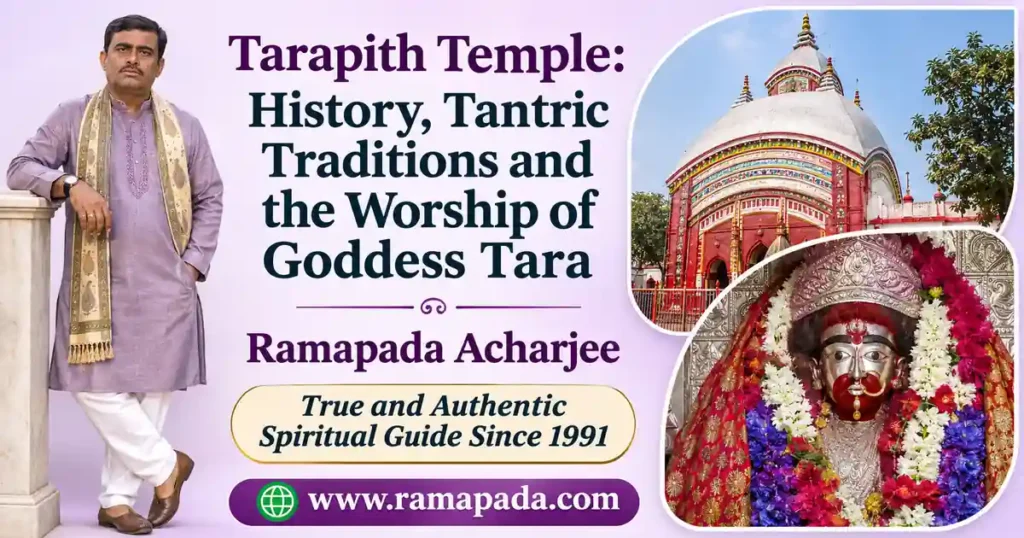
Walking into Tarapith Temple for the first time, most visitors do not remember an elaborate ritual chant. Instead, they remember a devotee calling out to Maa Tara. The voice carries the warmth reserved for a loving mother. Meanwhile, the cremation ground lies beyond the bustling temple lane. Its stillness reveals another dimension of this sacred town. Together, those two spaces explain why nobody can understand Tarapith merely as a brick structure or through sensational rumours about Tantra.
Resting near Rampurhat in West Bengal’s Birbhum district, Tarapith has drawn household pilgrims, spiritual practitioners, and historians for generations. Its heritage combines devotion to the Divine Mother with memories of Bamakhepa. It also includes stories of Vasistha, Bengali literature, and contemplation of mortality.
My own introduction to these sacred traditions began early through my father, Kamakhya Charan Acharjee. I began offering guidance part-time in 1991 and entered full-time practice in 1996. Later, experienced practitioners connected with Tarapith and Kamakhya, deepening my perspective. Those decades of lived experience taught me how essential it is to separate inherited spiritual devotion from independently documented history.
This guide explores Tarapith Temple’s cultural history and Maa Tara’s iconography. It also examines the cremation ground and the responsibilities of pilgrimage. Whenever an account belongs to devotional memory rather than archaeological proof, I state that clearly.
तारापीठ पश्चिम बंगाल के बीरभूम जिले में माँ तारा की प्रसिद्ध उपासना-स्थली है। मंदिर की भक्ति, बामाखेपा की स्मृति और पास के श्मशान की साधना-परंपरा इसके धार्मिक जीवन के अलग पहलू हैं। धार्मिक कथा, व्यक्तिगत अनुभव और ऐतिहासिक प्रमाण को एक ही प्रकार की जानकारी नहीं मानना चाहिए।
Where Is Tarapith Temple? Its Place in Birbhum
Situated near Rampurhat beside the Dwarka—also spelt Dwaraka—River, Tarapith anchors a vibrant rural pilgrimage landscape. However, the town is more than its main shrine. Nearby villages, riverbanks, markets, and pilgrim routes also shape its story.
Official resources like the West Bengal Department of Tourism recognise Tarapith as a premier religious destination in Birbhum with deep roots in Tara worship. For practical geographical context, the Birbhum district administration’s Tarapith gallery offers an additional government reference.
Why Geography Matters to a Sacred Tradition
Sacred geography always means far more than coordinates on a map. At Tarapith, the sanctum, devotional lanes, cremation ground, and Dwarka River form a connected cultural landscape. Over centuries, generations of worshippers have layered spiritual meaning onto every corner of this terrain.
तारापीठ केवल मंदिर का नाम नहीं है। आसपास का क्षेत्र, द्वारका नदी, यात्रियों के रास्ते और श्मशान भी इसकी धार्मिक पहचान का हिस्सा हैं। किसी स्थान के पवित्र होने की परंपरागत मान्यता और उसके निर्माण की ऐतिहासिक तारीख अलग प्रश्न हैं।
What Does the Name Tarapith Mean?
Combining the name of Goddess Tara with ‘pith’ or ‘pitha’—widely translated as ‘a sacred seat’—gives Tarapith its evocative name. However, Sanskrit literature uses pitha in several religious classifications. Therefore, not every shrine called a pitha appears on the same ancient list.
Many devotees associate Tarapith with Sati’s sacred eye and call it a Shakti Peetha. Other lineages instead celebrate it as a siddha pitha linked to spiritual attainment. Both descriptions illuminate different facets of the town’s sanctity rather than serving as interchangeable archaeological records.
Is Tarapith a Shakti Peetha or a Siddha Peetha?
Both identities thrive side by side in living tradition. To trace those titles, we must examine scriptures, oral narratives, and changing textual canons. After all, one sacred town can hold several meanings, even when texts disagree.
Academic studies such as Transformations of Tara: The Spatial Mediation of Fierce and Maternal Power compare Tarapith with other Tara shrines, illustrating how sacred spaces bridge fierce and nurturing expressions of the Goddess.
तारापीठ को शक्ति-पीठ और सिद्ध-पीठ, दोनों रूपों में समझने की परंपराएँ मिलती हैं। ये नाम अलग धार्मिक कथाओं तथा साधना-स्मृतियों से जुड़े हैं। सभी प्राचीन ग्रंथों में एक ही सूची या कहानी मिलने का दावा सावधानी से करना चाहिए।
The Historical Development of Tarapith Temple
A sacred site almost always stretches back far earlier than the physical temple standing on it today. Therefore, we must distinguish early Tara devotion from older shrines and the current building. This avoids reducing complex history to one unsupported date.
Tradition and the Present Temple Structure
Regional accounts credit Jagannath Ray of Mallarpur with rebuilding the temple, often dated to 1818 CE. However, folklore places the shrine’s origins much earlier. Because published sources vary on exact construction phases, treating 1818 as a well-known traditional date for today’s building—rather than proof of when Tara worship first began—keeps our history honest and grounded.
A Timeline with Necessary Caution
Viewing broad historical layers side by side clarifies what different sources actually establish:
| Historical layer | What is discussed | Important distinction |
|---|---|---|
| Early sacred narratives | Vasistha, Tara and the origin of worship | Mythic time is not a verified building date. |
| Mediaeval and early-modern developments | Regional Shakta literature and worship | Individual compositions require separate dating. |
| Eighteenth–nineteenth centuries | Rebuilding traditions and changing public religious life | The present building is not necessarily the first shrine. |
| Nineteenth–early twentieth centuries | Bamakhepa and the growth of remembered saintly traditions | Oral devotion and biographical evidence differ. |
| Contemporary period | Pilgrimage, worship, research and heritage management | Modern practice continues to evolve. |
वर्तमान मंदिर के निर्माण की तारीख और तारा-उपासना के आरंभ को एक नहीं समझना चाहिए। स्थानीय विवरणों में जगन्नाथ राय तथा उन्नीसवीं शताब्दी के पुनर्निर्माण का उल्लेख मिलता है, जबकि कुछ कथाएँ अधिक प्राचीन समय की बात करती हैं। उपलब्ध प्रमाणों के अनुसार भाषा सावधानी से रखनी चाहिए।
Goddess Tara: The Divine Mother and the Second Mahavidya
Across Shakta philosophy, Tara stands second among the Dasha Mahavidyas—the Ten Great Wisdom Goddesses. At Tarapith, her image combines fierce power with maternal tenderness. Thus, devotees approach her as a caring mother, even while contemplating mortality.
The Motherly Dimension of Tara
Beloved Puranic narratives depict Maa Tara nursing Shiva like an infant to soothe the burning Halahala poison he swallowed during the churning of the ocean. The story conveys divine compassion through sacred symbolism. However, it is neither a dated eyewitness account nor medical advice.
Readers wanting a deeper scriptural background can explore my earlier essay, Tara in the Shakta and Tantric Scriptures, whereas here our attention stays focused on the living temple and its cultural heritage.
Does Fierce Iconography Mean Harm?
Interpreting fierce sacred imagery always requires its proper theological context. Skulls and cremation-ground motifs symbolise freedom from ego and fear. Nevertheless, these images never justify violence or coercion.
माँ तारा का उग्र और मातृ रूप कई शाक्त परंपराओं में साथ-साथ मिलता है। स्तनपान कराती माता की कथा संरक्षण का धार्मिक प्रतीक है। उग्र प्रतिमा का अर्थ किसी व्यक्ति को हानि पहुँचाने की अनुमति नहीं है।
Vasistha, Tara and the Stories of Spiritual Origins
Regional folklore credits the sage Vasistha with receiving Maa Tara’s grace through spiritual discipline. Some texts also link these teachings to Mahacina. Such narratives hold immense value for literary and religious history, even though they cannot establish a carbon-dated archaeological timeline.
Different scriptures, local legends, and temple guides emphasise distinct characters and theological insights while retelling these origin stories. My article A Note About Reading Tantric Texts explains why identifying exact textual sources beats treating every circulating tale as one unchanging ancient record.
वशिष्ठ ऋषि और महाचीन से जुड़ी कथाएँ तारापीठ की धार्मिक स्मृति का हिस्सा हैं। विभिन्न संस्करणों में कथा का रूप बदल सकता है। इन्हें आस्था और साहित्य के संदर्भ में समझना चाहिए, न कि मंदिर की निश्चित पुरातात्त्विक तिथि के प्रमाण के रूप में।
Bamakhepa and the Living Memory of Tarapith
No portrait of modern Tarapith feels complete without remembering Bamakhepa—also spelt Bamakhyapa or Bamakshyapa—whose life is commonly placed between 1837 and 1911. His spontaneous devotion to Maa Tara continues to shape the town’s religious memory. So does his association with the cremation ground.
A Saint Remembered Through Stories and Places
Local families share stories of Bamakhepa with deep warmth, viewing his unconventional conduct as pure absorption in the Divine Mother. Historians, meanwhile, distinguish early records from later biographies and legends. This prevents devotional memories from being confused with independent evidence.
Ethnographic research such as Anthropology of the Profane in the journal Religions examines how Tarapith’s sacred spaces and Bamakhepa’s enduring legacy shape local devotional culture.
Why His Memory Still Matters
Beyond miracle tales, Bamakhepa’s historical impact lies in how his life bridged everyday household devotion with cremation-ground contemplation, cementing Tarapith’s distinct spiritual identity across Bengal.
बामाखेपा की स्मृति तारापीठ की पहचान का महत्वपूर्ण हिस्सा है। भक्त उन्हें माँ तारा के अनन्य साधक के रूप में याद करते हैं। उनके जीवन से जुड़ी ऐतिहासिक जानकारी, बाद की जीवनी और चमत्कार की कथाओं को अलग-अलग समझना चाहिए।
The Maha Shmashan: Understanding Tarapith’s Cremation-Ground Traditions
The Maha Shmashan lies beside the temple. It is an active cremation ground where families mourn. Some practitioners also contemplate life’s impermanence there.
Why Mortality Appears in Tantric Philosophy
Certain Tantric philosophies engage cremation-ground symbolism to confront human fear, vanity, and attachment to fleeting possessions. Those reflections belong strictly to spiritual philosophy and never make reckless or unsafe behaviour acceptable. Above all, mourning families deserve complete dignity and privacy—visitors must never photograph funeral rites, intrude into restricted areas, or treat grief as sightseeing entertainment.
Public Devotion and Specialised Practice Are Different
Nearly everyone visiting Tarapith comes for peaceful temple darshan and family prayer, requiring zero participation in cremation-ground rituals or formal initiation. What belongs to a specialized lineage never applies as a universal requirement for ordinary pilgrims.
You can compare both sacred centres in my overview of Tantric Practices in Tarapith and Kamakhya, which explores living cultural context without promoting hazardous rituals.
महाश्मशान मृत्यु और शोक से जुड़ा वास्तविक स्थान है। कुछ साधना-परंपराओं में इसका प्रतीकात्मक महत्व माना जाता है, लेकिन इससे असुरक्षित व्यवहार उचित नहीं हो जाता। मृतकों और उनके परिवारों की गरिमा तथा स्थानीय नियमों का सम्मान आवश्यक है।
Temple Worship: Darshan, Offerings and Daily Devotion
Stepping inside the main courtyard reveals an atmosphere far warmer and more family-oriented than sensational books suggest. Parents, couples, and villagers arrive with flowers, incense, and prayers. Meanwhile, priests perform daily worship.
Why Offerings Must Be Understood in Context
Traditional offerings of flowers, lamps, and consecrated food (bhog) express sincere gratitude within living custom. However, offerings must never be sold as guarantees of medical cures or promotions. Nor can they control another person’s feelings.
Because darshan hours, festival crowds, photography rules, and service arrangements shift throughout the year, pilgrims should always verify current details directly through official temple administration channels.
तारापीठ की सामान्य पूजा में दर्शन, फूल, दीप और भोग जैसे पारंपरिक रूप शामिल हैं। किसी विशेष सामग्री की कीमत से निश्चित कृपा या सफलता सिद्ध नहीं होती। दर्शन-समय तथा नियम यात्रा से पहले अधिकृत स्रोत से जाँचने चाहिए।
Tarapith in Shakta Tantra: Mantra, Initiation and Lineage
Tantric heritage encompasses many philosophical and liturgical paths, and no single routine speaks for every school. While specific Shakta lineages transmit specialized mantras through formal initiation (Diksha), public devotional hymns and scriptural reading remain open to everyone.
Why Responsible Teaching Matters
Anyone considering a structured spiritual commitment deserves transparent answers regarding daily obligations, expenses, health safety, and total freedom to decline. Liturgical confidentiality around a mantra never excuses secrecy around financial pressure, coercion, or personal boundaries.
Readers interested in wider historical background can consult my earlier discussion on Tarapith Tantrik traditions.
कुछ शाक्त तांत्रिक परंपराओं में मंत्र और दीक्षा का विशेष स्थान है। लेकिन सामान्य भक्त को हर परिस्थिति में दीक्षा लेने की आवश्यकता नहीं होती। सुरक्षित साधना, स्पष्ट जानकारी, स्वतंत्र सहमति और उचित मार्गदर्शन महत्वपूर्ण हैं।
Hindu Tara and Buddhist Tara: Connections and Differences
The name Tara appears in both Hindu and Buddhist traditions. However, a shared name does not mean identical theology. Buddhist Tara belongs to Mahayana and Vajrayana traditions of compassion and enlightenment. By contrast, Tarapith’s Maa Tara belongs to Bengali Shakta devotion and Mahavidya philosophy.
Historians study centuries of cultural dialogue across South Asia—including stories linking Vasistha and Mahacina—without reducing distinct traditions to a single simplistic origin. You can explore the broader goddess heritage further in Tara Mahavidya: The Second Mahavidya.
हिंदू और बौद्ध परंपराओं में तारा नाम मिलता है, पर दोनों के ग्रंथ तथा दर्शन हर जगह समान नहीं हैं। कुछ ऐतिहासिक संबंधों पर शोध जारी है। समान नाम के कारण सभी रूपों को एक ही परंपरा घोषित करना उचित नहीं है।
Sacred Architecture and the Changing Temple Environment
Today’s temple displays a Bengali curved chala roof and decorative motifs. Moreover, it remains closely connected to the pilgrimage town. Its appearance reflects centuries of rebuilding, artisan craftsmanship, and community care.
Observing architectural features alone cannot date an entire spiritual philosophy—stonework, royal patronage, and oral devotion each follow their own historical timeline. Resources like the C. P. R. Environmental Education Centre’s Tarapith heritage overview offer helpful background on the shrine’s cultural setting and Bamakhepa’s association.
मंदिर की वास्तुकला और पूजा का इतिहास आपस में जुड़े होने पर भी अलग विषय हैं। वर्तमान भवन अनेक पीढ़ियों के संरक्षण तथा बदलाव का परिणाम है। किसी शैली से समस्त साधना परंपरा की निश्चित आयु सिद्ध नहीं होती।
Tarapith and the Meaning of Motherhood in Shakta Worship
Perhaps Tarapith’s most touching gift is how intimately devotees speak to the Divine. Rather than addressing a distant ruler, worshippers pour out their joys and sorrows to Maa Tara as an approachable, forgiving mother.
Spiritual Comfort Is Not a Guaranteed Outcome
For many devotees, heartfelt prayer offers comfort and steadiness during difficult times. Even so, neither temple offerings nor mantra repetition has been scientifically shown to guarantee physical recovery, debt relief, or specific relationship outcomes—so faith works best alongside sensible, practical responsibility.
I reflect further on this devotional bond in Tara Mahavidya and Tarapith.
तारापीठ में माँ तारा को माता की तरह पुकारना भक्ति का गहरा रूप है। इससे व्यक्ति को व्यक्तिगत सांत्वना मिल सकती है। लेकिन धार्मिक भावना को किसी बीमारी या आर्थिक समस्या के निश्चित समाधान के रूप में प्रस्तुत नहीं करना चाहिए।
Sanskrit Reflection: The Divine Mother in All Beings
One of the most beloved hymns capturing Shakta reverence for universal motherhood appears in the Devi Mahatmyam. This is a general devotional verse, not an architectural record or initiation formula. Instead, it expresses spiritual warmth:
Devi Mahatmyam, Chapter 5, Verses 71–73
या देवी सर्वभूतेषु मातृरूपेण संस्थिता।
नमस्तस्यै नमस्तस्यै नमस्तस्यै नमो नमः॥English meaning: Salutations again and again to the Goddess who dwells in all beings in the form of the Mother. You can consult the original text in the Devi Mahatmyam at Sanskrit Documents, Chapter 5—keeping in mind that sacred poetry illuminates devotional philosophy rather than proving archaeological dates or miracle claims.
हिंदी अर्थ: जो देवी सभी प्राणियों में माता के रूप में स्थित हैं, उन्हें बार-बार नमस्कार है। यह देवी-माहात्म्य का व्यापक शाक्त स्तोत्र है, तारापीठ मंदिर के निर्माण का ऐतिहासिक प्रमाण या विशेष तारा-दीक्षा की विधि नहीं।
Common Misconceptions About Tarapith Temple
Sensational stories frequently overshadow authentic cultural understanding. Clearing away these eight myths keeps pilgrimage respectful and grounded.
Myth 1: Tarapith has one universally accepted founding date.
The ancient devotional heritage of the sacred site differs from the nineteenth-century rebuilding date of today’s temple structure.
पवित्र स्थल और वर्तमान भवन की तिथि अलग हो सकती है।
Myth 2: Every visitor must practise Tantra.
Everyday prayer, family darshan, and temple visits require zero formal Tantric initiation.
सामान्य दर्शन के लिए विशेष तांत्रिक दीक्षा आवश्यक नहीं है।
Myth 3: All stories about Bamakhepa are verified events.
Heartfelt devotional legends and independently documented biographical records belong to separate categories of evidence.
भक्ति-कथा और प्रमाणित इतिहास अलग हो सकते हैं।
Myth 4: Cremation-ground symbolism permits dangerous actions.
Philosophical reflection on mortality never excuses physical harm, coercion, or intruding upon mourning families.
श्मशान की प्रतीकात्मक मान्यता हिंसा का औचित्य नहीं है।
Myth 5: Hindu Tara and Buddhist Tara are identical.
Despite fascinating historical interactions, Hindu Shakta and Buddhist lineages preserve distinct scriptures and philosophies.
हिंदू और बौद्ध तारा की सभी मान्यताएँ समान नहीं हैं।
Myth 6: An expensive ritual guarantees a miracle.
Paying large sums of money never purchases guaranteed supernatural intervention or bypasses real-world effort.
महंगे अनुष्ठान से निश्चित परिणाम सिद्ध नहीं होता।
Myth 7: A fierce image means the Goddess commands cruelty.
Sacred iconography employs symbolic imagery to express spiritual liberation rather than literal harm.
उग्र प्रतिमा का अर्थ क्रूरता का आदेश नहीं है।
Myth 8: Every old account is archaeological evidence.
Puranic stories convey timeless religious meaning without functioning as carbon-dated historical timelines.
हर पुरानी कथा पुरातात्त्विक प्रमाण नहीं होती।
Visiting Tarapith Respectfully
Pilgrimage feels deeply rewarding when sincere devotion walks alongside everyday courtesy. Plan for festival crowds and confirm local transport. Also, follow staff instructions and keep pathways clear. Above all, respect mourners’ privacy.
Avoid anyone demanding urgent fees or claiming exclusive supernatural authority. Instead, choose only voluntary, transparent arrangements without fear-based pressure.
Practical Information Without False Certainty
Nearby Rampurhat serves as the main railway and road gateway for reaching Tarapith, with travel times varying according to local traffic and festival seasons. Always verify darshan timings and temple guidelines shortly before your journey through official channels rather than relying on outdated blog posts.
यात्रियों को मंदिर प्रशासन के नियम, भीड़ और स्थानीय परिवारों की निजता का सम्मान करना चाहिए। श्मशान में बिना अनुमति फोटो नहीं लेने चाहिए। शुल्क तथा दर्शन-समय अधिकृत स्रोत से जाँचना चाहिए।
What Tarapith Has Taught Me About Spiritual Heritage
My involvement with Indian spiritual traditions began in 1991. Since then, I have learned to respect sacred places without exaggerating their mysteries. Tarapith teaches lessons through prayer, local memory, and contemplation of impermanence. Most importantly, it reflects the tenderness of devotion to Maa Tara.
Sharing personal spiritual reflections honestly as personal experience—while separating oral practitioner accounts from documented texts and independent history—honours both living traditions and thoughtful readers.
मेरे अनुभव में किसी पवित्र स्थान का सम्मान करने के लिए हर कथा को चमत्कार का प्रमाण बनाना आवश्यक नहीं है। तारापीठ की भक्ति, स्थानीय स्मृतियाँ और धार्मिक प्रतीक अपने-अपने संदर्भ में महत्वपूर्ण हैं। निजी अनुभव और स्वतंत्र प्रमाण में अंतर रखना चाहिए।
Frequently Asked Questions About Tarapith Temple
1. Where is Tarapith Temple located?
Tarapith is situated near Rampurhat in Birbhum district, West Bengal, India, close to the Dwarka River.
तारापीठ पश्चिम बंगाल के बीरभूम जिले में रामपुरहाट के निकट है।
2. Who is worshipped at Tarapith?
The central deity is Maa Tara, revered across Shakta traditions as the compassionate Divine Mother.
यहाँ माँ तारा की प्रमुख रूप से उपासना होती है।
3. Is Tarapith associated with the Mahavidyas?
Yes, classical Shakta heritage celebrates Goddess Tara as the second of the Dasha Mahavidyas (Ten Wisdom Goddesses).
तारा को दशमहाविद्याओं में दूसरी महाविद्या माना जाता है।
4. Who was Bamakhepa?
Bamakhepa was a celebrated nineteenth- and early twentieth-century devotee closely remembered for his deep devotion to Maa Tara at Tarapith.
बामाखेपा तारापीठ से जुड़े प्रसिद्ध साधक थे।
5. Why is the cremation ground important?
While specialized lineages contemplate impermanence near the Maha Shmashan, it also functions as an active funerary site requiring quiet respect.
श्मशान साधना-प्रतीक के साथ वास्तविक अंतिम संस्कार का स्थान भी है।
6. Does every visitor need initiation?
Not at all—everyday temple prayer and darshan require no formal Tantric Diksha.
सामान्य दर्शन के लिए तांत्रिक दीक्षा जरूरी नहीं है।
7. Is the present temple thousands of years old?
Although devotional narratives reach far back into antiquity, today’s surviving structure reflects documented nineteenth-century rebuilding.
मंदिर का वर्तमान भवन और प्राचीन उपासना-कथा एक ही समय के नहीं हैं।
8. Are Hindu Tara and Buddhist Tara the same?
While historical exchanges exist, Hindu Shakta and Buddhist traditions preserve distinct theological frameworks and scriptures.
दोनों परंपराओं में संबंध तथा अंतर मिलते हैं।
9. Can a Tarapith ritual guarantee results?
Zero scientific evidence shows that temple offerings or ceremonies guarantee financial windfalls, medical cures, or control over another person’s choices.
अनुष्ठान से धन, स्वास्थ्य या दूसरे व्यक्ति की इच्छा पर निश्चित नियंत्रण की गारंटी नहीं है।
10. How should pilgrims check current darshan rules?
Always confirm current timings, rules, and festival schedules directly through official temple administration channels just before travelling.
दर्शन के नए नियम यात्रा से पहले अधिकृत स्रोत से पूछें।
Final Reflections: Understanding Tarapith Beyond Sensation
Tarapith brings maternal devotion together with an awareness of mortality. Therefore, its sacred landscape carries several meanings. Its living identity grew through Puranic stories, nineteenth-century temple rebuilding, daily worship, and the enduring memory of Bamakhepa—each deserving understanding in its proper context.
Devotional accounts of Vasistha and Maa Tara illuminate what the shrine means to heartfelt faith, while historical inquiry examines manuscripts, architecture, and social evolution. Neither perspective needs to erase the other. Ultimately, Tarapith’s lasting gift lies not in promises of instant miracles, but in a living heritage that invites prayer, humility, and genuine respect for every human life gathered around the Divine Mother.
तारापीठ का महत्व माँ तारा की उपासना, बामाखेपा की स्मृति, मंदिर का इतिहास और श्मशान की धार्मिक प्रतीकात्मकता में है। आस्था और प्रमाणित इतिहास में स्पष्ट अंतर रखकर ही इस परंपरा का संतुलित अध्ययन संभव है।
Ethical Disclaimer
This article is intended for historical, religious, and cultural education. Narratives surrounding Vasistha, Maa Tara, Bamakhepa, and Tarapith’s identity as a sacred pitha are presented within their respective devotional and scholarly contexts, recognizing that dates and interpretations vary across sources.
There is no reliable scientific evidence showing that any mantra, temple offering, initiation, or Tantric ceremony guarantees medical recovery, financial windfalls, relationship reconciliation, or control over another person’s free will. Specialized practices must never involve coercion, dangerous substances, physical deprivation, intrusion upon mourning families, or pressure to abandon qualified medical, psychological, legal, or financial advice.
यह लेख धार्मिक, सांस्कृतिक और ऐतिहासिक जानकारी के उद्देश्य से है। किसी पूजा या मंत्र से निश्चित स्वास्थ्य लाभ, धन, संबंधों में नियंत्रण या चमत्कार की वैज्ञानिक गारंटी नहीं है। सुरक्षा, स्वतंत्र सहमति और आवश्यक विशेषज्ञ सलाह का सम्मान करें।
Connect with the Best in Kolkata
Stop wandering in uncertainty. Your stars have a story to tell, and Ramapada Acharjee is here to help you read it. With a legacy built on truth, 35 years of experience, and a mission to bring peace to every household, your journey toward clarity starts here.
📍Consultation available in Kolkata, Guwahati, Siliguri, Tarapith & online.
Consultant: Ramapada Acharjee
Professional Experience: True & Authentic Spiritual Guide Practicing Since 1991
Phone / WhatsApp: +91 98749 54063
Official Email: astrologer@ramapada.com
🌐 Website
Consultations: By prior appointment (in-person & online)
You may also read:
- Tara Mahavidya and Tarapith
- Tara in the Shakta and Tantric Scriptures
- Tantric Practices in Tarapith and Kamakhya
- Tara Mahavidya: The Second Mahavidya
Related Category: Hindu Rituals
