
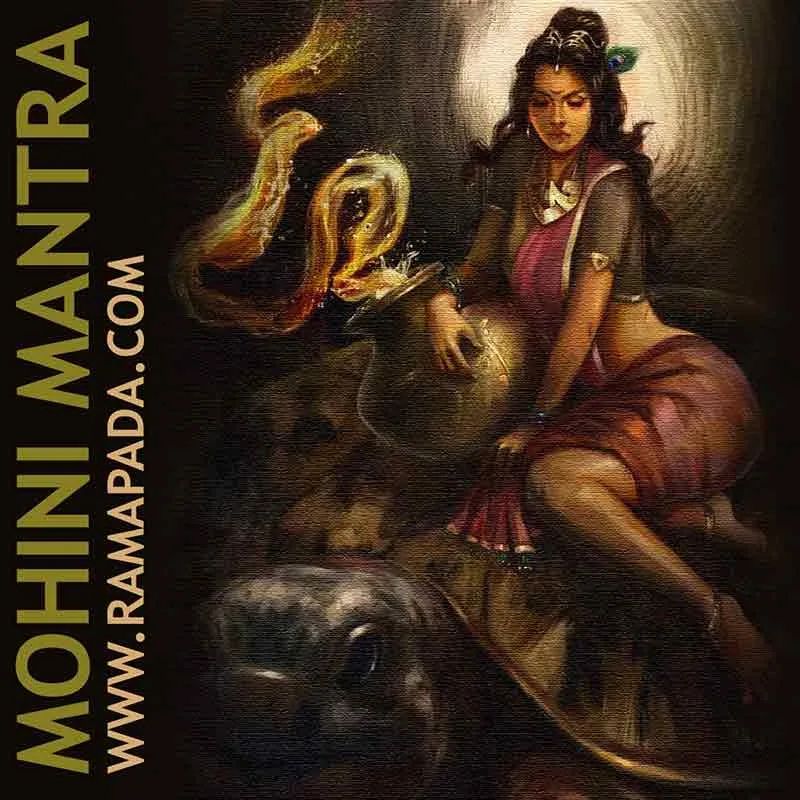
The Mohini Mantra’s meaning is often misunderstood because modern websites frequently connect it only with attraction, influence, romance, or control.
However, the traditional idea of Mohini is much deeper.
Mohini is associated with a feminine manifestation of Lord Vishnu in Hindu sacred narratives. Through this form, the mythology explores beauty, intelligence, discernment, illusion, divine strategy, and the mysterious power of attraction.
Therefore, a Mohini Mantra should not automatically be understood as a formula for controlling another human being.
I began practising astrology and related spiritual disciplines part-time in 1991 and became a full-time practitioner in 1996. Over the years, many people have asked me about attraction mantras, Vashikaran, lost love, marital difficulties, emotional attachment, and relationship problems.
Gradually, experience taught me one important principle:
Spiritual attraction should never become an excuse for manipulation. Genuine guidance should strengthen clarity, confidence, communication, and self-control.
For readers who want to understand the related subject more deeply, my article on Mohini Vashikaran provides additional context.
Who Is Mohini in Hindu Tradition?
Mohini holds a fascinating place in Hindu mythology.
She is generally associated with Lord Vishnu appearing in an enchanting feminine form.
The Metropolitan Museum of Art explains that Vishnu appears through different manifestations or avatars in order to restore cosmic and moral order. Its overview of Vishnu and Hindu divine manifestations provides useful background for understanding this broader Vaishnava concept.
Beauty is certainly part of the Mohini story.
However, intelligence, timing, perception, and divine purpose are equally important.
Therefore, focusing only on physical attraction gives an incomplete picture.
Mohini and the Churning of the Ocean
One of the most widely known stories connected with Mohini arises from the Samudra Manthan, or churning of the cosmic ocean.
According to the traditional narrative, Devas and Asuras participated in the churning in search of Amrita, the nectar of immortality.
Later, a dispute developed over its distribution.
At this stage, Vishnu appeared as Mohini.
Through intelligence, charm, and divine strategy, Mohini redirected the situation.
Consequently, the story became one of the best-known examples of divine enchantment in Hindu mythology.
Yet its deeper lesson need not be reduced to physical attraction.
It can also be understood through:
- Discernment
- Timing
- Intelligence
- Transformation
- Perception
- Divine purpose
- The limits of desire
Vishnu, Mohini and Divine Transformation
Art historical evidence also shows that the Mohini concept became important within Indian religious imagination.
A Metropolitan Museum publication discussing South Indian sacred imagery notes the manifestation of Vishnu as Mohini and its relationship with wider ideas of masculine and feminine divine forms. Readers interested in the historical context can consult the Met publication on divine images in South Indian art.
This gives the Mohini tradition a wider theological context.
For this reason, Mohini should not be viewed only through modern attraction-related marketing.
The tradition also raises deeper questions about divine identity, gender, transformation, illusion, and cosmic purpose.
What Is a Mohini Mantra?
A Mohini Mantra generally refers to a mantra associated in popular spiritual traditions with attraction, charm, personal magnetism, or the symbolic qualities represented by Mohini.
However, different traditions may interpret such mantras differently.
Some explanations emphasise devotion.
Others focus on mantra sadhana.
Meanwhile, modern websites often present Mohini mantras as quick methods for influencing a particular person.
That last approach requires caution.
A mantra belongs within a much wider spiritual context that may include discipline, pronunciation, concentration, intention, devotion, teacher guidance, and ethical limits.
Therefore, simply copying words from a website does not mean someone understands the practice.
Mantra Has a Deeper Spiritual Context
Mantra is an important part of many Indian spiritual traditions.
Within Tantra, mantra can form part of a wider discipline involving meditation, worship, ritual, yantra, visualisation, and spiritual training.
The academic article Mantra and Yantra in Tantra discusses mantra and yantra as important elements within Tantric spirituality rather than isolated magical formulas.
This broader context matters.
A mantra is not simply a password for obtaining a desired person or result.
Instead, spiritual practice traditionally involves discipline, intention, and inner participation.
Mohini Mantra and Vashikaran
The Mohini Mantra is frequently linked online with Vashikaran.
However, this association can create confusion.
Popular explanations sometimes describe Vashikaran as control over another person’s mind.
I prefer a more cautious approach.
Influence exists everywhere in ordinary life.
Speech influences people.
Appearance influences perception.
Confidence affects social interaction.
Kindness can improve relationships.
Likewise, communication influences understanding.
Nevertheless, influence is different from removing another person’s freedom.
For a wider explanation, read my article What Is Vashikaran and How Does It Work?.
Attraction and Control Are Different
This distinction deserves special attention.
Attraction allows another person to choose.
Control attempts to remove that choice.
A person may improve confidence, communication, personal presentation, emotional maturity, patience, self-respect, and social behaviour.
These changes can naturally make someone more appealing.
However, trying to force another human being to love, obey, marry, or return creates a very different ethical problem.
Therefore, I do not recommend interpreting spiritual attraction as ownership over another person.
Can Mohini Mantra Make Someone Love You?
No responsible practitioner should guarantee such a result.
Love is complex.
It depends on:
- Attraction
- Trust
- Communication
- Shared values
- Emotional compatibility
- Personal choice
- Timing
- Life circumstances
A mantra cannot erase these realities.
Therefore, statements such as:
“Your lover will return tomorrow.”
“This person will obey you.”
“Guaranteed attraction.”
“100% control.”
should be approached cautiously.
Marketing language is not evidence of spiritual knowledge.
Mohini Mantra and Consent
Consent remains essential in healthy relationships.
Every person has the right to decide whom they love, whom they marry, whether they want a relationship, and whether they wish to continue contact.
Therefore, no spiritual practice should become an excuse for ignoring another person’s decision.
This does not make spirituality less meaningful.
Instead, ethical boundaries make spiritual practice more responsible.
A Better Meaning of Attraction
In my experience, many people who ask about attraction actually want something deeper.
They want to feel noticed.
They want confidence.
They want affection.
Some want a broken relationship repaired.
Others are afraid of loneliness.
Therefore, instead of asking only, “How can I attract this person?”, a more useful question may be:
“How can I become emotionally stronger, clearer, and more capable of building a healthy relationship?”
That change in perspective can improve the entire direction of a consultation.
Mohini Mantra and Self-Transformation
A spiritual interpretation of Mohini can focus on self-transformation rather than control.
For example, a seeker may work on:
- Calm communication
- Personal confidence
- Emotional balance
- Patience
- Self-respect
- Better judgement
- Reduced jealousy
- Freedom from obsession
These qualities can improve relationships naturally.
Moreover, they remain valuable even if a particular relationship does not continue.
Therefore, spiritual practice becomes a method of personal development rather than dependency.
Tantra Is Much Broader Than Attraction
Another common mistake is to treat Tantra as though it mainly exists for attraction, Vashikaran, black magic, or secret powers.
Traditional Tantra is far broader.
It may involve:
- Mantra
- Meditation
- Ritual
- Deity worship
- Yoga
- Philosophy
- Sacred symbolism
- Initiation
- Spiritual discipline
- Teacher-student transmission
The Oxford Handbook of Tantric Studies presents Tantra as a diverse religious and historical field rather than a single technique for controlling others.
For this reason, Mohini-related practices should be understood within the wider landscape of Tantra.
Readers may also explore my article on Tantra in India: Ancient Wisdom, Traditions and Misconceptions.
India’s Mantra and Tantra Manuscript Heritage
India preserves a large manuscript heritage related to Tantra and mantra.
The Indira Gandhi National Centre for the Arts maintains collections covering subjects such as mantra, Tantra, Jyotisha, Agama, philosophy, ritual, and related traditions. Its catalogue of manuscripts gives an idea of how extensive this heritage is.
This is important because modern internet discussions can make Tantra appear recent or purely commercial.
It is neither.
The textual tradition developed over centuries.
Therefore, serious spiritual subjects deserve more depth than short promotional claims.
Historical Evidence of Mantra Traditions
IGNCA’s manuscript catalogue also includes individual records connected with Hindu Tantra and mantra traditions.
For example, its record for the Sanskrit manuscript Shabaramantra identifies it within Hindu Tantra and chant traditions.
This does not mean every mantra circulating online comes from such manuscripts.
Rather, it shows why traditional mantra practice deserves careful historical context.
Authenticity cannot be established merely because someone uses Sanskrit words.
Why I Do Not Publish “Control a Specific Person” Instructions
This article does not provide step-by-step instructions designed to control a named individual.
That choice is deliberate.
Public spiritual writing should not encourage obsession.
Nor should it teach readers to ignore consent.
Advanced traditions may also involve teacher guidance, ritual context, discipline, and ethical restrictions.
Therefore, a short internet article cannot responsibly replace traditional learning.
Relationship Problems Need Practical Understanding
Many people searching for Mohini Mantra are experiencing relationship problems.
The pain can feel intense.
However, before looking for a ritual, practical questions should come first.
Has communication stopped?
Has trust broken down?
Are both people willing to continue the relationship?
Is jealousy creating conflict?
Are relatives interfering?
Has emotional abuse occurred?
Could financial stress be affecting the relationship?
These questions matter.
Sometimes the real solution begins with honest conversation rather than a mantra.
When a Relationship Has Already Ended
Acceptance can be difficult.
A person may continue hoping that a former partner will return.
At this stage, attraction-related spiritual promises can become especially tempting.
However, endless attempts to control the outcome may increase suffering.
Instead, a person may need emotional recovery, perspective, self-respect, social support, new routines, acceptance, or professional counselling when needed.
Spirituality can support recovery.
It should not trap someone in obsession.
Mohini Mantra and Marriage
Marriage creates another common area of concern.
For example, someone may ask:
“How can I make my spouse listen?”
However, the deeper issue may involve resentment, communication failure, money, relatives, intimacy, trust, or years of unresolved conflict.
Therefore, the first goal should be to understand what is actually damaging the relationship.
Spiritual practice may support calmness and reflection.
Nevertheless, marriage still requires communication, respect, trust, and effort from both people.
My Experience With Clients Over the Years
Over decades of consultation, I have noticed a recurring pattern.
One client may request an attraction mantra even though fear of rejection is the deeper issue.
Meanwhile, another person may ask for Vashikaran after communication has already collapsed.
In some cases, a former relationship has ended for serious reasons, yet the person continues searching for a ritual that promises reunion.
At other times, loneliness is the real source of pain.
Therefore, experience has taught me to look beyond the requested remedy.
Instead of immediately asking, “Which mantra should be used?”, I prefer to ask:
“What is really happening in this person’s life?”
That question often leads to a more useful and responsible discussion.
Why Experience Changes Spiritual Guidance
Dramatic explanations can appear impressive when someone is new to spiritual work.
However, experience gradually changes that perspective.
Not every problem needs a ritual.
Likewise, rejection does not automatically require Vashikaran, and every argument should not be interpreted as black magic.
Sometimes practical advice helps more.
At other times, a person may need medical, legal, psychological, or financial assistance.
For this reason, long practice should make a spiritual adviser more careful rather than more dramatic.
My article on real Tantrik guidance and authentic traditional Tantra discusses the importance of ethics and discernment in greater detail.
Mohini Mantra and Emotional Healing
Sometimes a seeker is not really searching for attraction.
They are searching for relief from emotional pain.
Rejection can affect confidence.
Separation can produce sadness.
Relationship conflict can disturb sleep.
Meanwhile, loneliness can increase anxiety.
Therefore, emotional recovery may become the more important spiritual goal.
My article on spiritual healing discusses a broader approach based on balance, reflection, and inner well-being.
Warning Signs in Attraction-Based Spiritual Services
Be cautious when someone promises:
“Guaranteed love.”
“Your ex will return within hours.”
“Complete control over your partner.”
“Pay immediately or the opportunity will disappear.”
“Only I have the secret mantra.”
Such statements create urgency and emotional dependence.
Instead, ask:
What exactly is being recommended?
Why is it being suggested?
What are the fees?
Are more payments expected?
What happens if the desired outcome does not occur?
Transparency matters.
How to Approach a Mohini Mantra Responsibly
If someone wishes to explore Mohini-related spiritual ideas, I recommend a few principles.
First, understand the mythology.
Next, study the broader spiritual context.
Meanwhile, respect consent and personal freedom.
In addition, avoid guaranteed supernatural claims.
Most importantly, do not allow emotional desperation to control financial decisions.
A spiritual practice should increase clarity.
It should not reduce independence.
Mohini Mantra Versus Vashikaran Mantra
These terms often overlap online, but they should not automatically be treated as identical.
Mohini refers primarily to a sacred mythological and symbolic tradition associated with Vishnu’s enchanting feminine manifestation.
Vashikaran, meanwhile, is a broader term associated in some traditions with attraction or influence.
Therefore, each subject deserves separate explanation.
My detailed article on Vashikaran Mantra explores its ethical and spiritual dimensions separately.
Frequently Asked Questions
What is the Mohini Mantra meaning?
Mohini Mantra generally refers to mantra traditions associated with Mohini, attraction, charm, influence, or divine enchantment.
However, interpretations vary between traditions.
Who is Mohini?
Mohini is associated with a feminine manifestation of Lord Vishnu in Hindu sacred narratives.
Is Mohini Mantra part of Tantra?
Some modern and traditional discussions connect Mohini-related mantras with Tantra or Vashikaran traditions.
However, practices and interpretations vary.
Can Mohini Mantra control another person?
Claims of guaranteed human control should be treated with caution.
Personal choice and consent remain important.
Can Mohini Mantra bring back a lost lover?
No responsible practitioner should guarantee another person’s return.
Reconciliation depends on both people.
Is Mohini Mantra black magic?
Not automatically.
Mantra, Tantra, Vashikaran, folk magic, and black magic are different concepts and should not simply be treated as identical.
Is it safe to copy Mohini Mantra from the internet?
I do not recommend experimenting with unfamiliar advanced practices without understanding their background, meaning, and context.
Can Mohini Mantra improve confidence?
Spiritual practice may support focus and self-reflection.
However, confidence also develops through behaviour, communication, experience, and personal growth.
Does attraction mean control?
No.
Attraction leaves another person free to choose, while control attempts to remove that freedom.
What should I look for in a spiritual practitioner?
Look for experience, ethical conduct, transparency, realistic claims, clear fees, and willingness to listen before recommending a practice.
My Perspective After Decades of Practice
After many years of dealing with people’s emotional and spiritual concerns, my understanding of attraction has changed.
The strongest attraction does not come from forcing somebody.
Instead, it often begins with personal stability.
A calm person communicates differently.
Someone with confidence behaves differently.
Likewise, a person with self-respect makes different decisions.
Moreover, emotional maturity changes the way relationships develop.
Therefore, I believe the deeper spiritual lesson lies in self-mastery.
Develop patience.
Improve communication.
Reduce obsession.
Control anger.
Strengthen judgement.
Respect freedom.
These qualities remain valuable regardless of whether one specific relationship succeeds.
Understanding Mohini Mantra With Clarity
The Mohini Mantra meaning should not be reduced to a promise of controlling another person.
Mohini belongs to a much richer sacred tradition involving Vishnu, divine transformation, attraction, intelligence, illusion, discernment, and spiritual symbolism.
Therefore, approach the subject with respect.
First, learn the tradition before chasing results.
Next, respect consent and personal freedom.
Likewise, avoid guaranteed supernatural claims.
Most importantly, do not let fear or emotional desperation control your decisions.
Above all, use spiritual practice to become clearer, calmer, and more disciplined.
After decades of working with people, I believe good spiritual guidance should create greater self-understanding and independence rather than dependency on a practitioner or ritual.
That is the approach I consider responsible.
— Ramapada Acharjee
Conclusion
This mantra is a fascinating concept with deep roots in Hindu mythology. While it carries the promise of attraction and influence, it’s essential to approach it with wisdom and discernment. True empowerment lies in personal growth, respect for others, and a harmonious connection with the divine.
For an accurate, personalised, and transformative prediction & authentic remedy session, contact Ramapada Acharjee today.
Call/WhatsApp: +91 98749 54063
Contact Ramapada Acharjee
You may also read:
- Tantra in India: Ancient Wisdom, Traditions, and Misconceptions
- Kundalini Awakening and Tantra
- True Meaning of Tantra in India: Beyond the Myths
- Tantric Practices in Tarapith and Kamakhya
- Powerful Tantrik in Kalighat—Seek guidance
- Black Magic Removal Expert in India
🔗 Related Category: Tantra
