
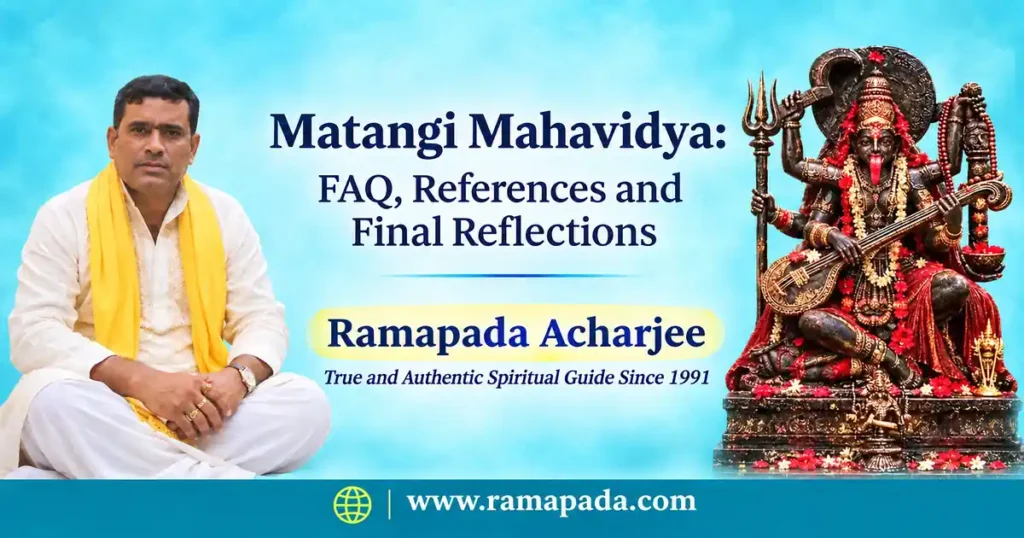
By Ramapada Acharjee
Practicing Astrologer, Palmist, and Spiritual Consultant Since 1991
After exploring Devi Matangi through her origin stories, iconography, scriptural background, mantra symbolism, connection with Saraswati, ethical worship, modern communication, and sacred geography, we finally arrive at the closing chapter of this series.
This final article has a different purpose.
Instead of introducing another theory, I want to bring the major themes together, answer common questions about Matangi Mahavidya, identify useful historical references, and share a few reflections from my own spiritual journey.
As discussed in Matangi Mahavidya: The Ninth Mahavidya, Devi Matangi occupies a distinctive place among the Dasha Mahavidyas.
She is associated with speech, sacred knowledge, music, creative intelligence, learning, social boundaries, unconventional wisdom, and the responsible use of influence.
Yet, to understand Matangi properly, we must resist the temptation to reduce her to one simple label.
She is not merely “a Tantric Saraswati.”
Her identity also extends far beyond the role of a deity of speech.
Likewise, reducing her to a goddess associated only with unusual rituals overlooks the deeper meaning of her Mahavidya symbolism.
এই পুরো মাতঙ্গী সিরিজ লিখতে গিয়ে আমার কাছে আবারও পরিষ্কার হয়েছে যে, কোনো দেবীকে একটি মাত্র শব্দ বা একটি মাত্র শক্তির মধ্যে বেঁধে ফেললে তাঁর গভীরতা হারিয়ে যায়। মাতঙ্গীকে বুঝতে গেলে বাক্শক্তি, জ্ঞান, সংগীত, সামাজিক সীমা এবং আত্মসংযম—সবকিছুকে একসঙ্গে দেখতে হয়।
Matangi Beyond a Single Definition
Historical art also reflects Matangi’s layered identity. The Metropolitan Museum of Art identifies Goddess Matangi as one of the ten Mahavidyas and connects her with speech, music, knowledge, and the arts.
Therefore, her symbolism deserves careful study rather than a single simplified definition.
Why Matangi Deserves Careful Study
Among the Mahavidyas, Matangi attracts interest because she combines elements that appear almost contradictory.
She is linked with refined speech as well as social marginality.
At the same time, her symbolism combines learning with unconventionality.
Another important dimension appears in her connection with Saraswati, while Matangi still remains firmly rooted in the Tantric Mahavidya framework.
Furthermore, art and beauty appear alongside ideas that challenge ordinary social concepts of purity.
These tensions make her philosophically important.
My article on Matangi Mahavidya Origin and Traditional Stories explored how different narratives attempt to express these unusual aspects.
Traditional stories should not always be treated like newspaper reports.
Instead, they frequently communicate through symbolism.
আমার মতে, পুরাণ বা তান্ত্রিক কাহিনি পড়ার সময় শুধু “ঘটনাটি সত্যিই ঘটেছিল কি না” এই প্রশ্নে আটকে গেলে অনেক গভীর শিক্ষা চোখ এড়িয়ে যায়। গল্পের প্রতীক কী বলতে চাইছে, মানুষকে কোন মানসিক সীমা নিয়ে ভাবতে বলছে—সেটাও সমান গুরুত্বপূর্ণ।
A symbolic reading does not mean ignoring tradition.
Rather, it means engaging with tradition more thoughtfully.
Matangi and the Meaning of Sacred Speech
One of the strongest themes throughout Matangi tradition is Vak, or sacred speech.
Speech is powerful because words do more than transfer information.
Words can:
- Encourage
- Teach
- Calm
- Inspire
- Mislead
- Humiliate
- Manipulate
- Heal relationships
- Damage relationships
For this reason, the discipline of Matangi cannot meaningfully remain confined to mantra recitation.
In Matangi Mahavidya Mantra Meaning and Spiritual Significance, I emphasised that sacred sound and ordinary speech should not move in opposite directions.
A person who chants sacred syllables but repeatedly uses everyday speech to deceive or humiliate others has created a contradiction between ritual and conduct.
আমার দীর্ঘ consultation জীবনে আমি বুঝেছি, মানুষের জীবনে সব সমস্যার সমাধান বড় কোনো ritual দিয়ে হয় না। অনেক সময় একটি সম্পর্ক শুধু ভাষার কারণে ভেঙে যায়, আবার একটি সঠিক বাক্য ভাঙা বিশ্বাসকে ধীরে ধীরে ফিরিয়ে আনতে পারে। তাই বাক্সংযমকে আমি বাস্তব সাধনার অংশ বলেই দেখি।
Ultimately, the spiritual value of speech appears in how responsibly we use it.
Matangi, Saraswati and the Question of Identity
One of the most common questions is:
“Is Matangi simply the Tantric form of Saraswati?”
The answer requires nuance.
The two goddesses share important symbolic territory:
- Speech
- Music
- Learning
- Knowledge
- Artistic expression
- The vina
The Met describes Matangi as an esoteric form associated with Saraswati-like domains of speech, music, knowledge, and the arts.
However, Matangi’s mythology and Mahavidya context introduce additional themes involving social boundaries, unconventional sacredness, esoteric practice, and marginality.
Therefore, calling Matangi simply “Tantric Saraswati” may be useful as a first introduction, but it does not explain her complete identity.
আমি মনে করি, তুলনা শেখার জন্য উপকারী, কিন্তু তুলনাই যদি শেষ ব্যাখ্যা হয়ে যায় তাহলে সমস্যা তৈরি হয়। Saraswati-র সঙ্গে মাতঙ্গীর মিল আছে, কিন্তু মাতঙ্গীর নিজস্ব Mahavidya identity-ও আছে—এই দুই দিক একসঙ্গে মনে রাখা দরকার।
Similarity should not erase individuality.
What Matangi Iconography Teaches Us
Sacred imagery often communicates ideas more efficiently than long explanations.
As discussed in Matangi Mahavidya Iconography and Symbolism, artists and traditional sources represent Matangi through symbols involving the vina, parrots, royal posture, distinctive colouring, ornaments, manuscripts, and natural surroundings.
Historical evidence confirms that her imagery has changed across time and region.
The British Library preserves a Bengal image from around 1770 showing The Goddess Matangi seated on a stool, playing a golden vina, with a parrot nearby.
Similarly, The Met preserves a nineteenth-century Kolkata representation of Matangi.
These differences remind us that sacred iconography is not always a single frozen template.
Instead, different artists and traditions emphasised different dimensions of the goddess.
আমি দেবীমূর্তি বা পুরনো sacred print দেখার সময় একটি বিষয় সব সময় মনে রাখি—শিল্পী শুধু একটি সুন্দর ছবি আঁকেননি; তিনি নিজের সময়ের ধর্মীয় ধারণা, আঞ্চলিক রুচি এবং প্রতীকী ভাষাকেও ছবির মধ্যে রেখে গেছেন। তাই iconography আমাদের ইতিহাসও শেখায়।
Therefore, the image itself becomes a form of cultural memory.
What the Scriptures Can and Cannot Tell Us
Scriptures are essential sources.
However, they require context.
In Matangi Mahavidya in Shakta and Tantric Scriptures, I discussed why passages should be understood within their textual, historical, and philosophical environments.
Ancient and medieval religious texts may contain:
- Symbolic language
- Ritual instructions
- Poetic exaggeration
- Sectarian theology
- Esoteric vocabulary
- Culture-specific assumptions
- Claims connected with historical ritual goals
The British Museum’s exhibition material on Tantra places Matangi within the wider historical development of Mahavidya and Tantric imagery.
Reading such sources is valuable.
However, historical description is not automatically a modern instruction manual.
আমার কাছে শাস্ত্রের প্রতি সম্মান মানে অন্ধভাবে প্রতিটি বাক্য বর্তমান জীবনে প্রয়োগ করা নয়। কোন কথাটি symbolic, কোনটি historical ritual context-এর অংশ এবং কোনটি আজও ethical principle হিসেবে প্রাসঙ্গিক—এই পার্থক্য বোঝার চেষ্টা করাই বেশি দায়িত্বশীল।
Therefore, context protects both tradition and the reader.
Worship Is Different from Collecting Rituals
A recurring problem in modern spirituality is the desire to collect more and more techniques.
One mantra may lead to another.
Then a new ritual may appear.
Later, another initiation may attract attention.
Gradually, quantity can replace depth.
My article on Matangi Worship and Sadhana: Ethical Guidance emphasised that ordinary household devotion and specialised Tantric sadhana should not be confused.
A simple devotional life may include:
- Prayer
- Reflection
- Ethical speech
- Study
- Music
- Gratitude
- Silence
- Responsible conduct
None of these requires spiritual exhibitionism.
আমি বহু বছর ধরে দেখেছি, মানুষ কখনও কখনও নতুন নতুন mantra সংগ্রহ করতে এত ব্যস্ত হয়ে পড়েন যে একটি practice-ও গভীরভাবে করেন না। আমার মতে, আধ্যাত্মিক জীবনে সংখ্যার চেয়ে ধারাবাহিকতা এবং চরিত্রের পরিবর্তন অনেক বেশি গুরুত্বপূর্ণ।
Ultimately, depth usually grows through repetition, not accumulation.
Matangi in Modern Life
The symbolism of Matangi becomes especially relevant in the digital age.
Today, speech includes:
- Social media posts
- Comments
- Reviews
- Messages
- Emails
- Videos
- Podcasts
- Forwarded information
- AI-generated content
We now possess communication tools that previous generations could not imagine.
This increases our power.
At the same time, it increases our responsibility.
A sentence written in anger may travel far beyond its intended audience.
Meanwhile, a false claim may spread to thousands.
In addition, a careless accusation may remain searchable for years.
আগে একটি ভুল কথা হয়তো ঘরের মধ্যে বা পাড়ার কয়েকজনের মধ্যে সীমাবদ্ধ থাকত। এখন একটি ভুল post বা forwarded message কয়েক মিনিটে হাজার মানুষের কাছে পৌঁছে যেতে পারে। তাই modern life-এ Matangi-র conscious speech-এর শিক্ষা আমার কাছে আরও বেশি প্রাসঙ্গিক।
Similarly, technology changes the scale of speech, but not its ethical foundation.
Sacred Geography Is More Than a Temple List
The previous article on Matangi Temples and Sacred Traditions explored why Matangi’s sacred presence cannot be reduced to a list of famous standalone temples.
Her tradition survives through:
- Mahavidya complexes
- Shakta centres
- Sri Vidya lineages
- Sacred art
- Family devotion
- Music
- Manuscripts
- Oral traditions
- Regional practices
The historical record is important here.
A British Library painting from around 1770 and nineteenth-century Kolkata prints in The Met demonstrate that Matangi’s visual tradition had a documented presence in Bengal long before the internet began compiling modern temple lists.
আমার কাছে sacred geography মানে শুধু map-এ মন্দিরের location নয়। একটি দেবীর সঙ্গে যুক্ত মানুষের স্মৃতি, ছবি, গান, শাস্ত্র, আঞ্চলিক tradition এবং বহু প্রজন্মের ভক্তিও সেই sacred geography-র অংশ।
Consequently, a spiritual tradition can remain alive even when it is not centred on one famous building.
Frequently Asked Questions About Matangi Mahavidya
Who is Devi Matangi?
Devi Matangi is traditionally counted among the ten Mahavidyas. She is associated with speech, music, knowledge, artistic expression, unconventional wisdom, and themes involving social boundaries.
Is Matangi the ninth Mahavidya?
Yes. Traditional Dasha Mahavidya lists commonly place Matangi as the ninth goddess.
Is Matangi another form of Saraswati?
Matangi shares important associations with Saraswati, especially speech, music, knowledge, and the arts. However, her Mahavidya identity includes additional Tantric, social, and symbolic dimensions.
Why is Matangi associated with speech?
Her traditions connect her with Vak, language, music, articulation, knowledge, and creative expression. This makes the ethical use of speech one of the most practical ways to reflect on her symbolism.
Why is a parrot associated with Matangi?
Historical iconography sometimes places a parrot near Matangi. The British Library’s c.1770 Bengal representation includes a parrot alongside her vina. The bird can be interpreted within broader themes of sound, repetition, articulation, and memory.
Why does Matangi hold a vina?
The vina connects her with music, disciplined sound, learning, and artistic expression.
Is Matangi worship only for Tantric practitioners?
No. Simple devotional remembrance, study, ethical reflection, music, and prayer should be distinguished from specialised lineage-based Tantric sadhana.
Does Matangi worship require initiation?
Simple devotion does not necessarily require specialised initiation. Advanced lineage-specific mantra or ritual practice may traditionally involve initiation and direct guidance.
Can anyone read about Matangi?
Yes. Historical, philosophical, artistic, and devotional study is open to anyone interested in understanding the tradition respectfully.
Is Matangi worship dangerous?
Simple respectful devotion should not be sensationalised as dangerous. Problems arise when people follow manipulative, fear-based, psychologically harmful, or context-free practices.
Can Matangi be worshipped for better communication?
Traditional symbolism connects her with speech and learning. A devotee may use this symbolism to inspire better communication, but actual improvement requires listening, study, patience, and practice.
Can Matangi help artists and musicians?
Her traditional associations with music and artistic expression make her especially meaningful to many artists, writers, musicians, teachers, and speakers. However, devotion should complement disciplined practice rather than replace it.
Is Matangi connected with control over other people?
Some historical traditions include claims involving influence or mastery. The Met records such historical associations. However, historical documentation should not be confused with ethical approval for coercion or manipulation today.
Can Matangi sadhana force someone to love or obey me?
An ethical spiritual approach should respect consent and personal autonomy. Another human being should never be treated as an object to control.
Are there many famous Matangi temples?
Mahavidya, Shakta, and Sri Vidya traditions all preserve forms of Matangi worship, but nationally prominent standalone Matangi temples are less extensively documented than temples dedicated to several other major Goddess forms.
Is Matangi worship connected with Kamakhya?
Matangi belongs to the wider Mahavidya tradition strongly associated with the sacred environment of Nilachal and Kamakhya.
Can a household devotee worship Matangi?
Yes. Simple prayer, respectful remembrance, study, music, ethical speech, and household devotion can all provide meaningful ways to approach her.
Can I use a mantra found online?
Finding a mantra online does not provide its lineage, pronunciation, ritual context, or suitability. Simple public devotional prayers should be distinguished from specialised mantra-sadhana.
What is the safest practical Matangi practice?
For ordinary daily life, one of the safest approaches is conscious speech: speak truthfully, listen patiently, avoid unnecessary gossip, verify information, and use knowledge responsibly.
What is the deepest teaching of Matangi?
For me, one of the deepest teachings is this:
Knowledge becomes sacred only when it improves the way we think, speak, create, and treat other people.
এই FAQ-গুলোর মধ্যে আমি ইচ্ছা করেই অলৌকিক guarantee দিইনি। কারণ আমার অভিজ্ঞতায় spiritual guidance তখনই বিশ্বাসযোগ্য থাকে, যখন মানুষকে ভয় বা অবাস্তব প্রত্যাশা না দেখিয়ে tradition-এর গভীরতা এবং বাস্তব জীবনের দায়িত্ব—দুটোই পরিষ্কারভাবে বলা হয়।
Reliable Historical and Cultural References
Anyone studying Matangi seriously should distinguish between traditional belief and documented historical evidence.
The following resources are especially useful starting points.
1. The Metropolitan Museum of Art — Goddess Matangi
The Met preserves a hand-coloured Kolkata lithograph from around 1880–85 identifying Matangi as one of the Mahavidyas and discussing her associations with speech, music, knowledge, and the arts.
View Goddess Matangi at The Met
2. The Metropolitan Museum of Art — Matangi
A related Met record preserves another historical representation connected with nineteenth-century Bengal devotional culture.
Explore Matangi in The Met Collection
3. British Library — The Goddess Matangi
The British Library catalogue documents a Bengal image from around 1770 showing Matangi playing a golden vina with a parrot nearby.
View The Goddess Matangi at the British Library
4. British Museum — Tantra: Enlightenment to Revolution
The British Museum’s exhibition material provides broader historical context for Tantra, Mahavidya imagery, and the cultural development of these traditions.
Read the British Museum Tantra Guide
5. The Metropolitan Museum of Art — Dhumavati and Matangi
Historical devotional prints that place Mahavidya imagery within nineteenth-century Bengal provide useful context for studying how these goddess traditions circulated visually.
6. The Metropolitan Museum of Art — Saraswati
For comparison with Matangi’s associations with learning, music, and the vina, historical representations of Saraswati offer valuable visual context.
আমি মনে করি, spiritual writing-এ reference দেওয়া ভক্তিকে দুর্বল করে না। বরং reliable museum, library এবং historical source ব্যবহার করলে পাঠক বুঝতে পারেন কোন অংশ tradition, কোন অংশ interpretation এবং কোন অংশ documented history।
Therefore, good references encourage deeper study instead of blind acceptance.
What I Have Learned from Writing This Matangi Series
Writing an extended series on one Mahavidya forces us to slow down.
That itself has value.
In modern online writing, there is constant pressure to simplify everything.
One headline may promise a quick answer.
A single definition may try to explain everything.
Yet spiritual traditions rarely fit comfortably into that format.
Matangi teaches us to resist oversimplification.
Her symbolism shows that refined speech does not need to become artificial.
At the same time, knowledge can remain powerful without turning into arrogance.
A tradition can also be respected without rejecting historical inquiry.
Likewise, devotion can remain deep without becoming fearful.
Finally, creativity can become spiritual without abandoning discipline.
1991 সাল থেকে মানুষের নানা সমস্যা, বিশ্বাস, ভয় এবং আশা খুব কাছ থেকে দেখেছি। এত বছর পরে আমার মনে হয়, আধ্যাত্মিকতার সবচেয়ে মূল্যবান দিক কোনো extraordinary claim নয়; বরং মানুষ ধীরে ধীরে নিজের চিন্তা, কথা এবং আচরণকে আরও সচেতন করতে পারছে কি না। মাতঙ্গী সিরিজ লিখতে গিয়ে এই কথাটাই বারবার ফিরে এসেছে।
The extraordinary often attracts attention.
However, the ordinary builds character.
Five Lessons I Would Carry Forward
After completing this series, five lessons remain especially important to me.
Speech Requires Responsibility
Words leave consequences.
Knowledge Requires Humility
The more we learn, the more clearly we should recognise what we do not know.
Tradition Requires Context
Sacred texts, rituals, and images should not be detached casually from their historical and philosophical settings.
Devotion Requires Ethics
No spiritual vocabulary can make manipulation or cruelty ethical.
Wisdom Requires Practice
Understanding an idea intellectually is not the same as living it.
আমার কাছে এই পাঁচটি শিক্ষা শুধু Matangi Mahavidya-র ক্ষেত্রেই নয়, যেকোনো spiritual path-এর জন্য প্রযোজ্য। আমরা কী জানি তার চেয়ে সেই জ্ঞান আমাদের আচরণে কী পরিবর্তন আনছে—শেষ পর্যন্ত সেটাই বেশি গুরুত্বপূর্ণ।
Ultimately, spiritual knowledge reaches maturity when it enters daily life.
A Final Reflection on Matangi and Human Communication
Human civilisation depends upon communication.
Families rely on it every day.
Relationships grow through it.
Teaching also depends upon it.
Religion and culture survive through communication.
Even conflict and reconciliation depend heavily upon language.
This makes speech one of the most ordinary and most powerful forces in human life.
Matangi’s symbolism asks us not merely to possess that power, but to refine it.
We can learn to speak without unnecessary cruelty.
Disagreement can remain strong without turning into hatred.
A thoughtful correction can guide another person without becoming humiliation.
Likewise, teaching does not require arrogance.
Ethical influence can remain effective without becoming manipulation.
Even silence can reflect wisdom rather than cowardice.
At the same time, courageous speech can remain compassionate.
আমার জীবনে যত বছর কেটেছে, ততই বুঝেছি—মানুষ সব সময় আমাদের বলা exact শব্দগুলো মনে রাখে না, কিন্তু আমাদের কথায় সে সম্মান পেয়েছিল না অপমান, সাহস পেয়েছিল না ভয়—সেই অনুভূতি অনেক দিন থেকে যায়। তাই বাক্শক্তির আসল মূল্য শব্দে নয়, তার প্রভাবে।
That may be one of the most practical ways to understand Matangi today.
Closing Perspective
This ten-part journey through Matangi Mahavidya began with a simple introduction.
From there, we explored her stories.
We examined her iconography.
The journey then moved into her scriptural contexts and the deeper meaning of mantra.
From there, her relationship with Saraswati became an important area of reflection.
Ethical worship added another practical dimension to the discussion.
Later, her philosophy entered the world of modern communication.
Finally, the series explored temples, pilgrimage, and sacred traditions.
Now, we have arrived at reflection.
Yet a spiritual subject never truly ends with the final article.
The reading may end.
However, the questions continue.
Reflection continues as well.
And perhaps practice begins.
এই Matangi series-এর শেষে আমি এটুকুই বলতে চাই—দেবীকে জানার উদ্দেশ্য শুধু তাঁর সম্পর্কে আরও তথ্য সংগ্রহ করা নয়। যদি তাঁর শিক্ষা আমাদের ভাষায় একটু সংযম, জ্ঞানে একটু বিনয়, কাজে একটু শৃঙ্খলা এবং অন্য মানুষের প্রতি একটু বেশি সম্মান আনতে পারে, তাহলেই এই অধ্যয়ন সত্যিকারের অর্থ পায়।
Matangi reminds us that sacred speech is not only what we say before an altar.
It is also reflected in how we speak to our family.
Likewise, our communication with strangers reveals the same principle.
Online conversations also show whether we use speech responsibly.
The way we use knowledge provides another important test.
Finally, the same awareness should guide how we create, listen, and choose silence.
It becomes a way of living.
Jai Maa Matangi.
— Ramapada Acharjee
Connect with the Best in Kolkata
Stop wandering in uncertainty. Your stars have a story to tell, and Ramapada Acharjee is here to help you read it. With a legacy built on truth, 35 years of experience, and a mission to bring peace to every household, your journey toward clarity starts here.
📍Consultation available in Kolkata, Guwahati, Siliguri, Tarapith & online.
📞 Call/WhatsApp: +91-98749 54063
🌐 Visit Website
You may also read:
Skills of Black Magic Specialist
Binding Love Spells
Mohini Vashikaran – Tantra Expert
Related Category: Tantra
