
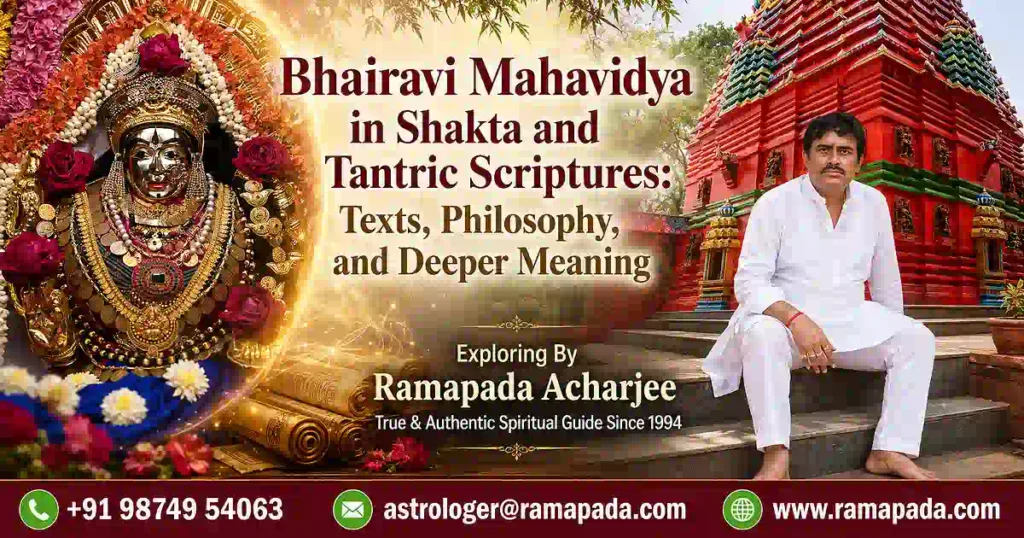
Texts, Philosophy, and Deeper Meaning
Introduction
Seekers widely recognise Bhairavi Mahavidya through Her radiant red form, three eyes, sacred book, rosary, and mudras. However, one cannot grasp Her true significance through sacred imagery alone.
To understand Her more deeply, we must explore the Shakta and Tantric philosophies where Her form originated.
These traditions never present Bhairavi merely as an intimidating goddess. Instead, they describe Her as the power of Tapas, disciplined transformation, spiritual intensity, and courageous self-awareness.
আমার দীর্ঘ ৩৫ বছরের উপলব্ধি : ভৈরবী মায়ের রূপ যেমন তেজস্বী, তাঁর দর্শনও তেমন গভীর। তিনি শুধু বাহ্যিক পূজার দেবী নন; মানুষের ভিতরের জড়তা, ভয় ও অজ্ঞানতা পরিবর্তনের আসল শক্তিও তিনি।
My spiritual journey began in 1994. Since then, across more than 35 years of consulting, I have observed human belief, inner turmoil, and the search for authentic transformation.
Furthermore, one understanding has become clear to me: we should not read sacred texts merely to collect quotations. Instead, scriptures must help us become disciplined, conscious, and compassionate human beings.
In this article, we will examine Bhairavi Mahavidya Tantric scriptures, the core philosophy behind Her worship, and Her practical lessons for modern life.
A particularly relevant historical source is John Woodroffe’s Hymns to the Goddess, whose table of contents includes a dedicated Bhairavi section.
Understanding the Shakta View of the Divine Mother
Shaktism understands the Divine Reality as Shakti—the conscious, dynamic power that creates, sustains, transforms, and dissolves the entire cosmos.
Shakta philosophy never treats Shakti as a secondary force. Rather, She represents the active dimension of ultimate reality.
Consequently, wisdom, time, speech, desire, and cosmic awareness emerge as direct expressions of this single universal energy.
The Ten Expressions of Wisdom
The Ten Mahavidyas reveal ten profound dimensions of this universal Shakti:
- Kali: Represents eternal time and radical transformation.
- Tara: Represents compassionate guidance across spiritual turbulence.
- Tripura Sundari: Represents ultimate beauty and transcendental consciousness.
- Bhuvaneshwari: Represents cosmic space and universal nurture.
- Chhinnamasta: Represents self-transcendence and non-dual awareness.
- Bhairavi: Represents Tapas, sacred discipline, moral courage, and transformative fire.
শাক্ত দর্শনের সারমর্ম : দশ মহাবিদ্যা দশজন সম্পূর্ণ বিচ্ছিন্ন দেবী নন। তাঁরা একই মহাশক্তির দশটি গভীর প্রকাশ—মানুষের চেতনার দশটি আলাদা স্তরও বলা যেতে পারে।
Therefore, this understanding prevents us from reducing Bhairavi to a frightening figure. Her fierceness forms an integral part of a profound philosophy.
For an introductory explanation of Bhairavi’s identity, origin, and position within the Mahavidya tradition, read Bhairavi Mahavidya: Meaning, Origin and Spiritual Significance.
What Does “Tripura Bhairavi” Mean?
Authentic scriptures frequently address Bhairavi as Tripura Bhairavi.
The title “Tripura” literally refers to three cities, three states, or three levels of human experience:
- The physical, subtle, and causal planes of existence
- The past, present, and future dimensions of time
- The cosmic functions of creation, preservation, and dissolution
- The waking, dreaming, and deep sleep states of consciousness
- The bodily, mental, and spiritual aspects of life
- The divine powers of Will (Iccha), Knowledge (Jnana), and Action (Kriya)
However, these three dimensions never limit Bhairavi. She operates as the transforming consciousness within and beyond them.
Moreover, in this philosophical context, “Tripura” has no connection with the modern Indian state. It serves purely as a metaphysical concept.
ত্রিপুরা ভৈরবী নামের তাৎপর্য : আমরা প্রতিদিন জাগ্রত, স্বপ্ন ও সুষুপ্তি—এই তিন অবস্থার মধ্য দিয়ে যাই। কিন্তু যে চেতনা এই পরিবর্তনগুলোকে অবলোকন করে, ভৈরবীর দর্শন আমাদের সেই পরম চেতনার সন্ধান দেয়।
The textual and ritual traditions surrounding Bhairavi and the other Mahavidyas are examined academically in David Kinsley’s Tantric Visions of the Divine Feminine.
Bhairavi in the Mahavidya Tradition
The Mahavidyas appear as an established group across classical Tantric texts and subsequent regional compilations. Lineages preserve distinct names, sequences, meditative descriptions, and ritual frameworks.
This diversity reflects the living depth of Tantric literature.
No single surviving manuscript presents every Mahavidya tradition in an identical manner. Different master-disciple lineages cultivate specific methods of contemplation.
Important Scriptural Compilations
Classical works connected with the Mahavidyas include:
- Todala Tantra: Explores cosmology, inner chakras, and the correspondence between the human body and the universe.
- Mundamala Tantra: Preserves foundational descriptions of the Mahavidyas and their metaphysical attributes.
- Shaktisamgama Tantra: A vast compendium covering extensive ritual and philosophical traditions.
- Shakta Pramoda: A respected compilation preserving traditional hymns, meditative verses, and worship frameworks.
- Tantrasara and Brihat Tantrasara: Krishnananda Agambagisha’s authoritative Bengal compilations organising earlier Tantric sources.
শাস্ত্র ও পরম্পরার বৈচিত্র্য : একটি বইয়ের একটি অনুবাদ পড়েই সম্পূর্ণ তন্ত্রশাস্ত্র বোঝা সম্ভব নয়। একই দেবীর বর্ণনা বিভিন্ন শাস্ত্র, অঞ্চল ও সাধনপরম্পরায় কিছুটা আলাদা হতে পারে।
Consequently, seekers must study every scriptural statement within its proper textual and cultural context.
Bhairavi and the Todala Tantra
The Todala Tantra is a concise yet frequently cited work that examines how cosmic principles reflect within the human body.
This core philosophical principle is deeply relevant when studying Bhairavi.
We should not search for Bhairavi’s transformative fire only in distant shrines. Instead, Her symbolic fire represents the discipline, moral courage, and self-mastery present within our own minds.
Traditional verses describe Her as radiant like the rising sun, dressed in crimson, possessing three eyes, and holding sacred objects:
- The Sacred Book: Symbolises deep scriptural understanding and self-enquiry.
- The Rosary: Symbolises patient, uninterrupted practice.
- Her Crimson Radiance: Symbolises awakened, focused vitality.
- Her Mudras: Symbolise divine protection and compassionate blessing.
অন্তরের দেবীতত্ত্ব : বাইরের মন্দিরে দেবীর দর্শন যেমন পবিত্র, তেমনি নিজের মনের ভিতরে সত্য, সংযম ও সাহস জাগিয়ে তোলাও এক পরম অন্তরের সাধনা।
Tantrasara and the Preservation of Tantric Traditions
The title Tantrasara represents fundamental compendiums across Indian Tantric lineages. In Bengal, Krishnananda Agambagisha’s Tantrasara organized extensive manuscripts into a clear, unified structure.
These works systematically preserve deity descriptions, meditative forms, Mantras, and Yantras.
However, these texts are not casual manuals for unsupervised experimentation.
Their practical sections assume preliminary training, formal initiation (diksha), phonetic accuracy, and guidance from an experienced spiritual mentor.
For this reason, I always distinguish between explaining universal philosophy and publicly promoting dangerous, restricted practices.
শাস্ত্র অধ্যয়নের সতর্কতা : তন্ত্রের বই হাতে পেলেই তার প্রতিটি গোপন ক্রিয়া নিজে থেকে করা উচিত নয়। বই তথ্য দিতে পারে, কিন্তু সাধনার উপযুক্ততা ও নিয়ম বোঝার জন্য উপযুক্ত আধ্যাত্মিক গাইড প্রয়োজন।
For broader background on Shakta scriptures, doctrine and the worship of Shakti, readers may consult John Woodroffe’s Shakti and Shakta.
Shakta Pramoda and the Mahavidya Tradition
Shakta Pramoda brings together devotional hymns (Stotras), protective armours (Kavachas), and meditative verses from dispersed manuscripts.
When reading such compilations, one must recognise how spiritual traditions evolve through interconnected layers:
+-------------------------------------------------------------+
|               Layers of Shakta & Tantric Tradition          |
+-------------------------------------------------------------+
| 1. Ancient Canonical Tantras & Agamas                       |
| 2. Master-Disciple Oral Lineages                            |
| 3. Regional Temple Customs & Folk Practices                 |
| 4. Lineage Commentaries & Compilations                      |
+-------------------------------------------------------------+
Respecting scriptures never means abandoning critical thinking. Understanding the historical context of each text remains an essential part of genuine study.
ঐতিহ্যের সম্মান ও বিচারবোধ : শাস্ত্রকে শ্রদ্ধা করার অর্থ অন্ধবিশ্বাস নয়। কোন বক্তব্য কোন শাস্ত্র ও পরম্পরা থেকে এসেছে, তা যুক্তির সাথে বোঝাও শাস্ত্রচর্চার অপরিহার্য অংশ।
Bhairavi and the Philosophy of Tapas
The philosophy of Tapas forms the bedrock of Bhairavi Mahavidya.
The Sanskrit root of “Tapas” relates to heat, focused effort, self-discipline, and inner purification.
However, Tapas does not mean self-harm or abandoning normal social duties.
Tapas in Daily Practice
In everyday life, Tapas translates into:
- Maintaining a disciplined daily routine
- Restraining harmful, impulsive reactions
- Speaking the truth with kindness
- Fulfilling necessary duties despite mental resistance
- Remaining patient and steady during adversity
- Examining personal shortcomings with complete honesty
- Renouncing destructive addictions permanently
Bhairavi represents the spiritual fire through which a chaotic life becomes purposeful.
তপস্যার প্রকৃত অর্থ : তপস্যা মানে শুধু অনাহারে থাকা বা শরীরকে কষ্ট দেওয়া নয়। নিজের তীব্র রাগ নিয়ন্ত্রণ করা, কথা রক্ষা করা, সৎভাবে কাজ করা এবং অন্যায় প্রলোভন ত্যাগ করাই হলো শ্রেষ্ঠ তপস্যা।
Throughout my journey since 1994, I have met many seekers chasing overnight miracles. Yet, true character develops only through steady, conscious discipline.
For a practical exploration of Tapas as disciplined self-transformation rather than extreme austerity, read Bhairavi Mahavidya and the Power of Tapasya.
Bhairavi as the Fire of Transformation
Fire is the primary cosmic symbol for understanding Bhairavi.
Fire provides light and life-giving warmth. It cooks food and purifies metals. However, uncontrolled fire becomes destructive.
The exact same principle governs human psychological energy:
+-------------------+----------------------------+-----------------------------+
| Raw Mental Energy | Uncontrolled Expression    | Conscious Transformation    |
+-------------------+----------------------------+-----------------------------+
| Anger             | Destructive Aggression     | Courage to Resist Injustice |
| Desire / Passion  | Addiction & Bondage        | Dedication to Noble Goals   |
| Emotional Turmoil | Mental Instability         | Creative & Devotional Power |
+-------------------+----------------------------+-----------------------------+
Therefore, Bhairavi does not teach the blind suppression of human energy. Instead, She represents its conscious sublimation.
Her fierce form and gentle blessing coexist because the fire that purifies illusion also illuminates our path.
শক্তির রূপান্তর : মনের শক্তিকে জোর করে চেপে রাখলে তা নষ্ট হয় না, বরং বিকৃত হয়। সেই মানসিক শক্তিকে সচেতনভাবে সঠিক ও কল্যাণকর পথে পরিচালিত করাই ভৈরবী দর্শনের মূল শিক্ষা।
A more extensive traditional treatment of Tantric doctrine, sadhana and ritual concepts is available in John Woodroffe’s Principles of Tantra.
Knowledge and Practice in Bhairavi’s Philosophy
Bhairavi holds a sacred book and a rosary simultaneously.
This iconographic pairing illustrates a central Tantric doctrine: knowledge (Jnana) and practice (Kriya) must always support each other.
- The Sacred Book: Represents scriptural study, self-enquiry, and higher wisdom.
- The Rosary: Represents patience, focused concentration, and regular practice.
Knowledge without practice turns into intellectual pride. Conversely, practice without knowledge deteriorates into superstition.
Thus, true spirituality unites clear understanding with disciplined action.
জ্ঞান ও অনুশীলনের ভারসাম্য : শুধু বই পড়লে আত্মিক উপলব্ধি হয় না। আবার বিচারবুদ্ধি ছাড়া যান্ত্রিক ক্রিয়া করলে তা কুসংস্কারে রূপ নেয়। আধ্যাত্মিক জীবনে জ্ঞান এবং নিয়মিত অনুশীলনের সুন্দর ভারসাম্য প্রয়োজন।
The symbolic relationship between Bhairavi’s sacred book, rosary, mudras, and other attributes is examined in Bhairavi Mahavidya Iconography and Symbolism.
Bhairavi, Speech, and Sacred Sound
Authentic traditions connect Bhairavi’s garland of heads with the sacred letters (Varnamala) of the Sanskrit alphabet.
In Tantric thought, letters manifest Matrika Shakti—the primordial power of sound that creates thoughts, speech, and mantras.
Human reality relies heavily on language.
A few encouraging words can inspire lifelong confidence. In contrast, harsh words can inflict lasting emotional wounds.
Therefore, discipline of speech (Vak Tapas) is an indispensable spiritual practice.
Bhairavi’s connection with sacred sound inspires us to ask:
- Are our words truthful and necessary?
- Do our words inflict avoidable pain?
- Do our actions match our spoken promises?
বাক্যের সংযম ও পবিত্রতা : মন্ত্র জপ করার আগে দৈনন্দিন কথাবার্তায় সংযমী হওয়া জরুরি। যিনি প্রাত্যহিক জীবনে অন্যকে কটু কথা বলেন, তাঁর মুখের মন্ত্র কখনো অন্তরের স্থায়ী পরিবর্তন আনতে পারে না।
Bhairavi and the Three States of Consciousness
The Tripura aspect of Bhairavi connects directly with the three recurring states of human awareness:
- Waking State (Jagrat): Experiencing the physical world through the senses.
- Dream State (Svapna): Experiencing an internal reality created by imagination.
- Deep Sleep (Sushupti): The temporary dissolution of ego-identity into silence.
Upon waking, we remember experiencing all three states.
Consequently, this raises a profound question: What underlying awareness observes these changing states?
Shakta philosophy reveals that Shakti is that foundational awareness. Bhairavi provides the spiritual focus required to realize this inner witness.
চেতনার তিন স্তর: জাগ্রত, স্বপ্ন এবং সুষুপ্তি—এই তিন অবস্থার পরিবর্তন হয়। কিন্তু যে সাক্ষী চেতনা এই পরিবর্তনগুলোকে লক্ষ করছে, আধ্যাত্মিক সাধনা আমাদের সেই পরম চেতনার কাছে নিয়ে যায়।
Bhairavi and the Vijnana Bhairava Tantra
The Vijnana Bhairava Tantra is a classical text of Kashmir Shaivism structured as a dialogue between Bhairava and Bhairavi. It outlines 112 contemplative methods using breath, sound, void, and emotion.
However, we must maintain a scholarly distinction here.
The Bhairavi in this dialogue represents the universal questioner and cosmic energy, which differs in ritual context from the specific Mahavidya form of Tripura Bhairavi.
Even so, the dialogue highlights an essential truth: we discover spiritual awareness through refined, inward attention rather than outward display alone.
শাস্ত্রের তুলনামূলক দৃষ্টিভঙ্গি : একই নাম বিভিন্ন শাস্ত্রে এলেই সব ক্ষেত্রে একই রূপ বা পদ্ধতি বোঝায় না। শাস্ত্রের সঠিক প্রেক্ষিত না বুঝে বিভ্রান্ত হওয়া উচিত নয়।
Bhairavi and Kundalini: A Necessary Clarification
Modern discussions frequently link Bhairavi with Kundalini Shakti and the Muladhara Chakra.
This correlation is valid within Yogic symbolism. Her transformative heat and awakening force represent the journey from unconscious habits to conscious awareness.
However, one should never treat Kundalini as a casual internet experiment.
Aggressive breath retention, forced visualisations, and unguided techniques can cause severe physiological and emotional distress.
Authentic spirituality prioritises emotional balance, moral integrity, and patient self-awareness over sensational experiences.
কুণ্ডলিনী বিষয়ক সতর্কতা : কুণ্ডলিনী নিয়ে কৌতূহল থাকা স্বাভাবিক। কিন্তু দ্রুত শক্তি জাগানোর লোভে শরীর ও মনের ওপর জোর করে কোনো বিপজ্জনক পরীক্ষা চালানো মারাত্মক ক্ষতিকর হতে পারে।
For a dedicated discussion of Kundalini, chakras, inner fire, and safe spiritual interpretation, continue with Bhairavi Mahavidya and Kundalini.
Does Scripture Support Fear-Based Claims?
Unscrupulous actors sometimes exploit Tantric imagery to terrorise vulnerable individuals.
They falsely claim a person is under a dark curse and demand money for expensive rituals.
This fear-mongering directly violates authentic Tantric philosophy.
Bhairavi personifies fearlessness, self-reliance, and truth. Using Her name to create panic or financial ruin contradicts the ethical core of Her teachings.
Therefore, we must always interpret scriptures through moral discernment and common sense.
ভয়ভীতি ও প্রতারণার বিরুদ্ধে সতর্কতা : ভৈরবী মায়ের নাম করে কাউকে ভয় দেখানো বা প্রতারণা করা তান্ত্রিক দর্শনের সম্পূর্ণ পরিপন্থী। সত্যিকারের আধ্যাত্মিকতা মানুষকে নির্ভীক ও স্বাবলম্বী বানায়, পরনির্ভরশীল করে না।
How Should Tantric Scriptures Be Read?
Tantric scriptures require mature reading because they contain coded symbolism, ritual metaphors, and restricted instructions.
A strictly literal reading creates severe misunderstandings. Conversely, dismissing every passage as mere metaphor distorts the tradition.
Essential Distinctions to Maintain
A mature seeker should distinguish between:
- Universal philosophical principles
- Devotional and meditative poetry
- Symbolic visualisations for mental focus
- Public ethical teachings
- Initiation-dependent practices under a qualified mentor
শাস্ত্র পাঠের সঠিক দৃষ্টিভঙ্গি : যা সর্বজনীন দর্শন, তাকে অপ্রয়োজনীয় গোপনীয়তা ভাবা ভুল। আবার যা উপযুক্ত গুরুর অধীন দীক্ষানির্ভর সাধনা, তাকে ঘরে বসে অপেশাদারভাবে চর্চা করাও চরম বিপজ্জনক।
For additional books, classical sources, study guidance, and further reading, see Bhairavi Mahavidya References, Scriptures and Further Reading.
Five Practical Principles for Modern Living
When my journey began in 1994, I initially viewed spiritual concepts through the lens of traditional faith.
Over decades of practical consulting experience, I learned that quoting scriptures is easy, but living their ethical truth in daily life requires genuine courage.
From my journey since 1994, we can distill Bhairavi’s philosophy into five practical principles:
+-------------------------------------------------------------------+
|               5 Practical Principles of Bhairavi                  |
+-------------------------------------------------------------------+
| 1. Honest Self-Examination   -> Face weaknesses without excuses   |
| 2. Consistent Discipline     -> Regular practice over excitement  |
| 3. Applied Knowledge         -> Ethics lived in everyday life     |
| 4. Channelled Energy         -> Anger/Fear transmuted to courage  |
| 5. Compassionate Fortitude   -> Inner strength rooted in empathy  |
+-------------------------------------------------------------------+
- Face Reality Honestly: Acknowledge personal flaws without making excuses.
- Embrace Structured Discipline: Consistent daily effort builds character far better than occasional excitement.
- Harmonise Study with Action: Implement ethical wisdom into daily behaviour.
- Transform Reactive Energy: Channel anger and grief into constructive service and inner fortitude.
- Anchor Strength in Compassion: Cultivate humility and empathy alongside inner discipline.
দৈনন্দিন জীবনের ৫টি মূলনীতি : শাস্ত্র মুখস্থ বলা সহজ, কিন্তু তা চরিত্রে রূপ দেওয়া কঠিন। ভৈরবীর আসল সাধনা হলো নিজের ভুল স্বীকার করা, নিয়মিত সংযম পালন করা এবং মানসিক শক্তিকে শুভ কাজে লাগানো।
Readers interested in placing Bhairavi within the broader historical development of Hindu goddess traditions may also explore David Kinsley’s Hindu Goddesses.
Bhairavi’s Philosophy in the Modern Age
Modern life is filled with cognitive distraction and emotional overload. People constantly search for instant solutions to deep psychological problems.
Bhairavi’s philosophy offers a grounded antidote:
- Build structured discipline amidst chaos
- Maintain mental composure during uncertainty
- Verify information thoroughly before believing it
- Exercise restraint over reactive speech
- Reject fear-based spiritual exploitation
- Seek professional medical and psychiatric healthcare whenever necessary
Spiritual reflection strengthens inner resolve, but responsible, evidence-based action remains essential for balanced living.
Conclusion
Bhairavi Mahavidya holds a monumental place within Shakta and Tantric philosophy.
The scriptures associated with Her reveal a worldview founded on Tapas, knowledge, conscious speech, and spiritual awakening.
Her sacred fire does not destroy; it purifies the mind of fear, lethargy, and ignorance.
From the understanding gathered throughout my journey since 1994, Her message remains clear: do not evade inner truth. Face it with courage, wisdom, discipline, and compassion.
উপসংহার বার্তা : ভৈরবী আমাদের অন্ধ ভয়ে কুঁকড়ে থাকতে শেখান না। তিনি আত্মসংযম, প্রজ্ঞা ও অটল সাহসের আলোয় জীবনের প্রতিটি কঠিন সত্যের মুখোমুখি হতে শেখান।
Frequently Asked Questions (FAQ)
1. Which scriptures discuss Bhairavi Mahavidya?
Bhairavi is discussed in several classical texts, including the Todala Tantra, Shaktisamgama Tantra, Mundamala Tantra, Shakta Pramoda, and Brihat Tantrasara.
(তোডল তন্ত্র, শক্তিসংগম তন্ত্র, মুণ্ডমালা তন্ত্র, শাক্ত প্রমোদ ও বৃহৎ তন্ত্রসারে ভৈরবী দেবীর বর্ণনা পাওয়া যায়।)
2. Is there only one definitive description of Goddess Bhairavi?
No. Her iconographic features, Dhyanas, and liturgical procedures vary across different traditions, texts, and regional lineages.
(না, বিভিন্ন শাস্ত্রীয় ধারা ও আঞ্চলিক ঐতিহ্যভেদে মায়ের রূপ ও ধ্যানবর্ণনায় বৈচিত্র্য রয়েছে।)
3. What is the central philosophical essence of Bhairavi?
She embodies Tapas (spiritual discipline), transformative heat, discriminating wisdom, courage, and the sublimation of raw psychological energy.
(ভৈরবীর মূল দর্শন হলো আত্মনিয়ন্ত্রণ, চারিত্রিক দৃঢ়তা, প্রজ্ঞা এবং মনের সুপ্ত শক্তিকে শুভ পথে পরিচালিত করা।)
4. What does Tapas mean in practical life?
Tapas means disciplined effort, honesty, controlling anger, fulfilling duties responsibly, and overcoming unhealthy habits without self-harm.
(বাস্তব জীবনে তপস্যা মানে অনাহার নয়; বরং রাগ সংবরণ করা, সত্যবাদী থাকা এবং নিষ্ঠার সাথে প্রাত্যহিক দায়িত্ব পালন করা।)
5. Can anyone practice advanced Bhairavi Tantra by reading books?
No. General philosophy can be studied openly, but advanced rituals, nyasa, and mantras require formal initiation and guidance from an experienced spiritual mentor.
(বই পড়ে সাধারণ দর্শন জানা যায়, কিন্তু জটিল তান্ত্রিক ক্রিয়া উপযুক্ত গুরুর প্রত্যক্ষ নির্দেশ ছাড়া করা একেবারেই উচিত নয়।)
6. Does Bhairavi’s worship involve terrifying or unethical rituals?
Authentic scriptures promote spiritual illumination, self-restraint, and courage. Using Her name to frighten or exploit individuals is completely unethical and unscriptural.
(না, খাঁটি শাক্ত দর্শনে ভৈরবী সাধনা মানুষকে নির্ভীক ও চরিত্রবান করে; ভয় দেখিয়ে শোষণ করা সম্পূর্ণ অনৈতিক।)
7. How is Bhairavi connected with Kundalini energy?
She represents the transformative spiritual fire that awakens consciousness from inertia. However, forceful or unguided practices must always be avoided.
(তিনি চেতনার রূপান্তরকারী শক্তির প্রতীক, তবে কোনো অবস্থাতেই জোরপূর্বক অপরীক্ষিত প্রক্রিয়া চর্চা করা নিরাপদ নয়।)
Continue the Journey
In the next part of this sacred series, we will explore:
Next Post : Why Is Bhairavi Called the Goddess of Tapas and Inner Transformation?
Connect with the Best in Kolkata
Stop wandering in uncertainty. Your stars have a story to tell, and Ramapada Acharjee is here to help you read it. With a legacy built on truth, 35 years of experience, and a mission to bring peace to every household, your journey toward clarity starts here.
📍Consultation available in Kolkata, Guwahati, Siliguri, Tarapith & online.
📞 Call/WhatsApp: +91-98749 54063
🌐 Visit Website
You may also read:
Kamakhya Tantrik—Exploring the Mystical Tradition
Role of Tantra in Kundali Matching
Tarapith Tantrik – Exploring the Mystical Tradition
The Secret Power of Yantras in Tantrik Rituals
🔗 Related Category: Tantra
