
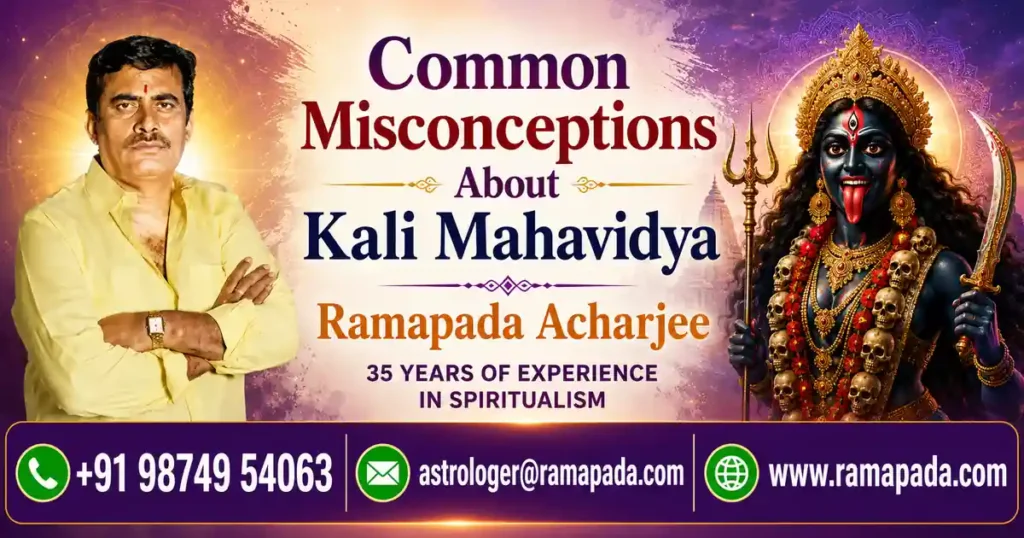
Understanding the Divine Beyond Fear and Myths
“যত বেশি আমি মা কালীর সম্পর্কে পড়েছি, তত বেশি বুঝেছি—মাকে নিয়ে মানুষের ভয় অনেক সময় তাঁর প্রকৃত রূপ থেকে নয়, ভুল ধারণা থেকে জন্ম নেয়।”
(The more I read about Goddess Kali, the more I realize that people’s fear often stems from misunderstandings rather than Her true form.)
For more than thirty-five years, seekers from diverse backgrounds have visited me with questions regarding astrology, spirituality, and the Dasha Mahavidyas. Among all the Mahavidyas, Kali Mahavidya remains perhaps the most misunderstood.
Many misconceptions arise when Kali’s fierce appearance is interpreted literally, so The Met’s discussion on understanding Kali more clearly offers valuable context.
Although some people feel instant devotion upon seeing Her image, others experience fear. Furthermore, many hesitate because they have heard sensational stories passed down without proper context or explanation. Over my decades of study, I realized that most misunderstandings do not arise from the sacred scriptures themselves. Rather, they stem from incomplete information, dramatic legends, and modern misconceptions shared without deep reflection. As we often say in Bengal:
“অজ্ঞতা অনেক সময় ভয়ের জন্ম দেয়; কিন্তু সঠিক জ্ঞান সেই ভয়কে শ্রদ্ধায় রূপান্তরিত করতে পারে।”
(Ignorance often gives birth to fear, but correct knowledge can transform that fear into deep reverence.)
Therefore, I believe this discussion remains essential—not to debate anyone’s personal beliefs, but to help sincere readers understand Kali Mahavidya with greater clarity, patience, and respect.
Many misconceptions can be avoided by first understanding Kali Mahavidya as the First Mahavidya
Misconception 1: Goddess Kali Is Only the Deity of Destruction
This misunderstanding is probably the most common one I encounter during consultations. Because Goddess Kali holds a sword, wears a garland of skulls, and stands in a fierce posture, many people immediately conclude that She represents destruction alone.
However, my understanding has evolved completely over the years. Within the Shakta tradition, destruction never signifies meaningless violence; instead, it represents the essential ending of ignorance, ego, attachment, and delusion (Maya). Just as autumn allows new leaves to bloom in spring, spiritual transformation often begins only after something false comes to an end. As another Bengali reflection reminds us:
The British Museum also examines the many dimensions of the Goddess in Kali Rises in the East.
“মা কালী ধ্বংস করেন, কিন্তু সেই ধ্বংস অকল্যাণের নয়—অহংকার, অজ্ঞানতা ও মায়ার।”
(Mother Kali destroys, but that destruction is not evil—it removes ego, ignorance, and illusion.)
Thus, Goddess Kali is not simply a deity who destroys; rather, she stands as the compassionate mother who clears the path for ultimate renewal.
A wider understanding of the tradition is possible when we first know what the Ten Mahavidyas are.
Misconception 2: Goddess Kali Worship Is Restricted Only to Tantra
Another misconception appears repeatedly in public discussions. Some people assume that anyone worshipping Goddess Kali must practice secret Tantric rituals. However, my personal experience reveals a completely different reality.
Throughout my pilgrimages to Kamakhya Temple, I have observed ordinary families, senior devotees, young students, working professionals, and simple villagers offering flowers and prayers with quiet devotion. In fact, many of them maintained no connection with complex Tantric practices at all. They simply worshipped Kali as their loving Divine Mother.
A contemporary devotional perspective is provided by the British Museum in its account of welcoming a new Goddess Kali icon.
Although Tantra forms an integral branch of the Shakta tradition, it is certainly not the only path to approach Her. Bhakti (devotion), meditation, self-discipline, and sincere prayer remain equally vital. As I often share with visitors:
Historical representations can be studied through The Met’s detailed record of Goddess Kali from nineteenth-century Bengal.
“মাকে পাওয়ার পথ এক নয়। কেউ ভক্তির মাধ্যমে এগিয়ে যায়, কেউ সাধনার মাধ্যমে, আবার কেউ নীরব প্রার্থনার মাধ্যমে।”
(The paths to reach the Mother are diverse. Some advance through devotion, others through spiritual discipline, and some through silent prayer.)
Recognizing this rich diversity helps us appreciate the true depth of our tradition.
Her traditional background also becomes clearer when we study the origin of Kali Mahavidya.
Misconception 3: Goddess Kali Symbolizes Fear
When people first look at Goddess Kali’s image, they frequently notice Her fierce expression before discovering the compassion hidden within it. Naturally, I understand that initial reaction because I once viewed her form in the exact same way.
Nevertheless, years of study and repeated visits to Kamakhya gradually transformed my perspective. Today, when I stand before the Divine Mother, I no longer see terror; instead, I perceive protection, strength, and maternal grace. She reminds her children that true courage is often born during life’s most difficult moments. As a personal reflection beautifully states,
“যে রূপকে একদিন ভয় পেয়েছিলাম, আজ সেই রূপেই মায়ের স্নেহ অনুভব করি।”
(In the very form I once feared, I now feel the Mother’s deep affection.)
Sometimes, our understanding transforms not because the image changes, but because we ourselves begin to see truth more clearly.
Misconception 4: Goddess Kali Is Completely Devoid of Compassion
Some seekers imagine Goddess Kali as fierce, believing that gentleness and love belong exclusively to other divine forms. Personally, I have never experienced the Divine Mother in such a divided way.
Compassion does not always manifest through gentleness; sometimes, true compassion means fearlessly removing what harms us. A loving mother occasionally speaks firmly to protect her child from danger. Likewise, Goddess Kali’s strength and compassion exist together in perfect harmony, and one never cancels the other. As we say in Bengali:
“কঠোরতা আর নিষ্ঠুরতা এক নয়। মায়ের কঠোরতা অনেক সময় সন্তানের মঙ্গলের জন্যই হয়।”
(Firmness and cruelty are not the same; a mother’s firmness often exists for the child’s well-being.)
Understanding this truth has helped many of my visitors view Goddess Kali with fresh, reverent eyes.
One of the most important ways to overcome fear-based interpretations is to look beyond Kali’s external image.
My Personal Reflection
Whenever I return home from Kamakhya, one lasting insight stays with me: the more we try to understand Goddess Kali through fear, the farther She seems to retreat. Conversely, the more we approach with humility, patience, and respect, the closer Her teachings begin to feel.
Therefore, my own understanding continues to evolve even after thirty-five years of study. I still consider myself a dedicated student of this tradition. Because every visit to Kamakhya teaches me something fresh, every prayer reveals another layer of cosmic meaning.
“মাকে জানার পথের শেষ নেই। যত এগোনো যায়, ততই মনে হয়—এখনও অনেক কিছু শেখা বাকি।”
(There is no end to knowing the Mother. The further one advances, the more one realizes how much remains to be learned.)
For additional clarification, readers can consult the Kali Mahavidya FAQ, key takeaways and final reflections.
Frequently Asked Questions (FAQ)
Q1. Is Kali Mahavidya associated only with destruction?
No. Rather than representing meaningless destruction, Goddess Kali symbolizes spiritual transformation, liberation, wisdom, and the removal of human ignorance and ego.
Q2. Is Kali worship reserved exclusively for Tantric practitioners?
No. Although Tantra holds a respected place in the Shakta lineage, ordinary devotees from all walks of life worship Goddess Kali through simple prayers, devotion, meditation, and daily family rituals.
Q3. Why do many people feel fear when viewing Goddess Kali’s image?
That initial fear usually arises from misunderstanding Her symbolism. However, once seekers learn the philosophical meaning behind Her sword, dark form, and garland of skulls, their fear transforms into deep respect.
Q4. Can beginners worship Kali Mahavidya at home?
Yes. Anyone approaching the Divine Mother with sincerity, humility, and clean intentions can offer simple prayers according to their personal faith and tradition.
Q5. What is the single biggest misconception about Goddess Kali?
The greatest misconception lies in assuming her fierce appearance represents cruelty. In reality, her fierce form symbolizes the protective power that destroys ego, ignorance, and internal fear.
The Smithsonian’s exploration of the different forms and meanings of Kali also helps place her fierce symbolism in a wider religious context.
Connect with the Best in Kolkata
Stop wandering in uncertainty. Your stars have a story to tell, and Ramapada Acharjee is here to help you read it. With a legacy built on truth, 35 years of experience, and a mission to bring peace to every household, your journey toward clarity starts here.
📍Consultation available in Kolkata, Guwahati, Siliguri, Tarapith & online.
📞 Call/WhatsApp: +91-98749 54063
🌐 Visit Website
You may also read:
- Mantra, Yantra, and Tantra
- Role of Tantra in Kundali Matching
- Vashikaran and Law: Warning & Safety Guide
- Tantric Practices in Tarapith and Kamakhya
- Kamakhya Temple Tantra – Secrets of Divine Power
Related Category: Tantra
