
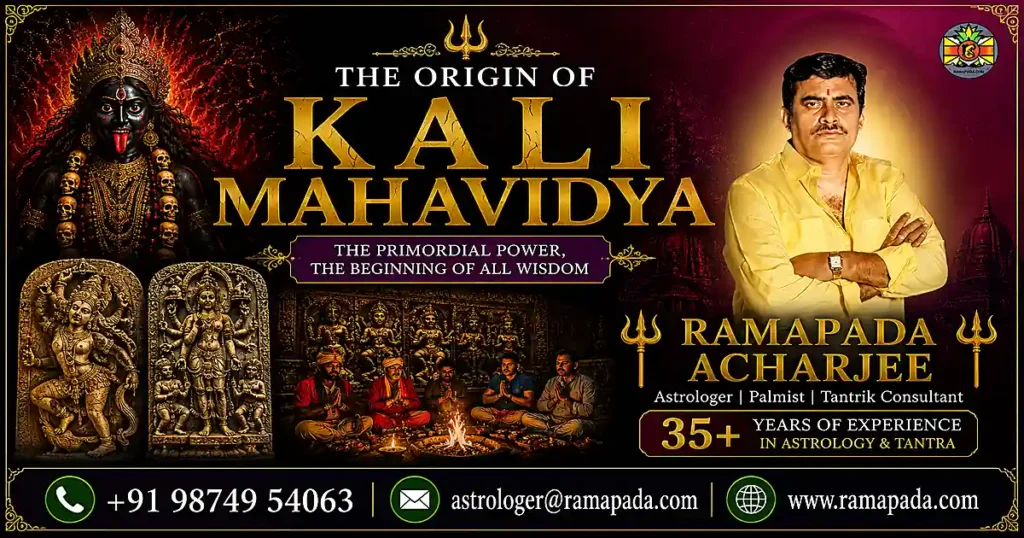
Ancient Scriptures, Shakta Tradition & the Living Spirit of Kamakhya
“মাকে বোঝার আগে তাঁর উৎসকে বোঝা দরকার।“
(Before we understand the Mother, we must understand Her sacred origin.)
Many readers ask me a simple yet profound question: Where did Kali Mahavidya actually originate?
The answer does not lie within a single book, a lone temple, or one isolated historical event. Instead, Goddess Kali emerges from centuries of spiritual practice, Shakta philosophy, Tantric lineages, and sacred scriptures that gradually established her place as the First Mahavidya.
The complex historical and spiritual identity of Kali is discussed in depth in The Met’s article Seeing Kali Clearly.
During my decades of study and repeated visits to Kamakhya Temple, I realized something essential. People often search for a single historical date; however, Indian spiritual traditions rarely develop in such a rigid way. Rather, they evolve organically, grow through daily practice, and deepen through generations of sincere seekers. As we often say in Bengali:
“আধ্যাত্মিক ঐতিহ্য এক দিনে তৈরি হয় না; বহু যুগের সাধনা তাকে পূর্ণতা দেয়।“
(Spiritual tradition is not created in a day; centuries of sadhana bring it to fulfillment.)
That timeless thought beautifully reflects the sacred story of Kali Mahavidya.
To understand her position within the wider tradition, readers may first explore Kali Mahavidya, the First Mahavidya.
Kali in the Ancient Shakta Tradition
The worship of the Divine Mother has flourished in India for thousands of years. Although different regions called Her by different names and described Her through various forms, one central truth remained unchanged—the Divine Mother stands as the ultimate source of creation, preservation, and transformation.
Within the Shakta tradition, Kali gradually came to represent the limitless power that transforms human ignorance into divine wisdom. Indeed, this is one reason why scholars and sadhakas place She was the first among the Ten Mahavidyas. She does not simply destroy; instead, she removes the internal obstacles that prevent spiritual growth. As another Bengali reflection reminds us:
“মা কখনও অকারণে ভাঙেন না; তিনি নতুন কিছু গড়ার জন্য পুরোনোকে সরিয়ে দেন।“
(The Mother never breaks anything without purpose; she removes the old to create space for the new.)
Understanding this single concept changes our entire perspective toward Her divine energy.
A museum interpretation of Kali’s divine form and traditional attributes can be found in this detailed record of Goddess Kali.
References to Kali in Sacred Texts
Many seekers ask whether references to Goddess Kali appear only in Tantric literature. In fact, the answer is a clear no. Descriptions of Kali and the Divine Mother exist across several fundamental Hindu scriptures and traditions, including:
- Devi Mahatmya: Highlighting her supreme power to destroy cosmic illusions and demonic forces.
- Kalika Purana: Detailing her deep connection with sacred places and rituals.
- Devi Bhagavata Purana: Explaining Her cosmic nature as the ultimate source of energy (Adi Shakti).
- Mahanirvana Tantra & Other Tantric Texts: Unveiling Her deeper philosophical and meditative forms.
- Regional Shakta Literature & Oral Lineages: Preserving intimate devotional songs and folk traditions.
Because each scripture presents Goddess Kali from a slightly different angle, they collectively enrich our spiritual understanding. While some texts emphasize Her cosmic force, others highlight Her maternal compassion and Her essential role in spiritual awakening.
Those unfamiliar with the wider spiritual system may also begin by learning what the Ten Mahavidyas are.
Why Kamakhya Temple Is Closely Connected with Kali Mahavidya
One question I frequently encounter is whether Kamakhya Temple is dedicated solely to Goddess Kali. The answer requires a more nuanced understanding.
Kamakhya Temple is primarily dedicated to Goddess Kamakhya, one of the most revered forms of Adi Shakti. Nevertheless, Kamakhya has long served as a vibrant center for Shakta Tantra, where the worship of the Ten Mahavidyas—including Kali—has flourished for centuries.
During my own pilgrimages to Nilachal Hill, I observed something that books alone cannot convey. For instance, pilgrims arrive with diverse personal prayers, and priests perform varied rituals; yet, the overall atmosphere reflects one unified truth. Seekers experience the Divine Mother in many forms. As we often say:
“রূপ আলাদা হতে পারে, কিন্তু মাতৃশক্তি একটাই।“
(The forms may differ, but the maternal power remains one.)
That living, breathing experience makes Kamakhya truly unique among sacred places.
The evolution of Kali’s imagery in Bengal is explored by the British Museum in Kali Rises in the East.
Is Kali Mahavidya a Historical Figure or a Spiritual Principle?
This question deserves careful thought. Within traditional Hindu thought, Kali Mahavidya is not viewed as a historical human personality. Rather, She represents an eternal spiritual principle within Indian philosophy. Her form teaches timeless lessons regarding the following:
- Transformation: Accepting change as the fundamental law of life.
- Fearlessness: Overcoming anxiety, uncertainty, and the fear of death.
- Inner Discipline: Mastering one’s senses, desires, and mental turmoil.
- Freedom from Ego: Surrendering the false self to realize higher consciousness.
- Spiritual Awakening: Discovering the eternal light within darkness.
Therefore, Goddess Kali continues to inspire spiritual seekers across generations. Her core teachings remain deeply relevant even in today’s fast-changing world.
Her living tradition can also be explored through the connection between Kali and Kamakhya Temple.
What I Learned from Visiting Kamakhya Repeatedly
No academic book can fully replace sincere personal observation. Every pilgrimage to Kamakhya has granted me a fresh realization. Sometimes the lesson came from watching the early morning rituals, while at other times it emerged from discussions with traditional priests. Frequently, wisdom revealed itself while quietly observing ordinary devotees waiting patiently for darshan.
Those sacred moments gradually reshaped my perspective. Today, I no longer view Goddess Kali solely through mythological stories. Instead, I see Her through faith, philosophy, living tradition, and personal experience. As a cherished Bengali saying reminds us:
“শুধু পড়ে নয়, অনুভব করেও অনেক কিছু শেখা যায়।“
(Not just by reading, but also by feeling, can one learn many profound truths.)
That, perhaps, remains the greatest blessing of true pilgrimage.
Kali’s origin becomes more meaningful when her divine form is interpreted beyond its surface appearance in Looking Beyond the Image.
Key Takeaways
Before moving to our next chapter, let us remember these essential insights:
- Evolution of Tradition: Kali Mahavidya grew organically through centuries of Shakta devotion and practice.
- Scriptural Harmony: Multiple sacred texts describe Her divine forms from complementary perspectives.
- The Kamakhya Connection: Kamakhya Temple remains a vital living sanctuary for Mahavidya traditions.
- True Purpose: Goddess Kali symbolizes inner transformation and spiritual liberation rather than physical destruction.
- Living Experience: Personal reflection and devotion deepen our understanding of scriptural knowledge.
Understanding her origins also helps clarify many common misconceptions about Kali Mahavidya.
Frequently Asked Questions (FAQ)
1. Is Goddess Kali mentioned in the ancient Vedas?
Direct references to the specific Mahavidya form of Kali are limited in the early Vedic hymns. However, her philosophical roots exist in Vedic concepts of time and cosmic power, while her full Mahavidya form developed later through Shakta Puranas and Tantric literature.
2. Why is Kamakhya Temple considered important for Mahavidya worship?
Kamakhya Temple stands as one of the most respected Shakta Peethas in India. Because it has preserved Mahavidya rituals, scriptural studies, and living Tantric traditions for centuries, it remains a central sanctuary for seekers of the Divine Feminine.
Early devotional conceptions of the supreme feminine principle can also be explored through these traditional hymns to Mahadevi.
3. Is the worship of Goddess Kali reserved only for Tantric practitioners?
No. Although Tantric lineages hold Goddess Kali in deep reverence, millions of householder devotees worship her daily through simple prayers, devotional songs, seasonal festivals, and traditional family rituals.
4. Can ordinary devotees worship Goddess Kali at home?
Yes. Sincere devotees can worship Goddess Kali through simple prayers, faith, and ethical living. In fact, traditional scholars emphasize that genuine devotion, clean intentions, and respect hold far greater value than complex rituals.
5. Why do different Hindu scriptures describe Goddess Kali differently?
Different scriptures highlight distinct aspects of the Divine Mother to suit different levels of spiritual understanding. Therefore, these variations do not create contradictions; instead, they present a complete and multifaceted understanding of Her infinite nature.
The Smithsonian provides another useful perspective through its exploration of Kali as the Great Goddess.
Connect with the Best in Kolkata
Stop wandering in uncertainty. Your stars have a story to tell, and Ramapada Acharjee is here to help you read it. With a legacy built on truth, 35 years of experience, and a mission to bring peace to every household, your journey toward clarity starts here.
📍Consultation available in Kolkata, Guwahati, Siliguri, Tarapith & online.
📞 Call/WhatsApp: +91-98749 54063
🌐 Visit Website
You may also read:
Best Tantrik in Chennai – Tantra Services
Best Tantrik in Hyderabad: Authentic Tantric Services
Best Tantrik in Navi Mumbai: Tantra Specialist
Related Category: Tantra
