
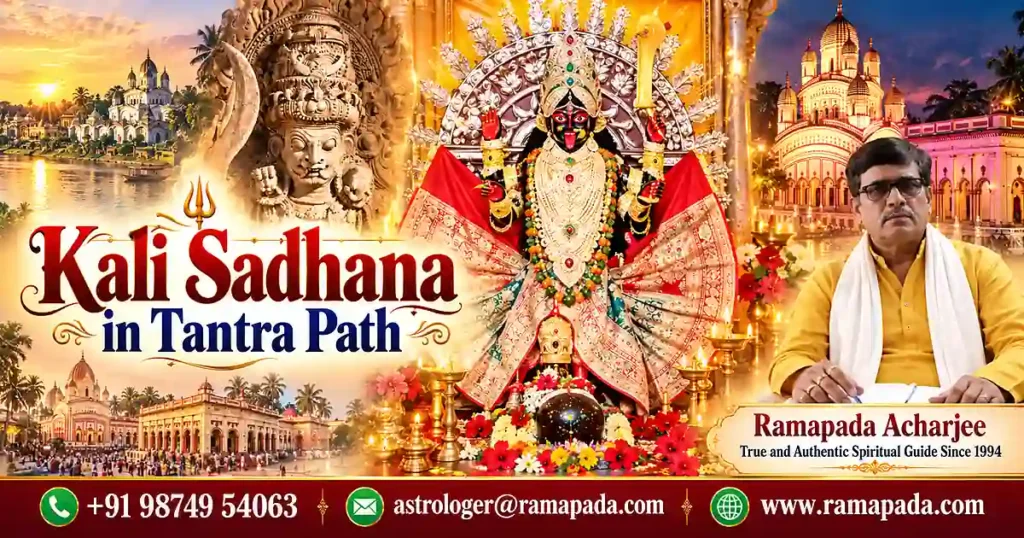
Kali Sadhana in Tantra represents one of the deepest spiritual paths within the Shakta tradition. Rather than focusing only on ritual or supernatural ideas, this path encourages courage, discipline, devotion, awareness, and freedom from fear.
During my long spiritual journey, I have noticed that people often approach Goddess Kali with two strong emotions—devotion and fear. However, her fierce appearance carries a much deeper spiritual message.
Kali represents transformation. Therefore, her symbolism encourages seekers to face fear, ego, attachment, and ignorance instead of running away from them.
The Metropolitan Museum of Art’s study of Kali also discusses her relationship with time, destruction, renewal, transformation, and compassionate motherhood.
Kali Sadhana in Tantra and the Meaning of Goddess Kali
Tantric traditions regard Kali as a powerful expression of Shakti, the dynamic divine energy.
Traditional interpretations see her dark form as a symbol that goes beyond ordinary limitation. Moreover, her association with time, death, transformation, and liberation gives her image a meaning far deeper than the frightening portrayals sometimes seen in popular culture.
A historic image of Kali from nineteenth-century Kolkata preserved by the Metropolitan Museum of Art also reflects the importance of Goddess Kali in Bengal’s Shakta tradition.
For a spiritual seeker, her form can represent the courage required to look beyond outward appearances.
More importantly, her message does not concern destruction alone. Kali symbolises the destruction of ignorance, uncontrolled ego, false identity, and inner bondage.
This relationship between divine consciousness and divine energy also connects with the principles discussed in my article on Shiva Shakti Energy Balance.
Why Does Goddess Kali Appear Fierce?
Many people wonder why devotees worship a compassionate Divine Mother in such a fierce form.
The answer lies largely in spiritual symbolism.
Life contains creation as well as destruction. Similarly, people experience happiness and sorrow, beginnings and endings, gain and loss.
Kali does not hide these realities. Instead, her form encourages a seeker to understand and accept change.
In many traditional representations, Kali stands upon Shiva. The British Museum’s discussion of Kali and Tantric Shakti explores this powerful symbolism.
Within Tantric philosophy, Shiva may represent consciousness, while Shakti represents active energy.
At the same time, seekers can contemplate this symbolism within themselves. Awareness needs energy to express itself, while energy needs awareness to find direction.
The Inner Purpose of Kali Sadhana in Tantra
The deeper purpose of Kali Sadhana in Tantra does not involve gaining control over other people.
Instead, genuine spiritual practice turns attention inward.
A seeker gradually learns to observe:
- Fear
- Anger
- Attachment
- Ego
- Jealousy
- Restlessness
- Desire for control
When people fail to understand these tendencies, inner peace often becomes difficult.
Therefore, Tantra encourages self-observation before a practitioner tries to understand anything outside the mind.
Many misconceptions have developed around this subject. For that reason, I have discussed them separately in Tantra Myths and Fear.
In practice, spiritual progress begins when fear stops controlling every decision.
Kali Sadhana Is a Path of Transformation
From my own spiritual observations over many years, I have found that meaningful transformation rarely happens dramatically.
Instead, change usually develops slowly.
Over time, a person may react differently to difficult situations. Fear becomes easier to observe, while anger becomes easier to control.
Meanwhile, attachment may become clearer to the mind. As a result, difficult circumstances can sometimes be faced with greater patience.
Such inner changes matter far more than simply collecting rituals.
The Smithsonian National Museum of Asian Art presents Kali as both Mother and Destroyer and discusses her connection with liberation and the removal of delusion.
This dual nature carries an important lesson.
Sometimes, genuine transformation requires letting go of old patterns before something new can develop.
Discipline Comes Before Ritual
Tantric traditions place great importance on preparation and discipline.
However, serious Kali Sadhana should never become an attempt to copy complicated rituals blindly from books, videos, or social media.
A strong spiritual foundation should come first.
For example, a seeker can gradually cultivate:
- Mental stability
- Patience
- Ethical conduct
- Respect for tradition
- Self-control
- Regular spiritual practice
- Humility
Without these qualities, even an elaborate ritual may lose its deeper meaning.
Moreover, proper guidance can help a person understand the difference between spiritual discipline and unnecessary experimentation. I have discussed this subject in Tantra Sadhana with a Spiritual Guide.
A genuine guide should create clarity. In contrast, spiritual guidance should never create unnecessary fear or unhealthy dependence.
The Importance of Mantra and Meditation
Mantra holds an important place within many Tantric traditions.
Nevertheless, a practitioner should not treat a mantra like a mechanical formula that guarantees instant results.
Concentration, devotion, sound, breathing, intention, and mental discipline all contribute to spiritual practice.
Similarly, meditation on Goddess Kali can encourage a seeker to observe fear and reflect on the impermanent nature of life.
The deeper aim should always remain greater awareness.
For most householders, therefore, simple prayer, disciplined meditation, remembrance of the Divine, and ethical living can provide a meaningful foundation. These approaches also avoid the risks of experimenting with advanced practices without proper understanding.
Kali Sadhana in Tantra and Fearlessness
Fear strongly influences human behaviour.
People may fear loss, illness, failure, rejection, loneliness, ageing, uncertainty, or death.
Spiritual practice cannot remove every difficult situation from life. However, it can influence the way a person responds to those difficulties.
Kali’s symbolism confronts the reality of impermanence directly.
Gradually, a seeker may begin to understand several important truths:
- Everything changes.
- Human control has limits.
- Excessive attachment often increases suffering.
- Acceptance can strengthen courage.
- Inner stability matters more than outward display.
For this reason, Kali Sadhana should never encourage reckless behaviour.
True fearlessness includes awareness, patience, and responsibility.
Kali as Mother and Protector
In Bengal, devotees do not see Kali only through her fierce appearance.
Millions lovingly call her Ma Kali.
Interestingly, the fierce Goddess and the compassionate Mother do not represent contradictory ideas. Instead, both forms express different dimensions of the same divine power.
The British Museum’s Kali collection also reflects the continuing significance of Kali worship, particularly in West Bengal.
A devotee may see the Mother as fierce when she destroys ignorance and compassionate when she protects spiritual growth.
Consequently, Kali Puja can contain both intense reverence and deep emotional closeness.
The seeker does not merely worship power. Rather, the deeper relationship develops through surrender, trust, devotion, and discipline.
The Role of a Spiritual Guide
Traditional Tantra gives considerable importance to proper guidance.
Yet this principle does not mean that a seeker should blindly follow another person.
A genuine spiritual guide should encourage understanding and independent awareness.
For example, proper guidance may help with:
- Understanding spiritual principles
- Correcting misconceptions
- Maintaining ethical boundaries
- Avoiding unnecessary fear
- Choosing appropriate practices
- Preventing harmful experimentation
I have explained this subject further in How to Find a Genuine Tantrik in India.
At the same time, people should remain cautious when someone constantly creates fear, promises impossible results, or demands unquestioning obedience.
Ultimately, spiritual knowledge should make the mind clearer and more stable.
Kali Sadhana and Negative Energy
Many people become interested in Tantra because they believe negative energy surrounds them.
However, every uncomfortable event does not come from an occult cause.
Stress, poor sleep, relationship problems, financial pressure, fear, conflict, and emotional exhaustion can also create a strong feeling of negativity.
Therefore, people should consider ordinary practical causes before reaching frightening conclusions.
Spiritual practice may still help someone become calmer and more centred.
My article on Tantra Protection from Negative Energy explains why awareness and inner stability matter more than constant fear of unseen forces.
Most importantly, Kali Sadhana should strengthen the mind rather than make someone suspicious of every event or person.
Kali Sadhana and Kundalini
People sometimes connect Goddess Kali with Kundalini and the awakening of inner spiritual energy.
This subject requires care and patience.
A practitioner should never try to force Kundalini through extreme exercises or dramatic experimentation.
Instead, serious spiritual traditions encourage gradual inner development.
Ethical living, mental preparation, devotion, concentration, and self-awareness all play important roles.
Furthermore, unusual sensations do not necessarily prove spiritual advancement.
A calmer mind, balanced behaviour, discipline, and greater self-awareness often provide more meaningful signs of genuine development.
Kali Sadhana for People Living a Normal Life
A person does not need to abandon family or professional responsibilities in order to develop spiritually.
This point matters particularly in modern life.
Most people have families, jobs, financial responsibilities, relationships, and everyday pressures. Therefore, spiritual practice should help them handle these responsibilities with greater awareness.
My article on Tantra for Modern People Living Normal Life discusses this practical approach in greater detail.
A householder can begin with simple disciplines such as prayer, meditation, truthful conduct, charity, self-observation, and remembrance of the Divine.
In other words, spirituality should improve daily life rather than become an escape from responsibility.
Kali and the Spiritual Tradition of Bengal
Kali worship occupies a special place in Bengal.
For generations, people have worshipped her in temples, family homes, festivals, devotional music, and spiritual traditions.
Moreover, the British Museum’s research on Kali’s history in Bengal discusses Bengal’s important connection with her Tantric traditions.
Devotees often approach Kali as both Mahashakti and the loving Divine Mother.
This combination of intensity and devotion helps explain why Kali worship remains deeply rooted in Bengali spiritual culture.
Sacred Places Connected With Shakta Tantra
India has many sacred places associated with Shakti worship.
Among them, Tarapith in West Bengal and Kamakhya in Assam hold great importance within Shakta and Tantric traditions.
However, visiting a sacred place should involve more than spiritual tourism.
A temple or pilgrimage centre becomes more meaningful when the experience encourages humility, devotion, reflection, and greater self-awareness.
Sacred geography can support spiritual practice. Nevertheless, the seeker must still experience transformation within.
What Long Spiritual Experience Teaches
During decades of spiritual observation and interaction with people, I have repeatedly noticed one misunderstanding.
Many people initially approach Tantra because they want immediate solutions.
For instance, they may seek quick success, relief from fear, protection from difficulties, or greater control over circumstances.
Over time, however, a deeper spiritual lesson often becomes visible.
Spirituality does not always change the outside world according to our wishes.
Instead, meaningful practice changes the person who faces that world.
This inner shift can influence daily life in several ways.
As the mind becomes more disciplined, decisions may improve. Likewise, reduced fear can lead to clearer judgment.
When ego decreases, relationships may become easier to understand. Similarly, greater awareness of attachment can change the way a person responds to suffering.
For me, this inner transformation remains one of the most meaningful aspects of Kali Sadhana.
Common Misconceptions About Kali Sadhana
Does Kali Sadhana Only Concern Occult Power?
No. Its deeper spiritual purpose involves transformation, devotion, awareness, courage, and freedom from inner limitations.
Is Kali Worship Dangerous?
Ordinary devotional worship of Goddess Kali should not be confused with advanced or extreme Tantric practices.
Does Every Kali Devotee Practise Tantra?
No. Millions of devotees worship Kali through prayer, temple worship, family traditions, and simple devotion.
Does Tantra Mean Controlling Other People?
No. Responsible spiritual practice begins with self-control and self-awareness rather than control over others.
Can Someone Learn Advanced Rituals Only From the Internet?
Books and online resources can provide general knowledge. However, a person should not casually experiment with specialised traditional practices without proper understanding.
Frequently Asked Questions
What Is Kali Sadhana in Tantra?
Kali Sadhana in Tantra is a spiritual approach centred on Goddess Kali. Traditional practitioners connect it with courage, devotion, transformation, awareness, and freedom from fear and attachment.
Can a Beginner Practise Kali Sadhana?
Yes. A beginner can begin with simple devotional practices such as prayer, respectful worship, meditation, and ethical living. However, beginners should avoid casually experimenting with advanced Tantric rituals.
Is Kali Sadhana Only for Tantriks?
No. Ordinary devotees also worship Goddess Kali. Tantric Kali Sadhana represents one particular spiritual approach within the much wider tradition of Kali worship.
What Is the Main Purpose of Kali Sadhana?
At a deeper level, the practice encourages inner transformation. It may help a seeker examine fear, ego, attachment, ignorance, and personal limitations while developing spiritual discipline.
Is Kali a Destructive Goddess?
Kali’s symbolism includes destruction. However, that destruction can represent the ending of ignorance and limitation.
Museum and academic interpretations also describe her as fierce, transformative, protective, and maternal. For example, The Metropolitan Museum of Art offers a useful historical explanation.
Is a Spiritual Guide Necessary for Tantra?
Simple devotional worship does not require complicated instruction.
However, specialised Tantric practices traditionally involve structured guidance. Therefore, a person should avoid copying advanced practices from unknown or unreliable sources.
A Practical and Spiritual Perspective
Kali Sadhana in Tantra becomes most meaningful when it leads a person from fear toward awareness.
Rather than encouraging obsession with supernatural power, the path should develop courage.
Moreover, genuine spirituality should not increase dependence. It should strengthen self-awareness and responsibility.
Kali’s fierce image reminds us that life constantly changes and that human control always has limits.
At the same time, her compassionate aspect reminds devotees that faith can provide strength during periods of transformation.
After many years of spiritual experience, I consider this balance especially important.
Ritual has its place. Mantra also has its place. Likewise, sacred traditions deserve respect.
Ultimately, however, everyday life provides the clearest test of spiritual practice.
When a person becomes calmer, more disciplined, more compassionate, less fearful, and more responsible, the spiritual path begins to create genuine meaning.
Call/WhatsApp: +91 98749 54063
Contact Ramapada Acharjee.
You May Also Read:
🔗 Related Category: Tantra
