
The Fifth Mahavidya—Meaning, Origin, and My Understanding
Exploring by Ramapada Acharjee
True & Authentic Spiritual Guide Since 1994
When I first began exploring the deeper meaning of the Dasha Mahavidyas, I gradually realized a profound truth. In fact, their outer forms cannot always explain their inner wisdom. Chhinnamasta Mahavidya is perhaps one of the clearest examples of this spiritual reality.
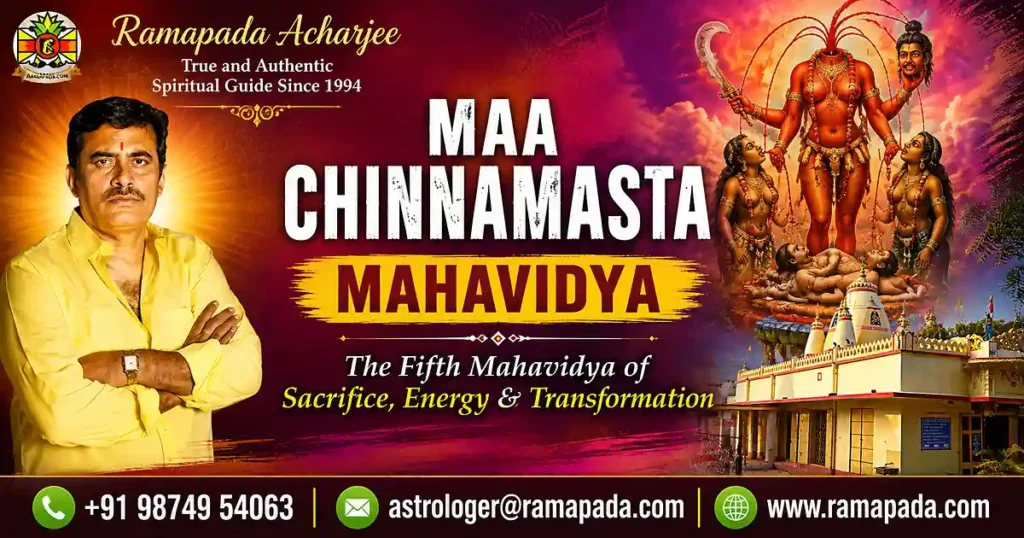
Her divine image is undeniably powerful and unusual. She holds her own severed head. Meanwhile, three vibrant streams of blood flow from her neck. At first sight, this form may appear frightening to many seekers. However, throughout my 34 years of spiritual practice, I have never felt that fear alone can explain Chhinnamasta.
In my personal understanding, her form speaks directly about life, death, cosmic energy, self-control, and transformation. Most importantly, it challenges us to look far beyond superficial appearances.
মা ছিন্নমস্তার রূপ প্রথম দেখলে ভয়ঙ্কর মনে হতে পারে। তবে আমার দীর্ঘ অভিজ্ঞতায়, তাঁর মূল উদ্দেশ্য ভয় সৃষ্টি করা নয়। বস্তুত এখানে জীবন ও মৃত্যু, ত্যাগ ও প্রাপ্তি, এবং কামনা ও আত্মসংযম—এই বিপরীত সত্যগুলি একই সঙ্গে প্রকাশিত হয়েছে।
For a comprehensive introduction to Chhinnamasta as one of the Ten Mahavidyas, readers may consult David Kinsley’s Tantric Visions of the Divine Feminine.
Who Is Chhinnamasta Mahavidya?
Chhinnamasta Mahavidya is traditionally revered as the Fifth Mahavidya among the sacred Dasha Mahavidyas.
Her name itself provides the first clue to her unique appearance. Specifically, the Sanskrit word “Chhinna” refers to something severed. On the other hand, “Masta” refers to the head. Therefore, Chhinnamasta is commonly understood as “She whose head is severed.”
Yet, the literal meaning reveals only a small fraction of the truth. In spiritual philosophy, the head symbolizes personal identity, repetitive thoughts, and human ego. Human beings naturally become deeply attached to ideas like “I,” “mine,” social status, and individual achievement.
Consequently, Chhinnamasta forces us to question this false attachment directly.
“ছিন্নমস্তা” নামটি মূলত তাঁর ছিন্ন মস্তকের রূপের সঙ্গে যুক্ত। তবুও শুধু আক্ষরিক অর্থে দেখলে তাঁর তত্ত্ব বোঝা যায় না। আমার উপলব্ধিতে, এখানে মস্তক আমাদের অহং, মিথ্যা পরিচয় এবং অহমিকার প্রতীক হিসেবে চিহ্নিত।
For readers who want to examine her traditional position through classical textual sources, see Chhinnamasta in Shakta and Tantric Scriptures.
Why Is Chhinnamasta Called the Fifth Mahavidya?
A widely followed sacred sequence of the Dasha Mahavidyas unfolds systematically:
Kali -> Tara -> Tripura Sundari -> Bhuvaneshwari -> Chhinnamasta
Therefore, Chhinnamasta comes immediately after Bhuvaneshwari and is worshipped as the Fifth Mahavidya.
Over decades of guidance and meditation, I have found this progression deeply meaningful:
- Kali brings us face to face with time and absolute transformation.
- Tara introduces divine guidance, shelter, and compassion.
- Tripura Sundari reveals cosmic harmony, sacred beauty, and pure consciousness.
- Bhuvaneshwari expands our inner awareness toward infinite space.
Then, Chhinnamasta appears before the seeker. Her form asks a much more challenging question: Can we truly transcend our rigid attachment to the ego?
মা কালী, মা তারা, মা ত্রিপুরাসুন্দরী এবং মা ভুবনেশ্বরীর পরেই মা ছিন্নমস্তার অবস্থান। সুতরাং এই ধারাবাহিকতার মধ্যে একটি আত্মিক গভীরতা রয়েছে। পূর্বের তত্ত্বগুলির পর ছিন্নমস্তা আমাদের প্রশ্ন করেন—আমরা কি নিজের অহং-এর গণ্ডি পেরিয়ে যেতে পারি?
Questions concerning Chhinnamasta’s origins and her relationship with Buddhist Chinnamunda traditions are explored in Elisabeth Anne Benard’s specialised study.
The Origin of Chhinnamasta Mahavidya
Several sacred narratives are associated with Chhinnamasta Mahavidya across ancient Shakta traditions. Therefore, I prefer not to treat a single folklore as the only possible explanation.
One widely known account describes the Goddess walking with her two companions, Dakini and Varnini. During their journey, her attendants become intensely hungry and ask the mother for nourishment.
The traditional narrative then takes a dramatic turn. Specifically, the Goddess severs her own head with a scimitar. Instantly, three streams of blood emerge from her neck. Two streams nourish her devoted companions, while the central stream enters her own severed head.
The visual representation is undoubtedly intense. However, its symbolic wisdom deserves far more attention than its fierce appearance:
- Nourishment and supreme sacrifice occur together at the same moment.
- Life and death merge into a single continuous reality.
- Energy is freely given away, yet consciousness remains unbroken.
প্রচলিত কাহিনিতে মায়ের দুই সহচরী ক্ষুধার্ত হলে আহার প্রার্থনা করেন। তখন মা নিজের মস্তক ছিন্ন করে প্রবাহিত জীবনধারায় তাঁদের তৃপ্ত করেন। মূলত এটি কোনো শারীরিক ঘটনা নয়, বরং নিঃস্বার্থ ত্যাগ ও অবিরাম শক্তির প্রবাহের এক পরম প্রতীক।
The severed head, three blood streams, Dakini, Varnini, and other elements of this sacred narrative are explained visually in Chhinnamasta Mahavidya Iconography and Symbolism.
Chhinnamasta Is Not Simply a Goddess of Destruction
This distinction is extremely important for every authentic seeker.
When people view the image of Chhinnamasta without spiritual context, they often associate her only with death, violence, or destruction. However, I firmly believe that this interpretation is completely incomplete.
Indeed, physical death appears in the visual depiction. Yet, vibrant life is simultaneously present in the very same frame:
- There is blood, but it acts as life-giving nourishment.
- There is physical severance, but pure awareness continues uninterrupted.
- There is apparent destruction, yet the eternal cycle of energy never stops.
Therefore, Chhinnamasta Mahavidya effortlessly unites seemingly contradictory realities.
মা ছিন্নমস্তাকে কেবল ধ্বংস বা মৃত্যুর দেবী ভাবলে তাঁর মূল দর্শন বাদ পড়ে যায়। বস্তুত তাঁর রূপে মৃত্যু যেমন আছে, তেমনই জীবনের পুষ্টিও বর্তমান। এই পরস্পরবিরোধী সত্যের মহামিলনই তাঁর রূপের প্রধান রহস্য।
Several fear-based interpretations of her form are examined and corrected in Common Misconceptions About Chhinnamasta Mahavidya.
Life, Death, and the Flow of Energy
Over 34 years of consulting and spiritual practice, one vital lesson has become clear to me: life rarely exists in simple black-and-white opposites.
Human beings habitually divide their everyday experiences:
- Life is welcomed, but death is feared.
- Gain is celebrated, but loss is mourned.
- Success is praised, but failure is despised.
However, the natural flow of existence does not follow these rigid mental divisions. Sometimes, the end of a chapter is necessary for a fresh beginning. Furthermore, dissolving an old, rigid identity allows us to discover authentic inner strength. At other times, accepting natural change brings profound peace.
Chhinnamasta Mahavidya expresses this cosmic paradox in a bold visual language.
আমরা সচরাচর লাভকে ভালো এবং ক্ষতিকে খারাপ বলে চিহ্নিত করি। কিন্তু আধ্যাত্মিক জীবন এত সহজ সরলরেখায় চলে না। অনেক সময় পুরোনো অধ্যায়ের সমাপ্তিই নতুন জীবনের সূচনা ঘটায়। মায়ের রূপ আমাদের এই সত্যই শেখায়।
For a complete discussion of how mortality and continuing life force coexist within her symbolism, read Life, Death and Self-Sacrifice in Chhinnamasta
Chhinnamasta and the Meaning of Sacrifice
The concept of sacrifice must be understood with great maturity when studying Chhinnamasta.
Her sacred imagery should never be misinterpreted as an instruction for physical harm or superstitious practices. In fact, genuine spiritual sacrifice carries an entirely internal meaning.
Throughout our lives, we must learn to sacrifice harmful qualities:
- We need to sacrifice excessive pride and arrogance.
- We must consciously control destructive anger.
- We need to release toxic attachments and negative habits.
Therefore, I always explain this dimension of Chhinnamasta Mahavidya as inner psychological surrender rather than physical sacrifice.
এখানে “আত্মত্যাগ” বলতে কোনো শারীরিক ক্ষতি বোঝায় না। মূলত অতিরিক্ত অহংকার, রাগ, লোভ এবং ক্ষতিকারক মানসিক আসক্তি বর্জন করাই হলো প্রকৃত আত্মবলিদান।
Her sacrifice is closely connected with the symbolic transcendence of ego and limited identity, which I have explored in Why Chhinnamasta Holds Her Own Severed Head.
Desire, Awareness, and Self-Control
Traditional Chhinnamasta iconography depicts the Goddess standing upon a copulating couple (often identified as Kama and Rati). This visual has led to various sensational theories over the centuries.
However, sensational interpretations create needless confusion. Human desire is a natural and fundamental part of existence. The real spiritual question is not whether desire exists, but rather: Does desire control our mind, or does conscious awareness guide our desire?
Because Chhinnamasta stands gracefully above the couple, her posture symbolizes mastered energy, sharp awareness, and supreme self-control.
মানুষের জীবনে স্বাভাবিক ইচ্ছা বা কামনা থাকবেই। আসল প্রশ্ন হলো—কামনা আমাদের চালাচ্ছে, নাকি বিবেক দিয়ে আমরা কামনাকে পরিচালিত করছি? মা ছিন্নমস্তার এই অবস্থান আত্মসংযমের প্রতীক।
An earlier academic overview placing Chhinnamasta alongside Tara and the other Mahavidyas is available in David Kinsley’s Hindu Goddesses.
My Personal Understanding of Chhinnamasta Mahavidya
During my lifelong study of Tantric philosophy, I have gathered one essential insight: a fierce divine form must never be evaluated solely by its exterior appearance.
This principle is especially vital when understanding Chhinnamasta. If a person sees only the blood and severed head, fear dominates the mind. However, when we look with sincere contemplation, three practical truths emerge:
- Energy must flow: Holding onto stagnation creates suffering.
- Ego must surrender: True wisdom begins where pride ends.
- Change is inevitable: Resisting life’s natural transitions brings mental anguish.
We spend decades defending our delicate ego and external titles. Yet, true inner growth begins only when we willingly surrender what we desperately tried to cling to.
দীর্ঘ সাধনার অভিজ্ঞতায় আমি বুঝেছি, দেবীর কেবল বাহ্যিক রূপ দেখে তাঁর গভীরতা মাপা ভুল। আমার দৃষ্টিতে মায়ের প্রধান তিনটি বার্তা হলো—শক্তির স্বতঃস্ফূর্ত প্রবাহ, অহং বিসর্জন এবং জীবনের পরিবর্তনকে সহজভাবে মেনে নেওয়া।
The historical relationship between Buddhist Vajrayoginī imagery and the Hindu Chinnamasta tradition is discussed in this Cambridge University Press research article.
Why We Should Not Approach Chhinnamasta Through Fear Alone
Experiencing initial hesitation when viewing an unconventional form is quite natural. Nevertheless, fear should never remain our final conclusion.
The Dasha Mahavidya tradition contains both serene forms and fierce representations:
- Sometimes, gentle compassion comforts our weary heart.
- At other times, fierce wisdom challenges our hidden weaknesses.
Chhinnamasta Mahavidya represents that direct, uncompromising wisdom. Her divine image invites us to examine our inner self rather than turn away in fear.
ভয় পাওয়া মানুষের স্বাভাবিক প্রতিক্রিয়া হতে পারে। কিন্তু ভয়ে আটকে থাকলে সত্য উপলব্ধি সম্ভব নয়। মা ছিন্নমস্তার রূপ আমাদের প্রশ্ন করতে শেখায়—এই রূপের অন্তরালে আমার জন্য কী আধ্যাত্মিক শিক্ষা লুকিয়ে আছে?
Chhinnamasta Mahavidya and Modern Life
Although rooted in ancient tradition, the philosophy of Chhinnamasta is remarkably relevant to modern life.
In today’s fast-paced society, people are constantly conditioned to acquire more:
- More recognition and social validation.
- More material possessions and financial control.
- More certainty in an uncertain world.
Yet, real mental peace often demands the exact opposite. Sometimes we must willingly let go of expectations. Moreover, we must accept life’s natural uncertainties and recognize when our own ego creates interpersonal conflicts.
For this reason, I view Chhinnamasta as a profound mirror for modern self-reflection.
আধুনিক জীবনের জটিলতায় মা ছিন্নমস্তার দর্শন অত্যন্ত কার্যকর। আজকের সমাজে মানুষ শুধু পাওয়ার পিছনে ছোটে। অথচ মানসিক শান্তি পেতে হলে অনেক সময় নিজের অতিরিক্ত প্রত্যাশা ও অহংকার ত্যাগ করতে হয়।
A Responsible Approach to Chhinnamasta Tantra
Chhinnamasta is associated with elevated Shakta and Tantric disciplines. Therefore, this article is intended strictly for spiritual education and philosophical clarity.
I strongly discourage copying complex rituals or secret mantras from social media videos or unverified websites. True spiritual practice requires systematic discipline, pure intention, and proper personal guidance.
My objective is simply to present the timeless philosophy, history, and symbolism of Chhinnamasta Mahavidya in a responsible, authentic manner.
এই আলোচনার মূল উদ্দেশ্য মা ছিন্নমস্তার তত্ত্ব, প্রতীক ও দর্শনকে স্পষ্টভাবে তুলে ধরা। কোনো দায়িত্বজ্ঞানহীন ইন্টারনেটের উৎস থেকে জটিল তান্ত্রিক ক্রিয়া অনুকরণ করা অনুচিত।
For the broader historical development of Hindu and Buddhist Tantric traditions, readers may also consult Oxford Academic’s overview of Tantra.
Frequently Asked Questions About Chhinnamasta Mahavidya
1. Is Chhinnamasta the Fifth Mahavidya?
Yes. In the widely accepted traditional sequence, Chhinnamasta appears immediately after Bhuvaneshwari as the Fifth Mahavidya.
- হ্যাঁ, প্রচলিত শাস্ত্রীয় ক্রম অনুযায়ী মা ভুবনেশ্বরীর পরেই মা ছিন্নমস্তা পঞ্চম মহাবিদ্যা রূপে পূজিতা হন।
2. What does the name Chhinnamasta mean?
The name literally describes the Goddess whose head is severed. Symbolically, it represents the dissolution of human ego and the triumph of pure awareness.
- আক্ষরিক অর্থে এর অর্থ ছিন্ন মস্তক হলেও, আধ্যাত্মিক দিক থেকে এটি অহং বিনাশ এবং আত্মচেতনার জাগরণ নির্দেশ করে।
3. Is Chhinnamasta solely connected with death?
No, certainly not. Her imagery beautifully balances death with nourishment and life-giving energy.
- একেবারেই না; তাঁর রূপে মৃত্যুর পাশাপাশি অমৃতময় জীবন ও পুষ্টির ধারা সমানভাবে বিদ্যমান।
4. Does Chhinnamasta teach physical self-harm?
No. Tantric scriptures emphasize internal self-surrender, psychological mastery, and detachment, not physical injury.
- না, এটি কোনো শারীরিক ক্ষতির নির্দেশ নয়; বরং ক্ষতিকর আসক্তি এবং ক্রোধ ত্যাগের শিক্ষা দেয়।
5. What practical lesson can we learn from Chhinnamasta today?
Her philosophy inspires self-control, healthy emotional detachment, courage in transitions, and clarity over our ego.
- আজকের জীবনে তাঁর রূপ আত্মসংযম, পরিবর্তন মেনে নেওয়া এবং নিজের অহংকারকে নিয়ন্ত্রণ করতে শেখায়।
Final Reflection
For me, Chhinnamasta Mahavidya represents one of the boldest and most liberating expressions of spiritual transformation.
Her visual form may initially startle the mind. Yet, that very shock breaks through our daily conditioning and encourages serious introspection. She reminds us that giving and receiving are interconnected, desire requires conscious awareness, and the ego must yield for real wisdom to dawn.
Above all, true transformation begins the moment we find the courage to surrender our inner limitations.
আমার দীর্ঘ সাধনার অভিজ্ঞতায় মা ছিন্নমস্তা আত্মসংযম, অহং অতিক্রম এবং রূপান্তরের অনুপম রূপ। নতুন সৃষ্টির জন্য পুরোনোকে বিদায় জানাতে হয়—এই পরম সত্যটিই তাঁর রূপ আমাদের প্রতিদিন মনে করিয়ে দেয়।
Continue the Chhinnamasta Mahavidya Series
Next – Part: Chhinnamasta Mahavidya Iconography & Symbolism
In the next article, I will explain in detail the deeper symbolism of the severed head, the three blood streams, the divine sword, Dakini, Varnini, and the sacred couple beneath her feet.
- পরবর্তী পর্বে মা ছিন্নমস্তার খড়্গ, তিন রক্তধারা, ডাকিনী, বর্ণিনী এবং পদতলের প্রতীকের বিশদ ব্যাখ্যা করব।
Connect with the Best in Kolkata
Stop wandering in uncertainty. Your stars have a story to tell, and Ramapada Acharjee is here to help you read it. With a legacy built on truth, 35 years of experience, and a mission to bring peace to every household, your journey toward clarity starts here.
📍Consultation available in Kolkata, Guwahati, Siliguri, Tarapith & online.
📞 Call/WhatsApp: +91-98749 54063
🌐 Visit Website
You may also read:
Relationship Problem Solution by Tantrik in Kolkata
Remove the Effects of Vashikaran
Tantrik Chakras in the Human Body
🔗 Related Category: Tantra
