
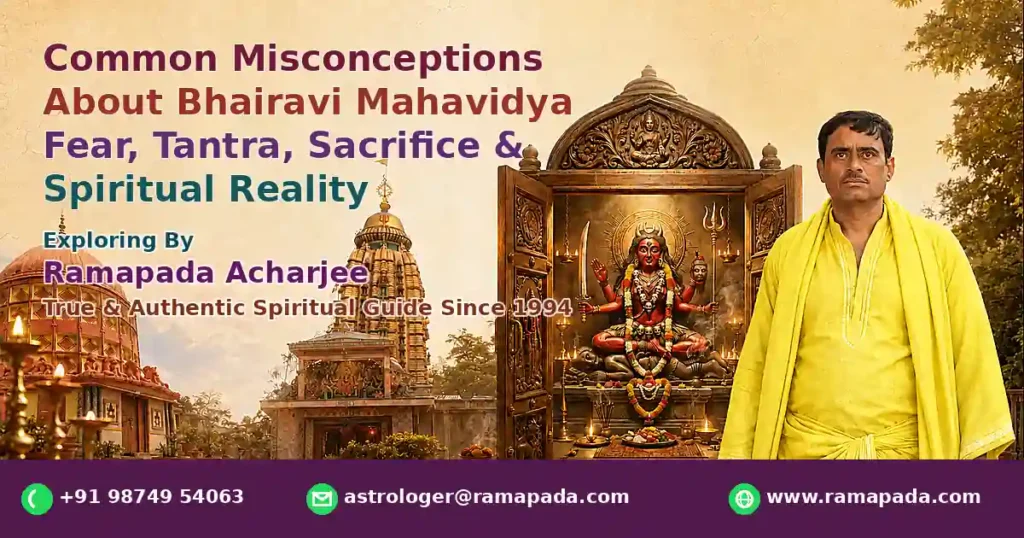
Fear, Tantra, Sacrifice, and Spiritual Reality
Bhairavi Mahavidya is one of the most powerful and frequently misunderstood forms within the sacred tradition of the Ten Mahavidyas. Her radiant red complexion, fierce gaze, traditional weapons, garland of skulls, and deep connection to Tantra often evoke hesitation or fear in those who observe only her outer form without understanding her profound philosophical symbolism.
মা ভৈরবীর উগ্র রূপ প্রথমবার দেখলে অনেকের মনেই স্বাভাবিকভাবে ভয় বা অস্বস্তি তৈরি হতে পারে। কিন্তু কেবল বাহ্যিক দৃশ্য দেখে তাঁর গভীর আধ্যাত্মিক সত্য বিচার করলে আমরা ভুল সিদ্ধান্তে পৌঁছাব।
In my journey of spiritual consultation and practice spanning over 35 years since 1994, I have met thousands of seekers from all walks of life. Time and again, I have observed that people form rigid opinions about Bhairavi Mahavidya through sensationalized television serials, social media videos, horror films, or terrifying folk tales. Very few take the time to study the authentic scriptures and the transformative philosophy behind her divine appearance.
১৯৯৪ সাল থেকে শুরু হওয়া আমার সুদীর্ঘ সাড়ে তিন দশকেরও বেশি সময়ের আধ্যাত্মিক অভিজ্ঞতায় আমি বারবার দেখেছি—মানুষ প্রায়শই সঠিক শাস্ত্রীয় ব্যাখ্যা ও দর্শনের গভীরে না গিয়ে কাল্পনিক এবং ভয়ংকর গল্পের ওপর বিশ্বাস স্থাপন করে। মা ভৈরবী মানুষকে অযথা আতঙ্কিত করার দেবী নন। তিনি আমাদের অন্তরের অন্তর্নিহিত ভয়, আলস্য, অজ্ঞতা ও আত্মপ্রবঞ্চনার মুখোমুখি দাঁড়িয়ে পরম সত্যকে উপলব্ধি করার অদম্য সাহসের প্রতীক।
Why Do Misconceptions About Bhairavi Mahavidya Arise?
Misconceptions take root whenever sacred icons and ritual metaphors are stripped of their philosophical, psychological, and historical contexts.
Skulls, glowing red hues, sharp weapons, blazing fire, and cremation grounds (Smashana) are often interpreted in a literal, physical sense. In classical Shakta and Tantric philosophy, intense iconography is used purposefully to convey deep psychological realities—such as the dissolution of the ego, the inevitability of mortality, and the burning away of mental impurities.
Commercial media and internet folklore have further reduced Tantra to secret spells, black magic, hypnotism, or instant supernatural shortcuts. While these dramatizations attract views, they completely ignore the ethical discipline, philosophical depth, and contemplative practices of genuine Tantric paths.
12 Major Misconceptions About Bhairavi Mahavidya Clarified
+-----------------------------------+-----------------------------------+
| Misconception                     | Spiritual Reality                 |
+-----------------------------------+-----------------------------------+
| 1. Evil or Demonic Entity         | Divine Mother of Purification     |
| 2. Worship Based Only on Fear     | Path to Overcoming Inner Fear     |
| 3. Tantra Means Black Magic       | Disciplined Science of Mind       |
| 4. Instant Occult Shortcuts       | Tapasya, Patience & Character     |
| 5. Requires Harmful Sacrifices    | Symbolic Surrender of Ego & Vices |
| 6. Skulls Promote Destruction     | Reminder of Mortality & Equality  |
| 7. Weapons Incite Violence        | Discernment Cutting Ignorance     |
| 8. Red Color Means Only Blood     | Awakened Energy & Inner Fire      |
| 9. Identical to Maa Kali          | Distinct Wisdom & Focus           |
| 10. Identical to Tripura Sundari  | Separate Mahavidya with Own Focus |
| 11. Only for Ascetics / Renunciates| Practical & Accessible to Families|
| 12. Fierce Means Lacking Love     | Fierce Compassion & Protection    |
+-----------------------------------+-----------------------------------+
1. Misconception: Bhairavi Is an Evil or Demonic Goddess
One of the most widespread myths is that her intense appearance marks her as dangerous, wrathful, or demonic.
In Shakta philosophy, Maa Bhairavi is an embodiment of Supreme Divine Shakti. Her fierce countenance does not represent malevolence; it signifies the unyielding spiritual intensity needed to destroy ignorance (Avidya) and conquer internal illusions.
Just as a surgeon’s scalpel may look sharp and intimidating while performing life-saving work, Bhairavi’s weapons cut away delusions, attachments, and destructive habits. Classical iconography also depicts Her as Sampadprada Bhairavi or Sakala Siddhidatri, holding a sacred book of wisdom, a japa mala, and displaying the Abhaya (fear-dispelling) and Varada (boon-bestowing) mudras.
মায়ের কঠোরতা এবং অপার করুণা পরস্পরবিরোধী নয়। সন্তানের মঙ্গলের জন্য যেমন একজন স্নেহময়ী মাকেও শাসন করতে হয়, তেমনই সাধকের আত্মশুদ্ধির জন্য মা ভৈরবীর এই তীব্র রূপ প্রকট হয়।
2. Misconception: Her Worship Is Driven Purely by Fear
Many believe that devotees pray to Bhairavi solely out of terror, hoping to pacify an angry deity.
In authentic spirituality, genuine devotion stems from reverence, understanding, and peaceful surrender—not dread. While fear or severe life crises might initially push someone toward prayer, Bhairavi’s teachings guide us to move completely beyond fear.
Her energy asks us to reflect with brutal honesty:
- What am I truly afraid of? (আমি কোন বিষয়টিকে সবচেয়ে বেশি ভয় পাচ্ছি এবং কেন?)
- Which truth am I actively avoiding? (জীবনের কোন দায়িত্ব বা সত্য থেকে আমি পালিয়ে বেড়াচ্ছি?)
- Which habit is weakening my body and mind? (আমার কোন ক্ষতিকর অভ্যাসটি জীবনকে নষ্ট করছে?)
- Where do I need disciplined effort? (আমার দৈনন্দিন জীবন ও কাজে কোথায় আত্মনিয়ন্ত্রণ প্রয়োজন?)
Maa Bhairavi does not create terror; she provides the clarity and moral backbone needed to face our real-world challenges.
3. Misconception: Tantra Equals Black Magic and Exploitation
Perhaps the most damaging falsehood is equating Tantra with harmful spells, controlling others (Vashikaran), or inflicting harm on adversaries.
Tantra is an ancient, structured spiritual and meditative science. It encompasses profound philosophy, mantra japa, yantra meditation, breath control, concentration methods, and devotion designed to expand human consciousness.
In my practical consultations since 1994, I have always maintained that responsible spiritual guidance must make an individual calmer, clearer, and self-reliant. Genuine spirituality never exploits vulnerability, promotes superstition, or instills dread for financial gain.
4. Misconception: Bhairavi Grants Instant Occult Shortcuts
The digital age often markets fierce deities as instant problem-solvers that promise sudden wealth, magical influence, or overnight mastery.
Maa Bhairavi represents Tapasya (spiritual discipline), patience, inner heat, and conscious evolution. Repeating a mantra for a few days while continuing dishonest, unethical, or aggressive behavior produces no spiritual growth.
Authentic progress from spiritual discipline manifests as real, lasting character changes:
- Greater patience during personal and professional adversity.
- Mastery over anger and conscious control of reactive words.
- Balanced decision-making driven by logic rather than emotional panic.
- Ethical and responsible action toward family, society, and career.
- Reduction of ego and freedom from the urge to dominate others.
- Deep compassion for the struggles of those around us.
These internal victories may not look like cinematic miracles, but they build a peaceful and resilient life.
5. Misconception: Her Worship Mandates Harmful Physical Sacrifice
The term “Bali“ (sacrifice) frequently creates intense confusion. Across different regions, lineages, and historical periods, practices have varied widely.
For the modern seeker and householder, sacrifice is understood on an internal, psychological level. It means surrendering our inner negative tendencies (Ripus) at the feet of the Divine Mother.
A true spiritual sacrifice involves:
- Sacrificing uncontrolled anger by choosing calm restraint.
- Sacrificing greed by refusing to profit at another’s expense.
- Sacrificing excessive ego by listening and learning with humility.
- Sacrificing destructive habits that compromise health and relationships.
- Sacrificing procrastination by executing daily duties diligently.
Authentic spiritual practice respects local laws, personal safety, and universal human dignity. It never condones self-harm or injury to any living being.
6. Misconception: Her Garland of Skulls Glorifies Death
Witnessing the Mundamala (garland of human skulls) leads some to assume that Bhairavi celebrates destruction and death.
The skull is an ancient symbol of impermanence (Anityata). It reminds us that our physical bodies, financial status, social standing, and material titles are temporary. Beneath our outer appearances, every human being shares the exact same mortality.
This powerful visual dissolves pride and arrogance. It inspires us to live meaningfully, treat others with dignity, and not waste our precious lifespan on petty conflicts.
7. Misconception: Her Weapons Encourage Physical Violence
Depictions of Bhairavi with swords, tridents, or scissors lead to the misconception that She promotes aggression.
In sacred Tantric iconography, weapons represent intellectual and spiritual discernment:
- The Sword: The power of Viveka (discernment) that cuts through illusion, distinguishing truth from falsehood.
- The Trident (Trishula): Complete mastery over thought, word, and deed, as well as the three Gunas (Sattva, Rajas, and Tamas).
- The Noose (Pasha): Awareness of the binding nature of unhealthy attachments and desires.
- The Severing Blade: Decisive separation from ignorance, bad company, and debilitating mental habits.
Her weapons are instruments of inner liberation, designed to conquer our lower nature rather than harm others.
8. Misconception: The Red Color Represents Only Blood and Fury
Maa Bhairavi is depicted in glowing shades of red, often misinterpreted merely as violence or danger.
In Indian spiritual tradition, red is the color of vital life-force (Prana), creative action, and the purifying fire of sadhana. It represents:
- Dynamic energy and purposeful action (Kriya Shakti).
- Spiritual heat (Tapas) that burns away mental stagnation.
- Unwavering determination to walk the righteous path despite hurdles.
- Transformation, where old mental limitations yield to higher realization.
Bhairavi’s red aura reflects concentrated, disciplined spiritual power rather than chaotic rage.
9. Misconception: Maa Bhairavi and Maa Kali Are Identical
While both deities belong to the Ten Mahavidyas and share fierce outer elements, they represent distinct cosmic functions and spiritual paths.
- Maa Kali: Embodies timelessness (Kala), cosmic dissolution, complete surrender, and freedom beyond all worldly structures.
- Maa Bhairavi: Embodies the active, focused spiritual heat (Tapasya), intense self-discipline, inner courage, and the awakening of consciousness within our active existence.
Each Mahavidya offers a specialized dimension of wisdom and should be studied with respect for its distinct philosophical focus.
10. Misconception: Tripura Bhairavi and Tripura Sundari Are Interchangeable
Because both names contain the word “Tripura“ (referring to the three realms of waking, dreaming, and deep sleep), they are often confused as the same deity.
Within the Dasha Mahavidya tradition:
- Tripura Sundari (Shodashi): Expresses balanced beauty, harmony, grace, creative wholeness, and the Sri Vidya lineage.
- Tripura Bhairavi: Expresses the fierce transformative fire, intense tapas, uncompromising discipline, and the warrior-like courage needed to purify the mind.
They represent complementary facets of the same Supreme Consciousness.
11. Misconception: Only Renunciates and Monks Can Worship Her
A persistent myth claims that householders and families should avoid Maa Bhairavi because her energy requires severe asceticism.
While secret, advanced Tantric rites require specific initiations (Diksha) and disciplined guidance, the universal principles and devotional prayers of Maa Bhairavi are fully accessible to householders.
A householder honors Maa Bhairavi through:
- Conducting their professional life with honesty and transparency.
- Taking full responsibility for their family and dependents.
- Exercising patient, constructive communication during disagreements.
- Maintaining daily prayer with a quiet, focused mind.
- Facing unexpected hardships with courage and dignity.
12. Misconception: A Fierce Goddess Cannot Be Compassionate
Many assume that strictness and love cannot exist together.
In practical life, real compassion often requires firmness. A caring physician must sometimes perform a painful intervention to cure a disease. A loving parent must set clear boundaries to protect a growing child.
Maa Bhairavi’s fierce energy is an expression of protective, purifying compassion. Her grace does not pamper our ego; it destroys the self-delusions that keep us suffering.
Practical Spiritual Lessons for Everyday Life
┌─────────────────────────────────────────────────────────────┐
│             CORE PRINCIPLES OF MAA BHAIRAVI                 │
├───────────────────────────┬─────────────────────────────────┤
│ 1. Face Reality Honestly  │ Stop avoiding problems; accept  │
│                           │ truth as the first step.        │
├───────────────────────────┼─────────────────────────────────┤
│ 2. Cultivate Discipline   │ Translate philosophical ideas   │
│                           │ into daily ethical actions.     │
├───────────────────────────┼─────────────────────────────────┤
│ 3. Master Impulse         │ Consciously regulate anger,     │
│                           │ greed, and reactive emotions.   │
├───────────────────────────┼─────────────────────────────────┤
│ 4. Replace Fear with Calm │ Understand the roots of anxiety │
│                           │ rather than panicking.          │
├───────────────────────────┼─────────────────────────────────┤
│ 5. Own Your Actions       │ Do not blame external forces;   │
│                           │ fulfill your practical duties.  │
└───────────────────────────┴─────────────────────────────────┘
When we move beyond sensational stories, Bhairavi’s wisdom becomes a practical guide for modern daily life:
- Face Reality Honestly: True transformation starts the moment we stop blaming others and acknowledge our own shortcomings.
- Cultivate Discipline: Knowledge has value only when it shapes our daily habits, work ethics, and speech.
- Master Destructive Impulses: Instead of repressing anger, jealousy, or greed, recognize them and channel that energy constructively.
- Replace Fear with Awareness: When you examine what frightens you, its grip naturally weakens.
- Take Full Responsibility: Spirituality is never an excuse to neglect practical duties, family care, or financial discipline.
A Safe and Meaningful Devotional Approach for Householders
You do not need complicated, secret rituals to connect with the grace of Maa Bhairavi. A simple, disciplined devotional routine at home is effective and peaceful:
- Keep a Clean Space: Maintain a quiet, orderly corner in your home for daily reflection and prayer.
- Light a Lamp with Reverence: Safely light an oil or ghee lamp, viewing the flame as the light of wisdom dispelling inner darkness.
- Offer a Sincere Prayer: Offer simple flowers, water, or clean thoughts, expressing gratitude rather than demanding instant boons.
- Practice Daily Self-Observation: Honestly evaluate one negative habit or emotional trigger you wish to overcome.
- Take One Constructive Action: Make a firm, quiet commitment to handle that issue with patience and integrity during the day.
Personal Reflections After 35+ Years of Practice
Having guided people through various spiritual, personal, and life challenges for over three decades, I have learned that true devotion brings clarity, stability, and courage.
Whenever an individual is made to feel helpless or constantly threatened by curses, enemies, or planetary fears, they lose touch with their inner strength and practical problem-solving. True spiritual guidance does not foster dependency or fear; it illuminates the mind and restores self-confidence.
মা ভৈরবী আমাদের দুর্বল বা ভীত হতে শেখান না। তিনি আমাদের নিজের অন্তরের অন্ধকারকে দূর করে সত্য, সাহস এবং গভীর আত্মমর্যাদার সঙ্গে বাঁচতে শেখান।
The most sacred offering we can make to Maa Bhairavi is not an elaborate external object—it is our willingness to surrender our anger, dishonesty, pride, and fear, transforming them into pure, courageous awareness.
Frequently Asked Questions
Is Bhairavi Mahavidya a harmful or evil goddess?
No. In authentic Shakta and Tantric philosophy, She is a revered form of Divine Shakti representing spiritual courage, purification, discipline, and the destruction of ignorance.
Does worshiping Maa Bhairavi require animal sacrifice?
No. While historical temple customs vary by region, the classical philosophical practice for householders and modern devotees is entirely symbolic—sacrificing one’s internal ego, anger, greed, and harmful habits.
Is Bhairavi worship connected to black magic or controlling people?
No. Genuine Tantric traditions focus on consciousness, self-realization, and ethical life. Misusing spiritual names for malicious practices or coercive claims contradicts authentic spiritual teachings.
Can a mistake in general prayer invite her anger?
No. Sincere prayer done with a clean heart and devotion does not invite wrath. Complex, specialized Tantric rituals require direct guidance, but pure devotional reflection is safe and peaceful.
Why is Bhairavi depicted with skulls and weapons?
The skulls symbolize the impermanence of physical life and the equality of all souls. The weapons symbolize spiritual discernment (Viveka) that cuts away ignorance and mental attachments.
Are Maa Kali and Maa Bhairavi the same?
Both belong to the Ten Mahavidyas and share fierce characteristics, but Kali governs cosmic time and dissolution, while Bhairavi represents the focused heat of tapas, personal discipline, and spiritual courage.
Can householders worship Bhairavi Mahavidya?
Yes. Householders can connect with Her through daily prayer, ethical conduct, honest work, fulfilling family responsibilities, and maintaining emotional self-control.
Next Post: Spiritual Lessons of Bhairavi Mahavidya for Modern Life: Courage, Discipline, and Inner Strength
Connect with the Best in Kolkata
Stop wandering in uncertainty. Your stars have a story to tell, and Ramapada Acharjee is here to help you read it. With a legacy built on truth, 35 years of experience, and a mission to bring peace to every household, your journey toward clarity starts here.
📍Consultation available in Kolkata, Guwahati, Siliguri, Tarapith & online.
📞 Call/WhatsApp: +91-98749 54063
🌐 Visit Website
You may also read:
A Devotional Journey to Meenakshi Temple
Kashi Vishwanath Temple, Varanasi
Eklingji Temple, Rajasthan
Balaji Temple, Rajasthan
🔗 Related Category: Tantra
