
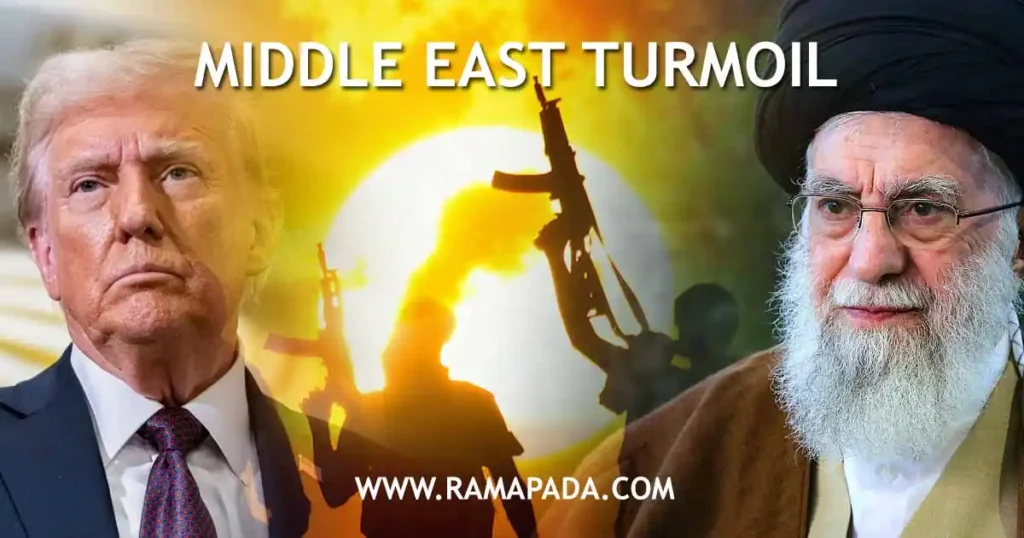
The Middle East turmoil unfolding today reveals how fragile and complicated modern geopolitics has become. The growing tension involving Iran, the United States, Israel, and several regional players suggests that the world may be entering a period of prolonged instability.
Recent political developments and strategic analyses indicate that the conflict is not merely a regional issue. Instead, it reflects a deeper geopolitical struggle involving power balance, economic interests, and long-term strategic dominance.
As global observers, it is important to examine the broader implications of this Middle East turmoil and understand how it could reshape international relations in the coming decades.
Israel’s Strategy and America’s Direct Involvement
One key question raised by the ongoing Middle East turmoil is whether Israel has successfully influenced the United States to take a more direct role against Iran.
For decades, Israel has viewed Iran as a significant strategic threat due to Tehran’s growing regional influence and its controversial nuclear ambitions. However, confronting Iran directly in a large-scale military conflict carries significant risks for Israel.
Because of this, many analysts believe Israel has strategically encouraged Washington to take stronger action against Iran. With the United States possessing unmatched military capabilities, its involvement could potentially weaken Iran’s regional influence.
However, this strategy could also place the United States in a long and costly conflict. History has shown that once Washington becomes deeply involved in Middle Eastern conflicts, disengagement becomes extremely difficult.
The current Middle East turmoil, therefore, raises an important question: has America stepped into a geopolitical situation that may prove far more complicated than anticipated?
The Danger of Creating New Extremist Strongholds
Another serious concern related to the current Middle East turmoil is the possibility of creating new breeding grounds for extremist organisations.
History provides several examples of what happens when strong governments collapse under external pressure. After the fall of Saddam Hussein in Iraq, the region witnessed the emergence of extremist groups such as ISIS. Libya and Syria experienced similar instability following the weakening of central authority.
If Iran were to face a comparable collapse of political structure, it could create a dangerous power vacuum. Such instability would not remain confined to the Middle East. Extremist movements could spread across borders, affecting global security.
Countries like India, which maintain strong economic and diplomatic ties in the region, could also face indirect consequences through rising terrorism, economic disruptions, and energy supply instability.
The lesson is clear: destabilising a state is far easier than rebuilding stability afterward.
Pakistan–Afghanistan Tensions and India’s Strategic Position
While the Middle East turmoil dominates global headlines, South Asia is also witnessing significant geopolitical shifts.
Tensions between Pakistan and Afghanistan have been increasing, adding another layer of complexity to the region’s security dynamics. Interestingly, Afghanistan—under Taliban rule—has occasionally taken positions that challenge Pakistan’s strategic interests.
If Pakistan allows the United States to use its military bases for operations against Iran, the situation could escalate dramatically. Iran has previously demonstrated its willingness to retaliate with missile strikes beyond its borders.
In such a scenario, Pakistan could become directly involved in a wider regional conflict.
From India’s perspective, these developments create a delicate but potentially strategic balance. Pakistan has historically contributed to regional instability, and current tensions may force it to confront the consequences of its own policies.
The broader Middle East turmoil, therefore, also influences power dynamics in South Asia.
The Economics of War: The “Missile Mathematics”
Another important dimension of the Middle East turmoil lies in the economic realities of modern warfare.
Advanced military systems are incredibly expensive to deploy. In many cases, relatively inexpensive drones or missiles used by one side force the opposing side to deploy extremely costly defence systems.
For example, an Iranian drone costing a few thousand dollars may require an interceptor missile costing hundreds of thousands or even millions of dollars to neutralise.
Over time, this imbalance becomes economically unsustainable, even for powerful nations. Long-term conflicts built around such asymmetrical costs can severely strain national budgets.
Political leaders may eventually try to declare symbolic victory and withdraw from the conflict, asserting that they have achieved their strategic objectives.
However, by that point the Middle East turmoil may already have caused deep political and humanitarian damage.
India’s Strategic Diplomacy in a Changing World
Amid the growing Middle East turmoil, India has adopted a pragmatic diplomatic strategy.
India maintains relationships with multiple actors in the region—including Iran, Israel, Gulf nations, and the United States. Rather than aligning purely on ideological grounds, Indian diplomacy increasingly focuses on national interest and strategic balance.
India’s investments in Iran and Afghanistan are not only economic but also geopolitical. They help maintain connectivity routes and counterbalance Pakistan’s influence in the region.
Modern international politics operates on shifting alliances rather than permanent friendships or rivalries. Understanding this reality is essential when analyzing the current Middle East turmoil.
Conclusion: War Rarely Creates Lasting Stability
The current Middle East turmoil serves as a reminder that war rarely produces lasting peace.
Military victories may create temporary strategic advantages, but they often leave behind devastated societies and deep political resentment. From these conditions, new cycles of extremism and conflict frequently emerge.
At this critical moment, the decisions made by global leaders will shape the future stability of not only the Middle East but also the broader international order.
Short-term political gains should never overshadow the long-term need for global peace and stability.
What is your view on the ongoing Middle East turmoil?
Do you think the United States has entered a strategic trap, or is this a necessary geopolitical move? Share your perspective.
🌐 Visit Website
👉 Get personalized spiritual direction based on Vedic wisdom
📍Consultation available in Kolkata, Guwahati, Siliguri, Tarapith & Online
📞 Consult with: Ramapada Acharjee (Call/WhatsApp: +91-98749 54063)
You may also read:
Related Category : Blog
