
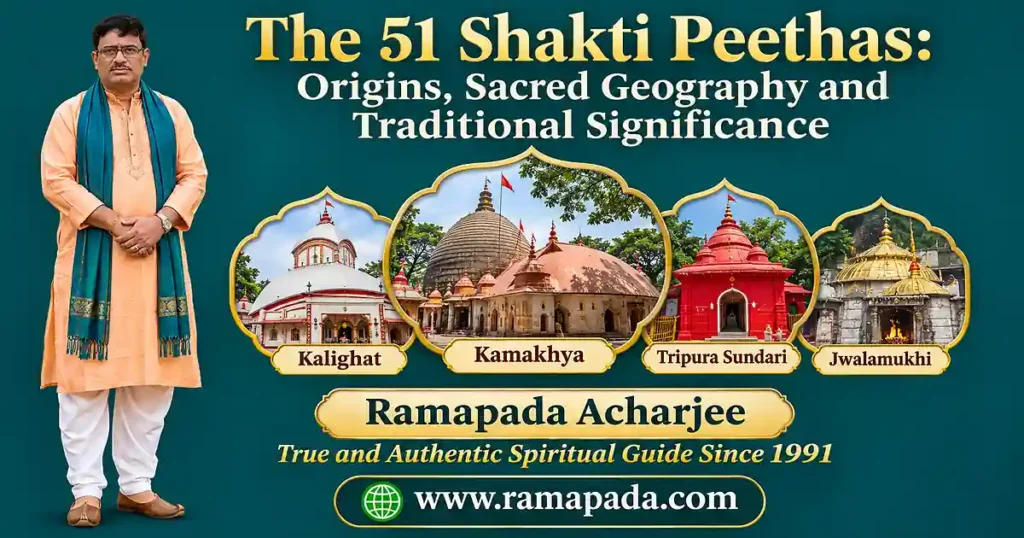
By Ramapada Acharjee
A pilgrimage map can show where a temple stands. Yet it cannot fully explain why generations regard that place as sacred. The 51 Shakti Peethas form a remarkable religious landscape. Here, stories of Goddess Sati, regional forms of the Divine Mother, and living Shakti worship converge.
From Bengal’s river plains to Assam’s hills and the Himalayan foothills, these sacred centres unite diverse communities. Yet they preserve local identities.
शक्ति पीठों का महत्व केवल उनके भौगोलिक स्थानों तक सीमित नहीं है। देवी सती की कथा, माता के विभिन्न स्थानीय रूप और पीढ़ियों से चली आ रही उपासना इन तीर्थों को एक साझा धार्मिक विरासत से जोड़ती है।
My own interest in sacred geography began through family teachings. Later, it deepened through decades of candid conversations with practitioners and pilgrims. I started part-time practice in 1991 and transitioned to full-time consultation in 1996. Since then, I have spent over thirty-five years observing how people experience these shrines.
Consequently, these experiences have taught me to distinguish between scripture, regional belief, and documented history. This is especially important when popular lists appear more rigid than their original manuscripts allow.
मेरे लिए किसी तीर्थ के प्रति श्रद्धा रखना और उसके इतिहास की सावधानी से जाँच करना परस्पर विरोधी नहीं हैं। आस्था का सम्मान करते हुए स्रोतों के मतभेद भी समझना आवश्यक है।
What Does the Term Shakti Peetha Mean?
In Sanskrit, ‘Shakti’ refers to the Divine Feminine power, while ‘Peetha’ means a seat or sacred abode. Therefore, within Shakta traditions, devotees understand a Shakti Peetha as a site consecrated by the Goddess’s presence.
However, this shared title does not imply uniform architecture or a single ritual calendar. Nor does it imply identical worship at every shrine.
संस्कृत में ‘पीठ’ का अर्थ आसन या पवित्र स्थान है। शाक्त परंपरा में शक्ति पीठ देवी की उपस्थिति और आराधना से जुड़ा स्थान माना जाता है। सभी शक्ति पीठों के पूजा-विधान और स्थानीय रीति-रिवाज एक जैसे नहीं होते।
Furthermore, these shrines illuminate the deep connection between Shakta and Shaiva heritage. For more on that philosophical bond, please consult my discussion of Shakta Tantra and Shaiva Tantra.
शक्ति और शिव का संबंध अनेक धार्मिक व्याख्याओं में महत्त्वपूर्ण है, लेकिन अलग-अलग संप्रदाय अपने ग्रंथों और परंपराओं के अनुसार इस संबंध को समझते हैं।
The Story of Sati, Shiva and the Sacred Sites
The best-known sacred narrative begins with Goddess Sati. Her father, Daksha, organises a grand sacrifice. Sati is deeply wounded by the public disrespect shown toward Lord Shiva. Consequently, she gives up her mortal form.
Overwhelmed by cosmic grief, Shiva carries her body across the earth. In widely told Puranic accounts, Lord Vishnu divides it with his Sudarshana discus. The parts then fall across different regions, sanctifying the land.
प्रचलित धार्मिक कथा में दक्ष के यज्ञ, सती के आत्मत्याग और शिव के गहरे शोक का वर्णन मिलता है। विष्णु के सुदर्शन चक्र से सती के शरीर के अंग अलग-अलग स्थानों पर गिरने की मान्यता उन स्थानों की शक्तिपीठ-परंपरा से जुड़ी है।
Importantly, this account serves as a profound theological narrative rather than an archaeological survey. Thus, its enduring message reminds seekers that divine presence cannot be confined within one temple or region.
Instead, devotees remember the Mother across mountains, forests, riverbanks, and bustling towns. Meanwhile, individual shrines preserve local histories that predate their later Peetha identification.
यह कथा धार्मिक विश्वास की अभिव्यक्ति है, पुरातात्त्विक रूप से सिद्ध घटना का विवरण नहीं। अनेक देवी-स्थानों का स्थानीय इतिहास उनकी शक्तिपीठ के रूप में प्रसिद्धि से अलग भी हो सकता है।
Why Are There 51 Shakti Peethas—and Why Do Lists Differ?
The number 51 carries immense authority in later Shakta and Tantric compilations. This is particularly true within the Pithanirnaya or Mahapithanirupana tradition linked with the Tantrachudamani. Nevertheless, surviving historical records contain no single, universally identical master list.
Across regional manuscripts, scribes and lineages often differ on exact place names. They also differ on Sati’s bodily parts or ornaments and the names of the Goddess and Bhairava.
इक्यावन शक्तिपीठों की सूची शाक्त और तांत्रिक साहित्य में प्रसिद्ध है, लेकिन सभी पांडुलिपियों में एक-सी सूची नहीं मिलती। स्थानों, देवी के नामों और भैरव के संबंध में भी पाठभेद पाए जाते हैं।
Meanwhile, contemporary researchers continue examining how this sacred network evolved across centuries. For further comparison, see the academic study Śakti-Pīṭhas Today: A Pan-Indian View offers a scholarly starting point. However, it does not claim that every list matches word for word.
आधुनिक शोध से स्पष्ट होता है कि शक्तिपीठों की पहचान एक जीवित परंपरा है। इसलिए किसी एक ऑनलाइन सूची को बिना उसके ग्रंथीय आधार की जाँच किए अंतिम प्रमाण नहीं मानना चाहिए।
| Tradition / Source | Typical Enumeration | What It Tells Us |
|---|---|---|
| Early Tantric networks | Four major seats in certain traditions | Regional sacred centres held prominence before longer catalogues developed |
| Eighteen-Peetha tradition | 18 | A shorter set preserved in specific devotional and regional lineages |
| Pithanirnaya / Mahapithanirupana | 51 | A widely cited Shakta-Tantric catalogue transmitted with textual variants |
| Some Bengali and other traditions | 52 | An alternative counting practice where specific shrine identities may differ |
| Other extended sacred-place lists | 64 or 108 | Distinct theological catalogues not automatically interchangeable with the 51 |
कुछ परंपराओं में चार या अठारह प्रमुख पीठों का उल्लेख है, जबकि अन्य स्रोत इक्यावन, बावन या एक सौ आठ स्थानों की चर्चा करते हैं। इन संख्याओं को जोड़कर एक समान सूची बनाना शास्त्रीय रूप से सावधानी माँगता है।
A Note on the Symbolism of the Number 51
Several spiritual interpreters connect the number 51 with the Sanskrit Matrika alphabet and sacred sound’s creative vibration in Shakta philosophy. Such symbolism has genuine contemplative value within particular lineages. Nevertheless, it is not the sole historical explanation for every compiled Peetha list.
कुछ शाक्त व्याख्याओं में 51 संख्या को मातृका अक्षरों और पवित्र ध्वनि से जोड़ा जाता है। यह एक प्रतीकात्मक व्याख्या है; सभी ऐतिहासिक सूचियों की उत्पत्ति का निश्चित प्रमाण नहीं।
Sacred Geography: A Network Beyond Modern Borders
The sacred geography of the Peethas spans the wider Indian subcontinent and adjoining Himalayan regions. Depending on the manuscript tradition, texts place sites across present-day India. Other sites are associated with Bangladesh, Nepal, Pakistan, Sri Lanka, and Tibet.
Clearly, we cannot project modern political boundaries backward onto the centuries when these spiritual traditions took root.
शक्तिपीठों की परंपरा वर्तमान राष्ट्रीय सीमाओं से पुरानी है। भारत के अतिरिक्त बांग्लादेश, नेपाल, पाकिस्तान, श्रीलंका और हिमालयी क्षेत्रों से जुड़े स्थान भी विभिन्न सूचियों में मिलते हैं।
Furthermore, matching an ancient scriptural name with a modern town is rarely straightforward. Over centuries, place names shifted and river courses changed. Meanwhile, different communities preserved distinct local identifications. Therefore, responsible guides cite the textual or regional tradition behind each proposed location.
किसी प्राचीन नाम को आज के एक स्थान से जोड़ने में इतिहासकारों और स्थानीय परंपराओं के बीच मतभेद हो सकते हैं। ऐसे मामलों में अनिश्चितता स्वीकार करना अधिक उचित है।
Important Peethas and Their Distinctive Traditions
Kamakhya, Assam: The Living Landscape of the Nilachal Hills
Kamakhya in Guwahati stands among the most celebrated seats of the Divine Mother. It also occupies a vital place in Shakta-Tantric heritage. Traditionally associated with Sati’s yoni, the shrine honours cosmic creation and life-giving power.
Its Nilachal hill setting, seasonal observances, and Assamese cultural heritage deserve thoughtful appreciation. They deserve more than sensationalized popular descriptions.
असम के कामाख्या मंदिर को देवी की सृजनात्मक शक्ति के प्रतीक के रूप में विशेष सम्मान मिलता है। यहाँ की परंपराओं को समझने के लिए नीलाचल पर्वत, स्थानीय इतिहास और वास्तविक पूजा-व्यवस्था को साथ पढ़ना चाहिए।
For a closer look at its historical and regional setting, please read my Kamakhya Temple history and Shakta traditions alongside the Government of India’s Kamakhya Temple visitor and heritage overview.
Kalighat, West Bengal: Goddess Kalika and the City of Kolkata
Communities across Bengal revere Kalighat as a major Shakti Peetha. Traditionally, it is linked with Sati’s right-foot toes. Its nineteenth-century temple architecture and vibrant patua art heritage reflect living traditions. Daily urban pilgrimage also shows how devotion thrives inside a modern metropolis.
Additionally, the presence of Nakuleshwar Bhairava nearby reflects the classic Goddess–Bhairava pairing found across many Peetha traditions.
कोलकाता का कालीघाट देवी कालिका की उपासना का प्रमुख केंद्र है। धार्मिक मान्यता इसे सती के दाहिने पैर की अंगुलियों से जोड़ती है। मंदिर के इतिहास और स्थानीय संस्कृति को इस कथा से अलग पहचानना भी आवश्यक है।
The Government of India’s Kalighat Temple heritage description offers a helpful public introduction to this historic shrine.
Tripura Sundari, Tripura: Regional Kingship and Devotion
The Tripura Sundari Temple at Udaipur in Tripura reflects close ties between Shakta devotion and regional royal patronage. Here, a revered Shakti Peetha identity blends with daily Goddess worship. It also reflects the historic Tripura kingdom’s architectural legacy.
त्रिपुरा के उदयपुर में स्थित त्रिपुरा सुंदरी मंदिर देवी-उपासना और क्षेत्रीय राजवंशों के इतिहास के संबंध को सामने लाता है। इसकी धार्मिक महत्ता को स्थानीय स्थापत्य और परंपरा के साथ समझना चाहिए।
You can also explore the national tourism account of the Tripura Sundari Temple to understand its standing within regional pilgrimage heritage.
Vimala at Puri, Odisha: Shakta Presence Within a Larger Temple Complex
Goddess Vimala’s shrine lies inside Puri’s famous Jagannath Temple complex. It reminds us that Shakta worship rarely exists in isolation. Instead, it flourishes alongside Vaishnava and other Hindu ritual systems in a shared sacred landscape.
पुरी में देवी विमला का स्थान बताता है कि शाक्त परंपरा अनेक बार अन्य हिंदू पूजा-पद्धतियों के साथ एक ही मंदिर परिसर में विकसित हुई है। धार्मिक इतिहास को समझने के लिए इस सह-अस्तित्व पर ध्यान देना चाहिए।
For additional context, the Odisha Tourism spirituality guide highlights Goddess Vimala among Puri’s essential sacred shrines.
Hinglaj and the Wider Northwestern Tradition
Hinglaj Mata is situated in present-day Balochistan, Pakistan. It exemplifies how living religious memory transcends modern borders. Names such as Hingula or Hinglaj appear prominently in classical Peetha catalogues. However, body-part associations and historical details vary across texts.
वर्तमान पाकिस्तान के बलूचिस्तान क्षेत्र से जुड़ा हिंगलाज तीर्थ इस बात का उदाहरण है कि धार्मिक स्मृति आधुनिक सीमाओं से परे भी जीवित रहती है। इसकी परंपरा से संबंधित अलग-अलग विवरणों को सावधानी से पढ़ना चाहिए।
Tarapith, West Bengal: Important, but Not Identical in Every List
Tarapith commands immense reverence as a centre of Goddess Tara devotion and Bengali Tantric heritage. However, scholars and traditionalists continue debating its placement in formal 51 Shakti Peetha lists.
Ultimately, a sacred site can hold extraordinary spiritual significance without appearing in every manuscript recension of the fifty-one list.
तारापीठ माँ तारा की उपासना और बंगाल की तांत्रिक परंपरा का प्रमुख केंद्र है। फिर भी सभी 51 शक्तिपीठ सूचियों में उसका स्थान एक जैसा नहीं है। आध्यात्मिक महत्त्व और ग्रंथीय सूची में स्थान दो अलग प्रश्न हैं।
To explore its living practices further, see my Tarapith Temple history and Tantric traditions as well as the scholarly paper From Bauddha Deśa to Śākta Pīṭha: Re/Locating the Hindu Goddess Tārā.
The Role of Bhairava at the Shakti Peethas
Many classical Peetha catalogues pair each Goddess form with a corresponding Bhairava. This Bhairava is a guardian manifestation of Lord Shiva. Philosophically, the pairing expresses Shakti and Shiva’s inseparable unity. At the same time, it honours distinct regional identities.
At individual shrines, however, Bhairava’s specific names, local legends, and ritual customs differ noticeably.
अनेक शक्तिपीठों में देवी के साथ संबंधित भैरव की मान्यता मिलती है। यह शिव और शक्ति के परस्पर संबंध को दर्शाती है, लेकिन हर स्थान पर भैरव का नाम तथा पूजा-विधान एक समान नहीं होता।
Readers seeking deeper clarity can explore my article on Bhairava and Bhairavi, which examines their symbolism across Tantric literature.
भैरव के विषय में पढ़ते समय दार्शनिक प्रतीक, स्थानीय देवालय की परंपरा और दीक्षा-आधारित साधना को अलग-अलग समझना उपयोगी होता है।
What Pilgrims Actually Encounter: Rituals, Festivals and Communities
Pilgrimage involves far more than memorizing a mythological list. When visiting a Peetha, devotees encounter seasonal festivals, family vows, and locally prepared bhog offerings. They also encounter traditional temple music and thriving artisan communities.
Consequently, a sacred seat’s living pulse shines through local people and daily customs. It shines as brightly as any printed scripture.
किसी शक्तिपीठ की यात्रा में दर्शन के साथ स्थानीय संस्कृति, पर्व, भोग, संगीत और समुदाय की भागीदारी भी दिखाई देती है। ये अनुभव उस स्थान की जीवित विरासत को समझने में सहायता करते हैं।
At the same time, visitors should not confuse ordinary public darshan with specialized, lineage-restricted Tantric rites. Advanced practices depend strictly on formal initiation, personal discipline, and temple rules. Moreover, fear-based marketing and promises of guaranteed miracles have no place in ethical spiritual guidance.
सामान्य मंदिर-दर्शन और विशिष्ट तांत्रिक साधना एक ही बात नहीं है। बिना योग्य मार्गदर्शन के गुप्त विधियों का प्रयोग करना उचित नहीं है और किसी निश्चित चमत्कारी फल का वादा भी नहीं किया जाना चाहिए।
How to Research a Shakti Peetha Responsibly
- Verify the textual source: Check which specific scripture or regional lineage identifies the shrine as a Peetha.
- Separate history from legend: Distinguish archaeological and architectural records from sacred origin narratives.
- Confirm historical names: Cross-check Sanskrit spellings, older place names, and modern geographical locations.
- Check local guidelines: Verify current darshan timings and temple rules through official channels before travelling.
- Honour local etiquette: Respect photography restrictions, fellow pilgrims, and regional ritual customs.
शक्तिपीठों के विषय में पढ़ते समय स्रोत का नाम, स्थानीय इतिहास, प्रचलित मान्यता और वर्तमान व्यवस्था—इन चारों को अलग-अलग जाँचना चाहिए। इससे श्रद्धा और अध्ययन दोनों अधिक संतुलित बनते हैं।
For a broader introduction to the Goddess’s symbolic forms, please read my Kali Mahavidya guide, while a focused regional comparison awaits in The Four Adi Shakti Peethas.
देवी के विभिन्न स्वरूपों की तुलना करते समय प्रतीकात्मक और शास्त्रीय भिन्नताओं का ध्यान रखना चाहिए। सभी स्थानीय परंपराओं को एक ही व्याख्या में सीमित करना उचित नहीं है।
Why These Sacred Places Still Matter Today
Today, the enduring power of the Shakti Peethas reaches far beyond their exact count. They preserve centuries of cultural exchange across regions and anchor multi-generational family memories. They also offer sanctuaries for gratitude, sorrow, courage, and quiet hope.
Moreover, these pilgrimage networks encourage genuine appreciation for India’s rich regional languages, folk arts, and diverse devotional traditions.
आज भी शक्तिपीठों का महत्त्व केवल संख्या या प्रसिद्धि से निर्धारित नहीं होता। वे परिवारों की स्मृतियों, क्षेत्रीय संस्कृतियों और देवी के प्रति श्रद्धा को पीढ़ी-दर-पीढ़ी जोड़ते हैं।
Throughout my consultations since 1991, I have observed how faith can nurture clarity and responsibility. In my experience, this enriches people’s visits to sacred places. Devotion provides profound emotional strength. However, it must never replace qualified medical care, legal advice, or practical action when needed.
आस्था व्यक्ति को मानसिक सहारा दे सकती है, लेकिन स्वास्थ्य, कानूनी या अन्य गंभीर समस्याओं में विशेषज्ञ सहायता और व्यावहारिक निर्णय आवश्यक हैं।
Frequently Asked Questions About the 51 Shakti Peethas
Origins, Counts and Sacred Geography
1. Are there exactly 51 Shakti Peethas? Fifty-one remains the most influential traditional count, though other scriptures and lineages enumerate 18, 52, 64, or 108 sacred sites. इक्यावन संख्या प्रसिद्ध है, लेकिन अनेक ग्रंथों में अन्य संख्याएँ भी मिलती हैं। सभी सूचियाँ एक जैसी नहीं हैं।
2. What is the origin story of the Shakti Peethas? Sacred Puranic tradition connects them with Goddess Sati’s self-immolation, Shiva’s grief, and the sites where portions of Sati’s body fell. मुख्य कथा सती और शिव से जुड़ी है। यह धार्मिक आस्था की कथा है, कोई पुरातात्त्विक रूप से सिद्ध घटना नहीं।
3. Are all 51 Peethas located inside India? No, several traditional Peetha locations lie outside present-day India across Bangladesh, Nepal, Pakistan, Sri Lanka, and Tibet. नहीं। कुछ परंपरागत स्थान आज के भारत से बाहर बताए जाते हैं और उनकी पहचान स्रोत के अनुसार बदल सकती है।
4. Is Kamakhya among the Shakti Peethas? Yes, Kamakhya in Assam is universally recognized among the foremost Shakta centres, celebrating the Goddess’s creative power. हाँ। कामाख्या शाक्त परंपरा के प्रमुख और व्यापक रूप से मान्य तीर्थों में से एक है।
Specific Shrines, Rituals and Responsible Devotion
5. Is Tarapith always included in the 51 list? No, while Tarapith is a deeply revered Tara shrine, its inclusion varies across different fifty-one-Peetha manuscripts. नहीं। तारापीठ अत्यंत महत्त्वपूर्ण है, पर सभी इक्यावन-पीठ सूचियों में उसका स्थान समान नहीं है।
6. Who is Bhairava at a Shakti Peetha? Bhairava is the guardian manifestation of Shiva paired with the Goddess at many Peethas, though his name varies by shrine. कई शक्तिपीठों में देवी के साथ शिव के भैरव रूप की मान्यता होती है, जिसका नाम और पूजा-पद्धति स्थानानुसार बदल सकती है।
7. Does visiting a Peetha require Tantric initiation? Ordinary public darshan and personal prayer generally require no formal initiation, unlike specialized lineage-based Tantric rites. सामान्य दर्शन के लिए प्रायः दीक्षा आवश्यक नहीं होती। विशिष्ट साधनाओं के लिए योग्य मार्गदर्शन और परंपरागत नियमों का पालन जरूरी हो सकता है।
8. Can visiting a Shakti Peetha guarantee personal outcomes? No, while pilgrimage offers deep spiritual comfort, no temple visit or ritual can guarantee wealth, health, or specific life results. नहीं। किसी मंदिर-दर्शन या आध्यात्मिक सेवा से धन, स्वास्थ्य या अन्य निश्चित परिणाम की गारंटी नहीं दी जा सकती।
One Sacred Landscape, Many Living Traditions
The phrase “51 Shakti Peethas” captures an inspiring devotional vision. Yet thoughtful study requires respect for its diverse textual sources. This sacred network unites distant communities through Sati’s story. Meanwhile, every shrine preserves its history, Goddess form, Bhairava guardian, and local ritual culture.
For any sincere seeker, that harmony of shared devotion and regional uniqueness defines the true beauty of Shakta heritage.
इक्यावन शक्तिपीठों की परंपरा हमें एक व्यापक देवी-तीर्थ भूगोल से परिचित कराती है। इसकी वास्तविक गहराई समझने के लिए साझा धार्मिक कथा के साथ प्रत्येक स्थान के अलग इतिहास और रीति का भी सम्मान करना चाहिए।
Ethical and Historical Note
This article presents traditional religious beliefs. It also distinguishes them from documented historical or archaeological evidence. Shakti Peetha counts, associated body parts, deity names, and modern geographical identifications vary across manuscripts and communities.
Furthermore, this overview offers no ritual instructions. It makes no promises of supernatural or material outcomes. Seekers interested in specialized Tantric study should always consult qualified, ethical teachers.
यह लेख धार्मिक विश्वास और प्रमाणित इतिहास के बीच अंतर बनाए रखने का प्रयास करता है। शक्तिपीठों की सूचियों और स्थानों की पहचान में मतभेद हो सकते हैं। किसी साधना या पूजा से निश्चित फल का दावा नहीं किया जाता।
Connect with the Best in Kolkata
Stop wandering in uncertainty. Your stars have a story to tell, and Ramapada Acharjee is here to help you read it. With a legacy built on truth, 35 years of experience, and a mission to bring peace to every household, your journey toward clarity starts here.
📍Consultation available in Kolkata, Guwahati, Siliguri, Tarapith & online.
Consultant: Ramapada Acharjee
Professional Experience: True & Authentic Spiritual Guide Practicing Since 1991
Phone / WhatsApp: +91 98749 54063
Official Email: astrologer@ramapada.com
🌐 Website
Consultations: By prior appointment (in-person & online)
You may also read
- Kamakhya Temple: History, Shakta Traditions and Spiritual Significance
- Tarapith Temple: History and Tantric Traditions
- Kali and Kamakhya Temple
- A Note About Reading Tantric Texts
Related Category: Hindu Rituals
