
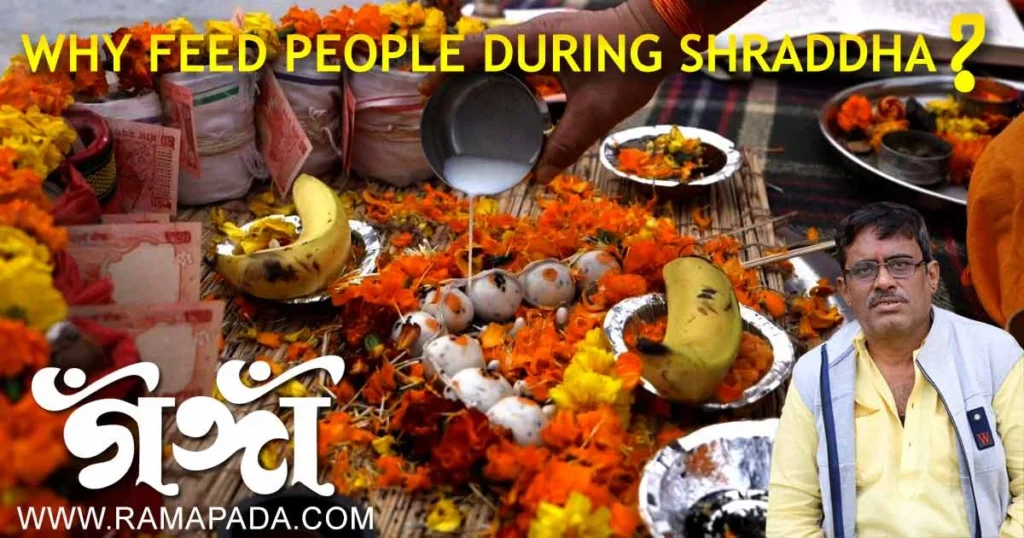
Nowadays, scrolling through social media, I often come across a recurring debate that strikes a chord of sadness within me. Many people ask, “What is the point of performing elaborate rituals and feeding people after a parent passes away?” They view it through a narrow lens of logic, completely missing the profound Hindu Shraddha Ritual Importance that has anchored our culture for millennia. As someone born and raised in a Sanatani Hindu Brahmin family, I have seen firsthand that these ceremonies are not just about grief—they are an opportunity for respect, remembrance, and the reuniting of broken family ties.
35 Years of Spiritual Mastery: The Journey of Ramapada Acharjee
For over 35 years, I have walked the path of an astrologer, palmist, and Tantrik. My journey has not been solitary. One of the core pillars of my practice is my deep-rooted coordination with the most revered Tantra Sadhaks across India. From the powerful altars of Tarapith to the mystical shrines of Kamakhya and the sacred heights of the Himalayas, I have established a profound brotherhood with practitioners at India’s most significant energy centers.
This pan-India network ensures that the guidance I provide at my website is backed by a collective reservoir of spiritual wisdom. When I speak about the Hindu Shraddha Ritual Importance, I do so with the authority of Vedic truth and decades of witnessing how these rituals heal the “Sukshma Sharira” (subtle body) of our ancestors.
The Social Architecture of Remembrance
Go back thirty or forty years in your mind. There were no smartphones, no instant hotel bookings, and no high-speed internet. When a family member passed away, it was a major event that stopped time. Relatives would travel from remote villages, spending days on trains or buses just to reach the bereaved family.
The 11th-day Shradh was the only occasion where everyone gathered. Their goal was simple: to honor the memory of the person who had left. They would sit together and recount stories—what the person loved to eat, how they helped a neighbor, or the struggles they overcame. For the younger generation, this was a vital history lesson. They learned about their lineage and values through these stories. This social bonding is a key part of the Hindu Shraddha Ritual Importance.
Shradh as an Act of Social Service and Charity
Many critics call Shradh a “waste of money”, but they forget that it is fundamentally built on the pillar of Dana (charity). Traditionally, Shradh involves the following:
- Donating Essentials: Giving umbrellas, blankets, beds, and clothes to those in need.
- Feeding the Community: Ensuring that no one in the vicinity goes hungry.
- Spiritual Knowledge: Distributing the Gita or other religious texts to Brahmins and seekers.
Through these acts, the family performs a final service on behalf of the deceased. It is a beautiful way of saying that even in death, our parents continue to do good for society through us.
The Sacred Science of Tantra: Cleansing the Path
As I explain on my dedicated Tantra page, this ancient science is often misunderstood as something dark. In reality, Tantra is a “Maha-Vidya”—a supreme science of liberation used to cleanse the mind. During Shradh, certain Tantric and Vedic vibrations are used to remove the “karmic dust” that might be weighing down the soul.
With my 35 years of experience, I have seen how these rituals provide a “Kavach” (shield) for the living family members, protecting them from ancestral doshas (Pitra dosha) and bringing peace to the household.
Addressing the Modern Skeptic: Ritual vs. Reality
I often hear people say, “Why feed the world? Is it not an ostentatious display?” My answer is simple: it is a choice. No one is forced into it, and skipping it doesn’t lead to legal trouble. But why criticize those who find peace in it?
In a world where old-age homes are multiplying and many parents die in loneliness, seeing a child spend time and effort in their parents’ memory is actually a sign of a humane society. Love and Shradh come from the same place—the deepest corners of the heart.
The Trap of “Social Media” Devotion
While I advocate for tradition, I am strictly against “showy” arrangements. I have seen cases where children ignore their parents while they are alive—refusing them a glass of water or a moment of conversation—only to organize a grand, expensive shradh after they pass.
I am personally opposed to this hypocrisy. To me, the greatest “dharma” is
- Caring for parents while they are alive.
- Giving them time and respect.
- Ensuring their comfort in their final years.
If you do not care for them while they are breathing, a million rupees Shradh is worthless. Rituals are meaningful only when they are an extension of the love you showed them when they were with you.
Why I Choose to Honor the Tradition
When my own parents passed away, I performed their Shradh according to our Brahmin customs. I didn’t do it because of social pressure; I did it out of a sense of duty and gratitude.
I even hope that when my time comes, my family follows these same Vedic traditions. Not for the sake of the feast, but for the continuity of our culture. If friends and family gather to remember me with a smile, I will be at peace. If they choose not to come, that is fine too. The ritual is for the soul and the lineage, not for the crowd.
The Unfair Criticism of the Brahmin Community
Lately, it has become common to target Hindu rituals and the Brahmin community. If someone doesn’t like Brahmins, the solution is simple: don’t invite them for your ceremonies. No one will force themselves into your home. But to constantly attack a culture that focuses on gratitude and memory is unnecessary. Our traditions are what keep our society compassionate.
Contact for Consultation
If you are seeking thoughtful astrology guidance and spiritual consultation, you may connect with Ramapada Acharjee through the official website.
📍Consultation available in Kolkata, Guwahati, Siliguri, Tarapith & online.
📞 Call/WhatsApp: +91-98749 54063
🌐 Visit Website
You May Also Read
- Wealth Attracting Hindu Rituals
- How Temple Rituals Influence Destiny
- Kashi Vishwanath Abhishek Ritual Guide
🔗 Related Category: Hindu Rituals
