
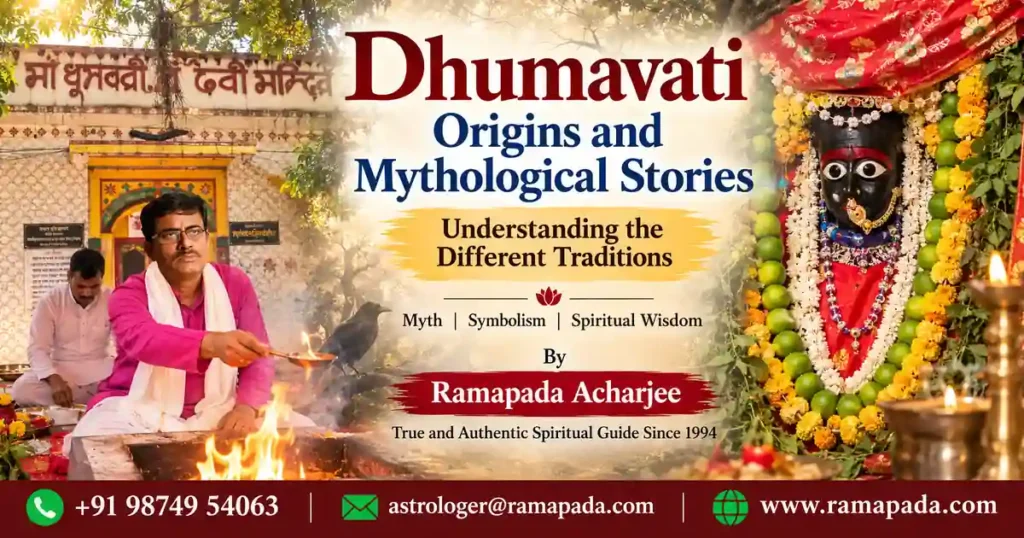
Understanding the Different Traditions
By Ramapada Acharjee
Spiritual Guide | Practicing Since 1994
The Dhumavati origins and mythological stories are never explained through one single narrative. Indeed, different Tantric, devotional, and later interpretive traditions preserve diverse accounts of how Maa Dhumavati came to be understood as one of the Ten Mahavidyas.
Furthermore, this matters because Dhumavati is sometimes introduced online through one dramatic story as though that were the only accepted explanation. In reality, the traditions surrounding the Mahavidyas remain far more layered.
Yesterday, in the previous article, I discussed the symbolism of Dhumavati’s unusual form—her aged appearance, winnowing basket, crow, and chariot. Today, in this article, we will examine the ancient stories behind that form.
My purpose here is not to declare that one account is true while every other account is wrong. Instead, we can explore what different traditions attempt to communicate through these narratives.
মা ধূমাবতীর আবির্ভাব নিয়ে একটি মাত্র কাহিনি প্রচলিত নয়। বিভিন্ন তান্ত্রিক ও আধ্যাত্মিক পরম্পরায় তাঁর আবির্ভাবের ভিন্ন ভিন্ন ব্যাখ্যা পাওয়া যায়। তাই একটি কাহিনিকেই একমাত্র সত্য বলে ধরে নেওয়ার পরিবর্তে, প্রতিটি কাহিনির অন্তর্নিহিত আধ্যাত্মিক অর্থ বোঝার চেষ্টা করাই আমার কাছে বেশি গুরুত্বপূর্ণ।
Before exploring the origin narratives in detail, it may help to understand the sacred imagery discussed in Dhumavati spiritual symbolism.
For a scholarly account of how the Mahavidyas developed through multiple textual, visual, and living traditions, see David Kinsley’s Tantric Visions of the Divine Feminine.
Why Are There Different Stories About Dhumavati?
Hindu sacred traditions often preserve more than one narrative around a deity, and the Mahavidyas form no exception.
Scholars treat them as a complex group whose identities developed through Sanskrit texts, regional traditions, imagery, and living interpretations rather than through one simple source. Researchers note that David Kinsley’s study of the Ten Mahavidyas draws upon Sanskrit and vernacular texts as well as interpretations gathered from practitioners across India.
For that reason, when seekers encounter two different Dhumavati stories, they do not necessarily need to force them into a single historical sequence. They may simply communicate different theological ideas.
আমাদের ধর্মীয় পরম্পরায় একই দেবদেবীকে নিয়ে একাধিক কাহিনি থাকা অস্বাভাবিক নয়। এই কাহিনিগুলিকে ইতিহাসের সাধারণ ঘটনার মতো বিচার করলে অনেক সময় বিভ্রান্তি তৈরি হয়। বরং দেখতে হয়—কাহিনিটি কোন আধ্যাত্মিক সত্য বা প্রতীক বোঝাতে চাইছে।
For wider background on the diversity of Hindu goddess traditions and their changing theological forms, readers may also consult David Kinsley’s Hindu Goddesses.
The Meaning Behind the Name Dhumavati
The Sanskrit word “dhuma” means “smoke,” and the name “Dhumavati” is commonly understood in relation to smoke or the smoky one.
Smoke presents an unusual symbol. While fire remains clearly visible, smoke obscures what lies behind it. It appears when something burns or undergoes deep transformation. Eventually, even the smoke disappears entirely.
This makes smoke a powerful image for impermanence, uncertainty, and what remains after something familiar changes. However, seekers should exercise caution. This symbolic reading should never turn into predictions such as warning signs. Sacred symbolism and ordinary daily events should never mix.
For me, the smoke associated with Dhumavati asks a meaningful question: when certainty becomes unclear, how do we respond?
The Metropolitan Museum of Art describes Dhumavati literally as “the smoky one” in its Goddess Dhumavati collection entry, providing a useful visual-historical reference for the name and iconography.
The Story of Sati and the Sacred Fire
One tradition connects Dhumavati directly with Sati, Shiva’s consort.
The wider story of Sati and Daksha remains well known in Hindu tradition. Daksha performs a great yajna, but conflict arises over Shiva. Sati eventually enters the sacrificial fire, and the event becomes one of the major narratives associated with Shiva and Shakti.
Some later traditions connect Dhumavati with the smoke or aftermath of Sati’s burning body. Scholars point out that one secondary overview attributes such an account to the Shakti-Sangama Tantra.
The important point is presenting this as one tradition concerning Dhumavati, rather than as a universally accepted origin account.
Because origin stories vary across later traditions, it is useful to compare narrative interpretations with the broader scholarly discussion in Kinsley’s study of the Ten Mahavidyas rather than treating a single retelling as the only account.
What Can the Story Symbolize?
When I contemplate this account, I do not see mere destruction. Instead, I observe the moment after something ends. Fire has consumed the familiar form, leaving only smoke.
Human life also contains such moments. Relationships can end, positions can disappear, and cherished plans can collapse. Age changes our bodies, and loved ones depart. The first feeling is naturally emptiness.
Dhumavati does not require us to pretend that such emptiness feels pleasant. Her symbolism simply allows us to look at it honestly.
ধূমাবতীর শিক্ষা আমার কাছে এই নয় যে জীবনে ক্ষতি বা বিচ্ছেদ কামনা করতে হবে। বরং জীবনে যখন সত্যিই কিছু হারিয়ে যায়, তখন সেই শূন্যতার মধ্যেও নিজেকে চিনতে শেখা যায়।
The Story of Parvati Swallowing Shiva
Another striking story concerns Parvati and Shiva.
In an account associated with later Tantric tradition, Parvati becomes extremely hungry and asks Shiva for food. Shiva does not immediately satisfy her hunger. Her hunger becomes so intense that she swallows Shiva himself.
Shiva then causes her to release him. In the narrative, her altered state becomes associated with the form of Dhumavati and with widowhood. Writers attribute this version to the Pranatosini Tantra.
Read literally, the story sounds strange. Yet, Mahavidya narratives frequently use extraordinary images. Kinsley’s broader study notes that the Mahavidyas embody qualities that challenge conventional expectations of divine femininity.
The question is therefore not how Parvati could swallow Shiva, but rather what kind of hunger can consume everything around us.
For a historical visual representation of Dhumavati that can be compared with these later origin narratives, see The Met’s nineteenth-century Dhumavati lithograph.
Why Hunger Appears in the Story
Hunger remains one of the important themes associated with Dhumavati, but hunger extends far beyond food.
Human beings can hunger for money, recognition, affection, status, control, security, or attention. None of these desires are automatically wrong. The difficulty begins when we expect one desire to grant permanent satisfaction.
We obtain something and soon desire something else. We receive praise and then crave more praise. We accumulate possessions yet remain restless.
The story of Dhumavati therefore becomes a mirror examining the difference between true need and endless craving.
মায়ের ক্ষুধার প্রতীকটি নিয়ে ভাবলে আমার মনে হয়, মানুষের জীবনে এমন কিছু চাহিদা আছে যা একটি জিনিস পাওয়ার পরেও শেষ হয় না। তখন প্রশ্ন করা দরকার—আমি আসলে কী খুঁজছি?
These stories repeatedly return to themes of impermanence, desire, loss, and release, which are explored further in Dhumavati Mahavidya—loss, detachment, and inner strength
What Does Shiva’s Disappearance Symbolize?
We must remain careful not to present personal symbolism as scriptural fact, so what follows is my own devotional reflection.
Shiva often represents stillness, consciousness, and the ascetic dimension of spiritual life. If desire becomes so overwhelming that even Shiva gets swallowed, I see an image of desire temporarily covering inner stillness.
The story thus becomes psychologically meaningful. When anger completely occupies the mind, calm judgment disappears. When greed occupies the mind, enough never feels sufficient. When fear occupies the mind, every uncertainty looks dangerous.
The spiritual task is not destroying every human desire but recognizing when desire controls us.
Why Is Dhumavati Shown Without a Husband?
Dhumavati’s widowhood is among the most distinctive aspects of her iconography. The swallowing-Shiva narrative provides one mythological framework explaining this feature.
However, this symbolism must never apply against actual widowed women. A widow is never impure, unlucky, or spiritually inferior.
Religious imagery belongs within its theological and historical context. Turning Dhumavati’s symbolic widowhood into discrimination against real women misses the deeper spiritual opportunity. We will examine this subject separately in a later article.
Are the Different Stories Contradictory?
At first sight, they appear contradictory. One story connects Dhumavati with Sati and sacrificial fire, while another connects her with Parvati’s hunger. Trying to make both accounts into one literal biography creates unnecessary difficulty.
Instead, we recognize that religious traditions preserve multiple explanations for a deity’s form. Each narrative highlights something unique:
- Smoke brings attention to dissolution.
- Hunger raises questions about desire.
- Loss confronts us with impermanence.
- Solitude questions who we remain when familiar support disappears.
These themes converge even when the stories differ.
Dhumavati and the Larger Mahavidya Tradition
Dhumavati should never stay isolated from the other Mahavidyas. The Ten Mahavidyas represent a striking range of Divine Feminine manifestations. Scholarly studies emphasize how the group includes forms challenging ordinary ideas about beauty, purity, and social order.
That context helps us understand Dhumavati. She does not need to resemble Lakshmi’s abundance or Tripurasundari’s beauty to remain the Divine Mother. Her very difference holds profound significance.
If divinity meant only youth, beauty, wealth, and success, vast human experiences would remain outside spiritual reflection. Dhumavati brings neglected experiences into view.
What These Stories Can Teach Us Today
Most people experience some form of loss. Businesses go through difficult periods, children build independent lives, and aging alters our physical appearance. Relationships change, and plans fail despite sincere effort.
Spirituality should never require denying these realities. For me, this is where Dhumavati becomes deeply relevant.
She reminds us that an ending and the end of our identity are separate things. Something may leave our life without taking away our core being. We can grieve without surrendering dignity. We can experience uncertainty without accepting frightening predictions.
জীবনে সব সময় পূর্ণতা থাকে না। কখনও শূন্যতাও আসে। ধূমাবতীর রূপ সেই শূন্যতাকে ভয় দেখিয়ে ব্যবহার করার শিক্ষা দেয় না; বরং তার সামনে দাঁড়িয়েও নিজের ভিতরের স্থিরতা খুঁজতে শেখায়—আমি অন্তত এভাবেই মায়ের এই রূপকে উপলব্ধি করার চেষ্টা করি।
Frequently Asked Questions
What Is the Main Origin Story of Dhumavati?
Seekers do not need to reduce Dhumavati to one single origin narrative. Different traditions preserve accounts connecting her with Sati’s fire and Parvati’s hunger.
Did Dhumavati Really Swallow Shiva?
A Tantric narrative describes Parvati swallowing Shiva during extreme hunger. Scholars view this as a sacred mythological narrative rather than ordinary history.
Is Dhumavati the Same as Sati or Parvati?
Some origin narratives connect Dhumavati with Sati or Parvati. Within Shakta understanding, the Mahavidyas represent forms of the Divine Feminine.
Does Worshipping Dhumavati Cause Loss?
A mythological story about loss does not mean respecting Dhumavati causes personal loss. Such claims lack validity.
Is Dhumavati an Evil Goddess?
Her austere appearance does not make her evil. Dhumavati belongs to the sacred Mahavidya tradition of the Divine Feminine.
Looking Beyond the Story
The origin stories of Dhumavati remain memorable because they are unusual. Yet, unusual events should not distract us from the core question.
What remains when something dependable disappears? Perhaps that is her most powerful question.
Her symbols do not glorify suffering. Instead, they encourage recognizing that spiritual awareness matters during uncertainty.
For me, Maa Dhumavati represents courage.
মায়ের কাছে আমার প্রার্থনা—জীবনে যখন সবকিছু আমাদের ইচ্ছামতো চলে না, তখন যেন ভয় নয়, বিবেক ও ধৈর্য দিয়ে সেই সময়কে বুঝতে পারি।
To see how these different narratives fit within the larger Shakta framework, continue with Dhumavati among the Ten Mahavidyas.
About the Author
Ramapada Acharjee is a Kolkata-based astrology and spiritual guidance practitioner, practicing since 1994. His writing explores Hindu spiritual traditions and symbolism.
Further Reading
For a broader academic treatment, David R. Kinsley’s Tantric Visions of the Divine Feminine: The Ten Mahavidyas studies the Mahavidyas through Sanskrit and vernacular sources.
আরও বিশদে জানতে গবেষণামূলক বই ও নির্ভরযোগ্য আলোচনা পড়ুন। কোনটি ঐতিহ্যের বর্ণনা আর কোনটি লেখকের ব্যাখ্যা, সেই পার্থক্য বুঝে পড়লে বিষয়টি পরিষ্কার হয়।
Connect with the Best in Kolkata
Stop wandering in uncertainty. Your stars have a story to tell, and Ramapada Acharjee is here to help you read it. With a legacy built on truth, 35 years of experience, and a mission to bring peace to every household, your journey toward clarity starts here.
📍Consultation available in Kolkata, Guwahati, Siliguri, Tarapith & online.
📞 Consultant: Ramapada Acharjee
Professional Experience: True & Authentic Spiritual Guide Practicing Since 1994
📞 Phone / WhatsApp: +91 98749 54063
✉️ Official Email: astrologer@ramapada.com
🌐 Website
Consultations: By prior appointment (in-person & online)
You may also read:
- Best Tantrik in Prayagraj – Guiding You to a Smoother Life
- Vashikaran Specialist in Varanasi – Overcome Life’s Barriers
- Best Tantrik in Ujjain – Unlock Your Spiritual Path
- Lost Love Back by Tantra
🔗 Related Category: Tantra
