
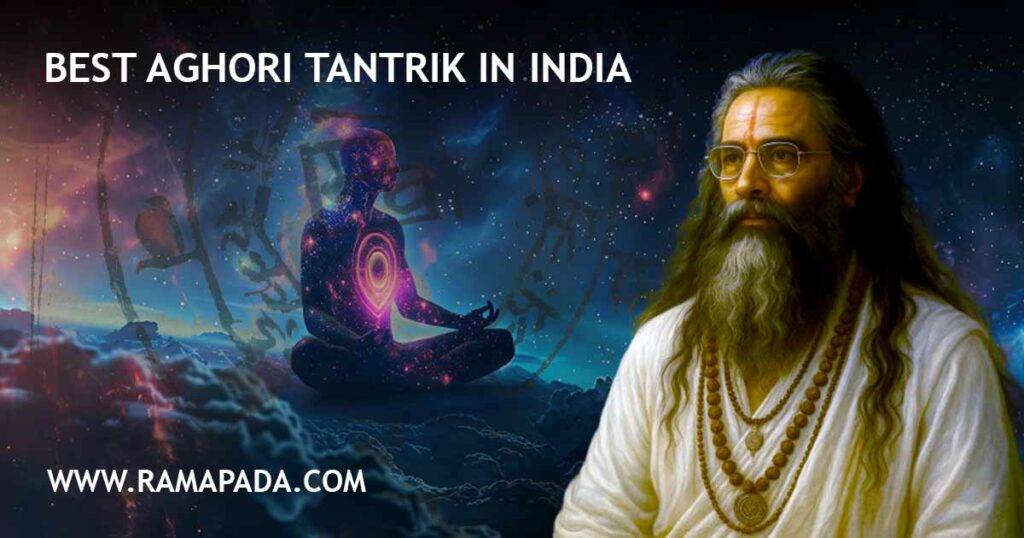
Best Aghori Tantrik in India is a phrase that attracts curiosity because the Aghor tradition remains one of the most misunderstood spiritual paths in India.
Popular media often shows Aghoris only through cremation grounds, ashes, skulls, or unusual rituals. However, these images do not explain the full philosophy behind Aghor.
At its deeper level, Aghor focuses on overcoming fear, discrimination, ego, attachment, and the division between what people call pure and impure.
Therefore, anyone searching for an Aghori practitioner should first understand the tradition rather than rely on dramatic images.
I am Ramapada Acharjee. I began practising astrology part-time in 1991 and entered full-time independent professional practice in 1996. Through many years of spiritual study and consultation, I have learned that unusual spiritual traditions should be approached with respect, context, and responsibility.
What Does Best Aghori Tantrik in India Mean?
There is no official authority that ranks one person as the absolute best Aghori Tantrik.
Therefore, the word “best” should not be understood as a guaranteed title.
Instead, examine experience, conduct, knowledge, discipline, transparency, and the practitioner’s approach to spiritual responsibility.
A sincere practitioner should not depend on fear.
Likewise, someone should not use the Aghori identity merely as a marketing tool.
My article on How to Identify a Genuine Tantrik explains several practical signs that can help people evaluate spiritual practitioners carefully.
What Is the Aghor Tradition?
Aghor belongs to a Shaiva spiritual tradition associated especially with Lord Shiva.
The word is commonly interpreted as a state beyond fear, aversion, or division.
The Aghor Foundation describes Aghor as a state of mind that transcends discrimination and duality. It also traces the modern lineage through figures such as Baba Kinaram and emphasises selfless service, inner wholeness, and spiritual discipline.
Therefore, Aghor is not simply a collection of extreme rituals.
Its deeper aim involves transforming how a person sees the world.
Baba Kinaram and the Aghor Lineage
Baba Kinaram occupies an important position in the modern Aghor tradition.
According to the Aghor Foundation’s history, the lineage flourished through Baba Kinaram, who is remembered as a spiritual teacher and social reformer.
Later teachers continued to emphasise meditation, compassion, practical spirituality, and service.
This point is important because popular descriptions often ignore the social and ethical side of Aghor.
Instead, they focus only on unusual ritual imagery.
A complete understanding requires both.
Aghor and the Idea of Non-Duality
One central idea within Aghor is the overcoming of duality.
People normally divide the world into categories such as:
pure and impure;
sacred and ordinary;
beautiful and frightening;
acceptable and unacceptable.
Aghor challenges such rigid divisions.
Therefore, some traditional practices deliberately confront things that society fears or rejects.
However, the philosophical purpose is not simply shock.
Instead, the seeker tries to overcome attachment, disgust, ego, and fear.
Why Cremation Grounds Appear in Aghori Traditions
Cremation grounds have become one of the most recognised images associated with Aghoris.
However, they also carry symbolic meaning.
A cremation ground reminds the practitioner that physical life is temporary.
Wealth disappears.
Status disappears.
Beauty changes.
The body itself eventually returns to nature.
Therefore, contemplation of death can become a way to reduce attachment and fear.
My article on Tantra Sadhana with a Spiritual Guide discusses why advanced practices require context, discipline, and experienced guidance.
Aghori Practices Should Not Be Romanticised
Certain historical descriptions of Aghoris mention practices that deliberately challenge ordinary ideas of purity.
The Concise Oxford Dictionary of World Religions, reproduced by Encyclopedia.com, identifies Aghoris as a Tantric Shaiva sect historically known for antinomian practices and cremation-ground associations.
However, sensational details should not become entertainment.
Advanced ascetic practices belong to particular traditions and contexts.
They are not instructions for ordinary seekers.
Therefore, one should not imitate extreme practices after seeing a video or reading an article online.
Aghor Is Not Simply Black Magic
A major misconception connects every Aghori with harmful magic.
That is an oversimplification.
Aghor has a spiritual and philosophical framework connected with Shiva, non-duality, fearlessness, detachment, and liberation.
Likewise, Tantra itself is much broader than harmful occult practice.
The British Museum’s Tantra overview describes Tantra as a major South Asian philosophy that influenced Hindu and Buddhist traditions for centuries.
Therefore, neither Tantra nor Aghor should automatically be equated with black magic.
Shiva and the Aghor Tradition
Lord Shiva occupies a central place in Aghor.
Shiva himself contains many apparently contradictory forms.
He is an ascetic and a householder.
He represents destruction and transformation.
He appears in mountains as well as cremation grounds.
Therefore, Aghor practitioners may see Shiva as a symbol of consciousness beyond ordinary social divisions.
This spiritual symbolism requires context.
Without context, unusual imagery can easily become frightening.
Fearlessness Does Not Mean Recklessness
Aghor often emphasises overcoming fear.
However, fearlessness does not mean behaving irresponsibly.
True fearlessness can involve facing reality.
It can mean accepting mortality.
Moreover, it may require confronting one’s ego, attachments, anger, and prejudices.
Therefore, a spiritually mature practitioner should become calmer and more disciplined rather than reckless.
Inner control matters more than outward appearance.
Aghor and Selfless Service
Modern Aghor organisations place considerable emphasis on social service.
The Aghor Foundation describes itself as a socio-spiritual organisation combining spiritual practice with education, service, community support, and humanitarian work.
This aspect is rarely shown in sensational media.
Yet it provides an important balance.
Spirituality should ultimately influence how someone treats other people.
Therefore, compassion and service matter just as much as meditation.
Aghor and Spiritual Living
Aghor should not be understood only as an isolated ritual path.
The Aghor Foundation’s guidance on spiritual living highlights introspection, compassion, detachment from ego, unity, and service to humanity.
These ideas are much closer to everyday spiritual discipline.
For example, someone can practise:
self-awareness;
compassion;
discipline;
reduced ego;
service;
meditation.
Therefore, one does not need extreme rituals to learn from spiritual principles.
Tantra and Aghor
Aghor and Tantra overlap historically in some contexts, particularly within Shaiva and Shakta traditions.
However, they should not be treated as identical terms.
Tantra includes many schools.
Likewise, Aghor has its own lineage and philosophy.
My article on Tantra Myths and Fear explains why Tantra is often misunderstood because popular culture focuses only on extreme imagery.
Therefore, spiritual traditions should be studied individually rather than placed into one broad category.
Kali, Shakti and Fierce Divine Imagery
Fierce divine imagery often appears in Tantric and Shakta traditions.
Kali provides one well-known example.
The Metropolitan Museum of Art describes Kali as an important manifestation of Shakti, especially significant within Bengali Shakta worship.
Her frightening imagery carries symbolic meanings connected with time, knowledge, transformation, and the destruction of ignorance.
Therefore, fierce appearance does not automatically mean evil.
The same principle helps when interpreting Aghori imagery.
Why Aghoris Are Often Misunderstood
Several reasons contribute to misunderstanding.
First, unusual appearance attracts attention.
Second, cremation-ground associations create fear.
Third, films and social media often focus on extreme examples.
As a result, philosophical ideas receive less attention.
However, the deeper questions of Aghor concern fear, attachment, ego, discrimination, death, and liberation.
Therefore, judging the entire tradition through photographs alone gives an incomplete picture.
The Role of a Teacher
Many traditional spiritual paths emphasise guidance from an experienced teacher.
Aghor also has lineage-based teaching.
The purpose is not simply to receive rituals.
Instead, a teacher may help the seeker understand discipline, philosophy, and personal transformation.
However, the title of spiritual guide or master should never become an excuse for manipulation.
A responsible teacher should not demand blind obedience in every aspect of life.
Transparency and ethical conduct still matter.
Do Not Copy Extreme Practices
The internet makes unusual spiritual practices highly visible.
However, visibility does not make them suitable for everyone.
Do not imitate cremation-ground rituals, consumption practices, or other extreme ascetic acts.
Such practices can carry physical, legal, psychological, and social risks.
Therefore, ordinary spiritual seekers should focus on safe practices such as meditation, prayer, self-reflection, and disciplined living.
Spiritual curiosity should not override common sense.
Aghor and the Fear of Death
One of Aghor’s most profound themes involves confronting death.
Most people avoid thinking about mortality.
However, awareness of death can change priorities.
Small arguments may appear less important.
Material competition may lose some of its power.
Likewise, gratitude for life may increase.
Therefore, contemplation of mortality can become a spiritual exercise in perspective.
It does not require living in a cremation ground.
Aghor and Ego
Ego can create division.
A person may constantly compare status, wealth, education, caste, appearance, or social position.
Aghor challenges these divisions.
The spiritual principle suggests that divine consciousness cannot be limited by social labels.
Therefore, ego reduction becomes an important part of practice.
A spiritually mature person should become less arrogant over time.
If spiritual knowledge produces greater pride, something has gone wrong.
Can an Aghori Solve Every Problem?
No.
No spiritual practitioner should promise to solve every problem.
Some issues require medical care.
Others need legal advice.
Relationship difficulties may require honest communication or counselling.
Financial problems may require budgeting and professional planning.
Therefore, spiritual guidance should recognise limits.
This principle applies regardless of tradition.
Medical Problems Require Medical Treatment
Aghor, Tantra, astrology, or any other spiritual system should not replace medical diagnosis.
If a person experiences persistent health problems, consult a qualified healthcare professional.
Spiritual practice may provide emotional comfort.
However, it should not become a substitute for treatment.
A responsible spiritual practitioner should understand this boundary clearly.
Relationship Problems Need Mutual Willingness
People sometimes approach spiritual practitioners hoping to control another person’s feelings.
However, love and marriage involve free will.
No ethical practitioner should guarantee that another person can be forced to love, marry, return, or obey.
Instead, relationship guidance should encourage:
communication;
respect;
honesty;
patience;
acceptance.
Spiritual practice should help you manage your own mind, not control someone else’s.
Avoid Fear-Based Spiritual Marketing
Fear can make vulnerable people easier to manipulate.
Therefore, be cautious if someone says:
“You are definitely cursed.”
“Only I can save you.”
“You must pay immediately.”
“Your life is in danger unless you perform this ritual.”
Such statements should raise questions.
My guide on Signs of Black Magick Influence explains why ordinary symptoms should not automatically be interpreted as supernatural attacks.
Fear should never become a sales method.
A Genuine Practitioner Should Welcome Questions
A responsible spiritual guide should allow you to ask questions.
What is this practice?
Why is it necessary?
What are its limitations?
Is there a simpler option?
Are there additional charges?
Can practical action help instead?
A person who becomes angry when you ask reasonable questions may not be the right guide.
Transparency creates trust.
Aghor and Varanasi
Varanasi holds a strong association with Shiva, death, cremation, liberation, and ascetic traditions.
For that reason, Aghori imagery is often connected with the city.
Modern Aghor institutions also maintain roots in Varanasi.
The Aghor Foundation describes its tradition as an ancient mystical lineage with strong roots in Varanasi.
However, location alone does not prove authenticity.
A practitioner must still demonstrate knowledge and ethical conduct.
Service Is an Important Test of Spirituality
Spiritual development should influence behaviour.
A person may chant mantras and perform rituals for hours.
However, if that person remains cruel, dishonest, or exploitative, spiritual practice has not achieved much.
Therefore, service provides an important test.
Does the practitioner help others?
Does the person behave compassionately?
Are vulnerable people respected?
These questions matter.
Aghor Should Not Become a Costume
Long hair, ash, rudraksha beads, or dramatic clothing do not automatically make someone an Aghori.
Appearance can be copied.
Likewise, photographs can be staged.
Therefore, judge deeper qualities.
Look for discipline.
Observe behaviour.
Check consistency.
Most importantly, examine whether the person understands the tradition beyond its outward symbols.
How to Evaluate the Best Aghori Tantrik in India
Before choosing someone, consider several points.
Look at long-term experience.
Check identity and background.
Ask about the spiritual lineage or training.
Read educational content.
Observe whether the practitioner uses fear.
Ask about fees clearly.
Notice whether practical solutions are also considered.
Finally, determine whether you feel calmer or more frightened after speaking with the person.
These questions often reveal more than titles.
Spiritual Guidance Should Build Independence
A practitioner should not make clients permanently dependent.
Instead, guidance should gradually increase clarity.
The seeker should learn to think calmly.
Fear should decrease.
Personal responsibility should increase.
Eventually, ordinary life decisions should not require constant spiritual consultation.
Therefore, genuine guidance should strengthen independence.
Simple Spiritual Practice for Everyday Life
People often assume that more complicated practices must be more powerful.
However, simplicity can have great value.
A basic spiritual routine may include:
a few minutes of meditation;
prayer according to personal faith;
self-reflection;
gratitude;
disciplined daily behaviour;
helping another person.
Such practices remain safe and practical.
Moreover, they connect spirituality with everyday life.
What I Have Learned Through Spiritual Work
Long experience changes the way a practitioner sees spiritual problems.
Early in practice, techniques can seem most important.
Over time, however, understanding people becomes equally important.
Someone may arrive asking for a powerful ritual.
After discussion, the person may actually need reassurance.
Another person may need medical help.
Someone else may simply need to make a difficult decision.
Therefore, listening often matters before ritual.
Frequently Asked Questions
Who Is the Best Aghori Tantrik in India?
There is no official ranking that identifies one person as the absolute Best Aghori Tantrik in India. Examine knowledge, experience, lineage, ethics, transparency, conduct, and whether the practitioner avoids fear-based claims.
What Is Aghor?
Aghor is a Shaiva spiritual tradition associated with overcoming fear, duality, attachment, discrimination, and ego.
Are All Aghoris Tantriks?
Aghor and Tantra overlap in some historical and spiritual contexts, but the terms are not identical. Both contain diverse traditions and interpretations.
Do Aghoris Practise Black Magic?
It is misleading to define the entire Aghor tradition as black magic. Aghor includes philosophical, ascetic, devotional, meditative, and service-oriented dimensions.
Why Are Aghoris Associated With Cremation Grounds?
Cremation grounds can symbolise mortality, impermanence, detachment, fearlessness, and liberation within certain ascetic traditions.
Can an Aghori Solve Every Problem?
No responsible spiritual practitioner can guarantee solutions for every problem. Medical, legal, psychological, financial, and relationship issues may require qualified professional help.
How Can I Identify a Genuine Aghori Practitioner?
Look beyond appearance. Examine knowledge, conduct, lineage, transparency, discipline, service, and whether the person respects ethical limits.
A Practical and Spiritual Perspective
Best Aghori Tantrik in India should not be understood as a search for the person who appears most mysterious or frightening.
Aghor is deeper than outward appearance.
Its philosophy challenges fear.
It questions ego.
Moreover, it asks the seeker to move beyond rigid ideas of purity and impurity.
The tradition also reminds us that life is temporary.
Therefore, discipline, compassion, self-awareness, and service become important.
During my years of spiritual and astrological work, I have learned that genuine spirituality should make a person more balanced.
It should reduce unnecessary fear.
Likewise, it should increase responsibility rather than dependency.
Respect ancient traditions.
Study them carefully.
Avoid sensational claims.
Most importantly, remember that spiritual growth is not measured by how dramatic someone looks.
It is measured by awareness, discipline, compassion, and conduct.
Ramapada Acharjee
Astrology, Palmistry & Spiritual Guidance
Practising since 1991
Kamakhya Ashram
- Kamakhya, Near Maa Dhumawati Mandir and Hotel Shreemoyee Inn,
Guwahati, Assam, Pin: 781010
Phone:
- +91-98749 54063
Location
You may also read:
- Genuine Tantrik in Mayang, Assam
- Black Magic kriya by a Black Magic expert in Kolkata
- Powerful Tantrik in Kolkata
🔗 Related Category: Tantra
