
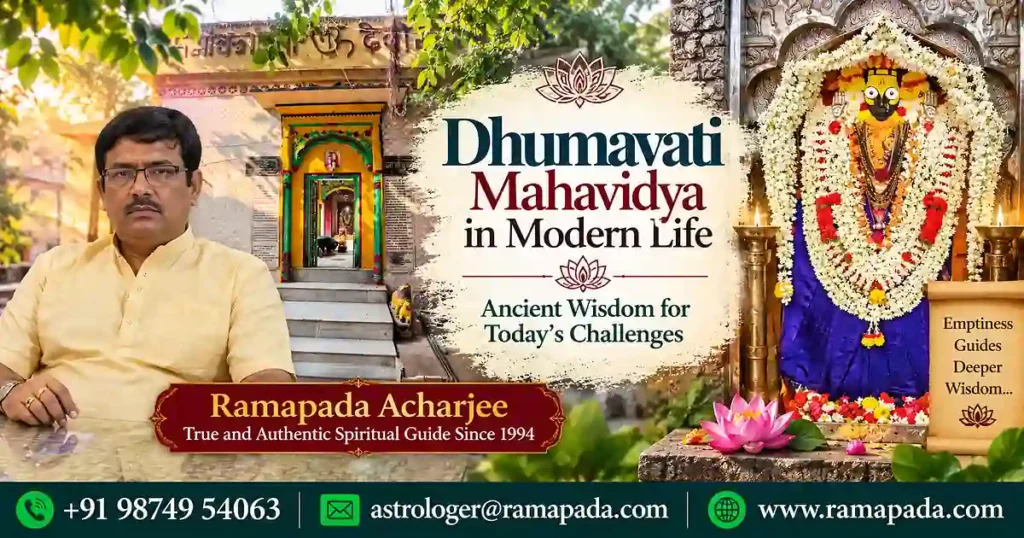
Ancient Wisdom for Today’s Challenges
Modern life moves quickly. People are constantly surrounded by expectations—career growth, financial success, relationships, social recognition, possessions, and the pressure to appear happy. Yet beneath this outward progress, many people experience loneliness, uncertainty, disappointment, emotional exhaustion, and a strange sense of emptiness.
This is where the symbolism of Dhumavati Mahavidya becomes deeply relevant.
Among the ten Mahavidyas, Dhumavati represents aspects of existence that people usually prefer not to discuss: loss, waiting, separation, disappointment, solitude, impermanence, and emptiness. However, her spiritual teaching is not about becoming pessimistic. It is about discovering wisdom when the things we normally depend upon are no longer available.
“हर खालीपन अभाव नहीं होता; कभी-कभी वही हमें अपने भीतर देखने की जगह देता है।”
For a modern person, Dhumavati can therefore be understood as a powerful symbol of acceptance, patience, inner independence, and spiritual maturity.
Why Dhumavati Still Matters in Modern Life
Technology has transformed the way we communicate, work, travel, and live. But human emotions have not changed nearly as much. People still experience rejection. Careers still face setbacks. Businesses sometimes decline. Relationships break. Loved ones leave. Plans fail. Age changes our priorities. Sometimes, despite having material comforts, a person may still feel that something important is missing.
Dhumavati represents precisely these uncomfortable phases of human experience. Her symbolism reminds us that life cannot always remain full, successful, beautiful, or predictable. Learning how to remain steady when circumstances change can itself become an important form of spiritual growth.
“जीवन हमेशा हमारी इच्छा के अनुसार नहीं चलता, लेकिन हर अनुभव हमें कुछ नया समझने का अवसर देता है।”
This makes Dhumavati surprisingly relevant to contemporary life.
The Modern Fear of Emptiness
Modern culture encourages us to fill almost every empty space. If we are alone, we reach for the phone. If we are bored, we open social media. If we feel uncomfortable, we look for entertainment. If something is missing, we often try to replace it immediately.
But Dhumavati symbolically asks a very different question: What happens if we stop running away from emptiness? Sometimes silence allows thoughts to settle. Solitude can reveal what constant social activity hides. A temporary pause in life may help us reconsider decisions that we were making automatically.
“खाली समय से भागना जरूरी नहीं; कभी-कभी मौन ही मन को सबसे स्पष्ट उत्तर देता है।”
Dhumavati does not necessarily ask us to reject worldly life. Her symbolism can instead encourage us to develop enough inner stability that we are not completely dependent on constant external stimulation.
Dhumavati and the Pressure to Always Succeed
Today, success is highly visible. People publicly share promotions, houses, cars, holidays, achievements, celebrations, and happy relationships. Failures usually remain private. This can create the illusion that everyone else is progressing while we alone are struggling.
Dhumavati challenges that illusion. Every human life contains both achievement and disappointment. Spiritual maturity begins when we stop judging our entire life through one temporary success or failure.
“हार हमेशा अंत नहीं होती; कई बार वही हमें उस रास्ते से हटाती है जो हमारे लिए सही नहीं था।”
A professional setback, financial difficulty, or failed plan may require practical action. But emotionally, it can also become an opportunity to reconsider priorities, expectations, and attachment.
Dhumavati and Loneliness in a Connected World
We live in perhaps the most connected period in history, yet many people still experience loneliness. Hundreds of online contacts cannot automatically create meaningful companionship. Constant communication cannot guarantee emotional understanding.
Dhumavati’s association with solitude offers another way of looking at being alone. There is an important difference between loneliness and conscious solitude. Loneliness can hurt. But voluntary periods of solitude can help a person understand personal emotions, examine decisions, pray, meditate, read, or simply remain quiet.
“अकेले रहना और अकेला महसूस करना एक ही बात नहीं है; कभी-कभी एकांत हमें स्वयं से मिलाता है।”
The goal is not social isolation. Rather, the teaching is to develop enough inner companionship that temporary solitude does not completely destabilize us.
What Dhumavati Teaches About Relationships
Attachment is natural in relationships. Problems arise when we expect another person to become the permanent source of our happiness, security, identity, and emotional stability. Relationships change throughout life. People grow differently. Circumstances change. Children become independent. Friendships evolve. Sometimes relationships end despite sincere efforts.
Dhumavati’s symbolism reminds us that love and attachment are not exactly the same thing.
“सच्चा संबंध पकड़कर रखने से नहीं, समझ और सम्मान से मजबूत होता है।”
Healthy relationships can contain affection while still allowing individuality. This is one of the ways Dhumavati’s traditional symbolism can be interpreted meaningfully for modern relationships.
Dhumavati and Financial Uncertainty
Money is necessary for practical life, but financial security can never make existence completely predictable. Business conditions change. Employment changes. Unexpected expenses arise. Investments fluctuate. A financially comfortable period may be followed by uncertainty.
Dhumavati does not offer an excuse to ignore financial planning. Quite the opposite: her symbolism can remind us not to become psychologically dependent on the belief that material circumstances will always remain unchanged.
“धन आवश्यक है, लेकिन मन की स्थिरता केवल धन पर निर्भर हो जाए तो भय कभी समाप्त नहीं होता।”
Practical financial discipline and inner detachment can coexist. One deals with external responsibility; the other deals with our relationship with uncertainty.
Dhumavati and Social Media Comparison
One particularly modern form of suffering comes from comparison. Social media allows us to see carefully selected moments from other people’s lives. We may then compare those moments with the ordinary reality of our own lives. Someone appears wealthier. Someone seems happier. Someone travels more. Someone looks younger. Someone appears more successful. But we rarely know the complete story behind another person’s public image.
“दूसरों की दिखाई हुई खुशी से अपनी पूरी जिंदगी की तुलना करना मन को अनावश्यक रूप से अशांत करता है।”
Dhumavati’s symbolism turns attention away from appearances and toward inner reality. The question gradually changes from “What do others have that I don’t?” to “What actually gives meaning to my own life?”
Dhumavati and Aging
Modern society often celebrates youth while treating aging as something to resist. But aging brings experiences that youth cannot provide. Priorities change. The desire to impress others may gradually weaken. Some ambitions lose importance, while health, family, peace, spirituality, and meaningful relationships become more valuable.
Dhumavati’s mature and unconventional imagery stands outside conventional ideas of youthful beauty. That itself carries an important symbolic message.
“उम्र केवल कुछ चीजें नहीं लेती; वह अनुभव, समझ और सही प्राथमिकताओं की पहचान भी देती है।”
Aging need not be viewed only as decline. It can also become a period of simplification and deeper understanding.
Difficult Times Can Reveal Hidden Strength
Many people discover their real strength only when life stops going according to plan. During comfortable periods, we naturally depend on familiar routines and support systems. When those disappear, we may initially feel helpless. But slowly, another capacity can emerge. We adapt. We reconsider. We become more patient. We learn what is truly necessary.
“कठिन समय हमेशा हमें कमजोर नहीं करता; कभी-कभी वही हमें हमारी छिपी हुई शक्ति से परिचित कराता है।”
This is one of the most practical ways to understand Dhumavati in everyday life. Her symbolism does not glorify suffering. Instead, it suggests that suffering need not remain meaningless.
Dhumavati Does Not Mean Rejecting Happiness
An important misunderstanding should be avoided. Dhumavati’s association with loss, solitude, and detachment does not mean that a person should reject happiness, family, prosperity, relationships, or worldly responsibilities. Detachment is not necessarily abandonment.
A person can love family without trying to control everyone. One can earn money without making wealth the entire identity. One can enjoy success while remembering that circumstances can change.
“वैराग्य का अर्थ जीवन छोड़ना नहीं; जीवन के बीच रहते हुए अत्यधिक आसक्ति से मुक्त होना भी वैराग्य है।”
This balanced interpretation makes Dhumavati much more relevant to ordinary householders and working people.
Dhumavati and the Power of Silence
Modern life contains enormous amounts of noise—not only physical noise but also informational noise. Messages, notifications, videos, opinions, advertisements, news, arguments, and endless content compete for attention. Silence has therefore become increasingly valuable. A few minutes of quiet reflection can sometimes reveal how restless the mind has become.
“हर प्रश्न का उत्तर तुरंत नहीं मिलता; कुछ उत्तर केवल समय और मौन के साथ स्पष्ट होते हैं।”
Dhumavati’s association with stillness and emptiness can remind us that we do not have to respond immediately to everything. Sometimes waiting is wisdom.
A Practical Way to Understand Dhumavati Today
For most people, the deeper lesson of Dhumavati does not require dramatic spiritual practices. It can begin with ordinary awareness. When something does not happen according to expectation, observe the reaction before responding. When loneliness appears, understand whether you need companionship or simply fear silence. When another person’s success creates dissatisfaction, return attention to your own path. When life changes unexpectedly, distinguish between what you can change and what you must learn to accept.
“जो बदल सकता है उसके लिए प्रयास करें, और जो नहीं बदल सकता उसे समझने की शक्ति विकसित करें।”
This approach makes ancient symbolism practical without turning every difficulty into something mysterious or supernatural.
My Understanding of Dhumavati After Years of Spiritual Study
In my years of studying astrology, Tantra, spiritual traditions, and human behavior, I have seen that people often approach spirituality when life becomes difficult. When everything is comfortable, we rarely question our assumptions. But loss asks questions. Silence asks questions. Waiting asks questions. Uncertainty asks questions. Dhumavati represents these uncomfortable questions.
For me, her teaching is not that suffering should be sought. Rather, when a difficult phase arrives naturally in life, we should try to understand what it is revealing about our attachment, expectations, fears, and inner strength.
“आध्यात्मिकता केवल सुख पाने का मार्ग नहीं; कठिन अनुभवों को समझने की दृष्टि भी है।”
That is why I believe Dhumavati’s symbolism can remain meaningful even for people living completely modern lives.
Dhumavati’s Message for the Modern Person
The world will continue to change. Technology will become more advanced, lifestyles will evolve, and communication will be faster. But some fundamental realities will remain. Nothing stays exactly the same. Success changes. Relationships change. The body changes. Possessions change. Circumstances change. Dhumavati asks us to recognize this truth without becoming frightened by it.
“जब हम परिवर्तन को जीवन का स्वाभाविक हिस्सा मान लेते हैं, तब हर बदलाव हमें पहले जितना भयभीत नहीं करती।”
Her wisdom is therefore not simply about emptiness. It is about what remains after we have learned not to fear emptiness.
Frequently Asked Questions
- Is Dhumavati relevant to modern people? Yes. Her traditional symbolism concerning impermanence, solitude, loss, patience, and detachment can be interpreted as meaningful lessons for many experiences of contemporary life.
- Does Dhumavati represent only suffering? No. Although her imagery is associated with difficult aspects of existence, her symbolism can also be understood in relation to wisdom, independence, acceptance, and transformation. “कठिन अनुभव का मूल्य केवल उसके दर्द में नहीं, उससे मिली समझ में भी होता है।”
- Does following Dhumavati’s teaching mean leaving family life? No. Spiritual detachment does not automatically require abandoning family, career, possessions, or responsibilities. It can mean maintaining these things without allowing excessive attachment to control one’s inner state.
- Can anyone worship Dhumavati? General respectful prayer or contemplation should be distinguished from specialized Tantric practices. Complex rituals, mantras, or esoteric sadhana should not be attempted merely from online instructions or curiosity.
- What is Dhumavati’s simplest lesson for everyday life? One simple interpretation is: do not assume that every empty or difficult phase of life is meaningless. Sometimes it can reveal priorities, attachments, resilience, and truths that remain hidden during comfortable periods.
Final Thoughts
Dhumavati Mahavidya presents a side of spirituality that is rarely glamorous. She does not symbolically promise that life will always remain comfortable. Instead, she asks us to look directly at impermanence, solitude, disappointment, and uncertainty—and discover whether wisdom can emerge from them. Modern society teaches us how to acquire more. Dhumavati reminds us to ask a different question: Who are we when something is taken away?
“जब बाहरी सहारे कम होने लगते हैं, तभी कई बार भीतर की शक्ति का वास्तविक परिचय मिलता है।”
Perhaps this is why an ancient Mahavidya continues to carry such a powerful message for modern life.
— Ramapada Acharjee
True and Authentic Spiritual Guide Since 1994
Connect with the Best in Kolkata
Stop wandering in uncertainty. Your stars have a story to tell, and Ramapada Acharjee is here to help you read it. With a legacy built on truth, 35 years of experience, and a mission to bring peace to every household, your journey toward clarity starts here.
📍Consultation available in Kolkata, Guwahati, Siliguri, Tarapith & online by prior appointment (in-person & online)
📞 Consultant: Ramapada Acharjee
Professional Experience: True & Authentic Spiritual Guide Practicing Since 1994
📞 Phone / WhatsApp: +91 98749 54063
✉️ Official Email: astrologer@ramapada.com
🌐 Website
You may also read:
Genuine Tantrik in Mayang, Assam
Black Magic kriya by a Black Magic expert in Kolkata
Tantra defined by Best Tantrik in Kolkata
🔗 Related Category: Tantra
