
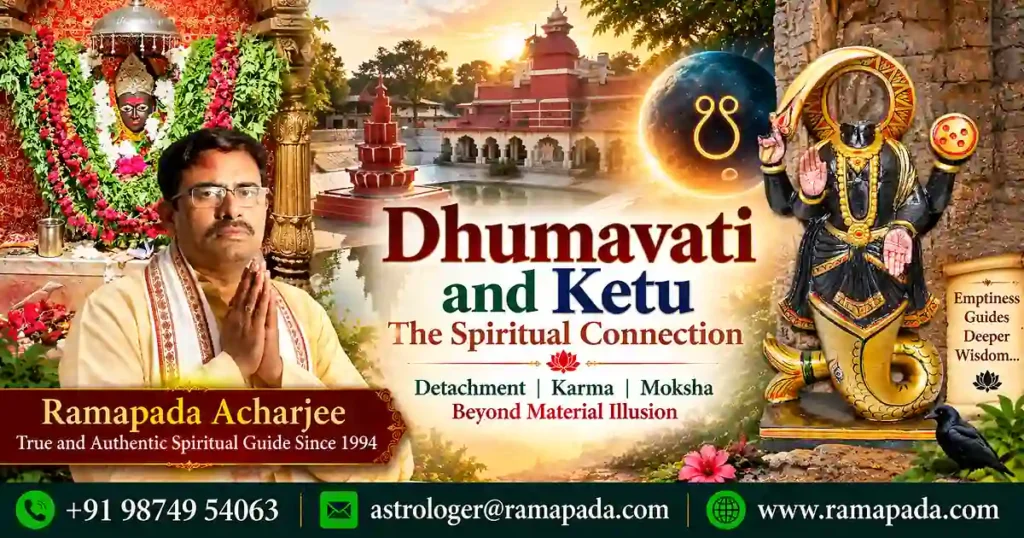
The Spiritual Connection Beyond Material Illusion
Among the many spiritual ideas connected with the Dasha Mahavidyas, the relationship between Dhumavati Mahavidya and Ketu is fascinating and deeply symbolic. In several modern Tantric and Jyotish traditions, Dhumavati is associated with Ketu because both are understood through themes such as detachment, uncertainty, spiritual withdrawal, liberation from illusion, and the search for truth beyond worldly appearances. However, this association is not interpreted identically across every Shakta or Tantric lineage, and it should therefore be approached as a spiritual correspondence rather than a universally fixed doctrine.
Ketu itself is not a physical planet in astronomy. Indian astrology treats it as one of the two lunar nodes, traditionally regarding it as a shadow graha. Jyotish literature has long connected its symbolism with separation, inwardness, karmic patterns, renunciation, and moksha-oriented reflection.
When these two symbolic traditions meet, an extraordinary philosophical idea emerges: Dhumavati represents the wisdom of emptiness, while Ketu represents the journey away from illusion. Together, they encourage us to ask a timeless question: What remains when the things we believed defined our life begin to disappear?
धूमावती महाविद्या और केतु का संबंध अनेक तांत्रिक और ज्योतिष परंपराओं में बताया गया है। दोनों का संबंध वैराग्य, मोह से मुक्ति, आध्यात्मिक चिंतन और जीवन के गहरे सत्य से जोड़ा जाता है। यह संबंध सभी परंपराओं में एक जैसा नहीं माना जाता, इसलिए इसे एक आध्यात्मिक प्रतीक के रूप में समझना अधिक उचित है।
Understanding Ketu in Vedic Astrology
Before exploring the connection with Dhumavati, we must understand what Ketu represents in traditional Jyotish. Ketu is known as a shadow graha because visible celestial bodies exclude it. Astronomically, it represents the descending lunar node—the mathematical point where the Moon’s path intersects the ecliptic.
Vedic astrology attributes symbolic rather than physical significance to Ketu. Traditional interpretations often connect Ketu with:
- Detachment
- Spiritual introspection
- Moksha
- Past karmic tendencies
- Isolation
- Sudden separation
- Inner transformation
- Dissolution of ego-based attachment
These meanings function as symbolic tools within Jyotish rather than scientific descriptions of human destiny.
ध्यान देने योग्य बात यह है कि केतु कोई दिखाई देने वाला ग्रह नहीं है। ज्योतिष में इसे छाया ग्रह माना जाता है और इसका संबंध वैराग्य, आत्मचिंतन, कर्म तथा मोक्ष की दिशा से जोड़ा जाता है। यह आध्यात्मिक प्रतीक है, न कि वैज्ञानिक रूप से किसी व्यक्ति के भविष्य का प्रमाण।
Why Is Dhumavati Associated with Ketu?
Shared symbolism primarily drives the association between Dhumavati and Ketu. Dhumavati represents:
- Emptiness
- Smoke
- Impermanence
- Solitude
- Dissolution
- Detachment
- Wisdom beyond appearances
Meanwhile, interpreters often associate Ketu with:
- Withdrawal
- Non-attachment
- Karmic separation
- Spiritual awakening
- Freedom from excessive material identification
Because these themes overlap, several contemporary spiritual teachers and Tantric traditions describe Dhumavati as the Mahavidya corresponding to Ketu. Yet experts present this correspondence carefully because other traditions emphasize different planetary associations, lacking any single universally accepted mapping across every school of Shakta practice. This makes the connection spiritually meaningful rather than mechanically absolute.
धूमावती और केतु के बीच समानता उनके प्रतीकों में दिखाई देती है। दोनों ही बाहरी आसक्ति से मुक्ति, परिवर्तन और गहरे आत्मबोध की ओर संकेत करते हैं। इसी कारण कुछ परंपराओं में दोनों का संबंध स्थापित किया गया है, लेकिन इसे सभी शाक्त परंपराओं का एक समान सिद्धांत नहीं माना जाना चाहिए।
Ketu as the Symbol of Detachment
Detachment stands out as one of the deepest spiritual ideas connected with Ketu. Human beings naturally create identity through many things. People commonly state:
- I am successful.
- I am wealthy.
- I belong to this family.
- I hold this profession.
- I maintain this reputation.
- I cherish this relationship.
None of these statements are wrong. However, difficulty begins when our inner peace becomes completely dependent upon them. Ketu symbolically challenges this dependence by asking, “Who are you without the labels?”
This inquiry strongly resembles the philosophical teaching represented by Dhumavati. She likewise prompts us to look beyond external identity—not because worldly life lacks meaning, but because constant change defines it.
केतु का एक प्रमुख प्रतीक वैराग्य है। इसका अर्थ संसार से भागना नहीं, बल्कि अपनी पूरी पहचान केवल धन, पद, संबंध या प्रतिष्ठा पर आधारित न करना है। धूमावती भी इसी आंतरिक स्वतंत्रता की ओर संकेत करती हैं।
Dhumavati and the Smoke of Uncertainty
Dhuma, meaning smoke, forms the root of the name Dhumavati. Smoke constitutes neither complete darkness nor complete clarity, occupying instead the space in between. Vision becomes uncertain when smoke fills the air. We know something exists ahead, yet clear sight remains impossible.
This condition serves as a beautiful metaphor for many phases of life. Clarity occasionally vanishes. Directional certainty disappears. Careers grow uncertain. Relationships shift. Dreams collapse. The future remains hidden. Symbolic language defines this as the landscape of Dhumavati. Consequently, interpreters often view Ketu through a similar experience—the removal of familiar certainty.
धुआँ हमें उस अवस्था की याद दिलाता है जहाँ रास्ता पूरी तरह दिखाई नहीं देता। जीवन में भी ऐसे समय आते हैं जब भविष्य स्पष्ट नहीं होता। धूमावती का प्रतीक हमें इसी अनिश्चितता में धैर्य और जागरूकता बनाए रखने की प्रेरणा देता है।
The Difference Between Loss and Liberation
Recognizing this distinction remains essential. Hearing the names Dhumavati or Ketu frequently leads people to assume loss alone. Spiritual symbolism operates with greater subtlety, however, since loss and liberation differ fundamentally.
Envision holding a burning object tightly. Releasing it causes pain due to attachment. Yet letting go prevents deeper injury. Similarly, spiritual benefit does not accompany every separation, nor does every difficult experience automatically generate wisdom. The teaching denies that every loss proves beneficial; rather, it highlights that letting go sometimes becomes necessary for deeper growth. Both Dhumavati and Ketu symbolize the possibility that freedom begins where excessive attachment ends.
हर हानि मुक्ति नहीं होती और हर दुःख ज्ञान नहीं देता। लेकिन कई बार जिस चीज़ को हम बहुत कसकर पकड़े रहते हैं, उसे छोड़ने के बाद ही मन में नई स्पष्टता आती है। यही अंतर हानि और आंतरिक स्वतंत्रता के बीच समझना आवश्यक है।
Ketu and the Illusion of Permanent Security
Security ranks among the greatest human desires. People desire permanent happiness, permanent wealth, permanent health, permanent relationships, and permanent success. Yet everything governed by time undergoes constant change. Spiritual philosophy reiterates this truth continuously.
Ketu symbolically reminds us that certainty proves far more fragile than imagined. Dhumavati embodies the wisdom emerging after those illusions dissolve. Her teaching avoids pessimism, offering realism instead. She never claims life lacks beauty; she merely asserts that beauty alone cannot form the foundation of ultimate truth.
मनुष्य स्थायी सुरक्षा चाहता है, लेकिन समय के साथ हर परिस्थिति बदलती रहती है। धूमावती और केतु दोनों हमें यह स्मरण कराते हैं कि परिवर्तन से भयभीत होने के बजाय उसके भीतर छिपे सत्य को समझने का प्रयास करना चाहिए।
The Spiritual Meaning of the Headless Ketu
Traditional depictions present Ketu as the lower half of the celestial serpent within the mythology of Rahu and Ketu. This imagery leads many spiritual teachers to describe Ketu symbolically as headless. Constant calculation, ego, planning, and intellectual control attach closely to the concept of the head.
Ignoring literal mythology transforms the symbolism into pure philosophy. Can wisdom exist beyond endless mental noise? Can silence reveal insights that constant thinking misses? This question resonates beautifully with Dhumavati. She represents the state where excessive worldly identification fades, enabling deeper awareness.
केतु के सिरहीन स्वरूप को कई आध्यात्मिक व्याख्याओं में अहंकार और निरंतर मानसिक नियंत्रण से परे चेतना का प्रतीक माना गया है। यह शाब्दिक नहीं बल्कि प्रतीकात्मक अर्थ है, जो हमें भीतर की शांति और जागरूकता की ओर संकेत करता है।
Dhumavati and Moksha-Oriented Consciousness
Discussions regarding Ketu frequently feature the term moksha. Moksha extends far beyond escaping life; it denotes liberation from ignorance, excessive attachment, and repeated psychological bondage.
Dhumavati’s symbolism similarly points toward true freedom. She transcends conventional beauty, social approval, dependence upon prosperity, and the fear of solitude. Rejecting family or responsibility forms no part of this state. Instead, it advocates cultivating an inner identity capable of surviving changing circumstances. Consequently, numerous spiritual writers identify philosophical harmony linking Dhumavati and Ketu.
मोक्ष का अर्थ जीवन से भागना नहीं है। इसका अर्थ अज्ञान, अत्यधिक आसक्ति और मानसिक बंधनों से मुक्त होना है। धूमावती का स्वरूप भी इसी आंतरिक स्वतंत्रता की दिशा में चिंतन करने की प्रेरणा देता है।
Does Ketu Always Bring Difficult Experiences?
Responsible spiritual interpretation demands balance. Traditional Jyotish houses numerous descriptions detailing Ketu’s influence based on house placement, conjunctions, sign, dignity, and overall horoscope structure. Claiming that Ketu invariably produces suffering or universal spirituality therefore lacks accuracy.
Different astrologers interpret charts divergently, requiring meaningful analysis to evaluate the entire horoscope rather than isolating one graha. Similarly, treating Dhumavati as an automatic predictor of misfortune remains incorrect. Both belong to sophisticated symbolic systems encouraging reflection over fatalism.
केतु को देखकर किसी व्यक्ति के जीवन का एक निश्चित निष्कर्ष निकालना उचित नहीं है। ज्योतिष में पूरे जन्मकुंडली का अध्ययन आवश्यक माना जाता है। इसी प्रकार धूमावती को केवल दुर्भाग्य का प्रतीक मानना भी अधूरी व्याख्या है।
The Role of Solitude in the Dhumavati–Ketu Connection
Solitude features repeatedly within the symbolism of both entities. However, solitude never equates to mere social isolation. Distinct differences separate loneliness—feeling emotionally disconnected—from solitude—consciously entering silence for reflection.
Modern existence seldom allocates room for silence, filling every moment with notifications, conversations, entertainment, and endless data. Ketu symbolically withdraws attention, while Dhumavati symbolically strips away decoration. Together they shape a philosophical space quieting the mind, transforming quietness into genuine awareness.
एकांत और अकेलापन अलग अनुभव हैं। अकेलापन पीड़ा दे सकता है, लेकिन शांत एकांत आत्मचिंतन का अवसर बन सकता है। धूमावती और केतु का संयुक्त प्रतीक हमें बाहरी शोर से कुछ समय दूर होकर अपने भीतर झाँकने की प्रेरणा देता है।
Why Spiritual Growth Often Begins with Questions
Spirituality often gets perceived as receiving answers. Yet genuine spiritual growth regularly begins through superior inquiries:
- Why am I attached to this outcome?
- Why does this loss frighten me so deeply?
- Who am I without constant approval?
- What truly gives meaning to my life?
- What remains when circumstances change?
These questions fail to solve problems instantly, yet they alter our experiential approach entirely. Dhumavati and Ketu symbolize this internal transition, shifting focus from external certainty toward profound inquiry.
यही आध्यात्मिक यात्रा का एक सुंदर पक्ष है। हर समय उत्तर मिलना आवश्यक नहीं है। कभी-कभी सही प्रश्न ही मनुष्य को अधिक गहरी समझ की ओर ले जाते हैं।
Dhumavati, Ketu, and the Idea of Karma
Karma represents another concept frequently linked with Ketu. However, reducing karma to simplistic reward and punishment models distorts its reality. Traditional Indian philosophy encompasses sophisticated interpretations addressing action, intention, consequence, and spiritual evolution. Modern astrology often symbolizes Ketu through past tendencies or unresolved patterns.
Dhumavati introduces an additional philosophical layer. Rather than fixating solely on why events transpired, her symbolism inspires a different reflection: how do we respond to what occurred? That behavioral shift drives spiritual transformation regardless of personal beliefs regarding karma.
कर्म को केवल दंड या पुरस्कार के रूप में समझना बहुत सीमित दृष्टि है। धूमावती का प्रतीक हमें यह सोचने की प्रेरणा देता है कि किसी घटना के बाद हमारा आचरण, धैर्य और चेतना कैसी रहती है—यही भी उतना ही महत्वपूर्ण प्रश्न है।
Practical Reflection Without Fear
Spiritual links connecting Dhumavati and Ketu should spark reflection rather than panic. Planetary anxiety requires no obsession, nor should setbacks automatically trigger assumptions of Ketu’s interference.
Instead, this symbolism encourages grounding inner habits:
- Dedicate time to silence.
- Observe emotional attachments closely.
- Minimize needless dependence on external validation.
- Accept uncertainty as a natural life component.
- Fulfill everyday responsibilities sincerely.
- Pursue wisdom alongside practical labor.
These reflections support true spiritual growth while harmonizing seamlessly with ordinary family and professional routines.
धूमावती और केतु का संबंध भय पैदा करने के लिए नहीं, बल्कि आत्मचिंतन की प्रेरणा देने के लिए समझा जाना चाहिए। जीवन की जिम्मेदारियाँ निभाते हुए भी मनुष्य अपने भीतर वैराग्य, धैर्य और विवेक विकसित कर सकता है।
A Personal Reflection from Ramapada Acharjee
Years of guiding individuals through astrological counseling and spiritual dialogue reveal a common pattern: encountering the word “Ketu” frequently panics people. Some assume disaster follows instantly, while others attribute every delay or separation to a single planetary force.
Spiritual understanding should never amplify fear. Horoscopes demand comprehensive evaluation as unified systems, and spiritual symbolism must foster awareness instead of helplessness. For me, the profound bond uniting Dhumavati and Ketu avoids forecasting misfortune entirely; instead, it reinforces our innate capacity for inner growth amid uncertainty. Clarity surfaces post-confusion, wisdom unfolds after attachment wanes, and silence births genuine understanding.
मेरे अनुभव में केतु का नाम सुनते ही बहुत से लोग भयभीत हो जाते हैं। लेकिन ज्योतिष का उद्देश्य भय बढ़ाना नहीं होना चाहिए। धूमावती और केतु का गहरा संदेश यह है कि कठिन समय में भी मनुष्य अपने भीतर विवेक और आत्मबल विकसित कर सकता है।
Frequently Asked Questions
- Is Dhumavati directly connected with Ketu in every tradition? No. Several modern Tantric and Jyotish traditions recognize this association, but diverse Shakta lineages and texts reject uniform planetary correspondence. Treat it as a respected spiritual association rather than a universally fixed doctrine.
- Does Ketu always create loss? No. Traditional Jyotish evaluations rely on complete horoscope structures. Ketu symbolizes detachment and inward transformation, preventing responsible astrological reductions to a single graha.
- Why are Dhumavati and Ketu spiritually similar? Both align frequently through shared themes of impermanence, detachment, silence, spiritual inquiry, and liberation from excessive material attachment.
- Does worshipping Dhumavati remove Ketu dosha? Diverse traditions maintain distinct ritual views, but responsible spirituality never guarantees devotion will mechanically eradicate astrological hurdles. General devotion differs fundamentally from specialized Tantric practices.
- What is the practical lesson of the Dhumavati–Ketu connection? It teaches cultivating awareness, patience, detachment from inflated ego identities, and maintaining inner stability during turbulent times.
धूमावती और केतु के संबंध में विभिन्न परंपराओं में अलग-अलग मान्यताएँ हैं। किसी भी ग्रहदोष का निश्चित समाधान केवल एक पूजा से हो जाने का दावा करना उचित नहीं है। इस संबंध की सबसे व्यावहारिक शिक्षा यह है कि मनुष्य बदलती परिस्थितियों के बीच भी अपने भीतर धैर्य, विवेक और मानसिक संतुलन बनाए रखे।
Conclusion
The spiritual bond linking Dhumavati Mahavidya and Ketu extends far beyond astrology, charting a profoundly philosophical journey. Ketu draws our focus away from excessive worldly identification, while Dhumavati exposes the wisdom concealed within emptiness, silence, and impermanence.
Together they remind us that life measures value by more than accumulation alone. Release frequently triggers transformation. Wisdom occasionally follows the collapse of certainty. Silence instructs deeper lessons than perpetual noise. Ultimately, the most meaningful spiritual paths awaken when the illusion of absolute control finally fades away.
धूमावती महाविद्या और केतु का गहरा आध्यात्मिक संबंध हमें यह स्मरण कराता है कि जीवन केवल प्राप्ति का नाम नहीं है। परिवर्तन, वैराग्य, मौन और आत्मचिंतन भी उतने ही महत्वपूर्ण हैं। जब बाहरी सहारे बदलते हैं, तब भीतर की चेतना को पहचानना ही शायद इस प्रतीक का सबसे सुंदर संदेश है।
— Ramapada Acharjee
Connect with the Best in Kolkata
Stop wandering in uncertainty. Your stars have a story to tell, and Ramapada Acharjee is here to help you read it. With a legacy built on truth, 35 years of experience, and a mission to bring peace to every household, your journey toward clarity starts here.
📍Consultation available in Kolkata, Guwahati, Siliguri, Tarapith & online by prior appointment (in-person & online)
📞 Consultant: Ramapada Acharjee
Professional Experience: True & Authentic Spiritual Guide Practicing Since 1994
📞 Phone / WhatsApp: +91 98749 54063
✉️ Official Email: astrologer@ramapada.com
🌐 Website
You may also read:
Kashi Vishwanath Temple, Varanasi
A Devotional Journey to Meenakshi Temple
Best Tantrik in Ujjain – Unlock Your Spiritual Path
🔗 Related Category: Tantra
