
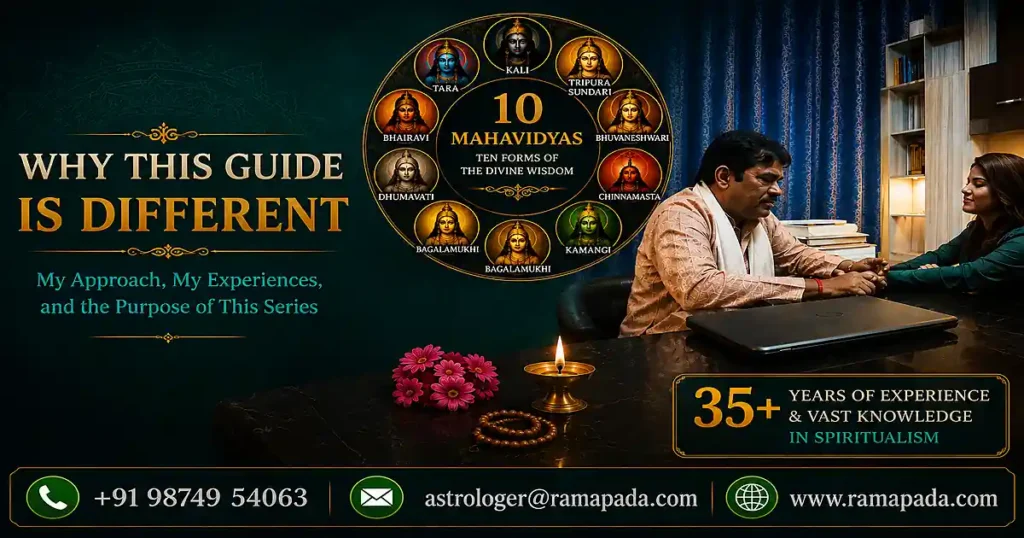
Why I Chose to Write This Guide Differently
Over the years, I have read many books, manuscripts, research papers, and online articles about the Mahavidyas. In addition, I have listened to countless discussions among priests, devotees, scholars, and spiritual seekers. Although each source offered something valuable, I often felt that an important connection was missing. For instance, some writings focused only on mythology, while others explained only Tantra. Besides, several articles simply listed the ten Mahavidyas without exploring what they truly represent in human life.
A reliable study begins by comparing interpretations with established references such as this overview of the Mahavidya tradition.
As a result of my continued study and repeated visits to Kamakhya Temple, I realized an essential truth. Indeed, we cannot understand the Mahavidyas by looking at only one aspect. They are not merely stories from ancient scriptures, nor are they symbols reserved for secret spiritual practices. Rather, they form part of a living tradition that continues to inspire countless people today.
সেই কারণেই এই গাইডটি লেখার সিদ্ধান্ত নিয়েছি। আমার উদ্দেশ্য কোনো মতবাদকে সঠিক বা ভুল প্রমাণ করা নয়। বরং, আমি এমন একটি পথ তৈরি করতে চেয়েছি, যেখানে একজন সাধারণ পাঠকও ধীরে ধীরে মহাবিদ্যার প্রকৃত তাৎপর্য উপলব্ধি করতে পারেন।
Readers who are completely new to this subject may begin with Before We Explore the Ten Mahavidyas.
What You Will Find in This Guide
Throughout this series, I will clearly distinguish between different perspectives so that readers always know what they are reading. Therefore, whenever I discuss the following:
- Traditional beliefs: I will identify them as traditions preserved within the Shakta lineage.
- Historical information: I will rely on available historical records and respected sources.
- Symbolism: I will explain the deeper philosophical meaning behind each Mahavidya.
- Personal observations: I will clearly present them as insights gathered during my own study and repeated visits to Kamakhya Temple.
আমি মনে করি—বিশ্বাস, ইতিহাস এবং ব্যক্তিগত অভিজ্ঞতা—এই তিনটিকে একসঙ্গে মিশিয়ে ফেললে বিভ্রান্তি তৈরি হয়। কিন্তু, প্রত্যেকটিকে তার নিজস্ব জায়গায় রেখে দেখলে বিষয়টি অনেক পরিষ্কার হয়ে ওঠে।
Historical art can also provide valuable context, as demonstrated by The Met’s collection record of Kali and Tara among the Mahavidyas.
Faith and History Are Not Enemies
During my years of study, one lesson has remained with me. Faith and history often answer different questions. Specifically, history tries to understand what happened, whereas faith helps us understand what it means. One speaks through records and evidence; the other speaks through devotion, experience, and tradition. Thus, neither should be dismissed simply because it approaches truth differently.
কামাখ্যায় যতবার গিয়েছি, ততবারই এই উপলব্ধি আরও গভীর হয়েছে। সেখানে দেখেছি—কেউ গবেষক হিসেবে আসেন, কেউ ভক্ত হিসেবে, আবার কেউ শুধুই কৌতূহল নিয়ে। তবে, মায়ের প্রাঙ্গণে দাঁড়ালে অনেকের প্রশ্ন একই জায়গায় এসে মিশে যায়।
A basic understanding can then be developed through my explanation of what the Ten Mahavidyas are.
Beyond Fear and Misconceptions
One thing has become increasingly clear to me over the years. Outside Kamakhya, people often describe the Mahavidyas through fear, mystery, or sensational stories. However, inside Kamakhya, I witnessed something very different.
For example, I saw ordinary families waiting patiently for darshan. Also, I saw senior women quietly chanting prayers and young students offering flowers before examinations. In fact, many people were sitting silently without asking for miracles.
Museum scholarship provides another perspective through the Smithsonian’s exploration of Goddess traditions in Asian art.
আমি কোথাও আতঙ্ক দেখিনি। বরং দেখেছি ভক্তি, ধৈর্য এবং বিশ্বাস।
তখনই আমার মনে হয়েছিল—
“মহাবিদ্যার প্রকৃত পরিচয় ভয়ের মধ্যে নয়, উপলব্ধির মধ্যে।”
Perhaps that is why I felt this guide should begin not with extraordinary claims, but with true understanding.
The detailed study of the individual Mahavidyas begins with Kali Mahavidya, the First Mahavidya.
An Invitation to the Reader
If you have come here expecting supernatural promises, you may not find them in this guide. Nevertheless, if you wish to understand why the Ten Mahavidyas have inspired seekers, saints, scholars, and devotees for centuries, I invite you to continue this journey with me.
We will move slowly, ask meaningful questions, and compare tradition with history. Above all, we will try to understand before we judge.
The British Museum’s discussion of Kali’s history and multiple forms offers useful cultural context beyond simplified modern descriptions.
কারণ আমার নিজের অভিজ্ঞতায় একটি বিষয় বারবার সত্য বলে মনে হয়েছে—
“মায়ের পথ কখনও তাড়াহুড়োর পথ নয়। যে ধৈর্য নিয়ে এগোয়, উপলব্ধিও তার কাছেই ধীরে ধীরে নিজেকে প্রকাশ করে।”
For a structured overview of the complete group, readers can continue with 10 Mahavidyas Explained.
Frequently Asked Questions
1. Why did Ramapada Acharjee write this guide on the Ten Mahavidyas?
This guide was written to present the Ten Mahavidyas in a balanced and easy-to-understand way. Rather than focusing only on mythology or Tantra, it combines traditional Shakta teachings, historical understanding, symbolism, and personal observations gathered during my visits to Kamakhya Temple.
2. Is this guide based on personal experience?
Yes. Along with years of study, this guide includes insights from my repeated visits to Kamakhya Temple, conversations with priests, and observations made over time. In addition, whenever I share a personal observation, I clearly distinguish it from historical facts.
3. Does this guide explain history, mythology, or spirituality?
It explains all three—but separately. For instance, historical information appears as history, traditional narratives are identified as beliefs, and spiritual reflections are shared as personal understanding. Consequently, readers can appreciate each perspective without confusion.
4. Do I need to know Tantra before reading about the Mahavidyas?
No. Because this guide is written in simple language, everyone can understand it. Therefore, prior knowledge of Tantra is not required.
5. Why is Kamakhya Temple mentioned throughout this guide?
Kamakhya Temple is one of the most revered Shakti Peethas with a deep association with the Mahavidyas. Thus, my repeated visits there helped shape many observations shared in this guide.
When discussing sacred places, readers can also compare information with official resources such as the Government of India’s guide to Kamakhya Temple.
6. Does this guide make supernatural or miraculous claims?
No. Because the purpose of this guide is understanding rather than sensationalism, it avoids extraordinary claims.
7. What makes this guide different from other articles on the Ten Mahavidyas?
Unlike articles that only list names, this guide brings together traditional teachings, historical references, philosophical symbolism, and personal observations gathered over years of study.
8. Who should read this guide?
This guide is suitable for spiritual seekers, devotees, students of Hindu traditions, researchers, and anyone who wishes to understand the Ten Mahavidyas with clarity and respect.
After exploring the individual chapters, readers can use my references and further reading guide to continue their study.
Connect with the Best in Kolkata
Stop wandering in uncertainty. Your stars have a story to tell, and Ramapada Acharjee is here to help you read it. With a legacy built on truth, 35 years of experience, and a mission to bring peace to every household, your journey toward clarity starts here.
📍Consultation available in Kolkata, Guwahati, Siliguri, Tarapith & online.
📞 Call/WhatsApp: +91-98749 54063
🌐 Visit Website
You may also read:
- Kundali Matching with Palm Reading
- Zodiac Signs—Most Compatible for Marriage
- Solution for Marriage Life Problems
Related Category: Tantra
