
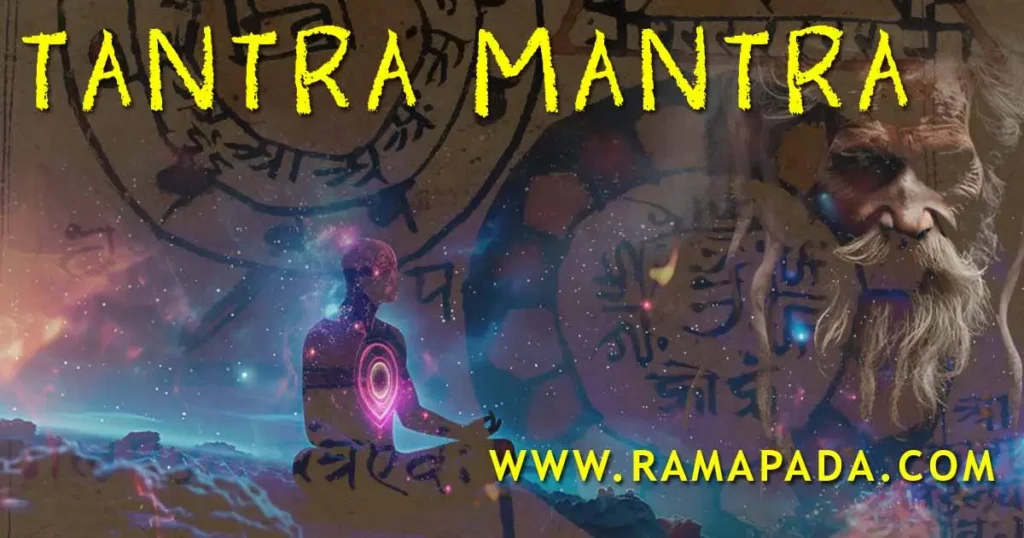
Tantra Mantra is a complex and multifaceted spiritual practice rooted in ancient Indian traditions. It involves the use of mantras (sacred sounds or chants), physical postures (asanas), and meditation techniques to achieve spiritual enlightenment. While often misunderstood, these offer a profound path to self-discovery and union with the divine.
What do you call a group of goddesses where one drinks her blood and the others wear skull garlands? One is a crone, the other a goddess of unparalleled beauty. There is a goddess who demands cleanliness and one who enjoys leftovers.
The Dasha Mahavidyas are the primordial Sakti, or energy, that originates, destroys, and maintains the universe. They are similar to how energy is defined by scientific rules as fundamental, ever-existing matter that is used through a medium. These are Mahavidyas, or “Great Knowledge,” and every goddess teaches a different lesson.
Tantra, often misconstrued as voodoo, black magic, or the art of love, is actually a lifestyle that prepares individuals for spiritual liberation through physical challenges. Contrary to popular belief, Tantra employs various objects considered taboo or disgusting. The items are merely powerful instruments for mind and sensory control.
The Core Principles of Tantra Mantra
- Unity of Existence: This asserts the interconnectedness and divine nature of everything in the universe. This belief fosters a sense of oneness with all beings.
- Shakti: The feminine principle of divine energy, Shakti, is central to Tantra Mantra. It is believed to be the creative force behind the universe.
- Kundalini: These practices can awaken and channel the dormant spiritual energy, known as Kundalini, residing at the base of the spine, leading to spiritual liberation.
Key Practices of Tantra Mantra
- Mantra Chanting: The repetition of sacred mantras is a fundamental aspect of Tantra Mantra. People believe that these mantras have powerful vibrations that can transform consciousness.
- Yantra Meditation: Yantras are geometric diagrams that represent specific deities or concepts. Meditating on a yantra can help to focus the mind and connect with the divine.
- Kundalini Yoga: This form of yoga incorporates physical postures, breathing techniques, and mantra chanting to awaken and channel the Kundalini energy.
- Tantra Rituals: Tantra rituals involve the use of offerings, symbols, and sacred texts to invoke the divine and achieve spiritual transformation.
Tantra Mantra and Modern Spirituality
In recent years, Tantra Mantra has gained popularity in the West as a means of personal growth and spiritual exploration. It offers a holistic approach to well-being, combining physical, mental, and spiritual practices. However, it is important to approach these with respect and understanding, as it is a complex tradition with deep roots.
What Tantra Mantra Has Taught Me Over the Years
After spending more than three decades with astrology, spiritual traditions, and people from very different backgrounds, my understanding of Tantra Mantra has changed considerably. When I was younger, I naturally had more curiosity about rituals, mantras, unusual experiences, and the mysterious side of Tantra. However, years of practical experience taught me something much more important: Tantra is not merely about performing rituals. It is also about understanding the human mind.
During my professional life, I have met thousands of people facing problems related to marriage, relationships, career, business, family disputes, fear, uncertainty, and personal setbacks. Many of them initially believed that every difficult situation must have a supernatural reason. My experience has taught me not to reach such conclusions quickly.
Sometimes a person needs spiritual guidance. Sometimes astrology may help to understand a difficult phase. At other times, the real solution may simply be better communication, patience, medical treatment, legal advice, financial planning, or a practical change in lifestyle.
For me, this distinction is extremely important.
Tantra Is Not the Answer to Every Problem
One lesson I have learned repeatedly is that Tantra Mantra is not required for every problem.
People sometimes approach a spiritual practitioner after hearing frightening statements from somewhere else. They may have been told that someone has performed black magic against them, that an enemy has blocked their progress, or that an expensive ritual must be performed immediately.
I do not believe fear should be the starting point of spiritual guidance.
Before suggesting any remedy, I prefer to understand the person, the circumstances, the horoscope (where relevant), and the practical reality surrounding the problem. In many cases, no complicated Tantric ritual is necessary at all.
A genuine spiritual practitioner should have the courage to tell a person, “You do not need this ritual,” when that is the truth.
That honesty, in my opinion, is more valuable than making dramatic promises.
My Experience with Different Traditions of Tantra
Over the years, my spiritual journey has brought me into contact with different traditions and practitioners, particularly in places associated with Shakta and Tantric worship.
My experiences connected with Kamakhya and Tarapith helped me understand that Tantra cannot be learned simply by collecting mantras from books or websites. Different traditions have their own discipline, philosophy, method, lineage, and way of interpreting spiritual practice.
I also learned from experienced practitioners and mentors that two people may perform apparently similar worship while understanding it in completely different ways.
This is why I do not consider Tantra a collection of “secret tricks.”
The deeper I went into the subject, the more I understood the importance of discipline, patience, observation, responsibility, and guidance.
Mantra Is More Than Repeating Words
People often ask me which mantra is the most powerful.
After so many years, I feel that this question itself requires a different way of thinking.
A mantra should not be treated like a password that automatically produces a particular result. Pronunciation, concentration, intention, regularity, mental condition, tradition, and understanding all matter.
A person may repeat a mantra thousands of times while remaining impatient, dishonest, angry, or obsessed with controlling another person. In such a situation, simply increasing the number of repetitions does not automatically create spiritual progress.
In my understanding of Tantra Mantra practice, inner discipline is as important as the external ritual.
This is also why I generally discourage people from collecting so-called secret mantras from random videos and immediately experimenting with them.
Knowledge without context can easily create confusion.
The Human Mind Is Often the First Battlefield
One of the most valuable things my profession has taught me is how complex the human mind can be.
I have seen people who appear successful but live with constant fear. I have met people with comparatively few resources who remain mentally strong and peaceful. I have also seen relationships damaged not by any mysterious force, but by ego, suspicion, uncontrolled anger, poor communication, and unrealistic expectations.
These experiences have influenced the way I understand Tantra.
Before trying to control circumstances outside ourselves, we must learn to observe what is happening within us.
Fear, jealousy, anger, attachment, ego, and obsession can become stronger obstacles than many external problems.
Therefore, to me, authentic spiritual practice should gradually make a person more balanced, responsible, courageous, and aware.
If a practice continuously increases fear and dependence, I believe we should question whether we are moving in the right direction.
Tantra Mantra Should Never Be Used to Frighten People
Unfortunately, Tantra is often marketed through fear.
Terms such as black magic, enemy destruction, instant vashikaran, guaranteed love return, or immediate miracle are frequently used because emotionally distressed people are easier to influence.
I strongly disagree with this approach.
A person coming for consultation may already be worried about marriage, money, health, children, business, or relationships. Increasing that person’s fear merely to sell a ritual is neither spiritual nor ethical.
In my own work, I prefer transparency.
If I believe spiritual guidance can be useful, I explain why. If another practical solution is more appropriate, that should also be clearly stated.
No responsible practitioner should promise complete control over another human being or guarantee an impossible result within a fixed number of hours or days.
Tantra, Astrology, and Practical Life
My experience has also taught me to keep Tantra Mantra and astrology in their proper places.
Astrology may help us study timing, temperament, recurring patterns, strengths, and challenging periods. Spiritual practices may provide discipline, confidence, prayer, concentration, and a different perspective.
However, neither should replace common sense.
For example, a business problem still requires business decisions. A serious health concern requires a qualified medical professional. A legal dispute may require a lawyer. A troubled relationship often requires honest communication from both people.
Spirituality can accompany practical action, but it should not become an excuse for avoiding reality.
This balanced approach has become increasingly important to me as my years of experience have grown.
Why Spiritual Guide and Guidance Matter in Traditional Tantra
Another question I frequently receive is whether someone can learn Tantra entirely from the internet.
General philosophy, history, devotional information, and spiritual concepts can certainly be studied through books and educational resources. However, advanced Tantric practices are different.
Traditionally, deeper practices developed through a Spiritual Guide-Shishya relationship, where the teacher understood the student’s temperament, preparation, discipline, and limitations.
A mantra written on a webpage cannot observe the person who is practising it.
A video cannot know whether that practice is appropriate for the viewer.
Therefore, I always distinguish between general devotional practice and specialised Tantric sadhana.
There is nothing wrong with simple prayer, meditation, remembering one’s chosen deity, or living a disciplined spiritual life. But complicated rituals should not become experiments performed merely out of curiosity.
What Genuine Tantra Means to Me Today
After all these years, my definition of genuine Tantra has become simpler rather than more complicated.
For me, Tantra should lead from fear toward awareness, from confusion toward clarity, and from uncontrolled impulses toward discipline.
It should not make a person arrogant about possessing some mysterious power.
It should make that person more conscious of his or her own actions.
It should not encourage obsession with enemies.
It should teach us to examine our own anger, greed, attachment, fear, and ego as well.
Perhaps that is one of the greatest lessons I have received from my years of studying people as much as studying astrology and spiritual traditions.
A Personal Note from Ramapada Acharjee
Throughout my professional journey, I have never believed that one method can solve every person’s problem.
Every human life is different.
Two people may come to me with apparently identical relationship problems, yet the causes behind those problems may be completely different. Similarly, two people going through financial difficulty may require entirely different forms of guidance.
Therefore, I prefer understanding the individual before discussing remedies.
My work with astrology, palmistry, Tantra, and other spiritual traditions has also taught me that experience does not mean claiming to know everything. In fact, the longer we work with human beings, the more clearly we understand how diverse and unpredictable life can be.
I continue to study, observe, and learn from every experience.
For me, this lifelong learning is also a part of Tantra Mantra.
Responsible Approach to Tantra Mantra
Anyone interested in Tantra should begin with understanding rather than fear.
Learn the philosophy. Understand the tradition. Ask questions. Avoid people who immediately frighten you or guarantee impossible outcomes.
Most importantly, maintain your own judgment.
Authentic spiritual guidance should help you become stronger and more independent in your decision-making. It should not create unnecessary dependence on a practitioner.
Tantra has survived for centuries because it contains deep philosophical, devotional, psychological, and spiritual ideas. Reducing such a vast tradition to instant miracles or controlling another person does injustice to its depth.
My purpose in discussing Tantra Mantra is therefore not to create mystery. It is to encourage a more responsible understanding of a tradition that is frequently misunderstood.
Frequently Asked Questions About Tantra Mantra
Is Tantra Mantra the same as black magic?
No. Tantra is a vast spiritual and philosophical tradition. Associating the entire tradition with black magic is an oversimplification. Different Tantric traditions include philosophy, meditation, mantra, worship, symbolism, yoga, and devotional practices.
Can Tantra Mantra solve every problem?
No. In my experience, many problems require practical solutions rather than rituals. Spiritual practices may provide guidance, confidence, discipline, and emotional strength, but medical, legal, financial, or relationship problems should also receive appropriate professional attention.
Can I practise Tantric mantras after finding them online?
Simple devotional prayer is different from specialised Tantric mantra practice. I recommend caution with advanced procedures copied from random websites or videos. Traditional practices often require context, preparation, and proper guidance.
Does Tantra Mantra give instant results?
I do not support claims of guaranteed instant results. Spiritual practice requires patience and discipline, and life outcomes depend upon many practical circumstances as well.
Is Vashikaran meant to control another person?
I do not support any practice intended to violate another person’s freedom or force someone to act against his or her will. Spiritual guidance should respect human dignity and free choice.
How can I identify a genuine Tantra practitioner?
Look for transparency, patience, ethical conduct, realistic explanations, and respect for your freedom. Be cautious if someone immediately frightens you, claims that every problem is caused by black magic, or promises guaranteed miracles within a fixed period.
Final Thoughts
My understanding of Tantra Mantra has developed through years of study, spiritual association, consultation, observation, and interaction with people from many different walks of life.
The greatest lesson I have received is simple: true spirituality should increase awareness, not fear.
Ritual has its place. Mantra has its place. Astrology has its place. Practical action has its place too.
When we understand the difference between them and use each responsibly, spiritual traditions can become a source of strength and perspective rather than superstition or dependence.
That is the approach to Tantra Mantra that I continue to follow and share through my work.
For an accurate, personalised and transformative Prediction & Authentic Remedy session, contact Ramapada Acharjee today.
Call/WhatsApp: +91 98749 54063
Contact Ramapada Acharjee
You May Also Read:
- Kundali Matching with Palm Reading
- Zodiac Signs—Most Compatible for Marriage
- Solution for Marriage Life Problems
🔗 Related Category: Tantra
